






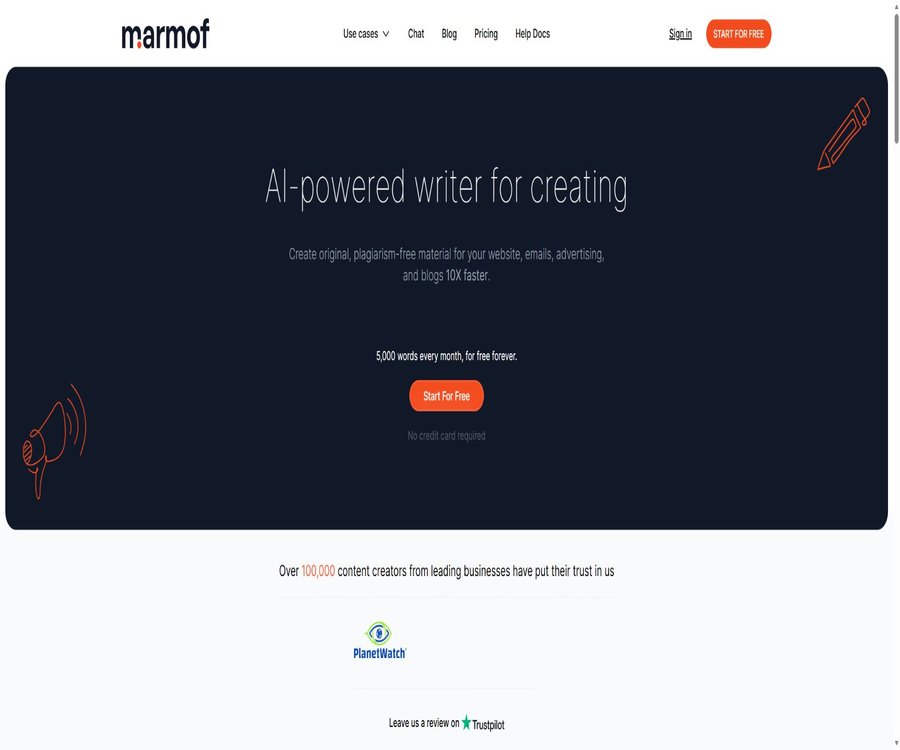
Marmof
Marmof, an intelligent tool focused on AI-driven design.
Tags:AI design toolsWhat is Marmof?
Marmof is a web-based AI tool for content creation and writing assistance, designed for blog authors, marketers, e-commerce sellers, social media managers, and anyone who needs to write on a regular basis. It breaks down common writing tasks into over 50 different template scenarios; users simply need to enter the topic, keywords, product details, and desired tone to generate a draft.
The core of this product is text generation rather than visual design; the term “AI design” used in the old database prompts is not accurate. The current public pages do not provide clear information regarding the full legal name of the development company, its team, its headquarters, or the underlying models, and the text does not attempt to infer such details.
Main functions
- Blog topic and outline: Enter a theme, keywords, or target audience to generate directions for the article, its title, and structure. It’s suitable for planning content from scratch, but editing is required to arrange the logic properly and add reliable facts.
- Blog paragraph writing: After providing the topic, keywords, tone, and maximum word count, a draft of the corresponding section is generated. Users can create multiple versions as candidates, select and combine them, rather than publishing the content right after it is generated.
- Long article generation: It enables the rapid creation of longer articles around a specific theme and keywords, and is suitable for drafting initial versions, expanding the structure of articles, and producing internal content. The product page describes it as content that has been researched, but this tool does not replace the need for verifying information in real time, conducting interviews, or getting professional feedback.
- Blog Post Wizard: It helps organize the title, structure, and content in a step-by-step manner, thereby reducing the difficulty of creating prompts for long articles. This feature is available in both the free and Pro plans; however, the actual length of each article is still limited by the character limit for that month or by the account restrictions.
- Content rewriting: It involves expressing existing sentences or paragraphs in a different way, which can help reduce repetition, adjust the tone, or create versions suitable for various platforms. Rewriting does not automatically address issues related to the facts presented in the original text, copyright, or citations.
- Marketing framework: It provides structures such as AIDA, solutions to identified problems, bridging elements between different parts of the message, and details on features, advantages, and benefits, which are used to organize product information into clearer marketing texts. The input should include actual functions, limitations, and evidence, so as to avoid the inclusion of unverified selling points in the marketing material.
- Advertising copy: Generate versions of headlines, descriptions, call-to-actions, and selling points for Facebook, LinkedIn, and Google ads. The output must still comply with character limits, platform policies, and the promises specified on the landing pages.
- E-commerce product content: It generates drafts for the product name, description, Amazon title, features, and details, helping sellers to organize their product catalogs in bulk. Before publishing, it is necessary to check the specifications, materials, compatibility, certifications, inventory levels, and any prohibited words.
- Emails and cold emails: Drafts for communications are created based on the sender, company, target audience, key points, and tone. The tool only generates text; it does not offer functions such as email delivery, contact management, automatic follow-up, or delivery analysis.
- Social and video content: This includes descriptions for Instagram, posts on LinkedIn, tweets and threads, titles or scripts for YouTube, as well as scripts and opening hooks for TikTok. Users can rewrite the same content in formats and styles suitable for different platforms.
- SEO assistance: Generation of keywords, meta titles, meta descriptions, as well as the structure for blog introductions and content. The output provides writing suggestions only; it does not include verifiable data on keyword search volumes, ranking tracking, or guarantees regarding inclusion in search engines.
- Marmof Chat: Enables brainstorming, rewriting, Q&A, and creative expansion through continuous conversations, while making use of the previous context within the ongoing chat. Responses in these conversations may contain outdated information or factual errors; important details should be verified separately.
- Multilingual support and tones: The package page lists over 25 languages and more than 20 tones, making it possible to create drafts in different languages and with various brand styles for the same content. The complete list of languages available and the differences in quality across these languages are not disclosed; content that is not in the native language requires manual proofreading.
- Documents and automatic saving: It is possible to create an unlimited number of documents, with their content being saved automatically, which facilitates continuous editing in the web-based workspace. The specific rules regarding the character limit, as well as information on previous versions and export formats, have not yet been fully made public.
Input and output
| Task | Common inputs | Output | Check before publishing |
|---|---|---|---|
| Blog | Theme, keywords, audience, sections, and tone | Title, outline, paragraphs, or draft of a longer text | Facts, structure, original expression, and internal links |
| Advertising | Products, advantages, activities, and action goals | Title, description, and call to action | Character limits, evidence, and platform policies |
| E-commerce | Product name, attributes, specifications, and users | Title, key features, description, and specifications | Parameters, compliance statements, and inventory |
| Sender, company, purpose, key points, and tone | Subject and message body | Contact consent, title, link, and unsubscribe | |
| Social and video | Platform, theme, audience, and desired length | Posts, instructions, hooks, and scripts | Platform format, brand tone, and copyright |
| Dialogue | Questions, existing drafts, and further instructions | Answers, creativity, revisions, and candidate versions | Statute of limitations, facts, and professional risks |
Usage tutorial
- Create an account using your email password, or log in via a Google account; no credit card is required for the free tier.
- In the workspace, select the use case that is most relevant to the task, such as blog outline, product description, email, advertisement, or Freestyle.
- Fill in the product, target audience, theme, keywords, main information, and phrases that should be avoided. The more specific the details provided, the easier it will be to edit the resulting content.
- Select the target language, tone, and maximum number of characters; first use a shorter output to test the direction, so as to avoid using a large amount of characters at once.
- Click to generate and compare multiple candidate versions, keeping the parts with better structure and expression; do not mechanically copy all of the results.
- For long texts, use an outline and sectioning to create them; add data, examples, definitions, and transitions in each section, ensuring consistency in terminology throughout.
- Check facts, numbers, brand names, citations, product specifications, copyright issues, and regulatory requirements, and then carry out manual editing and plagiarism checking.
- Save the final document and note the scope of use for the materials created; when approaching the monthly quota, check the remaining character count and the renewal status in the account.
Ways to improve output quality
- Replace “write an article” with a clear audience, objectives, order of information, tone, length, and facts that cannot be included.
- Provide verified product parameters, keywords, customer questions, and brand examples in the input to reduce the need for the model to fill in information on its own.
- Complex articles are generated paragraph by paragraph based on an outline, with a unique purpose assigned to each paragraph to avoid repeated ideas.
- It is required to keep the technical terms, product names, and numbers unchanged, while exaggerated or unverifiable comparative statements are prohibited.
- The output should be regarded as an editable draft; the user remains responsible for fact-checking, assessing copyright issues, and making the final decision regarding publication.
Prices and packages
| Package or version | Price | Billing cycle | Core benefits or quota | Suitable for users |
|---|---|---|---|---|
| Free | 0 dollars | Reset monthly | The page offers two options for the character limit: 2,500 characters per month or 5,000 characters per month. There is no limit on the number of documents; there are over 50 different use cases, more than 25 languages available, as well as over 20 different tones. The service also includes a blog wizard, text rewriting functions, and automatic saving for long texts. | Mild writing and functional experience |
| Pro | 9 dollars | Displayed on a monthly basis | No limit on the number of characters generated, no limit on the number of documents; all writing examples are available publicly, along with options regarding language and tone. There is also a blog guide, a function for rewriting text, support for long articles, automatic saving, and priority email handling. | Individuals and small teams that continuously create content |
| Pro annual plan | Confirmation on the settlement page | Annual | The pricing page offers the option to pay annually, indicating that this saves two months’ worth of cost; however, the current content does not show the exact total amount for annual payment. | Identify users who will use it over the long term |
| Special needs | Custom quote | Negotiation | The public page invites customers with special needs to get in touch with the team; specific seats, quotas, and services are not yet available publicly. | Organizations that need non-standard solutions |
There is a conflict within the same pricing page regarding the free quota: the title section of the package states 2500 characters per month, while the list of benefits and the home page indicate 5000 characters per month. The quota for an account after registration should reflect the actual amount available at that time; the higher figure should not be regarded as a fixed commitment.
Pro’s “unlimited character count” option does not impose any restrictions regarding fair use, concurrent usage, speed, or abuse. Users who plan to use it heavily should check in advance whether there are any hidden limits, speed reductions, or maximum limits on the number of items that can be generated at one time.
Refunds and cancellations
- The terms of service provide a full refund within seven days from the date of purchase, provided that the amount of text for the Basic plan is less than 5,000 characters and for other plans it is less than 10,000 characters.
- The current pricing page no longer features a plan named Basic; as a result, the text regarding refunds does not match the names of the existing Free and Pro plans. It is advisable to consult the support team before making a purchase to find out the character limit applicable to the Pro plan.
- The terms do not provide a complete explanation regarding automatic renewal, the process for cancellation, proportional refunds, and what happens to the remaining period of an annual subscription; users should check the current conditions of their account before making a payment.
- The services are provided as they are, and the terms allow for changes to the agreement; for significant purchases, it is necessary to keep record of the package selected, the price, and the conditions regarding refunds at the time the order was placed.
Which users are it suitable for
- Authors who need to plan and draft blogs quickly, but are able to research facts and arrange the content structure on their own.
- Marketing professionals in small and medium-sized enterprises who routinely create advertisements, emails, landing pages, product descriptions, and social media posts.
- For marketers who need to quickly create titles, hooks, and script versions for YouTube, TikTok, LinkedIn, or X.
- A cross-border team is needed that can provide draft versions in multiple languages and various tone variations, as well as resources for native speaker review.
- For individuals who wish to use a large number of text templates at a low monthly fee, without the need for team collaboration, approval processes, or complex integrations.
Advantages
- The templates cover a wide range of use cases, so users do not need to design prompts from scratch for each marketing task.
- The free tier does not require a credit card, allowing you to first test the language, tone, and common content types.
- The monthly fee for the Pro version is straightforward, and it offers support for long texts, rewriting, documents, as well as priority email handling.
- The three entry points – Long-form Guide, Freestyle, and Chat – accommodate both structured tasks and open-ended creation.
- The input fields are designed for specific use cases and are suitable for users who are not familiar with prompt engineering.
Capabilities boundaries and limitations
- Marmof produces drafts only; it does not guarantee that the information is accurate, up-to-date, free of bias, or in compliance with professional standards.
- The platform’s messaging regarding originality, absence of plagiarism, and the quality of the content cannot replace independent plagiarism checks, rights verification, or assessments of the search results.
- The public page does not specify the name of the model used, the range of training data, the knowledge cutoff date, or whether online research is supported.
- The number of languages available does not mean that all of them are of equal quality; terms, cultural context, and local regulations require to be checked by native-speaking editors.
- No built-in citation verification, fact-checking tools, brand knowledge base, multi-person approval processes, version rollback options, or data search functions are available.
- There are discrepancies on the page regarding the free quota, the name of the refund package, and the annual payment amount; the information related to purchases and usage should be based on that available in the account dashboard.
- An unlimited number of characters does not necessarily mean unlimited speed, a fixed length per invocation, or automated calls; the official rules do not specify these details.
Platform, API, and open-source status
| Project | Current status | Explanation |
|---|---|---|
| Web application | Support | Accounts, use cases, chats, documents, and generation workspaces are all accessed through a browser. |
| Mobile web page | It can be tried using a browser. | The degree of optimization for mobile phones has not been confirmed. |
| iOS native apps | Not confirmed | No official App Store page that corresponds to a stable product identity was found. |
| Android native apps | Not confirmed | No official Google Play page that corresponds to a stable product identity was found. |
| Browser extensions | Not confirmed | No official Chrome Web Store extensions were found. |
| Public APIs and SDKs | Not yet made public | The documentation site mainly provides information about the products; it does not disclose any details regarding certifications, endpoints, limits, or development packages. |
| Official GitHub | Not confirmed | A warehouse with the same name does not prove that it belongs to Marmof. |
There is currently no evidence indicating that the source code of Marmof products is licensed under an open-source license; therefore, it should be considered a proprietary web service. The absence of a public API also means that the fact that there is no limit on the amount of text cannot be used as an indication that scripting for bulk generation or reselling of services is allowed.
Privacy and security
- The privacy page states that personal data will be processed for legitimate purposes and retained only for as long as necessary; once its use ceases, the data may be archived, though the specific number of days it will be kept is not specified.
- The platform claims to use technical and organizational measures appropriate to the type of data and the level of risk, as well as to restrict access by authorized personnel; however, it does not disclose the encryption standards, the location where the data is stored, nor any certification or security audit reports.
- Users can object to direct marketing processing, and can also request access, correction, deletion, restriction of use, or being forgotten.
- The privacy page specifies that certain requests for rights must be submitted in the form of a signed written letter sent by registered mail, and it states that these requests are usually processed within fifteen working days; the actual mailing address and whether it is applicable in a particular region should be confirmed with the team.
- Data that must be retained for legal or tax purposes may not be removed immediately upon account deletion, and the deleted content can remain in the system for a short period of time.
- The public policy does not clearly specify the uses for generating prompt words, document content, payment data, Cookies, sub-processors, cross-border transfers, and model training.
- Do not enter customer lists, passwords, undisclosed trade secrets, or sensitive information related to health or finance, unless the organization has given a clear commitment to handle such data.
Copyright and commercial usage notes
- The terms consider copyright infringement to be a form of abuse, and allow the platform to delete relevant documents or account information; users should submit only original content and materials for which they have the rights to use.
- The public terms do not clearly specify the allocation of ownership regarding user inputs, generated content, commercial use, permissions for platform training, and similar outputs.
- For use in commercial advertisements, product pages, or before delivering to customers, it is necessary to conduct checks for plagiarism, trademarks, factual accuracy, portrait rights, citations, and compliance with industry regulations.
- Imitating the style of living authors, competing brands, or specific protected works can pose rights risks; it is preferable to use the brand’s own established guidelines.
- Save the original facts, as well as records of manual modifications and approvals, to prove that the final product is not an automatically generated output without any review.
Summary
The value of Marmof lies in its use of a large number of scenario-based templates, which reduces the barriers to carrying out marketing activities and drafting long texts. The free version is suitable for testing purposes, while the Pro version is intended for those who need to produce content on a regular basis. However, its features related to company information disclosure, models, APIs, content ownership, and certain billing rules are not yet complete; therefore, the results generated should be regarded as drafts, and it is necessary to check the account requirements and legal responsibilities before subscribing to the service or using it for commercial purposes.
Tools similar to Marmof



 Guigong Network Security Registration No. 45132202000164