






A one-sentence summary
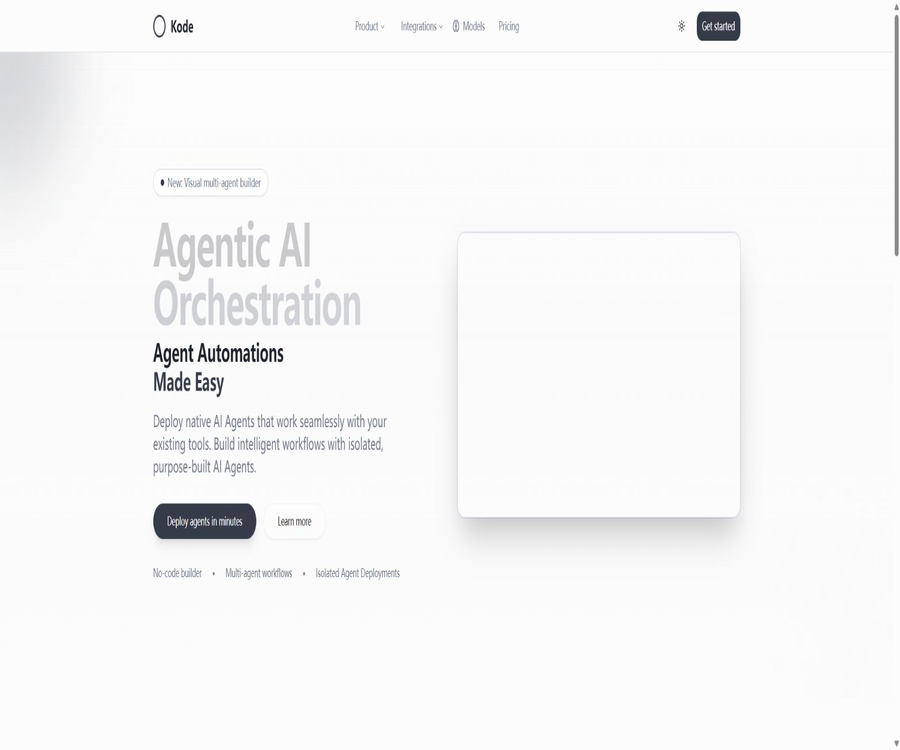
Kode AI is a code-free platform for orchestrating enterprise agents; it enables the creation of custom agents, the connection of various tools and models, the organization of multi-agent workflows, and the coordination of complex business tasks through dynamic memory and meta-agents.
What is AI code?
Kode is operated by the British company Kode AI Limited, and it serves businesses that wish to integrate AI Agents into their business processes. It emphasizes that these Agents do not merely respond to given instructions; rather, they can conduct research, browse information, summarize content, update records, and carry out tasks using authorized tools.
The product is not related to the AI code generator, application development platform, or mobile programming assistant that share the same name. The current purpose of the official website is Agentic AI Orchestration; when identifying it, focus should be placed on code-free multi-agent systems and enterprise automation.
Overview of Core Competencies
| Ability | Specific functions | Suitable for tasks | Key boundary |
|---|---|---|---|
| Code-free Agent Builder | Configure roles, targets, models, tools, and rules | Quickly create a department assistant | Complex logic still requires testing and technical support. |
| Multi-Agent Workflow | Split the task among multiple dedicated Agents | Research, approval, and cross-departmental collaboration | It is necessary to prevent cycles and unclear responsibilities. |
| Isolated deployment | Allow different agents to use separate contexts and permissions. | Sensitive operations and division of labor | The isolation scope needs to be confirmed within the account. |
| Inflow Memory | Update memory based on task inputs and execution results | Ongoing processes and long-term tasks | Incorrect memories need to be corrected and made obsolete. |
| Meta-agent | Coordinate Agents and routing based on global objectives | Inter-departmental orchestration | High-risk decisions cannot be fully automated. |
| MCP tool | Connects search, crawling, data, and business services | Research and system operation | External tools have separate costs and terms. |
| Multi-model directory | Select language, reasoning, security, and audio models for different agents. | Balance mass, speed, and cost. | Model availability and price may change. |
| Human Oversight | View Agent behavior, questions, and interventions | Approval, error correction, and termination | Clear human responsibilities must be defined. |
Code-free Agent Builder
Users can define Agent roles, objectives, capabilities, and tools within a visual interface, and then combine multiple nodes to create processes. The code-free approach reduces the barriers to initial setup, but production systems still require data structures, permissions, error handling, and validation mechanisms.
- Define clear roles and business objectives for the Agent.
- Select a model suitable for the task.
- Add search, research, data, or business tools.
- Configure input, output, and memory fields.
- Define triggers, branches, and Agent handovers.
- Set up manual approval and termination conditions.
- View the status and results of each step.
The objectives of an agent should be verifiable; for example, it should be able to provide a list of qualified leads or update specified records, and it cannot simply be stated that its role is to improve efficiency. Each node should also define how to handle situations where there is a failure, insufficient evidence, or the tools are unavailable.
Isolated professional agent
Kode emphasizes the use of isolated, purpose-specific Agents to carry out different tasks, rather than allowing a single Agent to have access to all knowledge and tools. Sales, finance, customer service, and research Agents can have different models, data ranges, credentials, and approval rules.
| Isolation dimension | Configuration example | Security value | Verification is required. |
|---|---|---|---|
| Characters | Sales research and financial reconciliation are separated. | Reduce tasks that exceed authorized scope | Can a character invoke unauthorized tools? |
| Data | Customer records and personnel data sections | Restrict the spread of sensitive information | Are retrieval and memory truly separated? |
| Tools | The browser has read-only capabilities, while CRM is designed for writing data. | Control operational risks | Keys and operation logs |
| Model | Different models are used for security classification and content generation. | Select capabilities by task | Enter whether to route to an external provider |
| Environment | Testing agents are separated from production agents. | Avoid incorrect entries in formal systems | Credentials, Webhooks, and data boundaries |
| Approval | Payment or dispatch requires manual confirmation. | Prevent irreversible errors | Approver identity and proxy authorization |
Isolation does not mean simply dividing the canvas into multiple boxes. Enterprises should use privilege testing to ensure that agents cannot access the sensitive data, keys, and tool outputs of other nodes.
Multi-Agent Workflow
Multi-Agent processes break down complex tasks into steps such as research, analysis, execution, and verification; each agent handles the tasks for which it is best suited. This facilitates model replacement and auditing, but it also increases coordination efforts, delays, and costs.
- Receive user requests, Webhooks, or business events.
- Verify the input, identity, and scope of the task.
- The meta-agent splits tasks and selects specialized agents.
- The research Agent collects the information needed to complete the task.
- The analysis agent generates suggestions or structured results.
- Check the Agent to verify rules, risks, and integrity.
- Sensitive actions are subject to manual approval.
- The execution agent calls the tool and records the results.
- The final state is written back to the business system and dynamic memory.
Each time an agent is handed over, the context may be lost or tasks may be repeated. The process requires a stable task ID, structured output, a maximum number of iterations, timeout settings, and idempotency rules.
Inflow Context-aware Memory
Kode’s Inflow Memory updates the Agent’s context in real time, based on changing task data and user inputs, rather than relying solely on pre-uploaded static information. It is suitable for ongoing tasks, sales opportunities, research projects, and any work that requires maintaining state across different steps.
| Memory content | Uses | Risk control |
|---|---|---|
| Task objectives | Maintain consistency in the multi-step direction. | Save a version when the target changes |
| User input | Understand the latest requirements and restrictions | Filter sensitive and malicious content |
| Tool results | Provide facts for subsequent agents. | Record time and tool status |
| Agent decides | Explain why a certain path was chosen | Distinguish between recommendations and approved decisions |
| Human feedback | Correction processes and preferences | To prevent a single opinion from being generalized indefinitely |
| Execution result | Inform subsequent steps of success or failure. | Do not turn temporary failures into permanent facts. |
Dynamic memory accumulates errors, outdated information, and content injected as prompts. Production environments should provide mechanisms for viewing, correcting, deleting, setting expiration dates for, and reverting such memory contents, and they should prevent text from external web pages from becoming permanent rules.
Meta-agent coordination layer
The meta-agent starts from the overall goals and organizational memory to assign tasks to various departmental agents and determine the best routes for carrying out those tasks. It is suitable for tasks that involve different systems and teams; for example, it may involve first investigating a customer’s issue, then checking the relevant contracts, updating the CRM system, and preparing a response.
- Parse complex requests and targets.
- Select the appropriate professional agent.
- Arrange the order in which agents execute tasks or run them in parallel.
- Merge the outputs of different Agents.
- If missing information is detected, a task to supplement it is initiated.
- Submit sensitive decisions to humans.
- Route again based on the execution status.
Excessive permissions for meta-agents create a single point of risk. Companies should restrict them to coordinating only those capabilities that have been approved, preventing them from adding new tools, expanding the scope of data, or bypassing human approval processes.
Tasks that an Agent can perform
| Ability | Enter | Output | Supervision is required. |
|---|---|---|---|
| Browse and Search | Questions, keywords, and web tasks | Search results and summaries | Website Terms, Privacy, and Fact-Checking |
| Research | Thematic, corporate, or market issues | Structured reports and comparisons | Integrity of evidence and time limits |
| Summary | Documents, records, and long texts | Summary, key points, and tasks to do | Omissions and misinterpretations |
| Update record | Allowed fields and new information | Changes to CRM, forms, or databases | Permissions, idempotency, and rollback |
| Task execution | Plan and tool credentials | External system operations | Approval for irreversible actions |
| Content security | Text or output | Classification and blocking decisions | False positives and missed detections |
| Audio transcription | Recording or voice input | Text and structured content | Agree, reserve, and speaker error |
MCP tool ecosystem
Kode provides a catalog of MCP tools that enable agents to carry out tasks such as search, web scraping, browser automation, and integration with external services. Tools available include Bright Data, Firecrawl, and Brave; the specific authentication procedures, rate limits, and pricing are determined by each provider.
| Tool category | Tasks that can be completed | Common authorizations | Main risks |
|---|---|---|---|
| Search engine | Search for web pages and public information | API Key | Result deviations and outdated information |
| Web scraping | Extract content from one or multiple pages | API Key | Website rules, copyright, and personal data |
| In-depth research | Cross-page search and generation of analyses | Pay-as-you-go service | Combination of costs and errors |
| Browser automation | Navigation, clicking, typing, and screenshotting | Session or account credentials | Accidental actions and account security |
| Structured data | Extract e-commerce, social, or industry-related fields. | Professional plan | Field validity and platform restrictions |
| Business system | Read or update records related to payments, CRM, etc. | OAuth or API Key | Risks of unauthorized writing and transactions |
MCP only specifies the way in which agents can call the tools; it does not mean that Kode is responsible for all aspects related to the data of these tools, their costs, and security matters. Each connection must have its own permissions, terms, warranties, geographical considerations, and procedures for handling incidents reviewed separately.
Multi-model support
Kode’s model directory displays models for language, reasoning, security, audio, commands, and open-weight models, covering providers such as OpenAI, Anthropic, Meta, DeepSeek, Alibaba, Google, IBM, and community models. The models available to actual accounts may be affected by region, plan, and platform updates.
| Model type | Directory example | Suitable for tasks | Precautions |
|---|---|---|---|
| Language models | GPT series, Claude series | Writing, analysis, and tool invocation | Costs, data processing, and version changes |
| Inference model | O series, DeepSeek inference models | Complex planning and mathematical analysis | Delays and high usage |
| Security model | Llama Guard | Content classification and policy filtering | It cannot be used as the only safety control measure. |
| Audio model | Whisper series | Speech transcription | Recording agreement and language accuracy |
| Multilingual models | Qwen and Allam | Tasks in Asian languages or Arabic | It is necessary to use actual business text for testing. |
| Open-weighting model | GPT OSS, etc. | Controllable reasoning and specific deployment | An open weight does not equate to the open-source nature of the Kode platform. |
The model details page shows values such as latency, throughput, and accuracy, but it does not disclose the standard testing methods, hardware, or datasets used. The choice of model should be based on one’s own requirements regarding tasks, costs, privacy, and stability.
Human supervision
Kode allows users to see what the Agent is doing and why, to ask questions, to review the actions taken, and to intervene when necessary. The supervision features should be combined with a risk assessment system; not all operations should use the same confirmation button.
- Read-only studies can run automatically and be sampled for review.
- The content draft needs to be published by the person in charge.
- When sending something out to a customer, it is necessary to verify their identity and the relevant facts.
- The record write should show field differences.
- Deletion, payment, and contract-related actions require secondary approval.
- Abnormal loops and high-cost tasks should be stopped automatically.
- Each manual modification should be recorded in the audit log.
Companies should also implement mechanisms for emergency shutdown and revocation of credentials. Being able to view a process on the interface does not mean that it is possible to prevent external actions that have already been sent or submitted in a timely manner.
Typical business scenarios
- Automatically research potential customers and update the CRM.
- Monitor the market, competitors, and price changes.
- Process tickets, search for information, and prepare responses.
- Coordinate customer processes for sales, delivery, and finance.
- Crawl web pages and extract structured data.
- Upon receiving a Webhook, multiple Agents are assigned to handle it.
- Summarize meetings, documents, and project records.
- Execute external system tasks after manual approval.
- Use a security model to inspect the generated content.
Setup steps
- Select business processes with clear objectives and verifiable outcomes.
- List the input data, tools, responsible persons, and prohibited actions.
- Break down complex processes into multiple specialized agents.
- Select a model, memory, and tools for each Agent.
- Configure the Meta-agent routing and the maximum number of iterations.
- Set up data isolation, credentials, and least privilege.
- Define approval, stop, retry, and rollback rules.
- Testing is carried out using historical cases and malicious inputs.
- First, run it on the testing system with read-only permissions.
- Observe quality, cost, latency, and the rate of manual corrections.
- Production writing will be gradually enabled after passing the acceptance test.
Price and trial version
Kode offers a 7-day free trial without the need for a credit card; this trial includes 500 points as well as a limited number of agent requests. The paid plans are based on a monthly point system, and currently there are two tiers available: Pro and Ultra. For team and enterprise solutions, it is necessary to contact sales.
| Plan or project | Price | Billing cycle | Rights and interests have been confirmed. | Suitable for users |
|---|---|---|---|---|
| Try | Free | 7-day trial period | 500 points, limited number of Agent requests, access to mainstream models and Pro features | Functional and technical verification |
| Pro | $ | On a monthly basis | 1,500 points per month, mainstream models, code-free Builder, multi-Agent workflows | Individuals and small automation projects |
| Ultra | $ | On a monthly basis | All Pro features, approximately 15 times more model usage, MCP, priority access to new models and features | High-frequency Agents and MCP Users |
| Additional points | 30 dollars/2000 points | Buy as needed | Increase the operational quota for solutions such as Pro. | Those with insufficient monthly points |
| Team or company | Contact the team | Custom contract | Collaboration, management control, dedicated support, and procurement services | Large organizations and the public sector |
| External models and MCP tools | Decided by the provider. | By subscription or usage | Model inference, search, scraping, and third-party operations | Agents that require capacity expansion |
The way in which monthly points are allocated to different model and tool requests depends on the actual operations; the usage level, which is about 15 times that of Ultra, is not a fixed value either. The third-party prices shown on the model and MCP pages serve only as a reference for external services; before making a purchase, it is necessary to verify the details related to seats, storage, logging, tools, SLAs, and excess usage rules.
Public sector and corporate services
Kode presents publicly the capabilities of its procurement framework for artificial intelligence, automation, and non-clinical AI solutions, designed for use by the UK’s NHS, government agencies, and public sector organizations; this framework offers both a platform as well as consulting services, implementation support, and maintenance. The fact that a framework is included in this list does not mean that all its agents and models are automatically suitable for use in regulated environments.
- Verify the specific status and validity period of the suppliers under the procurement framework.
- Distinguish between non-clinical and clinical or high-risk applications.
- Complete the data protection impact assessment.
- Explanation is required for the model, hosting region, and sub-processors.
- Establish mechanisms for manual supervision and accident reporting.
- Specify acceptance, support, and exit in the contract.
Privacy Policy
Kode’s privacy policy lists names, phone numbers, email addresses, job titles, user names, passwords, contact preferences, authentication information, and billing addresses; it also explains that data is processed for the purposes of managing accounts, services, support, orders, as well as to meet legal requirements. The customer is the controller of the data that he or she entrusts to Kode for processing.
| Privacy projects | Public explanation | It is necessary to pay attention. |
|---|---|---|
| Operating entity | Kode AI Limited, United Kingdom | Verify the contract party and registered address |
| Account data | Contact, authentication, and billing information | Enable minimum field requirements and account security. |
| Sensitive data | The main text states that sensitive information will not be processed. | Sensitive content may still be passed in during the Agent business process. |
| Retain | It is retained only for as long as it is necessary and as required by law. | No specific timeline is available. |
| Delete and correct | Support for account and data rights requests | Confirm workflow memory, log, and backup scope |
| Children | Not available for users under 18 years old. | Corporate processes must not circumvent age restrictions. |
| Customer data | As the processor, handle things according to the customer’s instructions. | A separate data processing protocol is required. |
The privacy policy was last updated in 2023; the page contains blank fields for the payment processors, and there are inconsistencies in some summaries, sensitive data, as well as the classification of information in the United States. Companies should not rely solely on this page to understand the data flow of the agent platform – they should obtain an updated DPA, information regarding sub-processors, and related security documents.
Security and permission considerations
Kode promotes enterprise-level encryption, data minimization, and security measures, but the public website does not provide details regarding specific encryption algorithms, SOC 2, ISO 27001, penetration testing, SSO, data residency rules, or the Trust Center. Customers with highly sensitive data needs must obtain relevant evidence through pre-sales discussions and contracts.
- All keys are stored in a controlled credentials database.
- Different Agents use separate service accounts.
- The production and testing environments are completely separated.
- Restrict automated login sessions by browsers.
- Record the tool parameters, approver, and result.
- Protection against prompt injection attacks when inputting from external web pages.
- Set upper limits on model and tool costs.
- Regularly clean up dynamic memory and expired credentials.
- Require the supplier to provide procedures for handling accidents and for backups.
GitHub and the open-source status
No official GitHub repository containing the source code for Kode’s no-code Agent Studio, Meta-agent orchestration layer, or core platform has been found. The model directory includes models with open weights, and MCP is based on open protocols; however, this does not mean that the Kode product itself is open source.
| Project | Current status | Correct understanding |
|---|---|---|
| Kode platform | Commercial hosting services | It has not been confirmed whether the core source code is publicly available. |
| Agent workflow | It can be configured within the account. | Configurability does not equate to self-hosting. |
| Open-weighting model | The model directory contains | Licenses belong to each model. |
| MCP tool | Supports various external connections | The openness of the protocol does not mean that the tools or platforms are open source. |
| Official core GitHub | Not verified. | It cannot be labeled as an open-source product. |
Which users are it suitable for
- Hope to have an operation team that can set up business agents without using any coding.
- Enterprises that require division of labor among multiple agents and global coordination.
- Teams that aim to connect search, research, and record updates.
- Processes that require dynamic task memory rather than a static knowledge base.
- Organizations that wish to use different commercial and open-weighting models.
- Technical teams prepared to connect external tools via MCP.
- Enterprises that require manual review, approval, and intervention by agents.
- UK public sector organizations that require consultation and implementation support.
Product advantages
- A visual interface is used to lower the barrier to creating Agents.
- It supports the deployment of isolation Agents with specific purposes.
- Multi-Agent processes are suitable for complex business task division.
- Inflow Memory can be updated in real time as tasks progress.
- The meta-agent provides a coordination layer across agents.
- Agents can extend from research to tool execution.
- The model catalog covers language, reasoning, security, and audio tasks.
- The MCP tool enhances search, scraping, and business connectivity.
- It provides the ability to view, ask questions, and obtain human assistance.
- A 7-day trial is available without the need for a credit card.
Main limitations
- The amount of integration resources consumed varies depending on the model, the tools used, and the complexity of the task.
- The amount, about 15 times that of Ultra, is not a fixed number of requests.
- Custom quotes are still required for team and enterprise solutions.
- For some models, there is no standardized public testing method for the detailed performance figures.
- Dynamic memory may accumulate errors and injected prompt content.
- Meta-agent coordination increases costs, delays, and failure paths.
- External MCP tools come with separate costs, terms, and privacy risks.
- Public security certifications and technical details are limited.
- The privacy policy is outdated, and it contains template placeholders as well as inconsistencies.
- The core platform is not an open-source software that has been confirmed.
- No-code does not mean that there is no need for engineering testing or permission design.
- Browsers, record updates, and payment transactions require strict approval.
Purchase and acceptance checklist
- Verify the current contract holder, hosting location, and platform status.
- Obtain the official package details, usage limits, overage charges, and model cost table.
- A complete architecture, DPA, sub-processors, and security materials are required.
- Confirm the isolation methods for agents, memory, tools, and the environment.
- Test viewing, correcting, deleting, and expiration of dynamic memory.
- Verify that the Meta-agent does not bypass permissions and approvals.
- Review the credentials and data flows of each MCP tool individually.
- Simulation tool failures, recurring events, loops, and out-of-control costs.
- Confirm audit logs, export, rollback, and emergency stop.
- Test Chinese language, technical terms, and real business data.
- Clarify the process of exiting migration for data, workflows, and custom configurations.
- Complete legal, privacy, and security audits before going live.
Frequently Asked Questions
What is Kode AI mainly used for?
It helps businesses create professional agents, multi-agent workflows, and Meta-agent coordination in a code-free manner, and carries out actual business tasks through dynamic memory, models, and MCP tools.
Is Kode an AI code generator?
It is not the main focus of the current official website. Here, Kode refers to the enterprise’s Agentic AI Orchestration platform, whose focus is on the deployment and orchestration of Agents within business processes.
Is Kode free?
A 7-day trial period without the need for a credit card is available, along with 500 points. The Pro version costs $25 per month and includes 1500 points; the Ultra version costs $200 per month and offers more model usage, access to MCP, as well as priority access to new features. Quotations are required for team plans.
Which models are supported?
The model directory includes models from OpenAI, Anthropic, Meta, DeepSeek, Alibaba, Google, IBM, as well as community models; it covers categories such as language, reasoning, security, audio, and open weights.
What is Inflow Memory?
It updates the Agent’s context based on new data generated during the task, user inputs, and tool outputs, making it suitable for business processes that are in constant change. Companies need to manage errors, outdated information, and sensitive data.
What is a Meta-agent?
The meta-agent assigns tasks based on the overall goal, coordinates multiple specialized agents, and manages the workflow. It should operate under constraints of minimal permissions and require human approval.
Does Kode support MCP?
It supports MCP tool catalogs, enabling integration with search functions, web scraping, browser automation, and business services. Each external tool has its own authentication mechanisms, rate limits, pricing, and terms of service.
Is Kode open source?
No official public source code for Core Agent Studio and the orchestration platform has been identified. The support for open-weight models and the MCP open protocol does not mean that the Kode product is open-source.
Summary
Kode AI is suitable for teams that wish to connect multiple agents with specific functions within corporate processes, and to enhance their practical capabilities through dynamic memory, Meta-agents, and MCP tools. Its no-code builder, multi-model catalog, and human oversight enable it to cover all the key stages, from prototyping to business automation.
Before implementation, it is necessary to calculate the costs associated with integration, models, and tools based on the actual workflow, and to ensure that mechanisms for data management, permission isolation, auditing, and security are in place. The privacy policy is outdated and incomplete, and it has not been confirmed whether the core platform is open source; therefore, procurement for production purposes must be based on updated contracts and technical documentation.
Tools similar to Kode AI



 Guigong Network Security Registration No. 45132202000164