






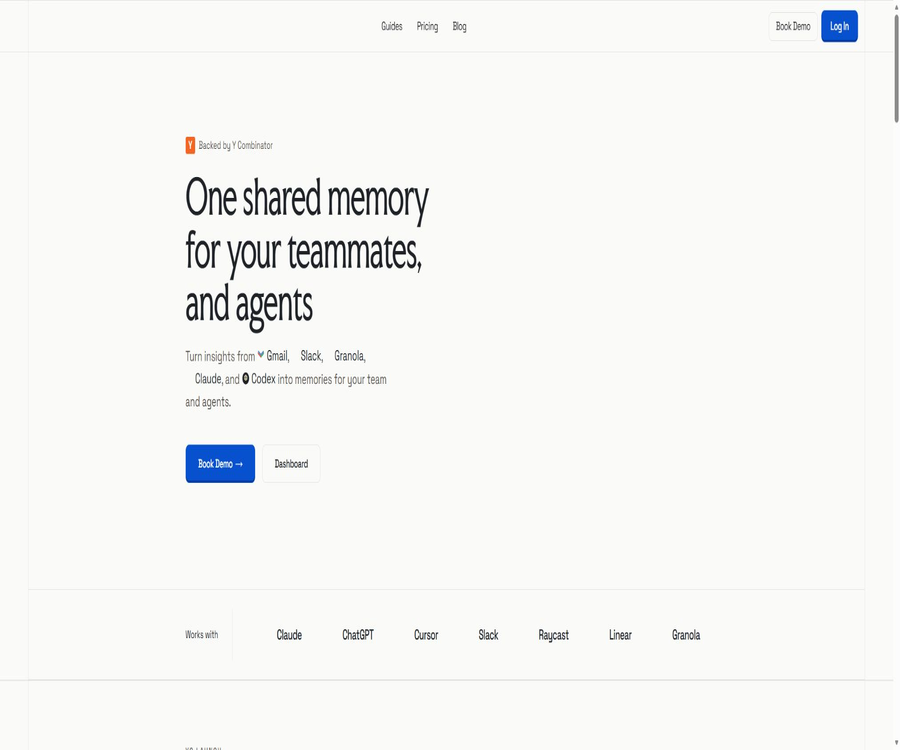
Julep → memory.store
Julep → memory.store, an intelligent tool focused on AI-driven design
Tags:AI design toolsA one-sentence summary
Julep is an open-source AI agent and persistent workflow platform designed for developers, while Memory Store, which is currently developed by the same team, organizes conversations, meetings, decisions, and work contexts across different applications into shared memories that can be accessed by multiple AI clients.
Current product status
The term “Julep or memory.store” mentioned in the records now refers to two related products that serve different purposes. The Julep platform has been fully open-sourced, and the team’s official website states that the main focus of development has shifted to Memory Store.
| Products | Current location | Primary users | Open-source status |
|---|---|---|---|
| Julep | Persistent AI agents and composable workflow platforms | AI application developers and platform teams | Apache-2.0 open source |
| Open Responses | Self-hostable Responses-compatible interface | Developers who need self-control models and deployment capabilities | Open source under Apache-2.0, in alpha stage |
| Memory Store | Sharing memories among individuals and teams across AI tools | Knowledge workers and teams | The managed product itself does not indicate that it is open source. |
| Memory Store plugin market | Workflow plugins for hosts such as Codex and Claude | Agent Workflow Users | Apache-2.0 open source |
Just because the Julep code is open source does not mean that the Memory Store hosting service and its data backend are also fully open source. The licenses for the product repositories, connector repositories, and plugin repositories should be indicated separately in the directory.
What problem does Julep solve?
Traditional agent prototypes often consist of temporary iterative models and tools; once their operation is interrupted, it is difficult to resume, and it’s not easy to audit each step of the process. Julep represents agents as persistent, composable data streams, enabling long-running tasks to maintain their state, be retried, and have their execution process explained.
- Define AI agents with clear configuration and tool permissions.
- Maintain cross-session conversations and user context.
- Orchestration involves tasks such as conditional logic, loops, parallel processing, and function calls.
- Log the execution status, step outputs, and errors.
- After a failure, retry or recover in a secure manner according to the strategy.
- Retrieve relevant information from documents and historical records.
- Accessible via Python, Node.js, APIs, or self-hosted services.
Agents
An agent stores the model, name, purpose, instructions, system templates, default generation parameters, metadata, documentation, and the tools that can be used. The same agent can handle multiple sessions or tasks.
| Agent configuration | Function | Design suggestions |
|---|---|---|
| Instructions | Define role, task, and behavior boundaries | Stay clear and avoid conflicts with one another. |
| Model | Select the actual reasoning model. | Based on quality, latency, and cost tests |
| Default Settings | Configure parameters such as temperature and output format. | Start with conservative values. |
| System Template | Render proxies, users, sessions, and documents into the context. | Avoid injecting untrusted instructions. |
| Tools | Granting functions, systems, integrations, or API capabilities | Only the permissions necessary to complete the task are granted. |
| Docs | Provide searchable knowledge materials | Record the version, permissions, and update cycle. |
| Metadata | Classified by project, environment, or purpose | Do not store plaintext keys. |
Sessions status session
Sessions are used to store the continuous interactions between the agent and the user, including historical messages, context, system templates, metadata, and context overflow policies. Dialogue memory is part of the session, rather than being permanently incorporated into the agent’s definition.
- Create multiple isolated sessions for the same agent.
- Bind users and agents to a specific conversation.
- Save historical messages and the current context.
- Set truncation or adaptive context policies.
- Vector, text, or mixed search to control document retrieval.
- Decide whether to execute or forward the tool call automatically.
- Use metadata to save non-sensitive business states.
Long-term memory and RAG
Julep can associate documents with agents or users, and it enables vector, text, or hybrid retrieval during sessions. Document storage, embeddings, and historical messages together provide agents with long-term context.
| Memory layer | Save content | Uses | Precautions |
|---|---|---|---|
| Session History | Message per round of conversation | Maintain the coherence of the current session. | It is necessary to set a context budget. |
| Situation | Current session background | Provide short-term scenarios for the model. | Update outdated status in a timely manner. |
| User Docs | User-specific documents | Personalized search | Isolate permissions by user |
| Agent Docs | Agents share knowledge. | Provide materials for all relevant sessions. | Control version and visibility range |
| Embeddings | Fixed-dimensional vector | Similarity retrieval | When replacing a model, compatibility must be assessed. |
| Metadata | Structured tags and business fields | Filtering, grouping, and status management | Avoid writing down confidential credentials. |
The results of the retrieval are merely relevant materials; they do not guarantee accuracy, timeliness, or suitability for use in the current task. The application still needs to implement mechanisms for determining the validity period of the materials, applying permission filters, and citing sources for answers.
Tasks: multi-step tasks
A Task is similar to a workflow template in the GitHub Actions style; it describes the input structure, the tools used, and a series of steps. It is suitable for automating tasks that require long-running processes and a clear control flow, such as research, document processing, customer service, and data pipelines.
- Verify the input structure of the task.
- Pass the output from the previous step to the subsequent steps.
- Execute conditional branching based on intermediate results.
- Process collections using foreach or mapping.
- Invoke models, system tools, integrations, and external APIs.
- Set retry, timeout, and error handling options for the steps.
- Use the Execution object to query task status and results.
The document advises against including very large objects of several MB or more directly in the workflow inputs. Large files should be uploaded and their references passed on, or they should be processed in a paginated or segmented manner.
Persistent execution
Julep ensures that tasks can be resumed after process crashes, network failures, or temporary service errors, and it implements strategies for handling retryable errors. Each execution saves information on status changes, step outputs, points of failure, and error messages.
| Execution ability | Function | Engineering value |
|---|---|---|
| Frozen IR | Compile the build-time process into a fixed representation | Reduce structural drift during operation |
| Retries | Re-execute for retryable errors | Deal with temporary network or service failures |
| Timeouts | Limit waiting time per step or task | Prevent permanent suspension |
| Transitions | Record steps and status changes | Facilitates auditing and debugging |
| Resume | Restore from persistent state | Supports long-duration business processes |
| Idempotency | Tool for marking safe repeated executions | Reduce the repetitive side effects caused by retries. |
Flow programming model
Julep 3 organizes ordinary Python names into composable flows, supporting pure steps, reasoners, tools, branches, fanouts, retries, and timeouts, and compiles them into a unified linear representation. The current 3.x version is still available as a candidate release; installation requires the pre-release option.
The interfaces of candidate versions may change; therefore, production projects should rely on fixed versions, run integration tests, and establish an upgrade plan. Old Tasks documents and the new Flow API should not be used interchangeably in the same code examples.
Toolset
| Tool type | Execution location | Typical uses | Risk |
|---|---|---|---|
| User-defined Function | Sent back after being processed by the client. | Invoke the application’s local capabilities | The client must verify the parameters. |
| System Tool | Julep backend | Manage sessions, tasks, and metadata | It is possible to modify the platform status. |
| Integration | Julep Integration Service | Call third-party business services | It is necessary to store credentials securely. |
| API Call | During the workflow execution | Directly request the external interface | Addresses, permissions, and costs need to be restricted. |
| MCP Tool | Dynamically discovered MCP servers | Connect to the ecosystem of external tools | To verify server and tool permissions |
Models can only use tools that have been explicitly granted access to, but the list of allowed tools might still be too broad. Tools that are used for sending messages, making payments, or deleting or modifying production data should incorporate approval mechanisms, idempotent keys, and audit logs.
MCP integration
The Julep agent can connect to public or private servers that are compatible with MCP, in order to dynamically discover available tools. The documentation supports two types of data transmission: request-response and server event streams.
- Confirm the MCP server operator and deployment location.
- List the tools and actions that the agent truly needs.
- Place the authentication token in Julep’s secret storage.
- Connect to the testing environment and check the tools that were identified.
- Restrict write operations and the transmission of sensitive data.
- Simulate timeouts, repeated calls, and server unavailability.
- Record each tool invocation along with its business outcome.
- Regularly revoke old credentials and unused connections.
Secret management
Secrets is used to store model keys, third-party API tokens, and other sensitive values, which can be referenced by name within tasks and tools. The documentation states that these keys are encrypted using AES-256 in a static manner, and they are isolated according to each developer’s account.
- Do not write keys in code, YAML, or logs.
- Different credentials are used for development, testing, and production.
- Assign the minimum permissions based on integration and purpose.
- Regularly rotate and document the persons in charge of credentials.
- Upon detecting a leak, it should be revoked immediately rather than simply deleting the code.
- Check whether the workflow output contains keys unexpectedly.
Models and suppliers
Julep uses LiteLLM to provide a unified connection to Anthropic, OpenAI, Google, Groq, OpenRouter, Amazon Nova, as well as various embedded models. Developers can switch between different model providers through the same proxy interface.
| Supplier group | Representative capabilities | Precautions for production |
|---|---|---|
| OpenAI | Text, visuals, tool calls, and structured output | Use your own production key and billing information. |
| Anthropic | Long contexts, tool calls, and caching | Check the specific model areas and parameters. |
| Long-context, multimodal, and audio capabilities | Identify the differences between Vertex and AI Studio | |
| Groq | Low-latency inference for various open-source models | Capabilities vary depending on the model. |
| OpenRouter | Unified access to multiple models | Add a layer showing the relationship between data and costs. |
| Local or self-hosted models | Control deployment and data boundaries | Handle computing power, performance, and operations. |
| Embedding Models | Document vectorization and retrieval | Julep currently uses 1024 dimensions uniformly. |
The platform may provide keys for development and testing purposes, but for production deployment it is necessary to use one’s own supplier’s keys. Costs related to models, rate limiting, data retention, and regional policies are determined by the respective supplier or by the self-hosted environment.
Python and Node.js SDKs
Julep offers Python packages and a Node.js SDK for creating proxies, users, sessions, documents, tasks, and executions. API keys should be retrieved from environment variables or a secret management system.
- Choose the stable version or a specific candidate version.
- Install the SDK for the corresponding language.
- Create an isolated development environment and API Key.
- First, create a single-responsibility proxy.
- Create sessions and test users for the agent.
- Add minimal tools and example documents.
- Create a task and poll the Execution status.
- Verify for errors, retry, check permissions and costs before going online.
Open Responses
Open Responses is an open-source, self-hosted interface compatible with Responses, provided by Julep; it enables connection to various model backends and allows existing SDKs to be integrated by modifying the base address. It is suitable for teams that need local or private deployment in order to reduce dependence on specific models.
| Ability | Current status | Uses | Restrictions |
|---|---|---|---|
| Responses compatible interface | Available | Alternative entry for generating similar responses | It does not cover all official actions. |
| Docker deployment | Support | Start microservices in the cloud or locally | Docker Compose is required. |
| CLI installation | Support | Automatically generate configuration and container files | The underlying layer still relies on Docker. |
| Model switching | Support | Connect to Claude, Qwen, DeepSeek, and more | The corresponding supplier key is required. |
| Built-in tools | Supports plug-in replacement | Execute tool calls such as searches. | It is necessary to assess safety and consistency. |
| Maturity | Alpha | Experiments and verification | The interface may change. |
Self-hosted architecture
The full Julep can be run in single-tenant or multi-tenant mode using Docker Compose; its components include an API proxy, memory storage, integration services, model proxies,Temporal, object or Blob storage, monitoring tools, and a gateway.
| Components | Function | Operations requirements |
|---|---|---|
| Agents API | Manage agents, sessions, tasks, and executions | Authentication, scaling, and API monitoring |
| Memory Store | Save relational data and vector embeddings | Backup, migration, and access control |
| Temporal | Persistent long workflows | Task queue and historical capacity management |
| Integrations Service | Execute third-party tool adaptation | Key and network exit management |
| LLM Proxy | Unified model invocation | Model throttling, costs, and failover |
| Blob Store | Store larger execution data | Lifecycle and encryption |
| Grafana and Prometheus | Monitoring and Metrics | Alarm, log, and data retention |
| Gateway | Route and perform tenant authentication | Certificates, rates, and boundary security |
Single-tenant and multi-tenant
The single-tenant mode allows the use of the SDK directly without requiring an API key, and it is suitable for local development or controlled internal environments. The multi-tenant mode requires the generation of JWTs in order to isolate developers’ resources at the gateway layer.
The fact that a key is not required does not mean that a single-tenant service can be exposed to the public network. A reverse proxy, authentication mechanisms, network isolation, backups, and auditing are still necessary in a production environment.
What is Memory Store?
Memory Store is the team’s current key product; it is described as a Dropbox-style solution tailored for the context of agents. It organizes meetings, messages, notes, decisions, contacts, and project details into a readable form of memory for individuals or companies.
- Synchronize content from work platforms such as Slack, Gmail, Granola, and Fathom.
- Organize the conversations and notes into characters, projects, and decisions.
- Generate Living Briefs that are updated as new memories arise.
- To save personal preferences, notes, and long-term context.
- Retain the discussions and reasons behind the decisions for the team.
- Use MCP to enable different AI clients to retrieve the same context.
- Users are allowed to view and delete memories.
Sharing memory across tools
Memory Store connects to compatible clients such as Claude, Codex, ChatGPT, Cursor, and Raycast via MCP, allowing the context recorded in one tool to be retrieved by another. The official website states that it is compatible with all MCP clients, with Claude having been tested the most thoroughly.
| Memory operations | Function | Usage principles |
|---|---|---|
| checkin | Establish the current account and working context | It is executed at the start of each important workflow. |
| recall | Search for relevant memories based on a question. | Only collect the materials required for the task. |
| list-briefs | View available Living Briefs | Select an authoritative topic map. |
| record | Save newly confirmed facts or decisions. | Do not record unverified assumptions. |
| report-issue | Feedback memory or tool issues | Attached is the reproducible context. |
Sharing memories across clients expands the reach of data. Users should distinguish between personal and team spaces, and avoid storing confidential client information, credentials, or private conversations in inappropriate shared memories.
Living Briefs
Living Briefs are thematic documents that are updated as new information becomes available; they can consolidate decision logs, team status, customer requirements, project background information, or brand guidelines. Instead of simply accumulating all original conversations, they help maintain a relatively stable understanding of the work at hand.
- Define a clear theme and responsible person for each Brief.
- Retain the key evidence behind the conclusion.
- Mark decisions that are outdated or have been overturned.
- Avoid turning every temporary event into a permanent rule.
- Major changes require manual confirmation.
- Regularly clean up duplicate and conflicting memories.
Memory Store installation method
Hosts that lack a plugin system, such as Claude Desktop, can connect directly to Memory Store MCP. Claude Code and Codex, on the other hand, can install Memory Store workflow capabilities through public plugin markets and then obtain MCP certification.
| host | Access method | Current status | Precautions |
|---|---|---|---|
| Claude Code | Plugin market plus MCP | Verified | Reload and authenticate after installation. |
| Codex CLI | Add a market and enable it in the plugin interface. | Verified | Plugin-level installation is primarily carried out through the interface. |
| Claude Cowork | Upload the personal plugin interface to the marketplace | Verified | It is recommended to enable automatic synchronization. |
| Claude Desktop | Connect only to MCP | Connectors are supported, but plugins are not. | Plugin skills will not be loaded. |
| Other MCP clients | Configure Memory Store MCP | Compatible in principle | The specific host may not have been verified yet. |
Memory Store plugin market
The mem-plugins repository is released under the Apache-2.0 license; it includes the basic memory-store plugin as well as the separate gtm-agent plugin. The code for these plugins is available under an open-source license, but for normal use it is still necessary to rely on Memory Store to handle MCP authentication.
The GTM Agent may also rely on search, email, calendar, and automation connectors, and it is capable of carrying out outreach workflows. Before installing any extensions, it is necessary to check the required permissions, approval processes for sending messages, suppression lists, and the costs associated with external services.
Price and cost
The price information was verified on August 23, 2026; the actual amounts, taxes, exchange rates, and discounts may vary, and the final figures will be those displayed on the settlement page.
The open-source code for Julep can be used and modified freely, but self-hosting is not cost-free. The personal version of Memory Store allows for a free trial, while the team version requires an appointment for a demonstration; at present, there is no publicly available list of fixed pricing plans.
| Products or costs | Current price status | What is included? | Suitable for users |
|---|---|---|---|
| Julep source code | Free, Apache-2.0 | Agents, sessions, tasks, tools, and self-hosted components | Developers and platform teams |
| Open Responses | Free, Apache-2.0 | Self-hosted compatible interfaces and CLI | Teams that need a self-control model interface |
| Model invocation | Charged by supplier or local computing power | Text, multimodal, and embedding reasoning | All production deployments |
| Infrastructure | Based on cloud resources and operational costs | Databases, Temporal, object storage, monitoring, and networking | Self-hosted teams |
| Personal experience with Memory Store | Free trial available; the fixed limit is not disclosed. | Personal memories, pages, and connection to MCP | Users of personal AI tools |
| Memory Store Team Edition | Book a demonstration or get a customized quote | Sharing company memories, synchronizing, and maintaining team context | Organizations and enterprises |
| mem-plugins source code | Free, Apache-2.0 | Memory Store and GTM workflow plugins | Host users such as Codex and Claude |
When purchasing Memory Store, it is necessary to obtain written confirmation regarding the number of slots, connectors, storage capacity, the number of recall operations, data retention policies, export options, support services, and deletion procedures. For self-hosted Julep, the costs related to models, cloud resources, backups, security measures, and personnel needed for upgrades must be taken into account as part of the total cost.
Data and security considerations
- Establish tenant isolation for agents, users, sessions, and projects.
- Apply permission filtering that is consistent with the business to document retrieval applications.
- Only send the data required to complete the operation to the tool.
- Treat the model and third-party integrations as separate data processing entities.
- Set the retention periods for messages, documents, execution history, and logs.
- Encrypted databases, object storage, backups, and network traffic.
- Add manual approval for deletion, sending, and payment tools.
- Regularly test backup restoration and credential rotation.
Full Julep self-hosting allows teams to take control of the infrastructure, but the responsibility for security also shifts to the person who deploys it. Memory Store is a product that operates in a shared context; before using it, it is necessary to confirm the location of hosting, the sub-processors involved, and the relevant enterprise contracts.
Open-source license
| Warehouse or products | License | What can be done | Nothing can be inferred. |
|---|---|---|---|
| julep-ai/julep | Apache-2.0 | Use, modify, deploy, and distribute code | Cloud resources and models are free. |
| Open Responses | Apache-2.0 | Self-hosted compatible services | It is completely consistent with any commercial interface. |
| julep-ai/mem-plugins | Apache-2.0 | Reusing and expanding plugin capabilities | Memory Store hosts open-source backend solutions |
| Memory Store SaaS | The license for the product’s source code has not been specified. | Use in accordance with the service rules. | Fully managed products can be deployed on your own. |
Apache-2.0 permits commercial use and includes patent licensing terms; however, the license and relevant statements must be retained when redistributing it. Deployers are also required to comply with the licenses of the models, databases, dependencies, and third-party tools.
Which users are it suitable for
- AI application developers who need to persist long-running tasks.
- A backend team that needs branching, loops, retries, and tool orchestration.
- Companies that wish to have a self-hosted proxy platform and data layer.
- Product teams that require session-crossing RAG and user memory.
- Developers who wish to switch model suppliers using a unified interface.
- Individual users who need tools such as Claude and Codex to share context.
- There is a desire to create teams that handle company decision-making and project documentation.
- Community members who develop the Memory Store plugin and agent workflows.
Product advantages
- The Julep core platform is licensed under the permissive Apache-2.0 license.
- Provide unified management for proxies, sessions, documents, tasks, and executions.
- It supports persistence, failure recovery, retry, and audit tracking.
- Deployment options include Python, Node.js, API, and Docker.
- Multiple model providers are supported through LiteLLM.
- Open Responses offers self-hostable compatible interfaces.
- Memory Store allows contexts to be shared across multiple AI clients.
- Living Briefs is suitable for maintaining up-to-date team awareness.
- The plugin market features open code and is scalable.
Main limitations
- Julep 3 is still in the candidate release phase.
- A complete self-hosted architecture involves numerous components, which raises the barrier to operation and maintenance.
- Calling the production model requires having the supplier’s key and incurs costs.
- Some old documents may coexist with the new version of the Flow interface.
- Open Responses is still in the Alpha stage.
- Providing compatible interfaces does not guarantee identical behavior.
- The details of the Memory Store fixed package, quota limits, and enterprise data terms are not available.
- Sharing memory across tools expands the scope of access to sensitive information.
- Open-source plugins do not imply that the backend is also open source when hosted by Memory Store.
Selection recommendations
| Demand | Give priority to | Reason |
|---|---|---|
| Build recoverable complex agents | Julep | Provides persistent workflows, tools, and execution status. |
| Continuous dialogue and RAG are required. | Julep Sessions and Docs | Integration of session history and document retrieval |
| Self-hosted Responses compatible interface | Open Responses | Controllable models and infrastructure |
| Personal AI tools enable the sharing of long-term memory. | Memory Store | Recording and retrieval across clients via MCP |
| Team company brain and decision records | Memory Store Team | Synchronize work channels and maintain Living Briefs |
| Expand Codex or Claude workflows | mem-plugins | Public plugin market and skills |
Pre-launch checklist
- Determine whether agent orchestration is required or memory sharing across clients is needed.
- Select a stable Julep version and lock in the dependencies.
- List the costs for models, databases, Temporal, and storage.
- Define minimum permissions and side effect levels for each tool.
- Design access control for tenants, users, projects, and documents.
- Recovery from test failures, idempotency, timeouts, and duplicate calls.
- Policies for data processing related to the integration of evaluation models with third parties.
- Users of the Memory Store team provide written confirmation of the prices and terms related to the data.
- Establish processes for memory error correction, deletion, export, and handover upon departure.
- Conduct safety and cost evaluations using small-scale real-world workflows.
Frequently Asked Questions
Is Julep open source now?
Yes. The core repository of Julep is licensed under the Apache-2.0 license, allowing it to be used, modified, and hosted on one’s own server; currently, version 3.x remains a candidate release.
Is Memory Store also Julep?
They are managed by the same team but serve different purposes. Julep is a developer proxy platform, while Memory Store is a product that provides shared intelligent agent memories for individuals and teams.
Is Julep free?
The source code is available free of charge, but there are actual costs associated with models, databases, object storage,Temporal, networking, and maintenance. The prices from the old cloud service model should not be used as a fixed basis for pricing the current open-source products.
How much is Memory Store?
The official website states that individual users can try it out for free, while the team version requires an appointment for a demonstration; no fixed price or usage limits have been disclosed yet. It is necessary to consult the sales team to obtain the complete contract before making a purchase.
Does Julep support long-term memory?
Supported. Sessions save conversations and contexts; Docs along with embedded storage enable vector, text, or hybrid retrieval methods. The fully self-hosted architecture also includes a persistent memory service.
Does Julep support MCP?
It supports connection to MCP-compatible servers as well as dynamic discovery of tools. Memory Store, in turn, enables multiple AI clients to record and retrieve shared memories through MCP.
Can Julep be deployed privately?
Yes. Both the full platform and Open Responses provide Docker self-hosting options, but the deployer is responsible for handling authentication, data management, monitoring, backups, and upgrades.
Is Memory Store open source?
The market code for the Memory Store plugin is licensed under the Apache-2.0 license, but the hosted products and the backend are not fully open source. Making a plugin open source does not equate to making the entire SaaS platform open source.
Summary
Julep is suitable for AI application development teams that require long-term stability, complex control flows, failure recovery, RAG, and integration of multiple tools. Its Apache-2.0 license, self-hosting capability, and multi-model interface offer strong engineering control.
Memory Store addresses the issue of individuals and teams having to repeatedly provide context across various AI tools. When making a choice, it is necessary to distinguish between \"building an agent backend\" and \"purchasing a shared memory service\", and then evaluate separately the costs associated with open-source maintenance, hosting fees, data permissions, and the management of memory across different clients.
A tool similar to Julep → memory.store



 Guigong Network Security Registration No. 45132202000164