






https://twitter.com/xenonstack
https://twitter.com/xenonstack – an intelligent tool focused on AI-driven design.
Tags:AI design toolsA one-sentence summary
XenonStack Agentic Foundry is a platform suite designed for large organizations, offering capabilities for enterprise AI inference, agent orchestration, data analysis, infrastructure automation, and security governance.
Platform Overview
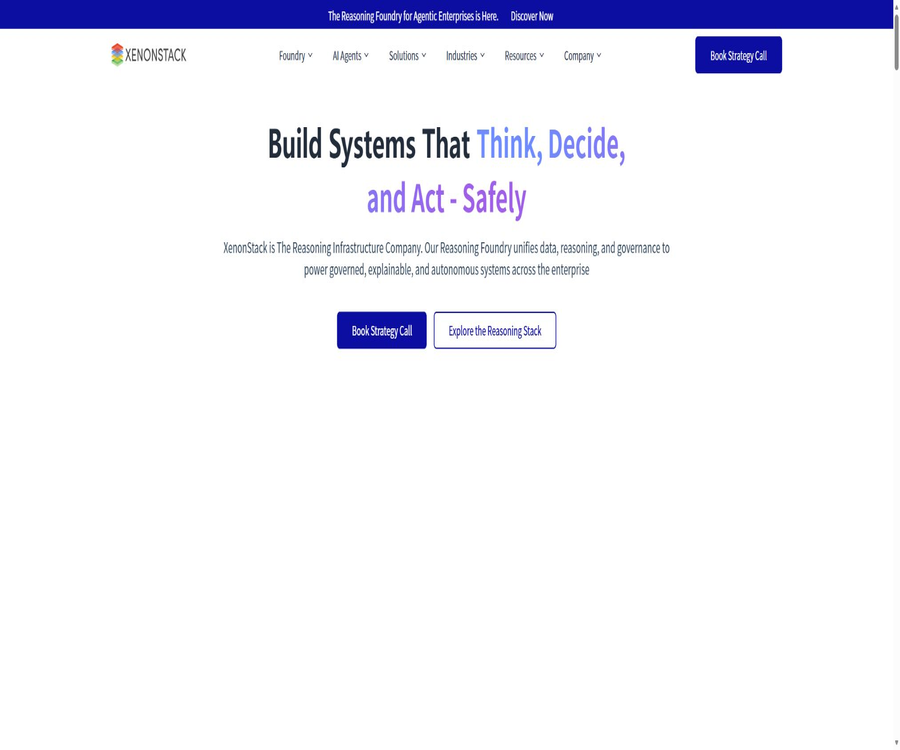
XenonStack is not a single AI chat application; rather, it is a technology company that offers enterprise software platforms, industry-specific solutions, engineering consulting services, and hosting services. Its official website is structured around Agentic Foundry, which integrates data, reasoning, agents, infrastructure, and trust management to create a unified foundation for enterprise AI.
The main products under Foundry are Akira AI, ElixirData, NexaStack, and MetaSecure; in addition, there are Neural AI as well as pre-built agents for operations, finance, risk management, analysis, supply chain, and security. Companies usually need to schedule demonstrations, assess their data and infrastructure, and then implement the solutions based on their specific needs, rather than purchasing a fixed subscription right after registration.
Four core platforms
| Platform | Core positioning | Key capabilities | Typical team |
|---|---|---|---|
| Akira AI | Reasoning and Agent Orchestration | Multi-agent collaboration, tool invocation, policy governance, and automation | AI products, business automation, and innovation teams |
| ElixirData | Agentic Analytics | Natural language analysis, pattern discovery, prediction, and explainable decision-making | Data, operations, and management decision-making teams |
| NexaStack | Agentic Infrastructure | Model deployment, inference, cloud-edge operations, and infrastructure management | Platform engineering, MLOps, and infrastructure teams |
| MetaSecure | Agentic SOC and AI security | Threat detection, AI-BOM, risk scoring, red teaming, and compliance | Security operations, risk management, and compliance teams |
Akira AI
Akira AI is responsible for transforming models into intelligent agent systems that can collaborate, learn, and carry out tasks, through the use of shared environments, tools, and policies. It is suitable for creating cross-system business processes; however, the higher the degree of autonomy, the more approval processes, permissions, and rollback mechanisms are required.
ElixirData
ElixirData transforms corporate data into context-rich tools for analysis and decision-making; its official website lists analysis modules such as Nyra, Iris, and Vera. These modules are designed for gaining insights from natural language, identifying unusual trends, enabling predictive analytics, and facilitating enterprise search, with an emphasis on providing explanations and a basis for decision-making.
NexaStack
NexaStack covers the deployment, governance, and real-time or batch inference of AI models, and can operate in cloud environments, on-premises data centers, and edge environments. Platform engineering teams can use it to standardize model services, policies, and observability, but the underlying computing resources and costs associated with third-party clouds still need to be evaluated separately.
MetaSecure
MetaSecure is designed for both AI-based systems and traditional security operations, incorporating elements such as Agentic SOC, threat detection, red team testing, AI-BOM, and continuous risk management. Automatic responses require hierarchical permission settings as well as human oversight, in order to prevent misjudgments that could lead to blockages, isolation, or disruptions in business operations.
Foundry architecture
The official website divides a company’s Agentic system into four layers: AI-Ready Data Fabric, Reasoning Engine, Trust and Governance Layer, and Autonomous Applications. This structure emphasizes that agents cannot rely solely on models; they also need reliable data, context, governance mechanisms, and auditable actions.
| Architecture layer | Responsible for content | Delivery target | Main risks |
|---|---|---|---|
| AI-Ready Data Fabric | Batch stream data, directories, quality, permissions, and context | Provide reliable data for agents. | Dirty data, identity mismatches, and unauthorized access |
| Reasoning Engine | Model routing, context, collaboration, and tool orchestration | Convert the problem into an executable plan. | Hallucinations, loops, and incorrect tool calls |
| Trust and Governance | Policies, auditing, explainability, and risk control | Make decisions verifiable and accountable. | Incomplete rule coverage or audit gaps |
| Autonomous Applications | Industry agents and business processes | Generate quantifiable business results | High-risk actions lack manual approval. |
Agents and industry solutions
Operations and SRE
AgentSRE, IncidentOps, and ReliabilityOps are used to link logs, metrics, and traces, thereby aiding in fault triage, root cause analysis, and provision of repair suggestions. Before automatically restarting services, scaling resources, or clearing queues, it is necessary to define the scope of those resources, as well as to establish change windows and rollback procedures.
Finance and FinOps
The FinOps Agent and Budget Enforcer are used to analyze cloud costs, budget deviations, and resource utilization, helping to identify abnormal expenditures and optimization opportunities. Cost recommendations must take into account contractual commitments, capacity risks, and business peaks; resources should not be shut down automatically based solely on short-term costs.
Risk and Compliance
Audit Agent, Risk Assurance, and TrustOps are used to continuously monitor policies, evidence, and control status, thereby reducing the burden associated with manual audits. The platform can assist in collecting and interpreting evidence, but the final determination regarding compliance must still be made by authorized professionals.
Analysis and Decision Making
The Analyst Agent and Decision Advisor are designed for natural language analysis, identification of deviations from KPIs, forecasting, and provision of decision-making recommendations. Enterprises should require that each significant conclusion be accompanied by information on the data range, time frame, assumptions, and level of confidence.
Supply chain and procurement
SourcingOps and supply chain agents can analyze suppliers, expenses, risks, and procurement opportunities to assist with price comparison and decision-making. When it comes to supplier selection, contracts, or payments, it is necessary to avoid biases in the training data, conflicts of interest, and automatic commitments.
Safe operation
DefenseOps and Agentic Security are used for detecting, analyzing, and responding to threats, and they include AI systems in the list of assets and risks. Security agents must avoid treating external alert texts as credible instructions.
Deployment and infrastructure
XenonStack emphasizes the hybrid deployment of cloud, edge, and on-premises data centers, serving enterprises that require data residency, low latency, or proprietary models. The actual architecture is influenced by existing Kubernetes systems, data platforms, model providers, network isolation measures, and compliance requirements.
| Deployment method | Main advantages | The main cost | Suitable scenarios |
|---|---|---|---|
| Public cloud | Elastic resources and managed ecosystems | Continuous usage, exports, and locking costs | Rapid expansion and global services |
| Private cloud | Enhance isolation and unified enterprise control | Platform development and long-term operation and maintenance | Sensitive data and internal sharing capabilities |
| Local deployment | Data residency and hardware control | Procurement, upgrading, and capacity planning | Finance, manufacturing, and regulated environments |
| edge | Low latency, offline, and on-site inference | Device heterogeneity and remote maintenance | Factories, vision, and on-site operations |
| Hybrid architecture | Select the execution location based on data and tasks. | Identity, networks, and governance are more complex. | Large enterprises operating across different regions |
Typical usage process
- Define business outcomes, users, risk levels, and actions that cannot be automated.
- Inventory the data systems, models, interfaces, identity permissions, and existing infrastructure.
- Choose a combination of Akira AI, ElixirData, NexaStack, or MetaSecure.
- Priority use cases and quantifiable success metrics are identified through discovery workshops.
- Build small-scale prototypes in an isolated environment to verify data and tool calls.
- Add policies, auditing, manual approval, costs, and termination conditions.
- Conduct security testing, red team exercises, performance tests, and disaster recovery drills.
- Deploy in phases to production and monitor quality, risks, and business value.
- Update knowledge, models, rules, and operation manuals based on real feedback.
Agent online check
- Verify the minimum permissions for each data connection and tool.
- Treat external text and search results as untrusted input.
- Add approvals for write operations, payments, deletion, and security responses.
- Set the maximum number of steps, timeout period, tokens, concurrency level, and cost limits.
- Save input data, plans, tool parameters, outputs, and approval records.
- Prepare plans for manual takeover, rollback, isolation, and service degradation.
- Regularly retest models, strategies, dependencies, and attack paths.
Product price
The official websites of Akira AI, ElixirData, NexaStack, MetaSecure, and Agentic Foundry do not disclose any standard pricing for licenses, tokens, or deployment; custom quotes are provided through scheduled demonstrations and consultations with experts. The total cost for enterprises typically consists of platform licensing fees, implementation costs, model-related expenses, computing resources, data integration needs, hosting support, and third-party cloud services.
| Project | Public price status | Common billing variables | Purchasing suggestions |
|---|---|---|---|
| Agentic Foundry | Contact sales | Organization size, use cases, deployment, and governance scope | Request for separation of the platform and implementation costs |
| Akira AI | Contact sales | Agents, tools, model invocation, and environment | First, verify the success rate and approval capability. |
| ElixirData | Contact sales | Data volume, connectors, users, and analysis load | Clarify the costs for calculation and storage. |
| NexaStack | Contact sales | Models, amount of inference, clusters, and deployment locations | Distinguish between licenses and underlying computing power |
| MetaSecure | Contact sales | Assets, logs, retention, responses, and compliance scope | Verify SOC coverage and security responsibilities |
| Implementation and hosting | Quotation based on range | Workshops, integration, migration, SLA, and support | Set milestones and acceptance criteria |
Public hosting service packages
On the official website, the pages dedicated to Next-Generation MSP and infrastructure services display the fixed monthly fees for the Standard, Pro, and Enterprise tiers; these are not the universal prices applicable to all four AI platforms. The benefits listed on those pages are only general in nature, and before making a formal purchase it is necessary to confirm the target audience, the scale of resources required, response times, location, as well as any exclusions.
| Package | Public monthly price | The main contents listed on the page | Confirmation is needed. |
|---|---|---|---|
| Standard | 49 dollars | Managed Security, basic monitoring, and 24/7 support | Monitor the number of assets, response methods, and SLAs |
| Pro | 99 dollars | It includes Standard, along with daily full snapshots, system patches, security enhancements, and optimization. | Storage, recovery scope, and change window |
| Enterprise | 125 dollars | Includes the first two tiers, along with application monitoring and advanced analytics dashboards. | Number of applications, metrics, alerts, and customization costs |
Why can’t these three tiers be considered as prices for AI platforms?
The three price tiers are listed on the specific hosting service page; the focus of the description is on security, monitoring, backup, and operating system maintenance, rather than agents, model inference, or data analysis capabilities. The main text of the catalog must indicate that these are reference prices for certain services.
Which companies are suitable?
- Large organizations that need to uniformly develop and manage multiple enterprise agents.
- Manufacturing and industrial enterprises that wish to deploy AI in cloud, on-premises, and edge environments.
- Data teams that require natural language analysis, prediction, and explainable decision-making.
- A security team that integrates AI governance, red teaming, and security operations.
- The platform team is working on advancing AIOps, SRE, FinOps, and automated repair capabilities.
- Financial companies that need to meet requirements regarding data retention and rigorous auditing.
- Operations teams that wish to automate processes related to procurement, the supply chain, or risk management.
- Traditional enterprises that require the combined delivery of consulting, implementation, and hosting services.
It is not very suitable for which users
- Individuals who simply want to register immediately to use simple AI chat or writing tools.
- The budget and scope of the use cases are not sufficient to support small teams engaged in customized implementation for enterprises.
- Organizations that lack foundations in data governance, identity and access management, as well as system interfaces.
- Users who hope to see transparent pricing for seats and the ability to make purchases directly on the official website.
- Teams that require all products to be fully open-source and capable of being deployed on their own.
- Companies that are reluctant to carry out discovery, prototyping, testing, and phased deployment.
- It is hoped that agents can be used to replace all manual approval processes in high-risk transactions.
- Developers who only need a single model interface and do not require Foundry’s governance capabilities.
Platform advantages
- Foundry unifies data, inference, agents, infrastructure, and security.
- The four platforms have clear divisions of labor and can be combined according to a company’s capabilities.
- It supports cloud, edge, on-premises, and hybrid deployment modes.
- It covers AgentOps, SRE, FinOps, RiskOps, and SecurityOps.
- Emphasis is placed on explainability, policy governance, auditing, and continuous compliance.
- It offers industry blueprints, consulting, implementation, and hosting services.
- It can connect traditional data platforms with Agentic applications.
- MetaSecure includes the AI systems themselves within the scope of security and red team testing.
- The official GitHub organization offers a large number of reference projects related to cloud-native technologies and engineering practices.
- A public statement confirms the achievement of SOC 2 certification, along with the display of various certification symbols.
Restrictions and Precautions
- The product portfolio is complex; before making a choice, it is necessary to distinguish between foundries, platforms, solutions, and services.
- The four major platforms do not have fixed standard prices; the budget must be assessed by the sales team.
- The fixed package ranging from 49 to 125 dollars is available only on certain hosting service pages.
- The implementation timeline depends on the data, permissions, network, and the complexity of the old system.
- Automated decisions can still be affected by illusions, biases, and incorrect context.
- Excessive permissions for agent tools can lead to accidental deletions, misassignments, and business disruptions.
- Cloudy and hybrid deployments increase the complexity related to identities, networks, and monitoring.
- Models, cloud computing power, logs, and data exports can generate additional costs.
- Compliance capabilities cannot automatically replace the client’s own legal and governance responsibilities.
- The claims made in the public marketing descriptions need to be verified using actual PoC metrics.
- A GitHub open-source repository does not mean that the backend of a commercial platform is fully open source.
- For high-risk automatic repairs and security responses, human intervention must be retained.
Security and Governance
XenonStack emphasizes policy-driven governance, AI-BOM, risk scoring, explainability, continuous monitoring, and red team testing. The official website states that it holds SOC 2 certification, and it displays labels such as ISO 9001 and ISO 27001; purchasers should request the current certificates and audit reports to verify the applicable entities, systems, regions, and validity periods.
| Objects of governance | Key controls | Acceptance evidence |
|---|---|---|
| Data | Classification, minimum permissions, quality, data masking, and retention | Table of contents, lineage, access logs, and deletion tests |
| Model | Version, evaluation, bias, robustness, and cost | Model cards, test set, and change logs |
| Agent | Tool allowlist, maximum number of steps, and approval process | Execute trajectory, reject tests, and conduct rollback drills |
| Infrastructure | Isolation, encryption, patching, and observability | Architecture diagrams, scanning, alerts, and recovery metrics |
| supply chain | AI-BOM, dependencies, and third-party risks | Component inventory, vulnerability management, and supplier review |
| Compliance | Policy mapping, evidence, and ongoing verification | Control matrix, audit reports, and exception processes |
| Security response | Hierarchical handling, manual intervention, and post-event review | Exercise records, timeline, and improvement points |
SOC 2 verification
Articles on the official website state that the certification has been audited by a third party, but the promotional materials published do not specify the full scope of the report or the time period over which the audit was conducted. Companies should not rely solely on the badges displayed on web pages to assess their suppliers; instead, they should request the reports, supplementary documents, and any explanations related to exceptions.
Privacy and data processing
The privacy policy states that information such as identity details, contact information, work-related data, metrics of interactions, IP addresses, device information, browsing habits, and cookies may be collected; limited data is shared with partners as required by the services provided. The policy mentions the use of encryption, access controls, continuous monitoring, vulnerability assessments, and internal audits.
| Data or scenario | Potential risks | Suggested questions |
|---|---|---|
| Corporate knowledge and documents | Models or agents accessing data beyond their permissions | Does it support permissions at the tenant, role, and document levels? |
| Operation tool invocation | Incorrect execution or prompt injection | Is it possible to set approval rules and parameter limits for each tool individually? |
| Logs and trajectories | Contains credentials, personal information, or confidential data | How to configure field masking, retention, and access auditing |
| Third-party models | Data leaves the customer’s environment | What are the model lists, regions, and terms regarding no training? |
| Hosting services | Supplier personnel access the production system | How to implement JIT access, two-person approval, and session recording |
| Delete request | Backup and residual downstream copies | What is the specific deletion SLA for each type of data? |
Data retention
The policy states that data should be retained for as long as is necessary for the purpose for which it was initially collected, after which it must be deleted, anonymized, or disposed of securely; no fixed deadline is specified for each type of platform data. The procurement contract should outline the timing for deleting production data, logs, backups, model outputs, and data after discontinuation of use.
GitHub and the open-source status
XenonStack has an official GitHub organization and makes available a variety of cloud-native, DevOps, data engineering projects and examples for learning and community collaboration. However, the commercial backends of Agentic Foundry, Akira AI, ElixirData, NexaStack, and MetaSecure do not constitute complete open-source platforms.
| object | Status | Correct understanding |
|---|---|---|
| XenonStack GitHub organization | Available publicly | Contains multiple project repositories and examples |
| Single warehouse | The licenses vary from one another. | Check the LICENSE for each warehouse before use. |
| Foundry business platform | The source code has not been fully made public. | Enterprise software and service ecosystem |
| Backend for the four main products | No complete open-source release was found. | It is not possible to label an organization’s repository as open source. |
| Third-party open-source components | The platform may be integrated. | The open-source nature of individual components does not mean that the entire system is open source. |
| Self-hosting capability | It needs to be confirmed in accordance with the contract and framework. | Local deployment also does not automatically grant access to the source code. |
Basic information
| Project | Content |
|---|---|
| Platform name | XenonStack Agentic Foundry |
| Operating entity | XenonStack Pvt. Ltd. |
| Tool type | Enterprise Agentic AI, analytics, infrastructure, and security platforms |
| Core products | Akira AI, ElixirData, NexaStack and MetaSecure |
| Deployment method | Cloud, edge, on-premises, and hybrid |
| Product price | Contact sales for a customized quote. |
| Some hosting services | Monthly plans of 49, 99, and 125 dollars are available. |
| Primary users | Medium and large enterprises and regulated industries |
| Safety Statement | SOC 2 and various other certification marks |
| Official GitHub | Yes |
| Is it open source? | Some warehouses are open source, while the commercial platforms are not fully open source. |
| Usage method | Schedule a demo, conduct an assessment, implement, and provide hosting. |
Frequently Asked Questions
What is XenonStack?
It is a company that offers enterprise AI platforms, data engineering, platform engineering, security, consulting, and hosting services; its core framework at present is Agentic Foundry.
What is included in Agentic Foundry?
It includes the agent orchestration platform Akira AI, the Agentic Analytics platform ElixirData, the AI infrastructure NexaStack, and the security governance solution MetaSecure.
Can it be registered and used independently?
The official website is primarily designed to facilitate reservations for demonstrations and consultations with experts, and it aligns more with the procurement and implementation processes of businesses, rather than serving as a self-service AI tool for individuals.
What is the price of XenonStack?
The four major platforms do not have publicly stated prices; it is necessary to contact sales for details. Some pages detailing the hosting infrastructure indicate monthly fees of 49, 99, and 125 dollars, but these cannot be considered as the standard pricing offered by Foundry.
Is local deployment supported?
The official website emphasizes deployment in cloud, edge, and on-premises environments. Specific components, licenses, hardware, and maintenance responsibilities still need to be determined in accordance with the project contract.
Which industries are suitable?
The official website covers various business sectors that require governance and automation, including aerospace, finance, manufacturing, IT operations, retail supply chains, travel and hospitality, as well as energy.
Is XenonStack open source?
The official GitHub organization makes several projects available publicly, but Agentic Foundry and the four commercial platforms are not fully open source; it is necessary to check the license of each specific repository.
Has it passed SOC 2?
The official website announces that it has obtained SOC 2 certification and displays the relevant symbols. Purchasers should request the current report to verify the type of audit, its frequency, the entities involved, the systems audited, as well as any exceptions.
Can it automatically fix production failures?
The platform offers options such as AgentSRE, IncidentOps, and automated repair; however, write operations in production should be limited, simulated first, require manual approval, and an rollback plan should be in place.
Can it be used for AI governance?
Yes. Foundry and MetaSecure place emphasis on policies, explainability, AI-BOM, risk scoring, red team testing, and continuous compliance, but customers still need to establish their own framework for responsibilities and legal matters.
How to start the evaluation?
First, select a low-risk, quantifiable use case, assess the available data and tool permissions, then schedule a workshop or demonstration, and require that a PoC be carried out under real-world constraints.
Summary
XenonStack Agentic Foundry is designed for organizations that wish to develop enterprise agents, conduct analytics, automate infrastructure, and ensure secure operations on a large scale under unified governance. Its four platforms cover the entire workflow, from reasoning and data processing to deployment and trust management.
It is not a lightweight personal tool; the focus of procurement should be on deployment boundaries, real-world PoCs, evidence of governance, third-party models, implementation costs, and long-term maintenance. It is necessary to distinguish between the pricing for customized platforms and the public monthly fees for partially hosted services, and open-source repositories on GitHub should not be considered equivalent to fully open-source commercial platforms.
Tools similar to https://twitter.com/xenonstack



 Guigong Network Security Registration No. 45132202000164