






HeyMilo AI
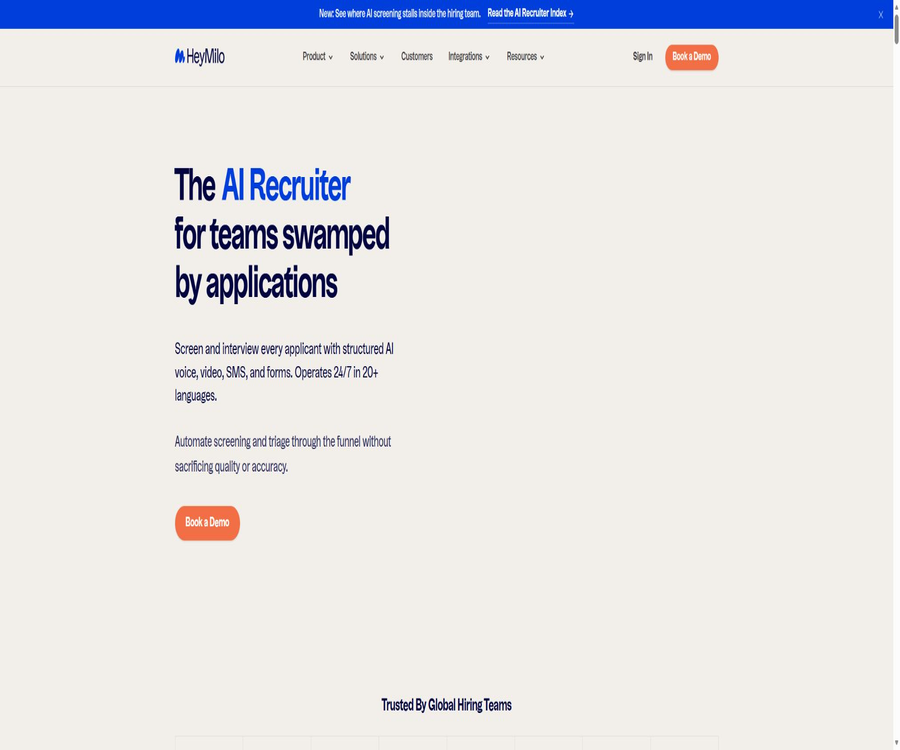
HeyMilo AI – an intelligent tool focused on AI-driven design.
Tags:AI design toolsA one-sentence summary
HeyMilo AI is an intelligent recruitment platform designed for teams that have high recruitment needs; it enables the integration of resumes, forms, text messages, voice recordings, videos, and scenario assessments into automated workflows, while also sending scores, transcriptions, and comprehensive reports back to the recruitment system.
Tool Introduction
HeyMilo AI is operated by Redsnack Technologies Inc., and it serves corporate talent recruitment teams, recruitment agencies, and staffing companies. It integrates functions such as the initial screening of candidates once they are added to the talent pool, interviewing, assessment, scheduling, and generating reports, all within a single platform.
As of August 23, 2026, the product’s role has evolved from being merely an AI-based tool for phone interviews to encompassing the entire recruitment process, including candidate sourcing, screening, interviewing, assessment, scheduling, and analysis. AI handles the increased volume of tasks, while recruiters and employers are still responsible for reviewing candidates, conducting further investigations, and making the final hiring decisions.
Scope of the recruitment process
| Stage | Enter | Handling method | Output result |
|---|---|---|---|
| Searching in talent pools | Historical candidates and job requirements within ATS | Re-match and sort potential candidates | List of candidates for recruitment officers to review |
| Resume screening | Resume, job requirements, and scoring criteria | Extract the work experience and evaluate it based on job requirements. | Score, reasons, and whether to proceed to the next step |
| Form filtering | Qualification issues, certificates, and uploaded materials | Immediately check the mandatory requirements and scoring criteria. | Clear results indicating pass, rejection, or manual review. |
| SMS filtering | Phone number and structured questions | 24/7 dialogue, follow-up questions, and conditional reasoning | SMS records, qualification outcomes, and scores |
| Voice interview | Job-related issues, resumes, and scoring scales | Conduct interview conversations via phone or browser | Recording, transcription, itemized scoring, and summary |
| Video interview | Interview script, camera, and microphone | Two-way dialogue, follow-up questions, and integrity checking | Video recording, transcription, scoring, and risk signals |
| Scenario evaluation | Job scenario, time, and scoring scale | Observe the candidate’s planning, hints, judgments, and delivery. | Deliverables, process evidence, and capability ratings |
| Interview scheduling | Recruiter calendar, time zones, and available hours | Allow the candidates who have passed the screening to choose their own time slots. | Calendar events, attendees, and video conference links |
| Report write-back | Answers, scores, and integrity signals for each stage | Generate structured reports and synchronize with ATS | Candidate records, PDF reports, and audit trails |
Main functions
Agent recruitment workflow
The team can organize resumes, forms, text messages, as well as voice and video interactions into sequential steps based on job roles, and set minimum scores, elimination criteria, and workflow rules. Once candidates reach a certain stage, the screening process begins automatically, which makes it suitable for use at night, on weekends, or during sudden peaks in demand.
Resume and initial candidate screening
The system reads the resume and job requirements, automatically identifies the relevant experience, skills, and gaps in relation to the position, and then generates a ranking along with explanations. The scoring should serve as a signal for priority, but it cannot replace manual verification of the authenticity of work experience, qualifications, and potential discrimination risks.
Structured form filtering
Recruiters can set requirements such as work permits, shift schedules, location, certificates, and other mandatory conditions, as well as include scoring questions and options for uploading documents. Once candidates submit their applications, they are immediately assessed according to these rules, which reduces the time needed for manual review of each response.
SMS candidate screening
Smart SMS messaging sends questions to candidates who enter the process, follows up automatically, and asks further questions based on their responses. It is suitable for positions that prioritize mobile usage and require rapid response times; however, companies should be aware of the options related to agreeing to receive SMS messages, unsubscribing, rules regarding where messages can be sent, and the communication costs involved.
Voice AI interview
The voice mode enables structured conversations via phone or browser, allowing for targeted follow-up questions related to the job requirements. Upon completion, a recording, a full transcript, individual score assessments, a summary, and an explanation of the scores are generated; recruiters still need to listen to the key segments again.
Video AI interview
In video mode, a two-way conversation takes place via the camera and microphone, rather than just collecting pre-recorded one-way responses. The platform provides recording, transcription, scoring, and integrity checks; alternative procedures should be in place for candidates who do not have cameras or who require accessible arrangements before deployment.
AI scenario evaluation
The team can provide information on the position and its tasks, allowing the system to generate editable scenarios, delivery requirements, and scoring criteria. The AI fluency assessment includes a built-in assistant and a timing element; it focuses on observing the candidate’s methods of following instructions, their sense of verification, their decision-making process, and the quality of the final output.
Candidate recommendation and ranking
The results of various screening steps can be summarized into candidate recommendations, a matching score, and clear reasons, which facilitates bulk review by recruitment staff. The system cannot guarantee that the candidate information or interview outcomes are entirely accurate, and ranking should not be the sole criterion for automatic elimination.
Interview integrity and anti-cheating
The system checks for risks such as suspected real-time AI responses, additional voices, prompts outside the screen, and identity substitution, and assigns a trust score or flags any abnormalities. Such flags indicate a need for further review; they do not constitute proof of cheating on their own, nor should they automatically affect hiring decisions in the absence of manual investigation.
Automatic interview scheduling
The team can connect to Google, Outlook, or Apple calendars to set working days, time slots, time zones, meeting durations, and participant templates. The selected candidates will identify their actual available times within the process, and the meeting and video links will then be added to the calendars.
Analysis and Recruitment Reports
The dashboard allows you to view the cost per interview, the cost of qualified candidates, the completion rate, the turnover rate, the duration of calls, the failure rate, and the quality score. The data can be filtered by workspace, customer, or position, and it’s possible to compare candidates side by side based on their skills.
White-label candidate experience
The white-labeling feature allows companies to use their own subdomains, sending addresses, logos, colors, as well as welcome and completion pages. Brand settings only affect the experience for candidates; scoring, transcription, and reports are still synchronized to the ATS according to the usual process.
Companies providing services
Complex deployments can be carried out with the assistance of dedicated customer success managers and pre-engagement engineers, who help with ATS field mapping, workflow management for different job categories, sandbox testing, training for recruitment staff, and reviewing the adoption process. A 90-day pilot period is typically used for corporate clients; technical integration is usually completed within the first two to four weeks, though the actual timeline depends on the data and procurement processes involved.
Multilingual abilities
The product overview states that it can operate around the clock in over 20 languages, while the detailed multilingual information lists more than 13 languages and dialects; these two statements are not entirely consistent with each other. Companies should verify within their work environment the target language, accent, voice quality, transcription accuracy, and the language in which reports will be generated.
| Project | Currently confirmable content | Usage suggestions |
|---|---|---|
| English | Includes variants such as those from the United States, the United Kingdom, Australia, and New Zealand. | Test accents and transcription based on the location of the position. |
| European languages | Includes Spanish, Portuguese, French, German, and Italian. | Review the cultural suitability of the position scale. |
| Asian languages | Includes Japanese, Korean, Hindi, and Filipino. | First, conduct a pilot using real job-related issues. |
| Arabic | Include a detailed list of languages | Confirm the specific dialect and pronunciation settings. |
| Total amount figure | There are over 20 types in total, with a detailed list showing more than 13 types. | Do not purchase based solely on the total number; it is necessary to check the specific languages. |
| Candidate side | The interview can be conducted in the specified language via the invitation link. | Provide advance information on AI involvement and available alternative arrangements. |
| Recruiter side | Receive structured scores, summaries, and transcripts | It is important to arrange for someone who understands the target language to review the recruitment process. |
ATS integration with calendar
The platform can retrieve candidates from ATS through Webhooks, polling, or recruitment phase triggers, and then write the structured results back into the corresponding candidate records. The current list of integrations includes major enterprise recruitment systems, staffing agencies, and recruitment CRM solutions.
- Enterprise recruitment systems: Workday, SAP SuccessFactors, SmartRecruiters, iCIMS, UKG Pro, and Greenhouse.
- Recruitment and staffing platforms: Bullhorn, Avionté, JobDiva, Tracker, CEIPAL, and Recruit CRM.
- Modern recruitment platforms: Ashby, Lever, Workable, Teamtailor, Jobylon, Manatal, and Zoho Recruit.
- Other business platforms: Systems such as Salesforce can be used to manage candidate and process data.
- Calendar: Supports integration with Google, Outlook, and Apple calendars for self-scheduling.
- Before making a purchase, companies should confirm the specific version, two-way synchronization of fields, Webhook permissions, historical data, and any additional implementation costs.
Basic usage tutorial
- First, identify a position with high demand for recruitment but where the risks are controllable; then outline the job description, the required qualifications, and the aspects that require human judgment.
- Create a workspace and invite recruitment managers, legal officers, privacy specialists, security experts, and recruitment operations staff to work together on setting up the permissions.
- Connect to an existing ATS or import test candidates, and define the pilot fields and data scope.
- Arrange resumes, forms, text messages, voice messages, videos, or scenario assessment agents in accordance with the actual process.
- Configure questions, elimination criteria, scoring scales, minimum scores, language, and candidate instructions for each step.
- Connect to the recruiter’s calendar to set time zones, available times, participants, and meeting templates.
- Use internal testers to cover normal responses, accents, disability accommodations, network disruptions, and abnormal behaviors.
- Check each scoring reason, transcription, and anti-cheat flag, and revise the issues with significant deviations as well as their weights.
- The pilot program is available only to a small number of candidates, with manual review and appeal options retained.
- Compare the completion rate, candidate experience, quality, and time saved by manual work before deciding whether to expand.
Enterprise deployment process
- Complete the data flow diagram by listing the locations where the resume, contact information, recordings, videos, transcriptions, scores, and integrity signals are processed.
- Sign a data processing agreement to clarify the responsibilities of the controller, processor, sub-processors, as well as those related to cross-border data transfers and data deletion.
- Request the latest summaries of security audits, bias audits, penetration tests, as well as materials related to incident response and business continuity.
- Verify ATS field mapping, permissions, Webhooks, duplicate candidates, and retry on failure in the sandbox.
- Confirm with the legal department the obligations related to notifying candidates, obtaining their consent, making automated decisions, recording audio and video, and using biometric data.
- Establish processes for manual review, reasonable accommodations, dispute resolution, as well as requests for data access and deletion.
- Cost, completion rate, quality rate, group differences, and false positives should be included in the pilot evaluation, rather than focusing solely on speed.
- Obtain management sign-off before expansion, and regularly retest the model as well as address any changes in issues, languages, and roles.
Which users are it suitable for
- Corporate talent recruitment team: Handles positions in stores, warehousing, customer service, healthcare, and other areas with high application volumes.
- Personnel dispatch and recruitment agencies: Apply uniform preliminary screening criteria across various clients, positions, and branches.
- Streamline the recruitment team: delegate repetitive tasks such as phone calls, qualification checks, and scheduling to automated processes.
- Global recruitment team: Allows candidates to go through the screening process in different time zones and in various languages, as needed.
- Hiring operations and analysis specialists: to monitor process completion rates, employee turnover, costs, and job quality.
- Development team: Connects internal systems, data warehouses, or automation processes via public APIs and Webhooks.
- Organizations that require brand consistency: deliver the candidate experience using white-label domain names, emails, and pages.
Typical use cases
- Chain stores automatically confirm the location, shift schedule, work permits, and arrival time during peak recruitment periods.
- The warehousing or manufacturing team first uses forms and text messages for screening, and then asks the qualified candidates to go through a voice interview.
- Recruitment agencies retrieve past candidates from ATS and sync the new ratings back to the original records.
- Multinational teams conduct structured interviews based on the candidates’ languages, followed by a review by local supervisors.
- Evaluation of the use scenarios in technical and knowledge-based roles, to observe how candidates utilize AI to carry out actual tasks.
- Candidates who pass the screening can directly choose the recruiter’s available time, reducing back-and-forth emails.
- The recruitment operations team analyzes at which agent stage there are losses, failures, or abnormal costs.
Prices and Purchases
HeyMilo AI does not disclose any specific names for its packages, nor any monthly or annual fees, nor a fixed price per interview; at present, it is necessary to schedule a demonstration so that a sales representative can provide a proposal. The cost per interview in certain customer cases depends on the specific circumstances of each deployment, and therefore cannot be regarded as a fixed price applicable to all customers.
| Plan or project | Price | Billing cycle | Core rights or scope | Suitable for users |
|---|---|---|---|---|
| Product demonstration | Contact sales | Not applicable | View workflows, filtering options, interview features, and integration capabilities | The team that is evaluating the product |
| Subscription to recruitment platforms | Custom quote | Not disclosed | Agent workflows, candidate evaluation, and reporting | Corporate recruitment and recruitment agencies |
| Usage and quotas | Not disclosed | Confirmed per contract | Usage such as interviews, text messages, recordings, storage, and the number of candidates | Teams with high recruitment needs |
| Companies providing services | Custom quote | It is usually done by combining pilot projects with further expansion. | ATS mapping, sandbox validation, training, and post-implementation review | Complex ATS and multiple branches |
| White-label deployment | Not disclosed | Confirmed per contract | Own domain name, brand page, and sending address | Recruitment agencies and large enterprises |
| Public APIs and Webhooks | Not disclosed | Confirmed by account and contract | Candidates, positions, interviews, transcripts, and event integration | Development and Data Teams |
Payment and refund rules
Payments are made in US dollars, using major credit cards or ACH; sales tax may apply if necessary, and prices may change. No refunds are provided for any purchases. Subscriptions can be canceled within the account, and such cancellation can take effect immediately. Before signing up, it is necessary to obtain written confirmation regarding the remaining credit limit, data export options, and the procedures for terminating the service.
Public API and MCP
HeyMilo provides public API documentation and MCP servers, which enable authorized systems to access information related to candidates, job positions, interviews, transcripts, and various pipeline activities. MCP allows compatible clients to query workspace data; companies must however restrict the range of jobs and candidates that can be viewed, as well as the permissions available for certain actions.
| Development capability | Current confirmable range | Key constraints |
|---|---|---|
| Authentication | An API Key is used for each request. | Keys must be stored in a secure credentials system and rotated regularly. |
| Position interface | Paginated reading of job listings and agent workflow configurations | The returned content may include internal recruitment rules. |
| Interview interface | View candidates, scores, recordings, and transcripts by interview or position | It belongs to highly sensitive recruitment data. |
| Candidate entry | Supports single and batch import of candidates. | Duplicate records need to be processed, as well as retries for successes and failures. |
| Webhook | Create, read, deactivate, and receive real-time events | The receiver must verify the request and prevent duplicate processing. |
| Data export | Export interview and structured results | It is necessary to comply with the contract as well as the retention and deletion policies. |
| Default rate | 300 requests per minute per API Key | A 429 response is returned when the limits are exceeded; backoff and queuing should be used. |
| MCP server | Allow the AI-compatible client to query recruitment data in the workspace. | Minimum privileges and comprehensive audit logs should be implemented. |
API integration steps
- Apply for an API Key in the independent testing workspace; do not use production administrator credentials for development.
- Restrict the positions, candidates, and environments to which a key can be accessed, and store it in a server-side credential management system.
- First, read a small number of job listings and interviews to verify pagination, fields, time zones, and handling of null values.
- Create an idempotent key for candidate import to prevent duplicate invitations resulting from network retries.
- Configure Webhook signature verification, event deduplication, a failure queue, and a replay mechanism.
- Set access logs, encryption, retention, and deletion rules for recordings, videos, transcriptions, and ratings.
- Throttling is applied according to the default limit of 300 times per minute, and exponential backoff is used for errors 429 and service interruptions.
- Connect the production ATS only after completing the reviews regarding security, privacy, and fair recruitment practices.
GitHub and the open-source status
No product source code, model weights, or official SDK repositories that can be confirmed as belonging to the HeyMilo official organization were found; projects with the same name on GitHub cannot therefore be considered official. The availability of public API documentation and MCP integration capabilities does not mean that the recruitment platform itself is open-source.
HeyMilo AI should be classified as a closed-source commercial service. Organizations that need to host it themselves, review the algorithm code, or reproduce the scoring model should determine at the procurement stage whether private deployment, model documentation, audit interfaces, and contract-level transparency are available.
Privacy and data processing
The platform handles names, phone numbers, email addresses, job titles, login information, resumes, work and educational history, accounts, bills, devices, usage data, and approximate location information. The interview process also generates audio recordings, video recordings, transcriptions, selected responses, application materials, and evaluations created by AI.
Recordings, videos, transcriptions, selected responses, resumes, and application materials will not be used to train or fine-tune general-purpose generative AI models or large language models. The data will still be used for providing recruitment services, operational purposes, security reasons, and other purposes permitted by the contracts; therefore, it is not completely exempt from processing or analysis.
| Data category | Primary uses | Risk | Deployment recommendations |
|---|---|---|---|
| Candidate status and contact information | Invitation, communication, and recording of matches | Accidental invitation sending, identity association, and marketing abuse | Limited use, with support for correction and deletion |
| Resume and professional experience | Qualification screening and position assessment | Incorrect extraction, historical biases, and overgeneralization | Only use fields related to the position, with manual verification. |
| Voice recording and transcription | Dialogue interviews, scoring, and playback | Accent deviation, sensitive statements, and voice recognition | Obtain consent and provide alternative options. |
| Video recording | Video interview and integrity check | Exposure of facial, environmental, health, or religious information | Restrict access, retention period, and reuse |
| AI assessment and scores | Candidate comparison and process flow | Risks of misjudgment, discrimination, and automated decision-making | Retention of interpretation, manual review, and appeal options |
| Integrity signal | Identify suspected proxy responses or identity substitution. | False reports can harm a candidate’s chances. | No automatic conviction or elimination is allowed. |
| ATS and API data | System synchronization, analysis, and automation | Excessive permissions or leakage by external clients | Least privilege, key rotation, and audit logs |
| Equipment and approximate location | Safety, diagnosis, and analysis | Create behavioral profiles | The retention is specified and restricted in the notice. |
Data retention and deletion
Personal information is retained as long as the account is active or as long as it is necessary to provide services; it is deleted or anonymized when there is no longer a need for such services, and it may remain in backups until it can be safely removed. If the interviews with candidates are arranged by the employer or a recruitment agency, the request to delete the information may require coordination with the organization that is in charge of the recruitment process.
Sales and targeted advertising
The platform states that it does not sell personal information, nor does it share such information for use in cross-context advertising. However, necessary disclosures may still occur in situations such as service providers, affiliated parties, business partners, corporate transactions, and legal requirements; companies should include a complete list of sub-processors in their data processing agreements.
Age limit
The service does not actively collect or market data from children under 18. In cases involving minor candidates, internships, or apprenticeship programs, employers must verify the consent of guardians, comply with local labor laws, and follow the relevant deletion procedures.
Safety, compliance, and fair recruitment
The platform states that it has carried out bias audits in accordance with the relevant laws in New York and intends to continue doing so; however, a single audit cannot cover all positions, languages, customer configurations, or future versions. Purchasers should request the latest reports, information on the scope of the audits, the groups that were tested, the dates involved, and records of any corrective actions taken.
- Explain clearly to the candidates the role of AI, the data collected, the purposes of the evaluation, and the methods of manual review.
- Verify the rules regarding automated employment decisions, recording and video surveillance, biometric data, and cross-border data in the applicable regions.
- Use job-related, interpretable scoring scales to avoid variables such as age, race, gender, disability, or family status.
- Monitor the completion rate, score distribution, and false positives by group, language, accent, device, and network conditions.
- Reasonable alternative arrangements are provided for those with disabilities, those lacking the necessary equipment, those for whom the language is not supported, or those who are unwilling to take AI-driven interviews.
- The anti-cheat score only triggers a manual investigation; it does not lead to the automatic elimination or accusation of candidates.
- Before employment, necessary checks are carried out, such as verification of certificates, background checks, reference verification, and subsequent face-to-face interviews.
- Request the latest security audits, sub-processors, encryption, incident response, recovery, and deletion certificates.
Voice identity verification guidelines
The product’s feature page describes identity verification as being based on voice biometric checks, but the privacy classification table lists biometric information as not being collected, while audio and video recordings are listed as data that is indeed collected. A written explanation is required before the product goes live, outlining the technical methods, legal classifications, consent requirements, retention periods, and applicable regions.
Product advantages
- A relatively complete recruitment process is established, ranging from searching in the talent pool to screening, interviewing, scheduling, and generating reports.
- Resumes, forms, text messages, voice messages, videos, and scenario assessments can be combined freely according to the job requirements.
- Candidates can go through the screening process at any time of day, which reduces constraints related to time zones and the scheduling of recruiters.
- Structured scores come with explanations, transcripts, and a complete report, making it easy for recruiters to review them.
- ATS integration pulls in candidates and writes back the results, reducing the need to copy data between multiple pages.
- The analysis dashboard focuses on costs, completion rates, churn rates, and candidate quality.
- Public APIs, Webhooks, and MCP facilitate the connection of internal data with automation tools.
- White-label and enterprise implementation services are suitable for recruitment agencies as well as for complex, large-scale deployments.
- Interview materials are not used to train general-purpose generative AI models, and the scope of use for such data is relatively clear.
Usage restrictions and precautions
- The fixed package, unit price, free trial period, and specific quotas are not disclosed; companies need to inquire for details.
- No refunds are provided for any purchases, and cancellations can take effect immediately; the terms related to exiting the contract must be confirmed in advance.
- There are two different figures regarding the total number of languages: over 20 and over 13; the exact number of languages needs to be determined through actual counting.
- Transcriptions, ratings, summaries, and recommendations generated by AI may contain errors, and employers must review them manually.
- The recruitment results do not constitute a guarantee of fact; the employer remains responsible for conducting background checks and making the final decision.
- Anti-cheat measures, as well as visual, audio, and identity signals, can produce false positives; therefore, it is not possible to automatically conclude that a candidate is cheating.
- There are differences between the descriptions of voice biometric features and the criteria for privacy classification; these differences need to be clarified in writing before deployment.
- Recordings, videos, and employment assessments are considered sensitive data, requiring consent, authorization, and controls for storage.
- Deep integration of ATS may require field mapping, sandbox testing, and enterprise implementation services.
- Public APIs have default limits per minute; for large-scale synchronization, queues, backoff, and idempotency must be used.
- Without confirmation that the complete product, model, or scoring algorithm is open source, it is not possible to conduct audits or implement them on one’s own.
- Rules regarding AI-based recruitment, recording, biometric data, and cross-border data transfer vary significantly across different regions.
Basic information
| Project | Content |
|---|---|
| Tool name | HeyMilo AI |
| Operating company | Redsnack Technologies Inc. |
| Tool type | AI recruitment agents, candidate screening, and AI-based interview platforms |
| Key customers | Corporate talent recruitment teams, recruitment agencies, and staffing companies |
| Core channels | Resumes, forms, text messages, voice messages, videos, and scenario assessments |
| Operation mode | Web management interface and candidate browser or phone process |
| Multilingual | There are over 20 types in total; the detailed list includes more than 13 types, and it is necessary to verify each language separately. |
| ATS integration | Supports various enterprise recruitment systems, staffing systems, and recruitment CRM. |
| Calendar | Google, Outlook, and Apple |
| Price pattern | Corporate quote requests and custom contracts |
| Refund | No refunds for any purchases |
| Whether API is provided | Yes, it includes public APIs, Webhooks, and MCP. |
| Default API limits | 300 requests per minute per API Key |
| Is it open source? | No; no verifiable official full product code was found. |
| Final hiring decision | Done by the employer |
Frequently Asked Questions
Is HeyMilo AI free?
There is no confirmed public free version available. The fixed packages, trial quotas, and unit prices have not been disclosed; it is necessary to schedule a demonstration in order to obtain a customized quote.
Do candidates need to install the app?
Candidates can carry out the necessary screenings via the invitation link, either over the phone or in a browser; generally, there is no need to install a dedicated application. The specific channels are determined by the recruitment team.
Can candidates be automatically eliminated?
Workflows can advance candidates based on certain conditions and scores, but high-risk decisions should not rely solely on automated scoring. Employers still need to review the outcomes, provide mechanisms for resolving disputes, and make the final decisions.
Which interview formats are supported?
It currently covers text messages, forms, voice communication, and two-way video; it also includes resume screening and AI-based scenario assessments. Different steps can be combined for various job positions.
Are Chinese-language interviews supported?
The public list of available languages does not include Chinese explicitly; therefore, it is not possible to assume that support for this language is available based on the overview of over 20 languages. It is necessary to verify the performance of Mandarin, dialects, transcription, and reporting in the actual working environment before making a purchase.
Can it be integrated with the existing ATS?
Yes, the integration catalog includes a variety of popular ATS systems, recruitment CRM tools, and staffing platforms. Two-way synchronization of fields, historical data, trigger mechanisms, and implementation costs need to be confirmed based on each specific system.
Will the content of the interviews be used to train large models?
It will not be used for training or fine-tuning general generative AI models or large language models. The platform will still process this data to provide recruitment services, ensure security, and fulfill contracts.
Is the anti-cheat score reliable?
It is a risk indicator, not proof of fact. Factors such as secondary sounds, line of sight, the internet, auxiliary devices, disabilities, or environmental conditions can all affect the signal; therefore, a manual investigation combined with audio and video recordings is necessary.
Does HeyMilo offer an API?
Available. The public interfaces cover candidates, job positions, interviews, transcription, import, export, and Webhooks; by default, each API key allows 300 requests per minute.
Is HeyMilo open source?
No. While public APIs and MCPs facilitate access, there is no official open-source release of a complete platform, scoring models, or model weights.
Summary
HeyMilo AI is suitable for companies and recruitment agencies that wish to integrate initial screening based on high volumes of applications, conversation-based interviews, scenario assessments, scheduling, and ATS integration. Its multi-channel agents, structured explanations, analysis capabilities, and public APIs are the aspects that make it more comprehensive compared to single-interview tools.
Before making a purchase, it is essential to confirm the customization price, the terms regarding non-refundability, the specific language to be used, the scope of ATS implementation, compliance with AI-based recruitment practices, as well as the procedures for recording, video recording, and voice identity verification. Using AI to enhance processing capacity rather than to replace human recruiters, while retaining options for manual review, alternative arrangements, and appeal processes, is a more suitable approach for formal recruitment.
Tools similar to HeyMilo AI



 Guigong Network Security Registration No. 45132202000164