






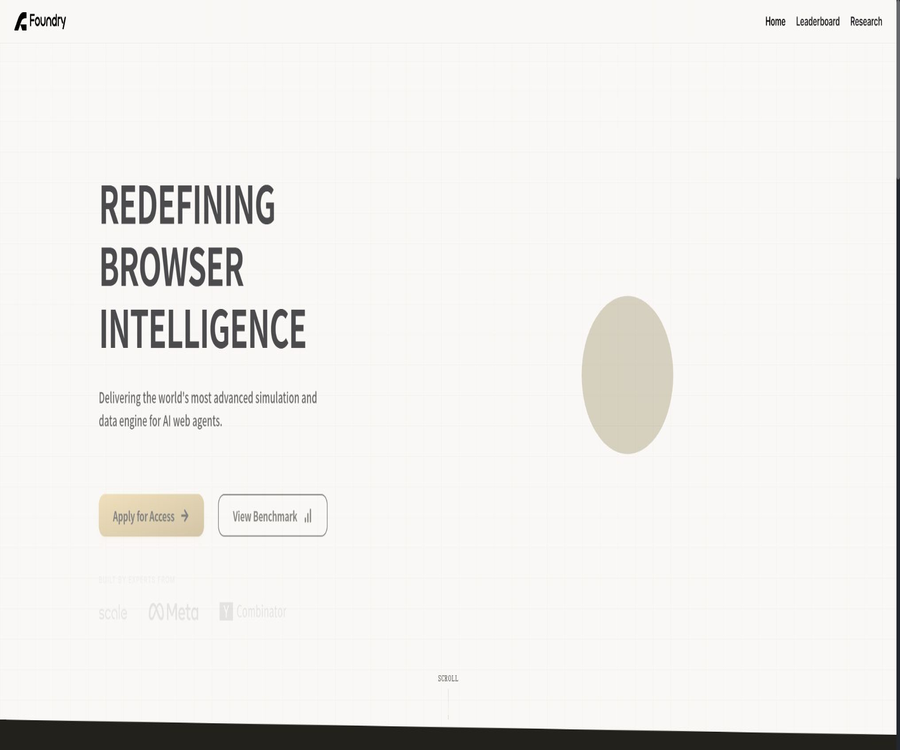
What is a foundry?
Foundry is a platform for simulation, evaluation, and training data, designed for teams working on AI browser agents. It provides a reconfigurable enterprise web environment that enables developers to test and train automated agents without relying on real websites that are constantly changing.
What is described here is a browser agent platform that operates at theaddress thefoundryai.com; it previously used the domain name foundryrl.com. It is not Microsoft Foundry, Foundry VTT, or any other product with a similar name.
A one-sentence summary
Foundry provides browser agents with reproducible web simulations, action-by-action evaluation, expert trajectory data, and reinforcement learning environments; it also allows integration with existing agents through a Python SDK.
Product positioning
| Project | The role of Foundry | Primary users |
|---|---|---|
| Simulation | Replicate corporate web pages and business status | Agent platforms and research teams |
| Evaluation | Record, categorize, and score each action taken | Evaluation, Quality, and Model Teams |
| Data | Generate expert long trajectories tailored to real enterprise processes. | Oversee the fine-tuning team |
| Reinforcement learning | Sample a large number of trajectories in a resettable environment | Post-training and Agent RL team |
| Ranking list | Compare the success rate and time taken on standard tasks | Model selection and R&D decision-makers |
Why do browser agents need simulation?
Real websites are constantly being revised, their data is updated, and different account statuses arise, which means that the same AI agent faces different environments at different times. Verification codes, measures to prevent automation, rate limits, and network fluctuations also make it difficult to repeat the training process.
Foundry attempts to keep web pages, accounts, and business data in a controlled state, so that each evaluation starts from the same baseline. This allows the team to attribute failures to the agents themselves, rather than to unexplained variations in the web pages.
Reproducible browser environment
The Simulation module provides a pixel-level, repeatable browser environment that eliminates page drift, random noise, and external rate limitations. The environment can be reset to its initial state, making it suitable for batch regression and strategy comparison.
The value brought by reproducibility
- Expose different models to the same page, data, and task conditions.
- After a failure, it is possible to replay the process and identify the specific interface or strategy-related issue.
- Perform consistent regression tests after upgrading prompts, models, or tools.
- Test write operations without contaminating the real business system.
- Batch sampling of trajectories is not affected by the anti-automation mechanisms of real stations.
Agent evaluation
The Evaluation module tracks, categorizes, and labels each action taken by the agent. States such as failed attempts, layout changes, incorrect operations, and failure to achieve the goal are not reduced to a single final score.
Core evaluation metrics
| Indicators | Meaning | Interpretation method |
|---|---|---|
| Task success rate | Percentage of goal execution completed | It should take into account the task difficulty and the sample size. |
| Average completion time | Average time taken for successful tasks | Being faster does not necessarily mean being more reliable. |
| Number of actions | The steps required to complete a task | Too much may indicate taking a detour or recovering. |
| Failure type | Categories such as clicks, layout, and accidental actions | Used to identify engineering problems |
| Status change | How are web pages and business data modified | Verify the results rather than just looking at the text. |
| Consistency across environments | Correlation between simulation results and those from the real environment | Assessing the fidelity of simulations |
Track, event, and status logging
The Python SDK examples show that developers can obtain task instructions, the starting page, login credentials, payment details, and additional notes; they can also record events, the final status, and any changes in status. The evaluator then compares the final results with the standard answers.
Evidence of operations suitable for preservation
- Task ID, environment version, and agent version.
- Time for each step: observation, action, tool return, and time.
- Clicks, inputs, navigation, and exception events.
- Changes in the initial state, final state, and intermediate states.
- Manual standards, automatic scoring, and failure categories.
- Models, prompts, sampling parameters, and costs.
Enterprise-level training data
The Data module generates custom long-sequence data created by expert annotators, designed for use in real enterprise platforms and cross-application workflows. Such data can be utilized for supervised fine-tuning, enabling the model to learn the correct sequence of operations, how to determine field values, and how to recover from failures.
Characteristics of long-track data
- The task requires moving across multiple pages and applications.
- The previous action will change the state of the subsequent pages.
- Errors may become apparent only after many steps.
- It should not only include successful paths but also examples of recovery and error correction.
- The task result is verified based on the business status, not just the last response.
Reinforcement learning environment
The RL module enables the repeated sampling and evaluation of a large number of trajectories in secure simulations, thereby avoiding the risks associated with verification codes, account bans, and production data on real websites. Development teams can use this to optimize credit allocation and error recovery within complex processes.
Research problems suitable for reinforcement learning
- How to distribute the final success reward to the intermediate actions.
- When an agent should retry, revert, or switch strategies.
- Memory and state tracking in cross-application workflows.
- Field alignment and validation in complex forms.
- Balance between action cost, time required, and success rate.
SDRBench benchmark
SDRBench, made available by Foundry, is a set of simulated, resettable browser benchmarks as well as a reinforcement learning training environment designed for sales development representative processes. It includes 50 deterministic tasks and maintains state across different applications.
These tasks cover business processes similar to those used in Gmail, Sheets, and LinkedIn for customer acquisition, as well as in Apollo and Salesforce; they are utilized for analyzing leads, personalizing outreach efforts, managing customers, and determining the suitability of potential clients.
Baseline coverage capability
| Work phase | Representative task | Required agent capabilities |
|---|---|---|
| Clue research | Search for company and contact information | Searching, reading, and evidence integration |
| Outreach preparation | Create personalized content based on clues. | Context understanding and copy generation |
| Table management | Read and update the clue list | Structured data manipulation |
| CRM maintenance | Create, modify, and advance records | Permission, field, and status checks |
| Qualification assessment | Evaluate potential customers based on rules. | Multi-condition reasoning |
| Cross-application handover | Transfer status between emails, forms, and CRM. | Long-term memory and consistency |
Public rankings list
The ranking table is designed to show the models, the average success rate, and the average time taken for successful tasks, while also providing an analysis of the various stages of the process. It allows teams to submit new agents, optimize existing ones, or establish benchmarks for their corporate processes.
During verification, the SDR Automation Benchmark indicated on the page was the version from September 2025, but the table showed no available public scores. The main text of the catalog should not include fictitious rankings or success rates for models.
Consistency between simulation and real environment
Foundry proposes carrying out tasks in parallel within both the simulation environment and the real world, and then using metrics such as success rate correlation, Pearson correlation, and sorting consistency to assess the fidelity of the simulation. The system also needs to detect any drift in the real-world interface and continuously calibrate the simulation accordingly.
Assess whether the simulation is reliable.
- Select a set of legitimate business tasks that are authorized and have controllable risks.
- The same agents and task definitions are used in both simulated and real environments.
- Compare success rates, steps, time taken, and failure types.
- Calculate the absolute difference, correlation, and consistency of model ranking.
- Investigate whether the differences stem from the pages, data, network, or business rules.
- Revise the simulation and run it again until the desired error range is achieved.
Integration method using the Python SDK
The example on the official website shows how to create a task using AWE environment objects, obtain the connection address between the task and CDP, and then pass the browser session to an existing agent. After execution, it is possible to read the final status, any changes in status, and relevant events.
Access process
- Apply for a private test to obtain a platform account, tasks, and keys.
- Install the Python SDK provided by the platform in the isolated development environment.
- Use the task ID to create an AWE environment and enable event logging.
- Read the task instructions and provide the browser connection address to the agent.
- Run the agent and wait for it to submit or reach the termination condition.
- Obtain the final state, state changes, events, and trajectories.
- Scores are calculated using standard answers or business heuristics.
Create a tutorial for regression evaluation
- Select a representative set of tasks based on business value, difficulty, and risk.
- Freeze task inputs, initial status, acceptance criteria, and environment version.
- Define scores for successful, partially successful, incorrectly modified, and timed-out cases.
- Record the model, prompts, tool version, parameters, and random seed.
- Run it multiple times to calculate the mean, variance, and confidence intervals.
- Identify issues related to prompts, visuals, planning, or execution based on the type of failure.
- Integrate the threshold into the release process to prevent the deployment of versions with significant degradation.
Tutorial on creating training data
- Identify the target platform, user roles, permissions, and high-value processes.
- Break down the workflow into verifiable initial states, steps, and results.
- It is carried out by authorized experts, with the complete trajectory being recorded.
- Label observations, actions, fields, reasons, errors, and recoveries.
- Remove real personal information, keys, and client secrets.
- The quality of the trajectory is checked through dual review and automatic rule validation.
- Split the data into training, validation, and test sets to prevent task leakage.
Submit a tutorial for evaluating agents
- Confirm eligibility for private testing and read the current submission requirements.
- Fix the version of the intelligent agent, the model, the tools, and the operational parameters.
- Use a test key to verify connections, handle termination, and manage errors.
- Submit the agent and let the platform run standard tasks.
- View success rate, duration, actions, and failure tags.
- Fix it at the stage where failure occurs and retest it in the same environment.
- When releasing the results publicly, indicate the version, date, and method as well.
Which users are it suitable for
- Browser agent companies: Need stable evaluation of product upgrades.
- Large model team: Training capabilities for understanding and manipulating web pages.
- Agent RL team: A resettable and scalable environment is required.
- Enterprise Automation Team: Verify whether the agents can operate internal systems safely.
- Data team: Acquire or generate high-quality long-track data.
- Research institution: Analyzes cross-application planning, recovery, and credit allocation.
- Model Evaluation Team: Establishes browser benchmarks with state evidence.
Typical use cases
- Compare the success rates of different models in the same corporate process.
- Regression test alerts, tool or browser executor upgrades.
- Determine at which step the intelligent agent fails to click, enter data, or make a decision.
- Train agents in handling emails, spreadsheets, customer acquisition, and CRM.
- Test write tasks without touching production data.
- Generate supervised fine-tuning and reinforcement learning trajectories.
- Convert the client’s proprietary workflows into internal standards.
- Assess whether the webpage is suitable for use by automated agents.
Product advantages
- The environment can be reset, facilitating fair comparison of different agents.
- Evaluate based on the final state and state changes, rather than just looking at the responses.
- Classifying events on a per-action basis helps identify the true cause of failure.
- Simulation avoids real website verification codes, blockings, and rate limits.
- It covers the evaluation, data, and reinforcement learning training processes simultaneously.
- It supports long-running processes, cross-application, and enterprise SaaS workflows.
- The Python SDK can be integrated with existing browser agent frameworks.
- SDRBench offers a public platform for task design and research.
Usage restrictions and precautions
- The platform is still in private testing phase, and access requires an application.
- The official website does not disclose any fixed packages, free quotas, or pay-as-you-go pricing.
- The sample dataset page is labeled as upcoming, so it cannot be considered available for download.
- When verifying the public ranking list, the scores of the available models are not displayed.
- Simulations may always exhibit differences from real websites in terms of appearance, latency, and rules.
- Enterprise-specific environments and custom workflows can involve higher production costs.
- Real accounts, login credentials, and payment details are highly sensitive information.
- The baseline score refers only to a specific task and version, and it does not demonstrate general autonomous capabilities.
- The availability of a Python SDK does not mean that the platform, environment, or data are open source.
- No official GitHub repository or explicit open-source license was found.
- The privacy policy does not specify a fixed retention period for different types of data.
Price and access methods
| Project | Current status | Fee details |
|---|---|---|
| Visit the official website | Public | View product descriptions, research, and rankings for free |
| Browse rankings | Public | No payment is required, but the score data is not displayed at the moment. |
| Private testing | Apply for access | Fixed price not disclosed |
| Complete platform | Apply for access | Negotiate by team, environment, task, and scale |
| Custom enterprise simulation | Enterprise services | The price depends on the website and workflow. |
| Expert training data | Enterprise services | Quotations are provided based on field, trajectory length, and quality requirements. |
| The agent submits the evaluation. | Contact the team | The public page does not list the pricing rules. |
| Sample dataset | Coming soon | There is no public price available, nor is it possible to download it. |
The price verification date is August 22, 2026. Foundry has not yet announced the costs for standard subscriptions, pay-per-use plans, or enterprise contracts; therefore, it is not possible to determine prices based on other Foundry products with similar names.
What needs to be confirmed when quoting?
| Quotation variables | Items that need to be confirmed | Factors that may affect costs |
|---|---|---|
| Number of environments | Enterprise applications and versions that require simulation | Every application requires modeling and maintenance. |
| Task scale | Number of tasks, difficulty level, average number of steps, and status | Longer task execution and more annotation. |
| Concurrency and frequency | Daily or monthly trajectories, concurrency, and peaks | Affects computing and browser resources |
| Data services | Is expert demonstration, review, and error correction required? | There are significant differences in the costs associated with human labor quality. |
| Fidelity | Visual, behavioral, data, and latency requirements | High fidelity requires more calibration. |
| Deployment and Security | Shared, dedicated, or private environments | Isolation and compliance requirements affect the architecture. |
| Support | SLA, response, customization, and research assistance | Corporate support is usually priced separately. |
Supported platforms and technical interfaces
| Platform or interface | Support status | Uses |
|---|---|---|
| Official Web Site | Support | Product introduction, application, and research content |
| Simulation browser environment | Support | Run and reset web page tasks |
| Python SDK | Private testing available | Integrate with existing agent workflows |
| CDP browser connection | Examples show support. | Let the agent control the task browser. |
| Events and States Interface | Examples show support. | Read events, final status, and changes |
| Public rankings list | Support | Present standard benchmarks and methods |
| Standalone desktop or mobile app | No findings were detected. | The product is primarily aimed at research and development as well as enterprise interfaces. |
| Public self-service console | No findings were detected. | Full capabilities require private testing access. |
Security of API keys and credentials
SDK examples require Foundry keys; tasks may also include login credentials and payment details. Teams should use test accounts, fictional payment methods, and a separate key management system, ensuring that production credentials do not end up in training sets or logs.
- Use separate, rotatable keys for each environment and team.
- Only grant the test account the permissions required to meet the benchmarks.
- Mask passwords, tokens, payment, and personal fields in logs and traces.
- Agents are prohibited from accessing domain names and networks outside the scope of the task.
- Set runtime timeout, action limits, and emergency termination.
- Add approval steps for data export and leaderboard publication.
- Periodically destroy expired credentials and test data from completed projects.
Privacy and data collection
The user information listed in the privacy policy includes email address, name, organization, data submitted by agents, baseline results, and communication content. The information collected automatically encompasses usage analytics, device details, IP addresses, cookies, performance metrics, and error logs.
These data are used for operating services, processing requests submitted by agents, generating baseline results, improving products, as well as supporting communication and security. Hosting, analysis, and customer service providers may handle such data as part of their duties.
Public or confidential ranking lists
The policy states that the performance of intelligent agents and the benchmark results may be displayed on public rankings, but personal identification information will not be made public without explicit consent. Companies should still verify before submission whether the name of the agent, the model configuration, and any records of failures will be made public.
Data retention, cross-border transfers, and rights
Personal information is retained for as long as it is necessary to provide services and fulfill the purposes outlined in the policies, or for as long as required by law; no specific number of days is specified. The data may be transferred to other countries for processing, and appropriate data protection measures must be applied.
Depending on their location, users can request access to, updating of, deletion of, restriction or objection to processing of their data, as well as the portability of such data and the withdrawal of consent. The service is not intended for children under 13 years old.
GitHub, SDKs, and open-source status
The official website provides examples of how to integrate the Python SDK, but no officially confirmed public GitHub repository, package page, or open-source license could be found. It is possible that the SDK is distributed only to private testing clients.
| Project | Public status | Conclusion |
|---|---|---|
| Foundry platform | Closed-source enterprise services | The product itself is not open source. |
| Python SDK | As shown on the official website, access is required to view it. | The public page does not specify the license. |
| SDRBench paper | Publicly readable | Making a paper public does not mean making the environmental code open source. |
| Sample dataset | The marker is about to be released. | It cannot be processed as already published. |
| Official GitHub | No warehouse that can be confirmed was found. | Do not confuse Microsoft with other projects that share the same name. |
| Simulation environment code | Not disclosed | It is not possible to deploy it on your own using only the official website. |
Differences from Microsoft Foundry
| Comparison items | Foundry on this page | Microsoft Foundry |
|---|---|---|
| Operating entity | Independent browser agent platform team | Microsoft |
| Primary use | Web simulation, evaluation, data, and reinforcement learning | Build, deploy, and manage enterprise AI applications and agents |
| Main interfaces | Private Python SDK and simulation browser | Azure cloud platform, SDKs, and services |
| Price | Private testing, not publicly available | Charging is based on specific Azure services and resources. |
| SDRBench | Official research benchmark | It’s not due to the composition of its products. |
| Official website domain name | thefoundryai.com | Microsoft Cloud Services Platform |
Basic information
| Project | Content |
|---|---|
| Tool name | Foundry |
| Former brand domain name | foundryrl.com |
| Tool type | Browser agent simulation, evaluation, data, and reinforcement learning platform |
| Core engine | Agent Web Engine |
| Public benchmark | SDRBench |
| Task scale | SDRBench contains 50 deterministic tasks. |
| Connection status | Private testing |
| Price pattern | Not publicly available; an application for access must be submitted and discussions with the company are required. |
| Main platforms | Web, simulation browser, and Python SDK |
| Development language | The example on the official website is in Python. |
| Public API | Complete public self-help documentation is not available. |
| Official SDK | Provide the access path for the Python SDK. |
| Is the product open source? | Not open source |
| Official GitHub | Not confirmed |
| Date of Privacy Policy update | October 28, 2025 |
| Price verification date | August 22, 2026 |
Recommendation score
Recommendation score: 4.1 / 5. Foundry provides a comprehensive approach to addressing the most challenging issues related to environmental drift, long-sequence evaluation, and training data for browser agents, making it suitable for professional Agent development teams.
The main shortcomings are that it remains a private test, the prices and complete documentation are not available, and there are no scores in the rankings yet. Ordinary users as well as companies that only want to automate web tasks will not benefit directly from it.
Frequently Asked Questions
What does Foundry do?
It provides the browser agent team with resettable web page simulations, evaluation tools, expert trajectory data, and a reinforcement learning training environment.
Is this Microsoft Foundry?
No. The products listed on this page are managed by a separate team that focuses on the simulation and evaluation of browser agents; they are different from Microsoft’s cloud platform with the same name.
Is Foundry free?
The website can be accessed for free, but the full version of the platform is in private testing; no information is available regarding free usage limits, standard packages, or fixed corporate pricing.
How can I obtain access rights?
To conduct private testing, it is necessary to apply through the official website or contact the team, specifying the requirements regarding agents, tasks, environments, volume of data, and other related details.
Is a Python SDK available?
An access path is provided; the official website offers Python examples for using the AWE environment, task IDs, browser connections, and event reading.
What is SDRBench?
It is a resettable browser benchmark and reinforcement learning training environment designed for sales development workflows, containing 50 deterministic cross-application tasks.
Are there model scores on the ranking list?
The ranking list includes fields for the model, success rate, and time taken, but when performing verification the page shows that no available benchmark scores are available; therefore, no rankings can be assigned.
Is it possible to evaluate one’s own agents?
It is possible to apply to submit agents, or to contact the team in order to use one’s own dataset or corporate workflow as a benchmark. The specific requirements and costs are not publicly available.
Can it be trained on a real website?
The focus of Foundry is on controlled simulation, in order to avoid variations that occur on real websites as well as to circumvent anti-automation measures. The results of such simulations still need to be verified in a real environment with appropriate authorization.
Can training data be generated?
Custom long-sequence data annotated by experts can be provided for supervised fine-tuning on real enterprise platforms. The specific scale, quality standards, and pricing are subject to negotiation.
Is Foundry open source?
It is not open source. The papers and SDK examples are available publicly, but no official open-source platform code, simulation environment, or clear licensing terms can be found.
Can the sample dataset be downloaded?
During verification, the sample dataset is still marked as upcoming and cannot be considered available.
Will the results be made public?
The privacy policy states that the performance of agents and their benchmark results may be displayed on public rankings; it is necessary to verify which fields are public and which ones require confidentiality before submitting.
How long are the data stored?
The privacy policy specifies only the period necessary to fulfill the purposes of the service or to meet legal requirements; there is no fixed duration for data retention. Corporate contracts should outline these matters on a case-by-case basis.
Is it suitable for ordinary web automation users?
It is generally not suitable for this purpose. It is designed for professional teams that are responsible for developing, training, and evaluating browser agents, rather than for ordinary users who want to record web page interactions directly.
Summary
Foundry integrates the web environment, status, events, ratings, and training trajectories within the same infrastructure, thereby enabling browser agent teams to achieve a stable, comparable, and repeatable development cycle. SDRBench illustrates the specific approaches for long-running processes across different applications.
Teams that intend to adopt this solution should first apply for a private test, use their own test tasks to verify the consistency between the simulation environment and the real world, and clarify in the contract the pricing, data confidentiality, disclosure of results, isolation of credentials, retention period, and SDK licensing terms.
Tools similar to Foundry



 Guigong Network Security Registration No. 45132202000164