






Fleak
Fleek, an intelligent tool focused on AI-driven design
Tags:AI design toolsA one-sentence summary
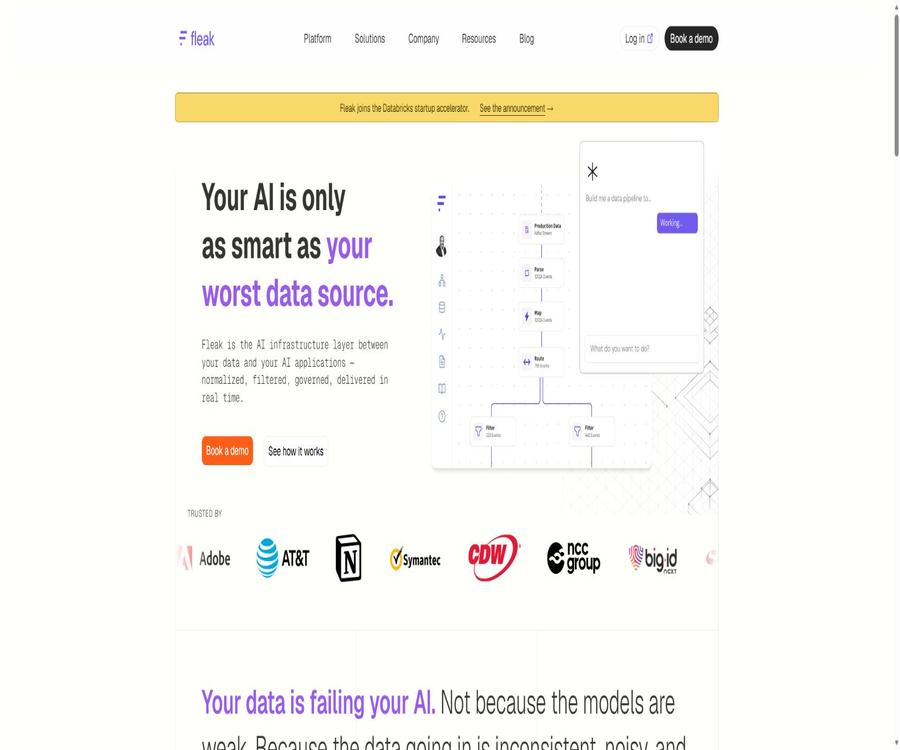
Fleek is a real-time data infrastructure designed for enterprise AI, machine data, and stream analysis; it enables parsing, standardization, filtering, deduplication, governance, and value-based routing between data sources and AI applications.
Tool Introduction
Fleak was developed by Fleak Tech Inc.; it is designed to function as an AI-native data layer, rather than a general-purpose chatbot. Users can define data processing workflows using visual DAGs or natural language, after which these workflows are deployed to hosted computing clusters for distributed, asynchronous processing.
The platform primarily addresses issues such as inconsistent data formats, changes in the schema used by upstream systems, duplicate events, unnecessary storage usage due to worthless data and tokens, as well as inconsistencies in permissions across different downstream systems. ZephFlow is an open-source, stateless processing engine that can be used independently.
Product composition
| Composition | Main function | Operation mode | Open state |
|---|---|---|---|
| Fleak hosting platform | Connecting, orchestrating, deploying, monitoring, and governing data pipelines | Managed computing cluster | Business services, appointment for demonstrations |
| Workflow Builder | Configure channels, processing nodes, and outputs using DAG. | Web interface | The documents are made public; account capabilities depend on the plan. |
| AI Copilot | Configure the natural language generation pipeline and assist with Schema changes | For use within the platform | Commercial functions |
| ZephFlow Core | Stateless stream-based data processing | Embedded applications, standalone processes, or network services | Apache 2.0 open source |
| ZephFlow Python SDK | Use Python to combine filtering, transformation, and error handling. | Python calls the Java 17 engine | Apache 2.0 open source |
Working principle
- Access raw events from Kafka, Splunk, machine logs, databases, industrial systems, or other sources.
- Identify event types, field meanings, schemas, and downstream application requirements through AI or rules.
- Use parsing, filtering, assertions, expressions, or SQL nodes to clean, validate, standardize, and branch.
- Route records to different destinations based on real-time value, compliance value, and target schema.
- Processing continues after deployment to the managed computing cluster, and throughput, errors, and pipeline health are monitored via the dashboard.
- When upstream Schema drift is detected, a new configuration is generated; it is reviewed by the team before being redeployed.
Main functions
AI Value Perception Routing
Fleak evaluates the value of each incoming data piece for downstream AI systems or business applications, and decides whether to transmit it in real time, store it on a long-term basis, or discard it. This approach helps to reduce unnecessary, repetitive, and low-value events before they reach the data lake, SIEM systems, or models.
Natural language orchestration
Users can describe the target in natural language, and Copilot will generate the data processing configuration. The results obtained need to be verified using actual event samples with regard to fields, boundary conditions, and error handling; the descriptions alone cannot be used as production rules.
Self-healing Schema drift
The platform can detect changes in the upstream schema, issue alerts, and generate new configurations. The official website includes pages discussing automatic redeployment; there are also instructions stating that deployment requires user approval. In a production environment, the configuration should be established through automatic detection and generation, followed by manual review before deployment.
Visualize DAG workflows
Workflow Builder connects the channels, processing, and output nodes into a directed acyclic graph, with the output of each upstream node serving as the input for the downstream nodes. Before deployment, the platform verifies the DAG; thereafter, the managed cluster handles parallelization, concurrency, and load distribution.
Multi-format parsing
The Parser node can handle structured or semi-structured texts such as JSON, key-value pairs, CSV, Grok, Syslog, CEF, and multi-line Windows formats. The fields obtained after parsing can be used for filtering, assertions, SQL operations, and schema mapping.
Filtering, assertions, and expressions
Filter is used to exclude unwanted records, Assertion is used to verify required fields and data quality, while Fleak Eval is responsible for creating or modifying fields. Failed records can be sent to the error tracking system or a dead letter queue.
SQL data conversion
FleakSQL enables teams familiar with SQL to convert records, thereby reducing the need to learn specialized expressions. It does not support all database dialects; before migrating complex queries, it is necessary to consult the syntax documentation and conduct compatibility tests.
Deduplication and standardization
The platform filters the data, removes duplicates, and standardizes the schema before storing it or using it in models, which helps to reduce duplicate content in storage, queries, and model contexts. The cost reduction figures listed on the official website are promotional figures; the actual impact depends on the quality of the data and the rules applied.
Fine-grained governance and auditing
Fleek implements access control at the data layer and keeps track of the processes of transformation and delivery; its website indicates a complete audit trail as well as SOC 2 Type II certification. Companies should request the latest reports, scope details, exceptions, and data processing agreements when making purchases.
Distributed asynchronous execution
Once the managed workflow is deployed, it runs on the Fleek computing cluster; the platform takes care of parallelization, concurrency, and resource scaling automatically. The team does not need to write code for multi-threading or load balancing, but it still has to set goals regarding capacity, latency, and fault tolerance.
Observability
The monitoring panel is used to check the health of the pipelines, their throughput, and any errors; it facilitates the detection of disruptions in the transmission process, parsing failures, or issues with the destination. Before putting it into use, it is necessary to determine the retention period for metrics, the channels for alerts, the fields included in the logs, and the service levels.
Zero-storage real-time transmission
The official website states that data can be converted in real time and sent directly to the target system, without having to be stored on Fleek for an extended period. Zero storage is a feature of the pipeline design; it does not mean that logs, audit records, error information, or operational metadata are not retained at all.
Public nodes and data formats
| Category | Nodes or formats that have been clearly made public | Primary uses | Verification reminder |
|---|---|---|---|
| Channels | Kafka Source, Splunk Source | Flow-based themes and Splunk query inputs | The claim on the official website that any channel is available does not mean that every connector comes with public documentation. |
| Processing | Fleak Eval, Filter, Assertion, Parser, SQL | Conversion, filtering, validation, parsing, and query-based processing | Expressions have their own specific syntax rules distinct from those of SQL. |
| Parsing format | JSON, key-value, CSV, Grok, Syslog, CEF, Windows multi-line | Convert the original text into structured records. | The samples should cover anomalies and multi-line boundaries. |
| Output | Kafka, Delta Lake, Databricks, Elasticsearch | Messages, data lakes, and search indexes | Different documents may have varying update speeds. |
| Error handling | S3 dead letter queue | Save events related to failures in ingestion, parsing, assertion, and transformation. | The Python SDK documentation explicitly supports it. |
| Industry Schema | Security Schemas such as OCSF, UDM, CSF, etc. | Standardization of security logs | The accuracy of the mapping must be verified using the target tool. |
Create a managed data pipeline
- Schedule a demonstration and prepare to enter the type, sample events, peak throughput, latency, target Schema, and destination.
- Create a DAG in Workflow Builder, and configure the input connectors along with the minimum necessary read permissions.
- Add Parser, Filter, Assertion, Eval, or SQL nodes to preview the output of each stage step by step.
- Set the destination for Kafka, Delta Lake, Databricks, Elasticsearch, or contract support.
- Use test data to verify scenarios such as normal cases, missing fields, type changes, duplicates, excessively large records, and target interruptions.
- Deploy it to a managed cluster, set up monitoring and alerts, and then gradually scale it out using controlled traffic.
Handling Schema drift
- Establish expected schemas, required fields, data types, enums, and sample baselines for key channels.
- Enable drift detection and alerts to identify new fields, deleted fields, type changes, and changes in nested structures.
- View the newly generated AI configurations and field mappings to check for any data loss, incorrect conversions, or expanded data access.
- Replay old and new events on isolated data to compare success rates, output schemas, and downstream compatibility.
- After the change is approved, it is redeployed, while the old configuration, rollback methods, and audit records are retained.
Introduction to ZephFlow in Python
- Prepare Python 3.8 or a newer version, as well as Java 17 or a newer version, since the Python SDK relies on the Java processing engine.
- Install the zephflow package, create a minimal flow locally, and verify the environment using memory events.
- Use JSONPath to filter records, and then use Eval expressions to create fields or modify the structure.
- Add Assertions and enable step-by-step error reporting to ensure that faulty data does not slip unnoticed into downstream processes.
- When a persistent channel is required, configure a profile or Kafka Source, and set up an S3 dead letter queue for handling production errors.
- Save the DAGs that pass the tests in YAML format, and run sample and regression tests as part of continuous integration.
Production verification process
- Collect event samples that represent normal, abnormal, duplicate, out-of-order, delayed, and future schemas.
- Define input, output, error, and performance acceptance criteria for each processing node.
- Run the old pipeline in parallel with Fleak, and compare the number of records, fields, latency, and destination results.
- Simulate channel disconnection, expired credentials, target throttling, network fluctuations, and a large number of error events.
- Verify audit, access control, alerts, dead letter replay, and rollback before deciding whether to switch to production traffic.
Which users are it suitable for
- Data engineering team: Enables rapid access to new channels and reduces the repetitive work associated with maintaining schemas and transformation rules.
- AI Platform Team: Cleanses, removes duplicates, and normalizes inputs before using RAG, agents, and models.
- Security Operations Team: Maps heterogeneous logs to a unified security schema and filters out noise that reaches the SIEM.
- Industrial and IoT team: Unifies sensors and OT telemetry to reduce duplicate readings and label discrepancies.
- Fintech team: Standardizes transaction events to provide consistent data for fraud, risk, and compliance systems.
- Java and Python developers: Use ZephFlow under Apache 2.0 to carry out stateless processing in their own applications.
Typical use cases
- Standardization of security logs: Events from different manufacturers are converted to OCSF, UDM, or CSF and then fed into the detection system.
- AI input governance: Remove duplicate and low-value events, standardize the fields, and then pass them to the model or agent.
- Lakehouse ingestion: Process data from Kafka or Splunk and write it to Delta Lake or Databricks.
- Real-time search index: Batch-convert events and write them to Elasticsearch for investigation and retrieval.
- Industrial telemetry cleaning: Standardize device labels, units, and schemas, and filter out noisy readings.
- Fraud data preparation: Standardize multi-channel transactions, add supplementary rules, and maintain complete processing audits.
- Embedded data processing: Integrate ZephFlow as a Java library into existing services, without relying on any managed platforms.
Product advantages
- Place connection, parsing, transformation, governance, and delivery within a single real-time pipeline to reduce the number of intermediate systems.
- The natural language generation configuration reduces the barriers to setup, while still retaining DAG nodes for engineers to inspect.
- Schema drift detection and configuration generation can reduce the time required to make corrections after changes in the upstream systems.
- Managed clusters handle parallelism, concurrency, and scaling, making them suitable for teams that do not want to manage the infrastructure for stream processing.
- Value-aware routing filters data before it enters storage and the model, thereby enabling control over storage usage and Token consumption.
- The ZephFlow Java core and Python SDK are licensed under Apache 2.0, which facilitates local testing and further development.
- Assertions, error tracking, and S3 dead letter queues provide a clear path for isolating bad data.
Usage restrictions and precautions
- The official website does not disclose any fixed packages, free usage quotas, or specific prices; purchases require an appointment for a demonstration and a quote from the company.
- Connecting to any channel is part of a broader description of the product; the public workflow documents only list some of the channels and output nodes.
- Self-healing cannot take place without any oversight at all; errors in schema mapping can cause problems to spread rapidly to all downstream components.
- The figures regarding website performance and cost savings are provided by the manufacturers; they must be verified using one’s own metrics related to events, throughput, and downstream costs.
- Zero storage does not mean zero data processing or no logs; the rules for storing audit, error, monitoring, and support data must be specified in the contract.
- The managed platform is not the same as the open-source ZephFlow; the open-source engine does not include a commercial console, AI orchestration, or managed services.
- The Python SDK requires the Java 17 engine; both deployment, containers, and local environments must meet these two runtime requirements.
- The S3 dead letter queue operates only in processes driven by data pipelines; memory-based processes handle errors step by step through the return values.
- Fine-grained data permissions and auditing need to be properly configured; otherwise, incorrect authorizations may still result in sensitive records being sent to inappropriate destinations.
- The website’s pages on privacy, terms, and EULA are accessible, but limited information can be retrieved from them; companies should request the full text before signing a contract.
Price and procurement methods
As of August 22, 2026, Fleak’s official website does not provide any verifiable public pricing list, free plans, trial periods, or unit prices based on usage volume; the main option available is to schedule a 30-minute demonstration. Any historical prices from third parties should not be used as a basis for current purchases.
| Product or cost item | Public price | Possible measurement methods | Confirm before purchasing |
|---|---|---|---|
| Fleak hosting platform | Custom quote | Pipelines, throughput, computing, or enterprise contracts | Minimum commitment, number of environments, support, and service levels |
| Channels and connectors | Not disclosed | Connector or data volume | Standard connector and custom connection fees |
| Stream computing | Not disclosed | CPU, number of events, or runtime | Peak values, scaling, and overcharging |
| Storage and dead letter data | Not disclosed | Quantity on hand and expiration date | Object storage, logging, and replay costs |
| Corporate governance | Not disclosed | Users, roles, auditing, and environment | Single sign-on, audit export, and data retention |
| ZephFlow open-source engine | The source code is free. | Cost of own infrastructure | Operations, support, cloud resources, and downstream services |
Official social media posts mentioned that billing is based on the pipeline canvas or stream-based CPU on a daily basis, but the official website does not provide current figures or detailed rules. The formal quote, order details, and settlement terms shall prevail at the time of signing the contract.
Platform support and deployment
| Platform or method | Support status | Uses | Requirements |
|---|---|---|---|
| Web DAG Builder | Support | Design, deploy, and monitor hosted workflows | Business account |
| Managed computing cluster | Support | Distributed asynchronous stream processing | Allocate resources according to the contract. |
| Java SDK | Support | Run ZephFlow as an embedded application or independently | Java 17 |
| Python SDK | Support | Build and run ZephFlow using Python | Python 3.8 and later, as well as Java 17 and later |
| Independent process | Support | Run stateless pipelines in a self-hosted environment | Self-monitoring and operation and maintenance |
| Network services | Support | Run the processing workflow through the service interface. | Self-protection of endpoints and capacity |
| Container or cloud environment | Deployable | Running open-source engines and dependencies | Users manage images, keys, and upgrades. |
APIs, SDKs, and open-source status
ZephFlow Core is a stateless data processing framework for Java 17; it can operate as a library, an independent process, or a network service. The version indicated in the current README is 0.4.1. It supports the use of composite nodes, assertions, error handling, and flexible deployment options.
The ZephFlow Python SDK can be installed from the Python package repository; it supports stream API, JSONPath filtering, Eval transformation, Flow merging, assertions, and S3 dead letter queues. Both the Java core and the Python SDK are licensed under the Apache 2.0 license.
| Project | Language or interface | License | Relationship with commercial platforms |
|---|---|---|---|
| ZephFlow Core | Java 17 | Apache 2.0 | Fleak has a stateless underlying processing capability, allowing it to operate independently. |
| ZephFlow SDK module | Java dependencies | Apache 2.0 | It can be integrated using Gradle or Maven. |
| ZephFlow Python SDK | Python 3.8 and later, along with the Java engine | Apache 2.0 | Python encapsulation and local pipeline API |
| ZephFlow Examples | Java example | Apache 2.0 | Demonstrate the use of the open-source engine |
| Fleak hosting platform | Web DAG, AI, and managed clusters | Closed-source commercial services | The entire system is not made open source just because the core engine is open source. |
Privacy, Security, and Governance
Fleak may handle security logs, transactions, industrial telemetry, and AI inputs, which contain information related to accounts, devices, networks, employees, or customers. Companies need to determine whether data is stored on disk, the retention period for metadata, who has access to it, which sub-processors are involved, the geographical location involved, and the procedures for deleting such data.
The official website states that SOC 2 Type II compliance, fine-grained access control, complete conversion logs, and audit trails are available, but the directory page cannot replace an audit report. Purchasers should verify the reporting cycle, the scope of the products, any control exceptions, as well as the boundaries of responsibility for open-source and hosted deployments.
- Use accounts with the minimum required permissions to connect to the channels and targets, managing read, write, and administrative privileges separately.
- Use masked samples in the testing environment; do not provide production security logs directly to unreviewed AI configurations.
- For each branch, data classification and allowed destinations are established to prevent sensitive fields from reaching unrelated systems.
- It logs configuration creation, manual approval, deployment, rollback, and permission changes, thereby creating an auditable trail.
- Verify whether the monitoring logs, dead letter queues, and support packages contain the complete original events.
- Set encryption, access control, retention period, and deletion procedures after replay for dead letter data.
- Regularly rotate the credentials for Kafka, Splunk, cloud storage, and databases, and monitor for abnormal access attempts.
- Include commitments regarding zero storage, data retention, and deletion in the contract and data processing agreements.
Basic information
| Project | Content |
|---|---|
| Tool name | Fleak |
| Development company | Fleak Tech Inc. |
| Tool type | AI-native data layer, real-time data pipelines, and stream processing |
| Core interface | DAG Workflow Builder |
| Open-source engine | ZephFlow |
| Primary users | Data engineering, AI platforms, security, industrial IoT, and finance teams |
| Price pattern | Custom quotes for businesses; free source code for ZephFlow |
| Is registration required? | A hosting platform requires a corporate account. |
| Chinese support | No clear Chinese interface was found. |
| Managed deployment | Support |
| Java SDK | Available, Java 17 |
| Python SDK | Required: Python 3.8 or later, along with Java 17. |
| Is the product open source? | The hosting platform is not open source; the ZephFlow components are open source. |
| Open-source license | Apache 2.0 |
| Price verification date | August 22, 2026 |
Recommendation score
Recommendation score: 4.0 / 5. Fleek combines real-time parsing, deduplication, standardization, governance, handling of schema drift, and multi-destination delivery, offering significant benefits for security logs, industrial telemetry, and AI input pipelines.
The main shortcomings are the lack of transparency in commercial pricing, discrepancies between the publicly available list of connectors and the information provided on the official website, as well as the need for sales representatives to provide details regarding privacy and contracts. Although ZephFlow’s open-source nature reduces the barriers to technical verification, a full POC is still required for enterprise platforms.
Frequently Asked Questions
What is Fleak used for?
It is located between the data source and AI systems, data lakes, SIEM systems, or search systems; it processes events in real time by parsing them, cleaning them, removing duplicates, standardizing them, managing them, and routing them as appropriate.
Is Fleak free?
The hosting platform does not offer any free plans or trial periods; it is necessary to schedule a demonstration in order to obtain a customized quote. The core of ZephFlow and its Python SDK can be used freely under the Apache 2.0 license.
How much is Fleak?
The official website does not provide a fixed figure. Public information suggests that the pricing may be related to the daily usage of the pipeline canvas or streaming CPUs, but the specific unit prices, minimum commitments, and rules for exceeding those limits must be as indicated in the quotation.
Can Fleak really repair pipes automatically?
The platform can automatically detect changes in the Schema and generate new configurations, but the official website also states that users need to approve these changes and deploy them again. Critical pipelines should not bypass testing, approval, and rollback procedures.
Which channels are supported?
The public workflow documentation explicitly lists Kafka and Splunk; the official website also shows a wide range of options such as security, industrial applications, interfaces, and databases. Connectors that are not listed in the documentation must be verified through demonstrations and testing.
What outputs are supported?
The documentation explicitly includes outputs such as Kafka, Delta Lake, Databricks, and Elasticsearch. The specific versions, authentication mechanisms, batch processing capabilities, retry options, and transaction semantics need to be verified depending on the target connector.
Can it handle security logs?
Yes, the platform is designed to standardize various security logs into OCSF, UDM, or CSF, and to filter and remove duplicates before they reach SIEM or AI detection tools.
Does Fleak save the original data?
The official website supports real-time, storage-free data transmission, but this does not mean that no monitoring, audit, error, or support data is stored. Companies need to clarify through contracts how each type of data will be stored and deleted.
What is ZephFlow?
ZephFlow is a stateless data processing engine made available by Fleak; it can be integrated into Java applications, run independently, or deployed as a service. It supports filtering, transformation, assertions, and error handling.
Is there a Python SDK?
Yes, the Python SDK supports stream combination, JSONPath filtering, Eval transformation, merging, assertions, and S3 dead letter queues. Java 17 is also required at runtime.
Is Fleak open source?
It cannot be simply classified as open source. The ZephFlow Java core, Python SDK, and some examples are licensed under Apache 2.0, but the hosting platform, AI orchestration tools, and console are commercial, closed-source services.
What does SOC 2 Type II cover?
The official website indicates SOC 2 Type II, but the homepage does not specify the scope and timeframe of the report. The company should obtain the latest report to verify whether it covers the hosting platform, related infrastructure, and the necessary data flows.
Is it suitable as a replacement for existing stream processing platforms?
It is possible, but one should not rely solely on the list of functions. Real data should be played back simultaneously, and aspects such as semantics, throughput, latency, error recovery, connectors, and overall cost should be taken into consideration before deciding on the scope of the migration.
How to avoid incorrect field mapping by AI?
Set assertions and target schemas for key fields, use historical and abnormal samples to reconfigure the AI, and retain options for manual approval, difference checking, and one-click rollback.
Summary
Fleek addresses the issues related to data quality and governance at the input stage of AI systems; it ensures that the data entering models, data lakes, data warehouses, or security tools is more consistent through real-time DAGs, AI configuration, handling of schema drift, and value routing.
Before adopting it officially, it is necessary to verify the connectors, latency, errors, and costs through reliable channels, and include provisions regarding zero storage, data retention, auditing, service levels, and data deletion in the contract. Teams that require only local, stateless processing can start by using Apache 2.0’s ZephFlow.
Tools similar to Fleak



 Guigong Network Security Registration No. 45132202000164