






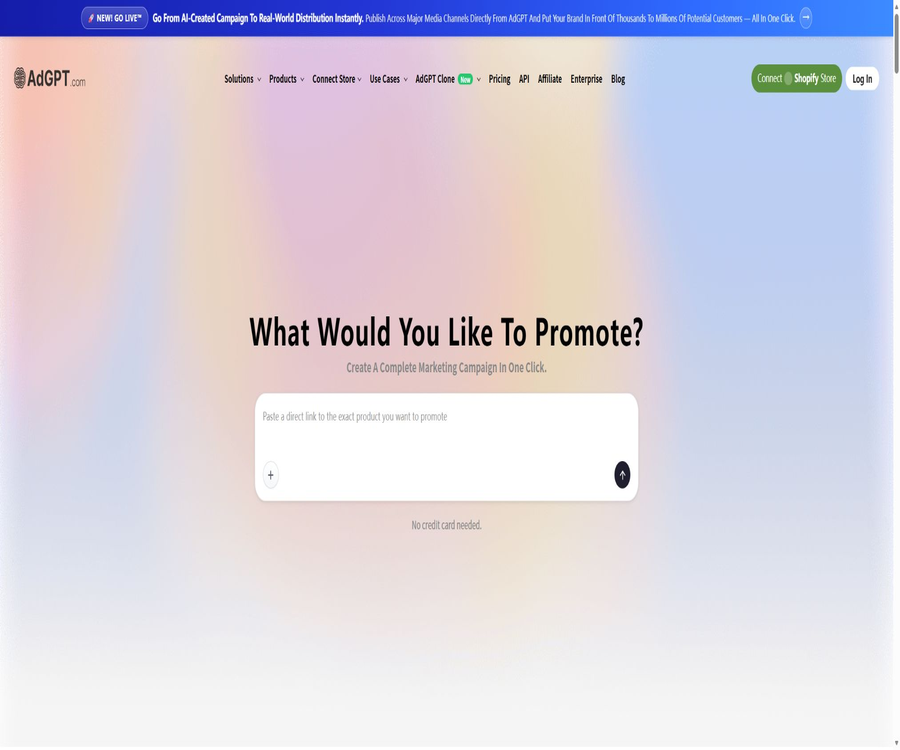
Create Ads with AI
Create Ads with AI – an intelligent tool focused on AI-driven design.
Tags:AI design toolsA one-sentence summary
AdGPT is an advertising creativity platform that generates ad copy, static images, product videos, and AI-generated UGC videos from product information; it also allows content to be published on platforms such as Meta, Google, and TikTok.
Tool Introduction
AdGPT is operated by the Israeli company AdGPT.com Ltd., and it serves e-commerce brands, small businesses, marketing teams, and agencies. Users can paste product links, connect to Shopify, or provide brand information; the AI then handles the creation of copy, visual elements, and adaptations for different sizes.
The platform emphasizes rapid production and the creation of multiple variants, but whether advertisements will lead to conversions still depends on the product, the target audience, the marketing strategies employed, the price, and market conditions. The speeds mentioned on the official website, as well as improvements in ROAS and costs, are part of the marketing claims; they cannot be considered guarantees that will be achieved in every account.
Main functions
Generate ads from product links
After the user pastes a product or store link, the system extracts the name, price, images, and key features, and then creates ads suitable for various platforms. Automatic extraction may miss variations, restrictions, and the latest prices, so these details must be checked before publishing.
Shopify catalog import
AdGPT can be connected to Shopify to import product data, thereby reducing the need for manual copying of each item. This connection allows the platform to access authorized data such as catalogs, store analytics, or orders; only the level of access necessary should be granted.
UGC video ads
The platform uses AI characters, scripts, voiceovers, lip sync, expressions, and video editing to create videos in the creator’s style. Basic and Pro support videos of 15 seconds and 30 seconds in length, while Prime and Premium also allow for videos of 60 seconds.
Product short videos
AdGPT can combine product images, features, subtitles, brand elements, music, and sound effects to create short videos. It is necessary to check whether the visuals accurately represent the product, ensuring that the AI does not create features that do not exist in reality.
Static image ads
The platform can create image ads that include titles, subtitles, product visuals, brand logos, and call-to-action messages; it is also possible to change the background. Errors often occur in the text, prices, and brand logos, so each ad needs to be checked individually.
Advertising copy
The system generates titles, main text, subtitles, and call-to-actions based on the product and platform. Users should specify the target audience, the brand’s tone of voice, prohibited words, and compliance requirements, in order to avoid using generic statements or making excessive promises.
Automatic size adjustment
The same creative can be adapted to various sizes, proportions, and ad slots, reducing the need for manual reorganization. Automatic cropping may cover up products, subtitles, or disclaimers; it is therefore necessary to check each final layout.
Publish directly
The package page lists the options available for posting on Meta, Google, and TikTok; there is no need to download content first before uploading it. Before connecting to the advertising account, it is necessary to set up approval processes, budgets, and appropriate permissions in order to prevent accidental postings or unnecessary spending.
Content Clone and AD Clone
Users can paste the link to an advertising video, analyze its scenario, hooks, pacing, message elements, and call to action, and then create new structural variations. Referencing highly successful ads does not mean that it is possible to copy materials protected by copyright, trademarks, or rights related to individuals.
Full Campaign
AdGPT offers a one-time package for a complete campaign at a cost of 79 dollars, which includes UGC content, product videos, static ads, Google keywords, and search ads. The page provides contradictory information regarding the exact number of elements that are included; therefore, a written confirmation from the billing statement should be obtained before making the payment.
Input and output
| Type | Typical content | System usage | Manual inspection |
|---|---|---|---|
| Commodity importation | Links, directories, images, prices, and selling points | Understand the product and create materials. | Facts, prices, inventory, and authorization |
| Brand input | Identifiers, colors, tone, and rules | Maintain consistency between the visuals and the text. | Trademarks, prohibited words, and brand guidelines |
| Audience input | Population, region, language, and pain points | Select scripts and expressions | Discrimination, sensitive targeting, and stereotypes |
| Video output | UGC and product short videos | Social and display ads | Lip movements, subtitles, and the authenticity of characters and products |
| Image output | Static ads and background variants | Multiple ad slot testing | Text, size, and product details |
| Copy writing | Title, body text, subtitles, and CTA | Develop a complete creative concept | Statements, evidence, and platform policies |
Supported channels
- Meta ads, including Facebook and Instagram.
- Google Ads and Google Search Ad materials.
- TikTok ads and the landscape vertical video format.
- Shopify product catalog and e-commerce advertising process.
- Analysis of ads from YouTube, Meta Ad Library, and TikTok links.
- Integrate image and video generation via APIs into other platforms.
Standard advertising production process
- Paste the product link or connect to Shopify to verify that the extracted product details are correct.
- Select the advertising platform, output type, aspect ratio, duration, and target language.
- Add audience, brand tone, key selling points, evidence, and prohibited expressions.
- Generate multiple versions of copy, images, or videos, and record the corresponding points consumed.
- Check each item: product facts, character permissions, subtitles, prices, and disclaimer.
- Approval is granted by the brand, legal, or compliance officer.
- Connect the advertising account and set the budget, location, target audience, and scheduling.
- After small-scale A/B testing, improvements are made based on actual data; deployment is not carried out solely based on AI scores.
UGC video production tutorial
- Choose a specific product problem, use case, and target audience.
- Provide verifiable advantages and limitations; there is no need for the AI to add unknown facts.
- Choose the AI character, language, accent, energy level, and duration ranging from 15 seconds to 60 seconds.
- After generating the script, review the text first, and then use points to create the complete video.
- Check the synchronization of characters, voices, lip movements, hands, product appearance, and subtitles.
- Add the AI identifier, advertising disclosures, and necessary disclaimers as required by the platform.
- Retain the approved version and the licensing records of the materials used before exporting or publishing.
Content Clone Usage Guide
- Paste the advertisement link that has permission to be analyzed and referenced.
- View a breakdown of the scene, hooks, rhythm, mood, and CTA.
- Extract the abstract structure, without copying the original author’s specific lines, characters, or protected visuals.
- Rewrite the direction using your product facts, brand tone, and original materials.
- Generate multiple variants and assess the risk of similarity to the original ad.
- Publish only after reviewing copyright, trademark, portrait, and platform policies.
Core subscription price
| Package | Annual payment conversion | Monthly price | Annual points card | UGC duration |
|---|---|---|---|---|
| Basic | $ | Confirmation on the settlement page | 6,000 | 15 seconds, 30 seconds |
| Pro | $ | $ | 27,000 | 15 seconds, 30 seconds |
| Prime | $ | $ | 72,000 | 15 seconds, 30 seconds, 60 seconds |
| Premium | $ | $ | 696,000 | 15 seconds, 30 seconds, 60 seconds |
| Enterprise | Customization | Customization | Customization | In accordance with the contract |
The page showing the annual pricing indicates that Basic costs $348 per year, Pro costs $1,188 per year, Prime costs $2,388 per year, and Premium costs $22,788 per year. The page claims that an annual payment can result in up to 33% savings; the actual amount due, including taxes, is determined on the settlement page.
How are points consumed?
| Generation type | Single integration | Theoretical amount: 6,000 points | Explanation |
|---|---|---|---|
| Video Ad | 300 | 20 | The specific duration and complexity can affect the range of availability. |
| UGC Video | 150 | 40 | The package still imposes restrictions on the length of videos that can be supported. |
| Image Ad | 70 | About 85 | When the remaining amount is insufficient, generation in decimal format is not possible. |
The theoretical amount is calculated based on the fixed points specified in the pricing FAQ only; it does not take into account attempts to retry after failure, additional variants, or future changes in pricing. It is necessary to check the actual deduction shown on the interface before generation.
There are inconsistencies in the numbers for the packages on the official website.
The Premium package card on the same price page states 696,000 annual points and 58,000 monthly points, but the FAQ indicates that Premium entitles to 162,000 annual points and 13,500 monthly points; these figures cannot both be true at the same time.
This will have a significant impact on the unit cost; before purchasing Premium, it is necessary to obtain written confirmation from sales or support regarding the contract limits. The figures shown are those from the current package, with conflict warnings still in place.
There are also conflicts in the rules for carrying over points.
The current pricing FAQ states that monthly subscription points are reset each month and are not carried over, while annual subscriptions grant points for the entire year which can be used within that same year. However, the terms of service specify that unused points during the validity period of a subscription can be carried over indefinitely across different periods.
The two rules are directly contradictory; users should not assume that the balance remaining after monthly payment will be retained. It is necessary to rely on the current settlement page and any written confirmation provided, and keep screenshots as proof.
Trial and refund
| Project | Official terms and conditions information | Precautions |
|---|---|---|
| Trial | $ | Automatic renewal of the selected plan after it ends. |
| Refund period | Within 3 days after the first purchase | Not applicable for subsequent renewals |
| Lose eligibility for a refund | The creative has been downloaded or shared on social media. | After trying it out or making a purchase, confirm that you are satisfied before downloading. |
| Cancel | Renewal will stop upon the end of the current cycle. | Refunds for completed cycles are generally not given on a proportional basis. |
Some marketing pages use phrases such as “Start for free, no credit card required,” while the official subscription terms state a 3-day trial at $1 with automatic renewal. The entry point may vary depending on the promotion or product, with the actual payment page taking precedence.
A conflict is indicated for a Full Campaign priced at 79 dollars.
At the top of the Full Campaign page it is stated that there are 3 UGC videos, 3 product videos, and 3 static ads, but the FAQ mentions 3 UGC videos, 20 product videos, and 18 static ads. There is a significant difference between these two figures.
Before making a payment, the user should verify what assets are included in the final order, as well as the duration, size, number of modifications allowed, and download rights; they should not make a purchase based solely on the page title.
APIs and developer capabilities
AdGPT provides public API documentation and OpenAPI specifications, which enable the integration of video and static ads, automatic size adjustment, and multilingual support into other products. The API is billed using the same credits as the account, and the amount consumed is displayed before generation.
| Ability | Public explanation | Key implementation points |
|---|---|---|
| Authentication | Configure through the developer account | Keys must not be placed in the frontend or public repositories. |
| Video generation | Support | Handling status and retrying on failure when using asynchronous tasks |
| Static ads | Support | Check the text, images, and output dimensions. |
| Multilingual | Over 50 kinds | Localization still requires review by a native speaker. |
| Automatic size | Supports multiple platforms | Check the cropping and disclaimer. |
| Billing | By account credits | Establish budgets, traffic limits, and alerts. |
| Enterprise API | Customizable | SLA, white labeling, and integration scope are specified in the contract. |
Enterprise capabilities
- Customized point allocation and bulk discounts.
- Dedicated account manager, priority support, and customized onboarding training.
- Custom API, integration, and white-label options.
- SLA guarantees and more comprehensive team governance.
- SSO, SAML, SCIM, role permissions, and audit logs.
- Dedicated infrastructure, private cloud, and on-premises deployment options.
- Ultimately, evidence must be obtained for verification regarding security, ISO, and SOC 2 compliance.
Data and Privacy
AdGPT handles accounts, payments, devices, usage patterns, location data, brand assets, images, videos, text, and the creation of creative content; it may also obtain authorized data from connected social, advertising, and e-commerce platforms.
The privacy policy states that personal data is not sold, and that the main storage locations are in Ireland; however, the data may be transferred to countries such as the United States and Israel. Users can request that their data be deleted, and this request is usually processed within 30 days, with backups being retained for no more than 90 days.
Data retention
| Data type | Public disclosure period | Management recommendations |
|---|---|---|
| Account data | During the account period and for up to 30 days after deletion | Delete the materials that are allowed to be retained before exporting. |
| Bill data | Up to 7 years | Subject to legal retention requirements |
| Identifiable analysis data | Up to 24 months | Adjust Cookie and analytics preferences |
| Marketing consent record | The consent period and 3 years after withdrawal | Retain cancellation records |
| Supports communication | Up to 3 years after resolution | Avoid including sensitive assets in work orders |
| Google user data | Usually up to 12 months. | Cancel connections that are no longer needed |
| Logs | Up to 12 months | More detailed specification of the scope of retention for corporate contracts |
Security and third-party connections
- The privacy policy states that TLS 1.2 or higher is used for transmission, and AES-256 is used for storage.
- Access management employs multi-factor authentication, the principle of least privilege, and audit logs.
- The platform makes use of services provided by AWS, as well as providers for payment processing, analysis, email, and support.
- Connecting to Meta, TikTok, Google, or Shopify expands data and operational permissions.
- Regularly revoke the permissions for unused advertising accounts, stores, and social media platforms.
- Enterprise promotes SOC 2 Type II and ISO 27001; when making purchases, it is necessary to verify the relevant certificates and the scope of the audits.
Commercial use and content rights
The pricing page states that all content generated under the various packages comes with full commercial usage rights, without the need for any additional licensing fees. However, these rights do not cover user-uploaded materials, third-party trademarks, music, characters, or those elements in the reference ads that are not covered by an authorization.
The service makes use of third-party generative AI tools, including OpenAI technology as mentioned in the terms. The publisher remains responsible for the accuracy of the advertisements, intellectual property rights, product claims, and platform policies.
Considerations for ad compliance
- Ads related to health, finance, law, employment, and politics require additional review.
- AI must not be used to make claims regarding efficacy, benefits, or performance that cannot be verified.
- AI characters cannot pretend to be real customers, experts, or unauthorized public figures.
- The prices, discounts, inventory levels, and time-limited offers must be consistent with those on the landing page.
- Advertising disclosure, consumer protection, and privacy rules vary from country to country.
- The direct publishing feature must retain manual approval and budget limits.
- Approval by an advertising platform does not equate to compliance with legal and brand requirements.
GitHub and the open-source status
AdGPT provides API documentation and machine-readable OpenAPI specifications, but no complete GitHub source code for the product or an open-source license confirmed on its official website could be found. The public availability of the API specifications only indicates the existence of interfaces; it does not mean that the entire platform is open source.
Core ad generation, models, editors, and hosting services are closed-source commercial products; the open-source status in the catalog should be marked as no.
Product advantages
- Generate copy, images, product videos, and UGC videos from product details simultaneously.
- It supports importing from Shopify as well as direct publishing on Meta, Google, and TikTok.
- The features of the packages are similar; the choice can mainly be based on the amount of creativity produced.
- Annual points are credited in a single payment, making it suitable for flexible planning according to the seasons.
- Content Clone can help break down ad structures and generate variations quickly.
- It offers public APIs, OpenAPI specifications, as well as customized enterprise integration solutions.
- The privacy policy outlines the main storage areas, retention periods, and deletion procedures.
Usage restrictions and precautions
- There are internal inconsistencies on the official website regarding Premium points, the number of Full Campaign assets, and point carryover.
- The marketing page and the terms state different things regarding the free access option and the 1-dollar trial.
- The trial version will be automatically renewed, and refunds are available only within three days of the initial purchase, with restrictions on downloads.
- AI may misrepresent products, subtitles, prices, characters, and brand logos.
- Copying the structure of advertisements can pose risks related to copyright, trademarks, and unfair competition.
- To have direct access to advertising accounts and budgets from the launch page, it is necessary to establish approval processes and permissions.
- The commercial rights to the generated content do not imply that the third-party materials have been authorized.
- The core platform is not open-source, and the use of its APIs still relies on AdGPT accounts and credits.
Which users are it suitable for
- E-commerce brands that need to quickly create a large number of image and short-video variations.
- Businesses that wish to create advertising materials directly from the Shopify catalog.
- Advertising agencies that manage multiple clients and need creative ideas in bulk.
- Teams that need AI-generated characters for UGC but find it inconvenient to arrange real-person filming.
- We hope to integrate ad generation into our own product platforms via APIs.
- A marketing team capable of handling approvals for branding, legal matters, and advertising campaigns.
It’s not very suitable for which situations
- Individuals with a very low budget who cannot afford subscriptions or the consumption of points.
- Businesses that hope the tool will ensure a certain ROAS or will automatically decide on which media channels to use for advertising.
- Teams that are unable to verify product claims, rights of individuals, and compliance with advertising regulations.
- Organizations that are fully open source and run entirely locally must be used.
- Purchasers who have strict requirements regarding contract amounts but are unwilling to resolve the discrepancies in the figures on their official website first.
Basic information
| field | Content |
|---|---|
| Tool name | AdGPT |
| Operating entity | AdGPT.com Ltd. |
| Place of registration | Tel Aviv, Israel |
| Tool type | Platform for generating AI-driven ad copy, images, and videos |
| Core channels | Meta, Google, TikTok, and Shopify |
| Public starting price | The basic annual plan amounts to $29 per month. |
| One-time Campaign | 79 dollars; the number of materials must be confirmed before purchase. |
| Trial | The clause states 1 dollar for 3 days, or 75 points. |
| Public API | Yes |
| OpenAPI specification | Yes |
| Official GitHub | No findings were detected. |
| Is it open source? | No |
Recommendation score
The recommendation score is 4.0 out of 5 points. AdGPT covers images, videos, UGC, copywriting, size adjustment, ad deployment, and APIs, making it suitable for scaling up creative efforts in e-commerce.
The main points deducted stem from Premium points, the number of campaigns, as well as discrepancies in the calculation methods for carried-over amounts and trial periods. For premium packages, a clear written order must be obtained before purchase; reliance solely on the information provided on the website forms is not sufficient.
Frequently Asked Questions
What is the minimum price for AdGPT?
The annual price for Basic is $348, which equals $29 per month. The monthly price will be as indicated on the settlement page after the billing cycle is changed.
How many points are consumed per type of ad?
The pricing FAQ states that Video Ads cost 300 points, UGC Videos cost 150 points, and Image Ads cost 70 points. It is necessary to check the prompts on the interface before creating the ads.
Are monthly points carried over?
The pricing page states that the monthly points are reset at the end of each month and are not carried over, but the terms specify that they can be accumulated across different periods, which creates a conflict. It is necessary to obtain written confirmation from the official party before making a purchase.
Which platforms are supported?
It supports advertising platforms such as Meta, Google, and TikTok, and can also be connected to Shopify. Specific account, region, and ad type restrictions are subject to those available after logging in.
Can UGC videos be created?
Yes, it includes AI characters, scripts, voiceovers, lip synchronization, and editing. The Basic and Pro versions allow for videos up to 30 seconds long, while the Prime and Premium versions support videos of up to 60 seconds.
Can the generated content be used for commercial purposes?
The package page grants commercial rights to use the generated content, but users still need to have the right to upload their own materials and third-party elements, as well as to comply with advertising regulations.
Are APIs provided?
Public API documentation and OpenAPI specifications are provided, with billing based on account credits. Enterprises can request customized APIs, SLAs, and white-labeling services.
Will a trial period result in automatic charges?
The official terms state that a $1 trial period lasts for three days, and automatic renewal occurs once 75 points have been used; if one does not wish to continue, cancellation must be done before the end of the trial period.
What are the conditions for a refund?
The request can be made within three days of the first purchase, but it is not applicable after the file is downloaded or shared on social media platforms, nor is it applicable for renewals.
Is AdGPT open source?
It is not open source. The disclosure of API specifications does not mean that the source code of the advertising generation platform or models is made available.
Summary
AdGPT converts product links and brand information into advertising copy, static images, short videos, and AI-generated user-created content, and it offers tools for importing data into Shopify, publishing content across multiple platforms, conducting advertising analysis, as well as API access.
Before official use, it is necessary to resolve issues related to points, carryovers, trials, and the quantity of available materials; thereafter, processes for product details, intellectual property rights, advertising compliance, and budget approval should be established.
Tools similar to Create Ads with AI



 Guigong Network Security Registration No. 45132202000164