






Chunky
Chunky, an intelligent tool focused on AI-driven design.
Tags:AI design toolsWhat is Chunky?
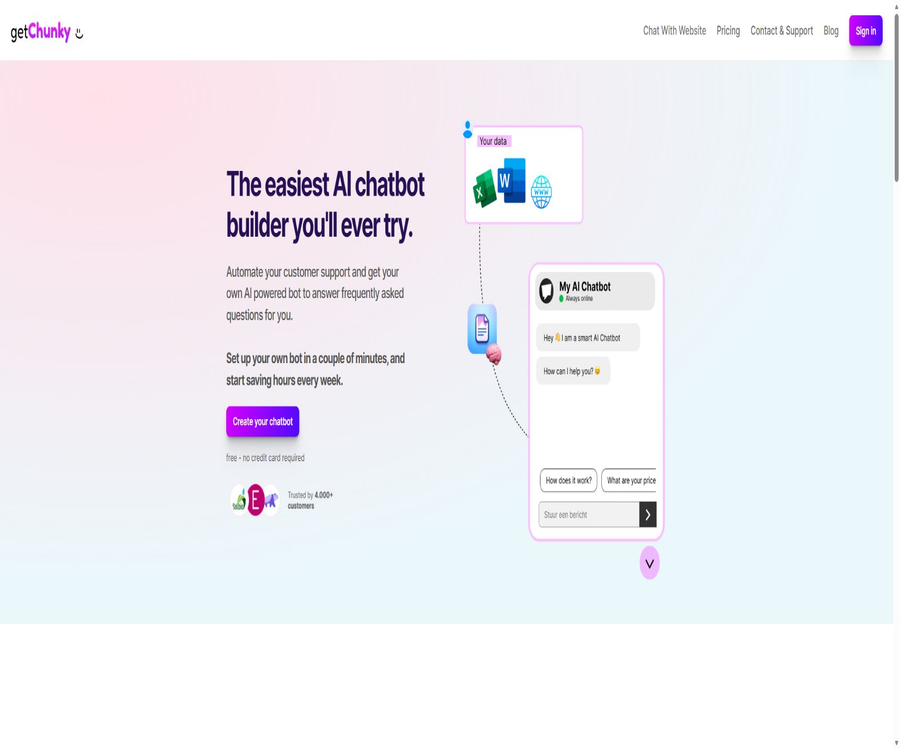
Chunky is a code-free platform for creating AI chatbots, used primarily for website customer service, answering common questions, and handling internal knowledge queries. Users can upload PDF files, provide website addresses, or connect to Google Sheets so that the bot can answer questions based on those materials.
The product is operated by Purple Panda BV, and it uses the ChatGPT API and Embeddings provided by OpenAI. It is more suitable for small and medium-sized websites that seek rapid deployment and simple maintenance, rather than for enterprises that require complex ticketing and call center processes.
A one-sentence summary
Chunky converts corporate websites, PDFs, and table content into conversational knowledge robots, which can be published on websites via public links or a single line of embedding code; it supports around 95 languages as well as basic customization of the appearance.
Main functions
1. Automatic training of website content
When creating a robot, you can provide a website address; Chunky will extract the text from that webpage and create searchable knowledge. It is suitable for converting product descriptions, service details, and frequently asked questions into automated Q&A systems.
- Readable content extracted from public web pages is used as training material.
- Different packages impose limits on the number of training website addresses allowed.
- There is no clear public indication as to whether data is automatically re-pulled after the website is updated.
- After logging in, the page content, script-rendered content, and restricted documents may not be available in their entirety.
2. Training with PDF files
Users can upload PDF files, allowing the robot to provide answers based on manuals, policies, courses, or product information. The free version permits up to 5 uploads of PDF files for training purposes, while the paid plans offer unlimited such uploads.
3. Knowledge sources for Google Sheets
Chunky allows connection to Google Sheets, enabling the use of structured questions, answers, or business data in robot responses. Table permissions, field quality, and update synchronization methods need to be verified using a real account.
4. Website chat component
Robots can be integrated into websites as chat components using just a single line of code, allowing visitors to ask questions without leaving the page. The paid plans permit integration on an unlimited number of websites, while the number of sites that can be integrated under the free plan is not clearly specified in the price list.
5. Share the link publicly
Each robot can be shared through a public link, which facilitates testing by the team before it goes live officially; it can also be used as a standalone Q&A page. The public link can be accessed by anyone who has the address, and it should not contain sensitive internal information.
6. Appearance and brand settings
Users can modify the name, icon, and color of the chat window to make it more in line with the website’s brand. The current pricing page includes custom appearances among both free and paid packages, but it does not specify whether it is possible to remove the Chunky brand.
7. Multilingual Q&A
Chunky claims to support nearly 95 languages, and both training data and responses are available in these languages. The presence of multiple languages does not mean that the quality of terminology and content in all of them is the same; each language should be tested individually before it is made available officially.
8. Customization of robot behavior
Users can adjust the robot’s role and way of responding, configuring it as a customer service agent, an internal assistant, a tool for screening leads, or a robot for preliminary candidate evaluation. The public version does not show full capabilities for prompt control, tool invocation, or workflow orchestration.
9. Messages and Analysis Panel
All public packages include an Analytics Dashboard that allows one to understand how the robots are being used. The page does not specify the dimensions of the metrics, the duration of sessions, the export formats, or the fields related to visitor identity; therefore, it should not be assumed that comprehensive customer service analysis is available.
How do robots work?
- Users can upload PDFs, submit website addresses, or connect to Google Sheets.
- Chunky extracts data and creates retrievable representations through Embeddings.
- Visitors enter natural language questions in the chat window.
- The system retrieves content related to the question from the training data.
- The ChatGPT API generates responses based on the search results and the instructions given by the robot.
- Sessions and usage data are displayed in the analysis panel for administrators to review.
Usage tutorial
Create the first website customer service robot
- Register for a Chunky account and create a new chatbot.
- First, add a set of organized product pages or PDFs with common questions.
- Set the robot’s name, icon, color, role, and response boundaries.
- Test the answers using real user questions and add explanations that are missing in the material.
- Use a public link for the team to review it, then copy the component code to the testing website.
- Go live after confirming that the desktop version, mobile version, privacy prompts, and page loading all function properly.
- Regularly review the conversations and analyses to address questions that are often left unanswered.
Organize training materials
- Remove expired prices, duplicate pages, and conflicting policies.
- Ensure that each web page or PDF organizes its content around a clear theme.
- Use clear titles, questions, and answers, and avoid relying solely on images or complex tables.
- Write down the business hours, refund policies, after-sales service, and contact information as sentences that can be quoted directly.
- Test the search results using different languages and different phrasings.
- After the data is updated, retrain or verify whether synchronization has taken effect.
Which users are it suitable for
- Small business website: Automatically answers questions regarding hours of operation, products, and services.
- SaaS team: Uses product documentation to handle basic pre-sales and usage inquiries.
- E-commerce website: Explains the features of the products, shipping options, return and exchange procedures, as well as the purchasing process.
- Education team: Create Q&A sections based on course materials and learning documents.
- Internal operations team: Turns processes, policies, and forms into internal assistants.
- Recruitment team: Answers candidates’ common questions based on the job requirements and company information.
Typical use cases
- Transform the website’s existing frequently asked questions into a chat interface available 24/7.
- Enable visitors to quickly find specifications and operating procedures in the product manual.
- Use Google Sheets to maintain a set of structured Q&A pairs.
- Internal validation is carried out through a public link prior to official integration.
- Provides basic support and information retrieval for multilingual websites.
- Collect duplicate questions to help the team identify gaps in the documentation.
Product advantages
- Creating a path is simple; training can begin using PDFs, websites, and Google Sheets.
- A permanent free plan is available; no credit card is required for testing.
- Public links and website components cover testing and official release.
- It supports about 95 languages, making it suitable for multi-language basic Q&A.
- The name, icon, and color can be matched to the website’s brand.
- The paid plan offers a lower price and provides access to an unlimited amount of training materials.
- All packages include an analysis panel.
Usage restrictions and precautions
- The free version allows only 100 messages per month, which is not suitable for websites with a steady volume of traffic.
- Although Growth has a higher price, the current table lists only 2 robots, which is fewer than the 3 offered by Hacker; it is necessary to check whether this is due to an error on the page before making a purchase.
- The official website does not disclose the size of individual PDF files, the number of pages, the total number of characters, or any limits regarding table parsing.
- There is no clear indication regarding automatic website updates, the frequency of re-crawling, or Sitemap support.
- No public information regarding citation sources, manual transfers, tickets, team roles, or advanced permissions was found.
- The deactivation that occurs when the message volume exceeds the limit, as well as the additional pricing options, are not specified in the main price table.
- Robots may provide incorrect or inaccurate responses; high-risk information must be reviewed manually.
- About 95 languages are listed as being covered, but this does not mean that all of them have the same quality.
- Public links cannot be used to share sensitive information intended only for internal access.
- The Privacy Policy was last updated in March 2023, and the descriptions of certain mobile applications and types of data are rather vague.
- No separate terms of service, refund policy, or clear instructions for canceling the subscription were found.
Prices and packages
The prices listed below were verified on August 21, 2026; the currency is the US dollar, and all figures are presented on a monthly basis. The main price page does not show annual payment discounts, additional charges for messages, or higher unit prices for larger quantities.
| Package | Monthly fee | Robot | Messages/month | Training materials and embedding | Suitable for users |
|---|---|---|---|---|---|
| Free forever | $ | 2 | 100 items | 5 PDF files, 15 website addresses; the scope of embedding is not specified. | Experiences and low-traffic personal websites |
| Hacker | 9 dollars | 3 | 1,000 pieces | There are no restrictions on PDFs or website addresses; they can be embedded on any website. | Small websites and multiple robot tests |
| Growth | 19 dollars | 2 | 2,500 items | There are no restrictions on PDFs or website addresses; they can be embedded on any website. | Teams with a high volume of messages but a small number of robots |
| Enterprise | Contact sales | Customization | Customization | More capacity and corporate requirements require discussion. | Organizations that go beyond the public packages |
Common benefits across all packages
| Ability | Free | Hacker | Growth |
|---|---|---|---|
| Analysis panel | Support | Support | Support |
| Customize chat appearance | Support | Support | Support |
| Individual onboarding support | Listed on the page | Not listed separately | Not listed separately |
| Unlimited website embedding | Not specified | Support | Support |
| There are no limits on training PDFs. | No | Support | Support |
| There are no restrictions on the address of the training website. | No | Support | Support |
Hacker has a larger number of robots than Growth; this figure is displayed directly on the price page and is not determined based on price. Users who intend to purchase Growth should first get confirmation from the official team regarding the actual number of robots available and the rules governing them after the upgrade.
Supported platforms and connection methods
| Platform or method | Support status | Explanation |
|---|---|---|
| Web management backend | Support | Create, train, customize, and view analyses |
| Public chat link | Support | For testing or independent sharing |
| Website chat component | Support | Embed using one line of code |
| Support | The free version provides 5 items, while the paid version offers an unlimited number of items. | |
| Website content | Support | The free version provides 15 addresses, while the paid version offers an unlimited number of addresses. |
| Google Sheets | Support | As a channel for structured training |
| Native iOS and Android apps | No findings were detected. | The privacy policy mentions mobile apps, but no entry to the official store can be found. |
| Native Slack integration | Not confirmed | It is not listed on the current official website. |
| Public APIs and SDKs | No findings were detected. | Website embedding code is not the same as business APIs. |
Privacy and data security
Chunky’s privacy policy designates Purple Panda BV as the party responsible for fulfilling the obligations under the agreement, and specifies that it can act as either the GDPR data controller or processor in different situations. When submitting end-user data, the company still remains responsible as the data controller.
The potential categories of data listed in the policy include accounts, contacts, payment information, location data, device permissions, information about other people, as well as materials submitted by the users themselves. Whether a chatbot actually collects each of these categories depends on the functions it uses, but the scope outlined in this policy is quite broad.
- Automatically collected information can include IP address, device, browser, location, pages visited, and usage time.
- Data can be used for accounts, services, support, marketing, analysis, security, and targeted advertising.
- Payments are processed by third-party payment processors, which apply their own privacy policies.
- Service providers may access data within the scope of providing necessary services.
- Users can request access to, correction of, restriction on, export of, or deletion of their personal information.
- After deletion, some copies may remain due to legal requirements, obligations toward partners, or dispute resolution.
- The policy is not applicable to children under 18 years old.
Security recommendations for training data and chat data
Chunky makes use of OpenAI’s ChatGPT API and Embeddings; therefore, the text required to generate responses may need to be processed by external model services. The privacy page does not clearly outline the fields that are transmitted, the regions involved, the retention rules, or the settings used for model training, and companies should obtain information regarding data processing.
- First, remove passwords, keys, identification documents, and other sensitive customer information from the document.
- Do not publish internal policies, employee information, or unreleased product details using public links.
- Next to the website components, inform visitors that the conversations are handled by AI.
- Specify the retention period for chat records, the methods of deletion, and the users who have access to them.
- For regulated activities, a data processing agreement must be signed first, and the sub-processor must be identified.
API, GitHub, and open-source status
The main ways to access Chunky at present are through website chat components and public links; no business APIs, official SDKs, or webhook documentation have been found. The embed code that can be copied is only used to load the component, and it cannot be regarded as an interface for an open platform.
No official GitHub repository or open-source license that corresponds to the reliability of getchunky.io’s commercial product was found. The projects with similar names that were searched for, such as those related to Minecraft, rendering, and text chunking, are not related to this product; therefore, Chunky should be classified as a non-open-source project.
Basic information
| field | Content |
|---|---|
| Tool name | Chunky |
| Operating entity | Purple Panda BV |
| Tool type | Code-free AI customer service and knowledge base chatbots |
| Training channels | PDF, websites, and Google Sheets |
| Underlying technologies | OpenAI ChatGPT API and Embeddings |
| Language support | About 95 languages |
| Price pattern | Permanent free version, monthly subscription, and enterprise quote request |
| Minimum payment amount | Hacker costs $9 per month. |
| Is registration required? | Creating and managing robots requires |
| Main deployment | Public links and website components |
| Public API | No findings were detected. |
| Official SDK | No findings were detected. |
| Is it open source? | No |
Recommendation score
The recommendation score is 3.9 out of 5. The advantages of Chunky are its simplicity for beginners, low cost, clear free usage limits, and the ability to quickly create multilingual Q&A robots using websites, PDFs, and Google Sheets.
The main shortcomings are the limited number of public features and security documents; there is a lack of clear API specifications, manual handling procedures, automatic data updates, and guidelines for session management. It is suitable for basic question-answering tasks with low risk, but it is not appropriate for handling sensitive customer data without additional verification.
Frequently Asked Questions
Is Chunky free?
There is a permanent free plan that includes 2 robots, 100 messages per month, 5 training PDFs, and 15 URLs to training websites. No credit card is required for the free trial.
How much is the minimum pricing plan for Chunky?
Hacker costs $9 per month; it includes 3 robots, 1,000 messages per month, unlimited access to training PDFs and website addresses, and the possibility of embedding it on an unlimited number of websites.
Why are there fewer robots of type Growth than hackers?
On the current pricing page, Growth is listed as including 2 robots, while Hacker is shown as including 3; this could be due to the design of the packages or an error on the page. It is advisable to get confirmation from the official team before making an upgrade.
What types of files can be uploaded?
The official website explicitly supports PDF, website addresses, and Google Sheets. There is no official confirmation regarding Word, TXT, CSV, or other formats; therefore, one should not assume that they are supported.
Can it be embedded in WordPress?
It is usually possible, as long as the theme or plugin allows the addition of custom embedding code. Before going live, it is necessary to check the cache, content security policies, mobile layout, and cookie notifications.
Does Chunky support Chinese?
The platform claims to support nearly 95 languages, and Chinese training materials and responses are included in this scope. However, specialized terms, long texts, and mixed-language content still require testing using actual questions.
Does Chunky provide an API?
No verifiable public API, SDK, or Webhook documentation was found. The currently confirmed methods of distribution are public links and website components.
Is Chunky open source?
It is not open source; no official source code repository or open source license has been found. GitHub projects with the same name have no credible connection to this commercial chatbot.
Do chatbots cite their sources?
The current official website does not specify whether the answers will show the original paragraph or the source citation. Teams that require traceable answers should conduct actual tests before making a purchase.
Can it be used for an internal knowledge base?
Robots can be configured as internal assistants, but the access controls for sharing links publicly are not detailed. For sensitive internal information, it is necessary to first verify authentication, permissions, and data processing protocols.
What happens when the messages are used up?
The main pricing page does not specify the rules regarding suspension in case of excess usage, additional purchases on a pay-as-you-go basis, or automatic upgrades. It is necessary to verify these details with the authorities before going live, in order to avoid the robots becoming unavailable during peak traffic periods.
Summary
Chunky offers a very straightforward code-free approach to creating robots; everything from importing data and customizing the appearance to conducting tests and embedding the robots on websites is easy to understand. The free version, along with the Hacker plan costing $9 per month, are suitable for small-scale testing.
Before being put into use for customer service, it is essential to verify data updates, the basis for responses, message volume limits, session retention, and the possibility of human intervention. In scenarios involving sensitive privacy information, data processing agreements and details regarding external models are also required.
Tools similar to Chunky



 Guigong Network Security Registration No. 45132202000164