






Brainfish
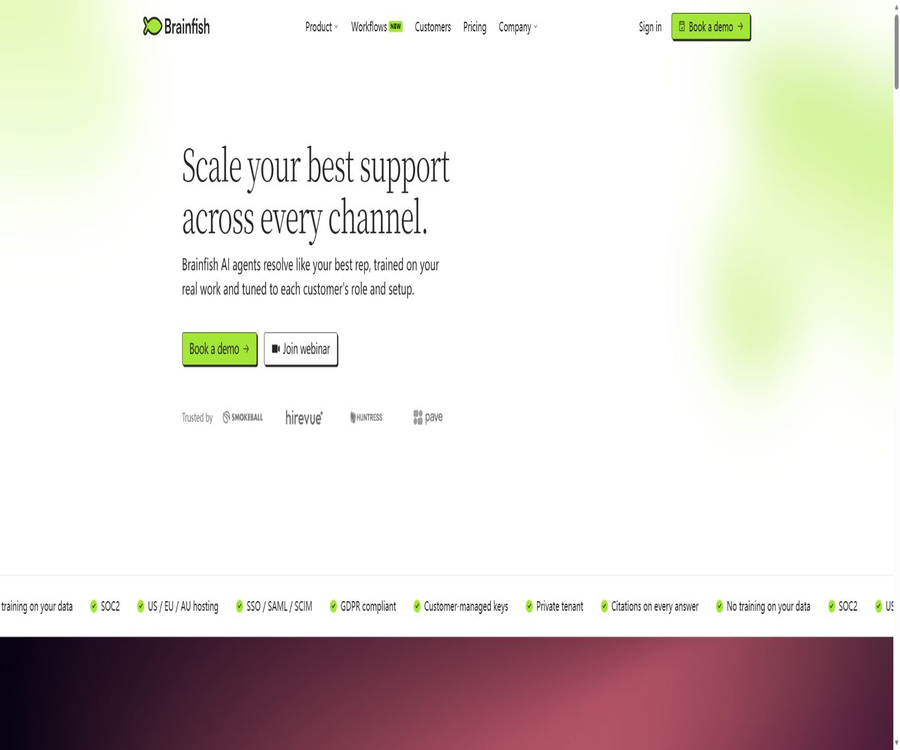
Brainfish, an intelligent tool focused on AI-driven design.
Tags:AI design toolsA one-sentence summary
Brainfish is an AI-powered customer service and knowledge platform designed for B2B products and support teams; it enables the organization of scattered documents, tickets, calls, and collaboration materials into a continuously updated knowledge base, providing traceable answers and automated actions on web pages, within products, in help centers, and on work platforms.
Tool Introduction
Operated by the Australian company Brainfish Pty Ltd, Brainfish aims not merely to add another chat window, but rather to enable customer service teams, product specialists, success managers, and users to share the same structured set of product knowledge. The platform synchronizes content from existing sources, and then AI-driven agents use this information to provide responses tailored to the channel and the user’s context.
The product is currently available for corporate purchases; the basic Platform includes team seats, a certain number of sessions per month, and a dedicated account manager. AI Actions, system integration, localization, and additional usage options are available as extra services that can be added to the order. No fixed price is listed on the official website – it is necessary to contact sales to obtain quotes for the Startup, Standard Platform, or Enterprise versions.
Main functions
AI supports agents.
The Brainfish agent can be deployed on websites, in-in-product chats, help centers, and development documentation, etc., to use the company’s own knowledge to answer users’ questions. Administrators can set the tone, the scope of responses, escalation rules, and available skills, without having to redeploy code each time changes are made.
AI-native knowledge base
The platform offers a page tree, an editor, as well as tools for organizing content; it enables the management of knowledge by product, theme, or target audience. Any updates are immediately reflected in the connected agents, thus reducing the need to maintain the same information in multiple channels separately.
External knowledge synchronization
Brainfish can synchronize knowledge from the help center, Notion, Google Drive, Confluence, OneDrive, SharePoint, development documentation, websites, tickets, and call records. The connections remain up to date, eliminating the need for manual copying and pasting to create static copies.
Knowledge Discoveries
The system identifies gaps, outdated content, and topics that need to be added by analyzing customer questions, conversations, and existing materials, and it can generate new pages or provide suggestions for updates. The content team should still assign responsible persons to verify the facts, determine the applicability, and set the publication date.
Internal knowledge Copilot
Employees can use natural language to query the entire knowledge base, thereby obtaining real-time guidance, editing suggestions, or draft pages. It is useful for support, product, and customer success teams to quickly find consistent answers, though permissions should be determined based on the relevant documents and job responsibilities.
Proactive prompts and notifications
In addition to providing passive responses, Brainfish can also display suggestions proactively, based on the page the user is on, their behavior, or the context in which they find themselves. It is necessary to control the frequency of these proactive messages as well as the audience to whom they are sent, in order to avoid causing interference or revealing information to the wrong people.
AI Actions and workflows
AI Actions enables agents to carry out tasks through APIs, tool calls, MCP, or callbacks, such as querying orders, collecting data, triggering processes, and interacting with business systems. Operational agents should employ the principle of least privilege, include confirmation steps, ensure idempotency, and maintain audit logs.
Transfer to live customer service
Zendesk Live Agent Handoff is now officially available; it allows all of the AI-driven conversations, the information collected, and the reasons for the handoff to be passed on to a human agent within the same chat window. The equivalent handoff capabilities in Intercom, Freshdesk, and Salesforce are still in the planning stage, so it cannot be assumed that they are all fully operational.
Customer and content analysis
The analysis panel tracks channel sessions, resolution rates, cases transferred to human agents, coverage of available knowledge, page creation and updates, as well as any gaps in topics and content. The team can identify the next set of tasks for optimizing the knowledge base based on issues with low confidence levels and recurring problems.
Working principle
- Connects to the help center, documentation, ticketing system, collaboration platform, website, and other authorized knowledge materials.
- Brainfish synchronizes and structures content, preserving the topic, audience, region, permissions, and channel relationships.
- Administrators organize pages in the knowledge editor and review update suggestions that are automatically detected or generated by AI.
- Configure agent tone, scope, skills, identity, refusal rules, and manual escalation rules for different channels.
- Users can ask questions via the website, products, help center, Slack, Teams, or customer service channels.
- Intelligent health checkers retrieve relevant information and generate answers backed by evidence, invoking controlled business operations when necessary.
- When a reliable solution cannot be found, pass the context to a human agent and continue to record the results and feedback.
- By analyzing gaps, failures, and the impact on content, the team continuously updates the same knowledge layer.
Getting started with deployment
- Schedule a demonstration and specify the product, users, language, existing customer service stack, monthly number of sessions, and compliance requirements.
- Select a high-frequency, low-risk scenario as a pilot and define the criteria for automatic resolution, rejection of requests, and referral to human agents.
- Review the knowledge materials, remove outdated and duplicate ones, and assign owners and expiration dates to the content.
- Connect to the testing channel in read-only mode with minimal permissions to verify the synchronization objects and permission inheritance.
- Configure the agent’s identity, tone, channels, channel references, business rules, and boundaries for sensitive topics.
- Use masked samples of real-world problems to test accuracy, channels, permissions, languages, and prompt injection.
- Release the agent to internal users or a small number of visitors first, in order to observe levels of low confidence and instances of redirection.
- After passing the acceptance, expand the channels and establish knowledge review, credential rotation, and monthly quality reviews.
Knowledge base development process
- List channels such as the help center, product documentation, internal Wiki, phone calls, tickets, Slack, and CRM.
- Distinguish between public, customer-exclusive, internal, and sensitive content; it is prohibited to place all materials in the same permission category.
- Add product, version, region, customer tier, language, release date, and responsible person to the page.
- Handle duplicates, conflicts, and historical versions to identify the authoritative source for each topic.
- After synchronization, perform a sample check to verify that the title, body, attachments, permissions, and deletion settings are transmitted correctly.
- Review the suggestions generated by Knowledge Discoveries; the AI should not be allowed to override already approved policies automatically.
- Standard test questions are created, and after the knowledge is updated, the responses, channels, and manual transfers are re-verified.
Which users are it suitable for
- B2B SaaS companies: Convert product documentation, tickets, and user context into self-service support within the product.
- Customer support team: Reduces repetitive questions and transfers complex conversations, along with their full context, to human agents.
- Product team: Understand functional friction and adoption barriers by examining problem topics and knowledge gaps.
- Customer Success Team: Provides consistent and traceable product guidance for customers at different levels.
- Technical documentation team: Develop documentation in a synchronized manner to create a closed loop between developer queries and content maintenance.
- Content operators: Create, update, and review knowledge in a unified manner using the AI-based editor.
- Enterprise IT and security teams: They need SSO, regional hosting, tenant isolation, and compliance materials.
- Development team: Connect business processes via AI Actions, MCP, REST, or Webhooks.
Typical use cases
- In-product help: Answers operational questions based on the page the user is on, and provides helpful suggestions proactively.
- Help Center Q&A: Provides answers generated from multiple knowledge sources along with citations, rather than just returning a list of articles.
- Zendesk to human agent: When AI cannot resolve the issue, the conversation, reasons, and collected information are passed on to a live agent.
- Developer support: Interface details and usage are explained with the help of documents such as ReadMe, Mintlify, and OpenAPI.
- Order and account inquiries: Authorized information is retrieved from e-commerce or CRM systems via AI Actions.
- Internal Q&A in Slack and Teams: Provides answers based on verified information within team channels.
- Identification of knowledge gaps: Determining the topics of new documents based on repeated questions, low confidence levels, and transfer records.
- Multi-region support: Supports different languages, regional content, and regional hosting services for various markets.
Product advantages
- Bring knowledge management, AI-powered responses, channel deployment, business operations, and analysis together on a single platform.
- Each response can be traced back to a specific source, which facilitates the support team in verifying and locating incorrect information.
- External materials are continuously synchronized, reducing the need to copy documents and maintain multiple versions of the knowledge.
- Knowledge Discoveries transforms customer questions into actionable suggestions for content updates.
- Agents can answer questions, provide suggestions proactively, execute actions, and transfer tasks to humans when necessary.
- The Zendesk integration covers knowledge synchronization, conversations, tickets, and manual handoff within the same window.
- The platform offers MCP and custom integration options, making it suitable for connecting with existing AI and business tools.
- The official website lists SOC 2 Type II, ISO 27001, SSO, private tenants, and regional data residency.
Usage restrictions and precautions
- Brainfish does not disclose a fixed amount; annual commitments, additional purchases, and implementation costs require a sales quote.
- The basic plan offers only 5 seats and 5,000 sessions per month; products with high traffic levels require an upgrade purchase.
- The official website defines the query quota as a session; multiple consecutive rounds of conversation are not billed individually, but the timing starts over after 30 minutes of inactivity.
- AI may still refer to outdated, conflicting, or incorrectly authorized information; channel displays cannot replace factual verification.
- AI Actions read from or modify real business systems, and incorrect permissions and parameters can have actual consequences.
- Zendesk’s in-window transfer feature is now available, but similar functions for other help desks are still part of the roadmap.
- Real-time translation, which supports over 100 languages, is an additional feature under Localization; the quality of translation may vary depending on the language.
- The terms on the official website state clearly that the service is not designed in accordance with specific regulations such as HIPAA, FISMA, or GLBA.
- The privacy policy states that the production infrastructure is primarily located in the United States, and any requirements regarding regional hosting must be specified in the contract.
- The terms do not exactly match the information provided on the current privacy page regarding the hosting location; companies should determine the actual location of the project.
- All purchases are generally non-refundable under the terms; cancellations take effect after the current contract period ends.
- Opening MCP or business interfaces increases the attack surface, so it is necessary to guard against prompt injection, privilege escalation, and the exposure of sensitive data.
Prices and packages
The following shows the structure of the pricing options as displayed on Brainfish’s price page as of August 20, 2026. The official website does not indicate prices in dollars or Australian dollars; for the Standard, Startup, and Enterprise versions, it is necessary to contact sales to obtain the final quote.
| Plan | Public price | Basic quota or positioning | Main content | Suitable for teams |
|---|---|---|---|---|
| Platform | Contact sales | 5 seats, 5,000 user sessions per month | AI supports agents, knowledge discovery, an internal Copilot, proactive suggestions, analysis, and dedicated account managers. | From small and medium-sized enterprises to corporate teams |
| For Startups | Request a quote | Lower annual commitment | Designed for streamlined teams, with the ability to scale as needed. | Early-stage and growing companies |
| For Enterprise | Custom quote | Custom range | MSA, SSO, localized hosting, and more flexible control | Large organizations or those with high compliance requirements |
A user session can consist of a single question or multiple rounds of conversation; a new session is initiated if there is no activity for 30 consecutive minutes. The pricing page defines the base amount of 5,000 Queries as 5,000 user sessions per month, so it is necessary to use the actual number of sessions rather than the number of individual messages when making estimates.
The terms state that all purchases are non-refundable; subscriptions can be canceled by contacting the authorities, and such cancellation takes effect at the end of the current contract period. The purchaser must specify in the order the details regarding annual commitments, renewal, handling of excess usage, downgrades, data export, and conditions for early termination.
Basic platform and additional options
| module | Basic Platform | Billing or configuration method | Primary uses |
|---|---|---|---|
| AI Support Agents | Includes | Provided with the platform | Answering support questions through various channels |
| Knowledge Discoveries | Includes | Provided with the platform | Identify and update knowledge gaps |
| Internal Copilots | Includes | Provided with the platform | Internal queries and content guidance |
| Proactive Nudges | Includes | Provided with the platform | Notifications and proactive prompts within the product |
| Customer Analytics | Includes | Provided with the platform | View queries, resolve issues, and check content performance |
| AI Actions | Add to cart | Every 5 Actions constitute one purchase unit. | API, tool calls, MCP, and callbacks |
| Integrations | Add to cart | Quotation based on connection and scope | Help desk, CRM, knowledge base, SSO, and data warehouse |
| Localization | Add to cart | Quotation based on language and hosting requirements | Over 100 languages, regional content, and regional platforms |
| Seat upgrade | Add to cart | Additional administrator or editor seats | Expand the management team |
| Query upgrade | Add to cart | Increases by 1 per 1,000 sessions | Increase the number of monthly user sessions |
Channel and platform support
| Channels | Support status | Uses | Precautions |
|---|---|---|---|
| Chat within the website and products | Support | Instant Q&A, operations, and manual transfer | It is necessary to configure identity, cookies, and context. |
| Help Center | Support | With self-service answering and content discovery based on evidence | Can operate in parallel with the existing help center |
| Dev Docs | Support | Developer Q&A and API knowledge | The code and versions need to be kept in sync at all times. |
| Slack | Support | Knowledge quizzes and content improvement within the channel | Permissions should accompany the knowledge materials. |
| Microsoft Teams | Support | Internal corporate Q&A | Tenants, channels, and identities need to be configured. |
| Zendesk | Deep support | Knowledge, tickets, chats, and manual handoff within the same window | Requirements such as Sunshine Conversations need to be confirmed. |
| Intercom | Supports connection | Messenger, routing, and knowledge | Some equivalent manual transfers are still on the roadmap. |
| Salesforce | Enterprise | Knowledge, CRM context, and multi-channel services | Permissions and data scope need to be confirmed. |
| Mobile apps | It can be embedded in products. | Supported within mobile apps | No standalone Brainfish application for consumers was found. |
Integration capability
| Integrated categories | Public examples | Main function | Key points for verification |
|---|---|---|---|
| Knowledge and documents | Confluence, Notion, Drive, OneDrive, SharePoint, ReadMe, Mintlify | Synchronize authoritative information | Objects, attachments, versions, and permissions |
| Help desk and customer service | Zendesk, Intercom, Freshworks, Help Scout | Knowledge, conversations, tickets, and manual escalation | Different platforms have varying capabilities for going live. |
| CRM and marketing | Salesforce, HubSpot | User and account context | The minimum field size is agreed upon with the customer. |
| E-commerce | Shopify, BigCommerce, Magento | Orders, products, and account actions | Identity verification and write control |
| Collaboration | Slack, Microsoft Teams | Internal knowledge Copilot | Channel permissions and message retention |
| Developer information | OpenAPI Spec, website, development documentation | Q&A on interface knowledge and technologies | Standardized versions and sensitive endpoints |
| Customize | REST, Webhook, and API connections | Connecting to business systems that are not listed | Authentication, signing, idempotency, and error handling |
| MCP | Claude connection | Search, draft, review, and update knowledge in the AI assistant. | Audit of permissions and tool calls |
Zendesk manual transfer
Brainfish’s Live Agent Handoff feature in conjunction with Zendesk will be available starting in May 2026; users will be able to transfer conversations from the Brainfish chat window to Zendesk agents. The system will transmit the entire conversation history, AI-generated responses, any information that has been collected, and the reason for the transfer, thereby avoiding the need to repeat information.
Routing can be triggered based on the user’s request, intent, or confidence level, and it is configured through Sunshine Conversations. Other Zendesk channels can continue to use AI within threads or create tickets according to predefined rules; however, the actual scope of deployment depends on the Zendesk products and the terms of the contract with Brainfish.
APIs, MCP, and developer capabilities
Brainfish supports AI Actions, as well as custom REST and Webhook integrations; it can also use OpenAPI specifications as a source of information. The official website does not provide details regarding general developer APIs, authentication procedures, rate limits, or pricing for self-service keys – the parameters related to the project’s interfaces need to be determined through demonstrations and implementation.
Claude MCP enables users to search for, read, create, update, draft, review, and test knowledge bases using AI assistants, and to generate responses or additional content. The fact that MCP is an open standard does not mean that the Brainfish service is open-source; the permissions for using this tool should be limited to specific tenants, collections, and operations.
| Development capability | Current status | Uses | Restrictions |
|---|---|---|---|
| AI Actions | Add to cart | Execute customer service and business processes | Every 5 Actions constitute one purchase unit. |
| REST and Webhook | Customization is supported. | Connect to systems not listed | No complete public API references available. |
| Claude MCP | Provide | Managing and utilizing cross-channel knowledge | Brainfish is required, along with an environment that is compatible with Claude. |
| OpenAPI Spec | Supports use as a knowledge source | Help the agent understand the interface documentation. | It is not the same as Brainfish’s open API. |
| Callbacks | AI Actions listed | Asynchronous business processes | Events, retries, and signatures need to be confirmed. |
| Official SDK | No findings were detected. | No public language software packages available | The MCP connection cannot be written as an SDK. |
Security, compliance, and data residency
The official website lists SOC 2 Type II, ISO 27001:2022, GDPR, private tenants, SSO, and regional data residency; it also states that hosting in the United States, the European Union, or Australia is an option. Companies should request certificates, information on the scope of audits, details regarding subcontractors, and architectural documentation related to the chosen region.
The pricing FAQ clearly states that the models are not trained using customer data, that sensitive fields are obscured before taking snapshots, and that such snapshots are discarded by default after processing. Relevant commitments should be included in the data processing agreement and the order, with particular attention paid to AI Actions, integrations, logging, backups, and support access.
The privacy policy also states that the production infrastructure is primarily hosted by AWS and Google Cloud in the United States; the previous version of the policy mentioned Australia, the United States, and Germany as well. Customers who require services to be located in a specific region must ensure that all relevant tenants, disaster recovery systems, support services, and subcontractors are indeed situated within that designated region.
- Use SSO, multi-factor authentication, and role-based permissions to distinguish between administrators, editors, analysts, and integrated accounts.
- Knowledge source connections are granted only to the necessary entities and on a read-only basis; write operations use separate credentials.
- Set organization, product, region, and permission filters for customer-specific content, and test for privilege escalation issues.
- Conduct security assessments on prompt injection, malicious web pages, hidden instructions in ticket contents, and documents.
- Mask tokens, payment, and personal sensitive fields in logs, transferred text, screenshots, and analyses.
- Confirm the backup, disaster recovery, support access, and deletion boundaries for tenants in the United States, the EU, or Australia.
- Export knowledge and analyses prior to contract termination, and verify the cancellation of connections, as well as the deletion of caching, backup, and model services.
Key points of the privacy policy
When handling data related to its own website, accounts, marketing activities, and contracts, Brainfish acts as the data controller; when dealing with content from customer knowledge bases and queries from end-users, it usually functions as a processor or service provider, following the instructions of the customers and the data processing agreements in place.
The data listed in the policy includes identity, contact, financial, transaction, technical, account, usage, customer content, marketing, and recruitment information. Payment card data is stored by Stripe, and Brainfish states that it does not store such data on its own servers or devices.
The service is intended for corporate users and not for children; it also does not handle any special categories of data. Organizations in the healthcare, financial, or other sectors subject to specific regulatory requirements should note that the terms specify that this service is not designed to meet the requirements of HIPAA, FISMA, and GLBA.
Content accuracy and operational governance
- Specify the authoritative source, owner, review date, and applicable customer scope for each knowledge topic.
- Treat AI findings as editing tasks; unsolicited suggestions must not be used to automatically modify official policies.
- For issues with low confidence, no available channels, conflicting channels, and high risk, responses are denied or the call is transferred to a human operator.
- A test set is created using real historical scenarios, including cases of spelling errors, negative sentences, as well as issues related to versions and permissions.
- Measure separately the solutions provided by AI, cases where users give up, instances of repeated inquiries, and situations where a human agent takes over, in order to avoid an inflated figure for the level of automation.
- Periodically check whether the channels can actually provide answers, and not just responses related to the title or keywords.
- Regression tests are carried out immediately after updates to products, prices, policies, and interfaces are made.
Is it open source?
Brainfish is a closed-source commercial SaaS product; its terms of service state that the platform’s source code, databases, features, design, and other elements belong to the company or the licensor, and unauthorized copying or commercial use is prohibited. There is no publicly available repository for the source code of this product as verified by its official website.
MCP, REST, Webhook, custom integrations, and OpenAPI documentation do not represent the core knowledge layer nor do they constitute open-source elements that enable the use of agents. No official open-source SDK license was found either; therefore, this product should be labeled as non-open-source, with no public official SDK available.
Basic information
| field | Content |
|---|---|
| Tool name | Brainfish |
| Development company | Brainfish Pty Ltd |
| Location of the company | Sydney, Australia |
| Tool type | B2B AI customer service agents, knowledge bases, and customer self-service platforms |
| Core competencies | Knowledge synchronization, agent support, content discovery, AI Actions, analysis, and manual transfer |
| Primary channels | Website, within the product, help center, development documentation, Slack, Teams, and customer service platform |
| Basic package | Platform: 5 seats and 5,000 user sessions per month |
| Price pattern | Platform fees, additional items, and custom quotes |
| Free version | No public permanently free version was found. |
| Trial | The official website offers demonstrations; there is a free trial period for the standard version, though it is not publicly available. |
| API | Supports project-level REST, Webhook, and custom integrations; the full developer API is not available publicly. |
| MCP | Supports Claude MCP |
| Official SDK | No findings were detected. |
| Official GitHub | No warehouse for certified products was found. |
| Is it open source? | Not open source |
| Language | Localization add-ons support over 100 languages. |
| Data residency | The United States, the European Union, or Australia can be chosen; the scope of the contract needs to be confirmed. |
| Security certification | The official website lists SOC 2 Type II and ISO 27001:2022. |
Recommendation score
Its rating is 4.3 out of 5 points. Brainfish combines cross-channel knowledge, evidence-based responses, content discovery, proactive suggestions, business operations, analysis, and human assistance into one cohesive solution; it is particularly suitable for B2B teams that already use Zendesk and various document management systems.
The deductions stem mainly from the lack of transparency regarding fixed prices, the fact that additional options might increase the overall cost, the fact that some support services are still part of the future plans, and the need for further clarification in the terms related to regional hosting. Industries in high-risk categories must also be aware that the terms do not take into account compliance with HIPAA, FISMA, or GLBA standards.
Frequently Asked Questions
What is Brainfish?
It is a B2B AI customer service and knowledge platform that organizes corporate documents, tickets, and collaboration materials into a continuously updated knowledge base, thereby providing responses and actions through multi-channel intelligences.
Will Brainfish replace Zendesk?
Usually not. Zendesk continues to serve as a system for handling tickets, managing queues, determining routing paths, and ensuring compliance with SLAs, while Brainfish acts as a knowledge and reasoning layer that enhances responses, provides self-service options, and facilitates manual transfers to human agents.
How much is Brainfish?
The official website does not specify a fixed price; it is necessary to contact the sales team. The basic version of the platform includes 5 user seats, 5,000 user sessions per month, and a dedicated account manager.
How is a Query calculated?
The pricing page defines a Query as a user session, which can involve a single question or multiple rounds of dialogue. If there is no activity for 30 consecutive minutes, a new session begins and the counting starts over.
Is there a free version or a free trial?
No public, permanently free version has been found, nor is there a standard free trial period. The official website primarily offers scheduled demonstrations and sales evaluations as a starting point.
Which languages are supported?
The additional localization features claim to support over 100 languages, real-time translation, region-specific content, and a local management platform. The quality of translation for different languages and the effectiveness of regional hosting require testing through pilot projects.
What knowledge materials can be connected?
It can be connected to Confluence, Notion, Drive, OneDrive, SharePoint, ReadMe, Mintlify, websites, help desks, ticket systems, calls, and other custom channels.
Will the AI’s response show the basis for it?
Yes. The official website states that each answer can be traced back to the source article, and the team can also use search functions to identify the materials from which incorrect answers were derived.
Is it possible to have a connection to a human customer service representative?
Supported. Zendesk’s Live Agent Handoff in the same window is now available; the equivalent capabilities of other ticketing systems need to be checked based on their current integration status.
What are AI Actions?
It enables agents to carry out tasks through APIs, tool calls, MCP, or callbacks; it is a supplementary module that is purchased in bundles of 5 actions each.
Does Brainfish offer MCP?
It provides MCP connections for Claude, enabling the search, retrieval, drafting, review, and updating of knowledge, as well as coverage testing and answer generation.
Are public APIs or SDKs available?
Custom REST and Webhook connections are supported, but no complete public developer API or official language SDKs are available. The specific interfaces, authentication methods, and rate limits must be provided by the implementation team.
Are customer data used to train models?
The current price FAQ clearly states that the models are not trained using customer data. Companies should still ensure that this commitment applies to all models, Actions, integration processes, and support services, and it should be included in the contract.
Where are the data stored?
The official website states that data storage can take place in the United States, the European Union, or Australia; the privacy policy indicates that the production infrastructure is primarily located in the United States. When purchasing regional hosting, it is necessary to consider aspects such as tenants, backups, disaster recovery, and support access.
Is Brainfish suitable for medically or financially sensitive data?
The terms specify that the service is not designed to comply with regulations such as HIPAA, FISMA, or GLBA, and it does not handle special categories of data either. Regulated organizations cannot rely solely on general security certifications for deployment.
How to cancel subscription?
It is possible to contact the authorities to cancel the order, and this cancellation usually takes effect at the end of the current contract period. The terms state that purchases are non-refundable; however, corporate orders may have separate terms regarding termination.
Is Brainfish open source?
It is not open source. The availability of integration options, MCP, and API capabilities does not mean that the source code of the product is made available; moreover, no official open-source SDKs or authenticated GitHub repositories have been found.
Tools similar to Brainfish



 Guigong Network Security Registration No. 45132202000164