






BotGPT
BotGPT: an intelligent tool specialized in AI design.
Tags:AI design toolsA one-sentence summary
BotGPT was one of the first third-party robots to offer AI-based Q&A services within Telegram; its public account still exists and shows a way to access it, but there are no up-to-date details available regarding its actual response capabilities, the models it uses, its usage limits, pricing, and privacy policies.
Tool Introduction
BotGPT provides a chat interface through Telegram bot accounts, allowing users to ask questions of the AI in the same way as they would send ordinary messages. It is not an official Telegram bot, and its name does not indicate any partnership with OpenAI or ChatGPT’s official services.
In a public presentation given about three years ago, the developers stated that BotGPT is designed to enable access to ChatGPT via Telegram, allowing for quick receipt of responses. That presentation is now historical material; the current page for this robot does not provide any further information regarding the underlying model, the developers behind it, or any changes in its functionality.
Current operating status
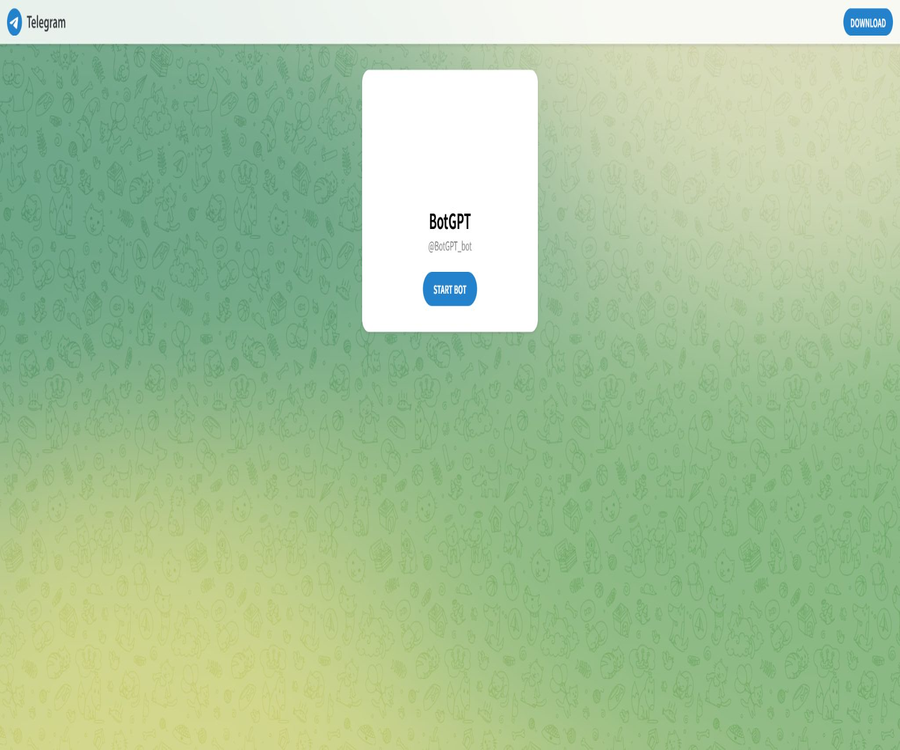
As of August 20, 2026, Telegram’s public page still recognizes the name of BotGPT as well as the corresponding bot account, and it provides a “Start Bot” button. This confirms that an entry point for such accounts exists, but it does not prove that the backend service will respond, that the response time will be consistent, or that all previous functions will remain available.
The public page lacks a robot overview, a preview of the command menu, a privacy button, terms of service, pricing information, or support channels. Since verifying actual responses requires sending messages to third-party robots, the unfinished session tests in this entry are not listed as verified features.
Historical public function
AI Q&A in Telegram
Early developers explained that users can directly send questions in Telegram and receive answers generated by ChatGPT. This approach eliminates the need to switch between a messaging app and a separate AI website.
Accessible via mobile and desktop devices
Telegram is available on mobile devices, desktops, and web browsers; therefore, in theory, bots can be used across different devices under the same account. Actual synchronization depends on the Telegram chat history and on whether the bot is still functioning properly.
Conversation history
Early user feedback indicated that the robot could retain previous prompts and responses, but the current official documentation does not provide information regarding the context window, the duration for which history is retained, or how to clear it. Old feedback should not be considered as an indication of current privacy or memory retention policies.
Natural language responses
Its historical role is to receive natural language queries and return text-based answers; it can be used for general Q&A and simple conversations. The underlying model, the date up to which knowledge is current, the ability to access the internet, file handling capabilities, and multimodal support have not been made public.
Start using the process
- Verify that you are accessing the correct BotGPT account to avoid falling into fake accounts with similar names.
- View the account name, profile picture, bio, command menu, and privacy settings currently displayed on Telegram.
- After clicking Start Bot, send low-risk test questions that do not contain personal information first.
- Observe whether the robot responds, and record the commands it provides, as well as its limits, prices, and data specifications.
- Use fact-checkable questions to test accuracy; do not submit sensitive or important tasks right away.
- If a robot requests payment, access to devices, or a redirect to an external site, first verify the identity of the operator and the relevant rules.
Security testing process
- Use general knowledge questions to test whether the responses are coherent; no real names, numbers, or company information is required.
- Ask the robot about its current model, the organization that operates it, its privacy policy, and how data is stored and deleted.
- Test the commands for clearing the context or starting a new conversation, to determine whether old messages still affect the responses.
- Check whether the payment prompt comes from Telegram’s official payment interface, and verify the currency as well as the auto-renewal setting.
- Test error-prone assumptions and high-risk scenarios to see whether the robot acknowledges uncertainty.
- After it’s over, delete the unnecessary chat records; keep in mind that local deletion does not necessarily mean deletion from the server managed by the service provider.
Which users are it suitable for
- Power users of Telegram: Those who wish to try out basic AI-powered Q&A features within existing messaging apps.
- Researchers in AI tools: Investigating early third-party ChatGPT bots and their current status.
- Low-risk testers: Use public questions to determine whether the robot is still functional.
- Mobile users: prefer a chat-based interface and do not want to switch between multiple apps frequently.
- Multilingual testers: They can check whether the robot understands their language, but they must assess the quality on their own.
Scenarios that are not suitable
- Tasks such as medical diagnosis, legal advice, and investment transactions that require clear accountability and reliable information.
- Handling identity documents, financial information, patient records, customer lists, and company secrets.
- Enterprise projects that require determination of the model version, data storage location, auditing mechanisms, service levels, and contractual guarantees.
- Tasks that require capabilities such as file uploading, image analysis, online research, or code execution – capabilities that have not yet been verified.
- System integration that requires public APIs, SDKs, rate limits, and comprehensive development documentation.
- It is necessary to clarify the procedures for refunds, billing, customer service, and account deletion in paid usage.
Typical use cases
- Availability testing: Verify whether the robot still responds to text messages and what the response time is.
- Simple knowledge quiz: Asks general questions that can be verified through publicly available information.
- Draft copy: Try to create short titles, rephrase sentences, or develop creative lists, which are then reviewed by humans.
- Language practice: Conduct low-risk conversations and check for grammatical and factual errors.
- Brainstorming: Generate multiple ideas without considering the results as professional conclusions right away.
- Research on historical tools: Comparing the early Telegram AI bots with the current official AI products.
Possible conveniences
- The entry point is Telegram, so users familiar with this platform have a lower learning curve.
- There is no need to install a separate BotGPT application; the account page can be accessed from Telegram.
- In theory, chat history can be viewed across different devices via a Telegram account.
- The robot format is suitable for short questions and continuous text conversations.
- Public accounts can still be located, allowing users to check the status of the pages on their own.
Main limitations and risks
- The presence of an account entry does not mean that the backend service is working properly; the robot may fail to respond, experience rate limiting, or stop operating at any time.
- The underlying model has not been publicly confirmed at present, so BotGPT cannot be considered equivalent to the latest version of ChatGPT.
- There are no existing functional documentation, and capabilities such as images, files, voice, networking, and context awareness cannot be preset.
- There is no public price page, so it is not possible to determine the free usage quota, the billing cycle, the currency used, or the rules regarding refunds.
- There is no dedicated privacy policy, and it is unclear how prompts, responses, identifiers, and logs are stored.
- Telegram messages pass through Telegram’s infrastructure, and the operators of the bots may also send the content to the model providers.
- Deleting a Telegram chat does not necessarily remove the robot servers, logs, or the data that has already been processed by the model provider.
- Third-party robots may be transferred, modified, or copied; it is necessary to verify the correct account details carefully before using them.
- AI responses may be outdated, incorrect, or fabricated, and are particularly unsuitable for high-impact decisions that have not been reviewed.
- There is no official customer service or error page available, making it difficult to hold anyone accountable in cases of charges being applied incorrectly, abuse, or data issues.
Price and quota
As of August 20, 2026, no current official pricing, quotas, or purchase information related to the operator of this robot could be found. Any free, monthly fee, or historical details listed in third-party catalogs should not be regarded as the current prices.
| Project | Current verifiable status | Make sure to confirm before selecting. |
|---|---|---|
| Start the robot | A link is available on Telegram’s official page. | Whether there is an actual response after startup |
| Free quota | Not disclosed | Daily message, character, model, and reset cycles |
| Paid plans | No official price was found. | Currency, period, equity, and auto-renewal |
| Trial | Not disclosed | Are payment methods and expiration rules required? |
| Refund | Not disclosed | Refund window, used credit limit, and processing methods |
| Enterprise solutions | No findings were detected. | Accounts, privacy, SLAs, and data processing agreements |
If the robot displays a payment button during the conversation, the user should first capture and read the full details of the package, to determine who will receive the payment, the status of the Telegram payment, the payment schedule, and how to cancel it. It is not advisable to pay large amounts in advance when the terms are not clear.
Comparison of historical information with current facts
| Project | Early public introduction | It can be confirmed as of 2026. |
|---|---|---|
| Product positioning | Using ChatGPT within Telegram | The robot account still exists. |
| Answering ability | Receive questions and generate answers. | Message response verification was not performed. |
| Conversation history | Early users said that the context would be preserved. | The retention range and deletion methods are not disclosed. |
| Model | At that time it was called ChatGPT. | The current model and version are unknown. |
| Price | Early sources did not provide reliable current prices. | There is no current official pricing. |
| Privacy | No complete explanation is provided. | The public page does not have a dedicated privacy section. |
Privacy and data security
The public page of BotGPT does not provide a privacy policy, so it is not possible to determine how long message content, Telegram user IDs, language information, timestamps, error logs, and payment details are stored. It is also unclear whether this data is used for training purposes, manual review, or analysis by third parties.
Using a robot involves at least two parties involved in the process: Telegram and the operator of the robot; if the robot relies on external models, a third-party model provider is also added to this chain. Users should not mistake the robots found in private messaging apps for end-to-end private AI solutions.
- Do not send passwords, verification codes, API keys, bank cards, identification documents, or exact addresses.
- Do not upload medical records, legal cases, internal contracts, customer data, or unpublished code.
- On the first use, only publicly available test content is sent; the risks are assessed afterward, after verifying the operators and relevant policies.
- In Telegram’s privacy settings, it is possible to limit the visibility of one’s phone number, profile picture, and online status to strangers.
- Be cautious of robots that request the addition of administrators, the installation of software, or transfers to personal wallets.
- Treat robot messages as content of third-party services that may be recorded, rather than as private local computations.
Accuracy and content responsibility
Even if a robot still uses some kind of GPT model, it may produce errors, invent fake sources, overlook certain conditions, or provide outdated information. In the absence of information regarding model versions and updates, it is even more difficult to determine the scope of its knowledge and its security policies.
Users are responsible for the final outcome of their use; important facts must be verified again through authoritative sources. When publishing generated text, it is also necessary to check aspects such as copyright, defamation, privacy, advertising claims, and platform rules.
Supported platforms
| Platform | Support status | Explanation |
|---|---|---|
| Telegram for mobile | The account entry page can be opened. | Actual conversations require a response from the robot’s backend. |
| Telegram desktop version | The account entry page can be opened. | The same Telegram account can be used. |
| Telegram Web | It depends on the account and region. | The robot entry point allows navigation to the client side. |
| Independent web version | No findings were detected. | There is no public website for chatting with BotGPT. |
| Separate apps for iOS and Android | No findings were detected. | A Telegram client is required, rather than the BotGPT application. |
| Standalone applications for Windows and macOS | No findings were detected. | Use it through the Telegram desktop client. |
APIs, SDKs, and open-source status
No public API, developer console, authentication documentation, pricing information, or official SDK released by the operators of BotGPT were found. Telegram does provide a platform for creating bots, but this does not mean that BotGPT makes its model interfaces available to others.
No official GitHub repository, source code, or open-source license that can be associated with this robot was found. The open-source status of the items in that directory should be marked as \"not open-source\", and it is not possible to use other projects with the same name such as BotGPT as a substitute.
| Development projects | Current status | Explanation |
|---|---|---|
| BotGPT public API | No findings were detected. | There are no official API documentation. |
| Official SDK | No findings were detected. | There are no language software packages available for verification. |
| Official GitHub | No findings were detected. | Third-party warehouses with the same name cannot be assigned to this robot. |
| Robot source code | Not disclosed | It should be considered a closed-source third-party service. |
| Telegram Bot API | Platform capabilities | Provided by Telegram; it is not an API exclusive to BotGPT. |
| Model suppliers | Currently unknown | The mention of ChatGPT in historical contexts does not refer to the current version. |
Basic information
| field | Content |
|---|---|
| Tool name | BotGPT |
| Tool type | Third-party Telegram AI chatbot |
| Current entry point | Telegram bot account |
| Current status | The account exists, but the backend response has not been independently verified. |
| Historical positioning | Access ChatGPT-style Q&A on Telegram |
| Developer | The initial public introduction was made by Alex Stoliar. |
| Underlying model | Not publicly available at the moment |
| Free version | Not publicly confirmed |
| Paid plans | No current official pricing was found. |
| Registration requirements | A Telegram account is required to have actual conversations. |
| Chinese support | Not disclosed; actual testing is required. |
| API | No findings were detected. |
| Official SDK | No findings were detected. |
| Official GitHub | No findings were detected. |
| Is it open source? | If the source code is not made public, it should be considered non-open source. |
| Privacy Policy | No specific public policy for BotGPT was found. |
Recommendation score
The recommendation score is 2.3 out of 5. The Telegram interface for BotGPT is still available; it is suitable for users who are willing to conduct tests using publicly available, low-risk questions, and it also holds value for research into early ChatGPT robots.
The deductions are mainly due to the lack of verification of actual responses, opacity regarding the models and functions used, absence of current prices, issues related to privacy and support, as well as problems with APIs and open-source materials. Users who require stability, data protection, or high professional accuracy should give priority to services that have clear ownership and policies.
Frequently Asked Questions
What is BotGPT?
It is a third-party Telegram AI chatbot; its initial purpose was to provide ChatGPT-style Q&A functions within Telegram.
Can BotGPT still be used?
The public account still exists and shows a start button, but this only indicates that the entry point is available. Whether the backend responds, as well as its speed and capacity, need to be tested by the user using low-risk messages.
Is BotGPT an official product of OpenAI?
There is no evidence indicating that it is an official OpenAI robot; it should be regarded as a third-party Telegram service provided by independent developers.
Which model is used at the underlying level?
There is no public information available at the moment. The introduction from three years ago mentioned ChatGPT, but this cannot be used to determine the models, versions, or suppliers available in 2026.
Is BotGPT free?
No current official prices or free quotas were found. Even if it is possible to start using the service, it is necessary to confirm the full package details, duration, and cancellation rules before making any payments.
Is it necessary to install a separate application?
There is no need to install a separate application named BotGPT, but for actual chatting, a Telegram account along with the client or web version is required.
Is Chinese supported?
The public page does not contain a list of languages; whether Chinese is understood, the quality of the output, and the presentation in simplified and traditional characters can only be determined through the actual conversation taking place.
Are chat records saved?
Telegram shows the history of conversations, but it is not known whether BotGPT’s operators and the model providers store this data or for how long. Deleting local chats does not necessarily mean that the data on servers is also deleted.
Can files and pictures be sent?
There are no current documents confirming the capability to work with files, images, audio, or video. Do not assume that a robot can handle such content safely just because Telegram supports attachments.
Is the answer reliable?
No guarantee can be provided. The version of the model is unknown, and the AI itself may make mistakes; therefore, important answers should be verified through authoritative sources.
Does BotGPT provide an API?
No dedicated public API or developer documentation for BotGPT has been found. The Telegram Bot API is part of the platform’s infrastructure; it does not imply that the model associated with this bot can be accessed by others.
Is BotGPT open source?
No official source code repository or license associated with this robot was found; it should therefore be marked as non-open source.
Why isn’t there a direct test for replies?
Public pages can be accessed without any messages, but actual testing requires sending content to third-party robots. To avoid presenting unauthorized or incomplete interactions as facts, this entry only records the currently verifiable public status.
What are the most important things to keep in mind before using it?
First, verify the correct account; only send public, low-risk questions, and avoid submitting sensitive information or making payments until the provider, prices, and privacy policies have been confirmed.
Tools similar to BotGPT



 Guigong Network Security Registration No. 45132202000164