






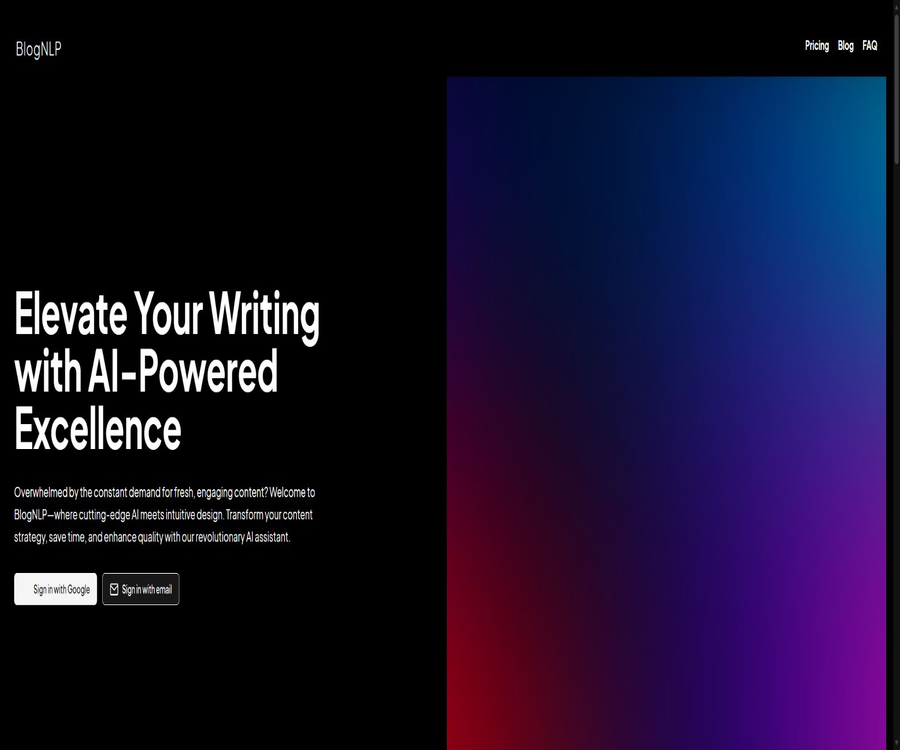
What is BlogNLP?
BlogNLP is an AI-powered writing tool for blogs, marketing, and everyday content creation, available in a web interface. After entering a topic, keywords, or a brief outline, users can generate a draft text, after which they can edit the tone, structure, and details as needed.
It is better suited for dealing with blank pages, drafts, and repetitive tasks related to various text formats, rather than replacing interviews, original research, or professional peer review. The official website offers a free version as well as a Premium subscription; however, the specific limits of the free version are not disclosed.
Main functions
AI articles and blog drafts
Users can start with a topic or a brief outline, and the system will generate a draft article with headings and paragraphs. The final version still requires verification of facts, sources, the brand’s tone, any repetitive content, and search intent.
Over 75 writing templates
The Premium pricing page lists over 75 template functions designed to suit various content-related tasks. The homepage of the official website mentions use cases such as blogs, email campaigns, product descriptions, website content, social media posts, as well as papers or research drafts, but it does not provide a complete list of all the templates available.
BlogChat conversation assistant
BlogChat allows Premium users to pose writing-related questions, expand on their ideas, or revise drafts through conversations. According to the official FAQ, BlogChat uses GPT-4o mini; it should not be confused with the Premium GPT-4o model mentioned on the pricing page.
SEO writing assistance
The official website lists SEO optimization as one of its key advantages, offering users tools to organize their content around keywords, titles, structure, and search readability. It does not guarantee that pages will rank well; the ultimate outcome depends on search demands, content quality, website technology, authority, and the level of competition.
Multilingual translation
The Premium plan lists more than 29 languages that are supported by DeepL for translation. The number of languages, term consistency, and regional expressions still need to be verified through actual samples; legal, medical, and contractual texts should not be used without professional review.
Content modification and customization
The workflow on the official website requires users to continue editing and customizing the content after it has been generated by AI; therefore, BlogNLP functions more like a collaborative writing assistant. Users should add real-world examples, data, brand guidelines, and their own insights, rather than releasing the initial version as-is.
Multiple user writing scenarios
BlogNLP outlines the various uses of its features for bloggers, marketing teams, academic writers, and small businesses. In academic contexts, it can be used only as a tool for creating outlines, drafting text, and providing assistance; it cannot write assignments on behalf of users, nor can it generate fake references.
Model and functional boundaries
| Functions | Current official statement | Applicable tasks | Precautions |
|---|---|---|---|
| Generated by Premium | The price page indicates GPT-4o | Generation of articles, copywriting, and templates | Model context, version locking, and call limits are not disclosed. |
| BlogChat | FAQ is labeled as GPT-4o mini | Dialogue rewriting, conception, and Q&A | Available only to Premium users. |
| Description of the privacy policy model | List GPT-3.5-TURBO and GPT-4o | Explain third-party model processing | The policy was last updated in 2023, and its wording is not entirely aligned with that on the current product page. |
| Translate | Supported by DeepL | Multilingual text translation | Premium lists over 29 languages. |
| SEO assistance | The official website lists it as a product feature. | Title, keywords, and article structure | It does not equate to a guarantee of ranking or a complete SEO audit platform. |
Different official pages use various model names; the most logical explanation is that different functions may call on different models, and there is a delay in updating the privacy policies. Users who have strict requirements regarding model versions should rely on the information displayed on the interface after logging in and on the confirmation provided by customer service.
Complete AI writing workflow
- Define the content objectives, target audience, distribution channels, tone, and the actions you expect users to take.
- Organize reliable information, product facts, keywords, examples, and expressions that should be avoided.
- Select an appropriate template, and enter the specific topic, outline, and content boundaries.
- After creating the draft, check the structure, repetitions, facts, logic, and brand consistency.
- Add unique perspectives, real-world experiences, data interpretations, and necessary original materials.
- Language, copyright, compliance, and search intent reviews are conducted, followed by approval by the responsible person.
- After publishing, monitor reading figures, conversion rates, and search performance, and update outdated content.
Tutorial on creating blog posts
- Log in to BlogNLP using your Google account or email address, and select the template that corresponds to the content of your blog.
- Enter a specific topic, rather than just providing a too broad keyword.
- Add information on the target audience, the purpose of the article, tone, length, key points, and information that must not be fabricated.
- Generate an outline first to check whether the sections address the issues that truly concern the users.
- Generate or refine the text chapter by chapter, to avoid having too long a output that might obscure the key points.
- Check each item individually: names, dates, prices, functions, citations, and statistical data.
- Rewrite the introduction, examples, and conclusions to reflect your own experience and opinions.
- Publish after completing SEO, readability, and compliance checks.
Tutorial on creating marketing copy
- Clearly specify the product, target customers, use cases, key benefits, and the demonstrable differences.
- Provides brand tone, prohibited words, legal restrictions, and examples of high-quality existing copy.
- Generate a title, a short description, the email body, a product description, or a social media post separately.
- Maintain multiple versions and filter them based on channel length and audience stage.
- Remove absolute claims that cannot be proven, false scarcity, and exaggerated effects.
- Fact-checking and trademark usage are conducted by product, brand, and legal personnel.
- Conduct small-scale tests to compare clicks or conversions, and then retain the version with better performance.
Use BlogChat to modify drafts.
- First, provide the original text, the target audience, and the specific issues that need to be addressed in this round.
- Ask BlogChat to point out issues with the structure, logic, or expression, rather than rewriting the entire content directly.
- Modify the titles, introductions, transitions, examples, and calls to action section by section.
- Have the assistant provide several alternative phrasings, and let the editor choose the version that best fits the brand.
- Check again to ensure that the modifications have not altered the original meaning, factual conditions, or compliance boundaries.
- Save the final version that has been manually verified; do not consider the output from the chat as an automatic approval.
Multilingual content workflow
- First, standardize the terms, units, product names, and words that cannot be translated in the source language text.
- Select the target language and generate the translation, avoiding major alterations to the facts in the same step.
- Check the date, currency, number format, titles, and regional cultural expressions.
- Have people who are familiar with the target language and the industry review brand names and technical terms.
- Adjust local search requirements for titles, keywords, and call-to-actions.
- Once verified, it is published, and the correspondence between the original text and its versions in various languages is saved.
Which users are it suitable for
- Blog author: Quickly draft an article based on the topic and outline, then add personal opinions and relevant information.
- Content marketers: Create emails, product descriptions, as well as copy for websites and social media.
- Freelance writers: Accelerate the processes of ideation, outlining, rewriting, and delivering multiple versions.
- Small business owners: Prepare basic marketing materials in the absence of a large content team.
- SEO editor: Helps to create search-friendly titles, keywords, and article structures.
- Students and researchers: Used for conceiving, explaining, and expressing modifications, but cannot replace research and verification of citations.
- Multilingual content team: Uses DeepL to carry out initial translations, followed by manual localization.
Typical use cases
- Organize the scattered topic notes into a well-structured blog outline.
- Generate different versions of emails, product pages, and social media content for the same product.
- Rewrite difficult or lengthy paragraphs to make the tone more appropriate for the target audience.
- Generate suggestions for angles, titles, and chapters when stuck while writing.
- Prepare draft versions of common pages and basic SEO copy for small websites.
- The approved source text is translated into multiple languages, after which it is revised by local editors.
- Discuss structural issues through BlogChat and carry out multiple rounds of iterations on the draft.
Product advantages
- The web interface is simple to use; it allows users to start writing quickly, either by selecting a theme or an outline.
- A single Premium subscription covers over 75 templates as well as all creation features.
- It offers two modes of operation: template generation and BlogChat conversations.
- Put blog, marketing, social media, websites, and academic draft scenarios on the same platform.
- Premium offers translation support in over 29 languages via DeepL.
- The monthly and annual prices are listed; the total cost for an annual subscription is lower than the sum of the monthly fees paid over 12 months.
- Login is supported via Google or email, and billing can be managed through the Stripe portal.
Usage restrictions and precautions
- AI may fabricate facts, sources, data, or product features; any content presented to the public needs to be verified.
- The claim on the official website of unlimited generation does not specify any rules regarding fair use, speed limits, or anti-abuse measures; therefore, it cannot be interpreted as true unlimited generation.
- A free version is available, but the limits on the number of generations, as well as those related to models, templates, and functions, are not clearly specified.
- SEO tools cannot guarantee rankings, nor can they replace keyword research, competitive analysis, and technical SEO.
- The official website does not disclose information regarding team workspaces, approval processes, role permissions, or brand asset management capabilities.
- The privacy policy was updated in 2023, which results in a timing discrepancy compared to the current descriptions for GPT-4o and BlogChat.
- The full terms of service, data retention period, or guidelines regarding the commercial use of the generated content were not found.
- The FAQ states that refunds are generally not provided after starting to use AI-related services, and no refund is given either for recurring subscriptions that were forgotten to be canceled.
- Academic, medical, legal, and financial content cannot be published directly without professional review.
- No official API or SDK is available, making it unsuitable for teams that require automated mass production.
Prices and packages
As of August 20, 2026, the BlogNLP website lists the monthly and annual premium prices, and provides access to a free version on its home page. The final price, taxes, currency conversions, and renewal amounts are subject to the details shown on the Stripe payment page.
| Package | Price | Billing cycle | Core benefits or quota | Suitable for users |
|---|---|---|---|---|
| Free | Free | The official website does not specify this. | It is available for use, but the number of generations, as well as the limits on templates, models, and functions, are not publicly disclosed. | Users who wish to experience basic writing first |
| Premium Monthly | 9.99 dollars | Monthly | Unlimited generation of all functions, Premium features, GPT-4o, over 75 templates, BlogChat, translation in more than 29 languages, and early access to new features | Short-term or monthly users |
| Premium Yearly | 99.99 dollars | Every year | The home page of the official website states that its functions are the same as those of Premium. | Users who use the service on a long-term basis and wish to reduce their average monthly cost |
Based on the figures provided on the official website, the monthly fee for 12 consecutive months amounts to $119.88; paying annually saves $19.89 compared to paying monthly. This calculation takes into account only the listed prices, and it does not include taxes, exchange rates, promotions, or any future changes in prices.
Bills, cancellation, and refunds
| Matters | Current official rules | Users need to pay attention. |
|---|---|---|
| Payment methods | Credit or debit cards, offering a variety of payment methods in different regions | PayPal is not accepted. |
| Payment processing | Processed by Stripe | BlogNLP states that bank card information is not saved. |
| Unsubscribe | It can be canceled by going to the Stripe billing portal under Billing. | After cancellation, it is usually available until the end of the current cycle. |
| Switch plans and invoices | Support for the Stripe billing portal | When unable to log in, you can use the purchase email to access the billing page. |
| General refund | The FAQ states that no refund will be given once the AI processing has begun. | Test the free version before making a purchase. |
| Forgot to cancel the recurring subscription. | The FAQ states that no refunds are provided. | It is necessary to cancel it proactively before the renewal date. |
The FAQ uses terms such as model training and image generation costs, but the main content on the official website focuses on text writing; the explanations regarding refunds are not very thorough. In cases of repeated charges, failure to provide the service, or issues related to consumer protection in the local area, it is necessary to keep the invoices and contact the payment service provider and the platform directly.
Platform and language support
| Platform or capability | Support status | Explanation |
|---|---|---|
| Web page version | Support | The entrance is used primarily. |
| Google login | Support | The home page provides Google login. |
| Login via email | Support | The home page provides email login. |
| Windows and macOS desktop applications | No findings were detected. | It can be used via modern browsers. |
| iOS and Android apps | No official store version was found. | The experience with mobile browsers needs to be tested by yourself. |
| Translation language | Over 29 types | Premium is supported by DeepL. |
| Chinese | It may be processed using models and DeepL. | The official website does not provide a separate guarantee regarding a Chinese interface or the quality of the generated content. |
| Browser extensions | No findings were detected. | Currently, it is mainly used on websites. |
Privacy and data processing
The BlogNLP privacy policy states that it collects the name and email address provided directly by users; it may also obtain IP addresses, browser information, device details, event data, and pages visited through cookies, web beacons, and analysis tools. The platform might also acquire information from social media platforms, advertising networks, and analysis services.
The policy permits the sharing of necessary information with service providers for hosting, analysis, and payment purposes, and this may also occur due to legal requirements, business transfers, or user consent to disclosure. It does not specify the exact retention period for prompts and generated content, the procedures for deletion, the locations where such data is stored, or whether it is used to improve the models.
- Do not enter confidential client information, unreleased product plans, sensitive personal data, or full texts protected by confidentiality agreements.
- Delete any fake references, personal information, and copyrighted material that the model might generate before publishing.
- If it is necessary to process corporate data, it is first necessary to obtain the latest data processing agreement and a list of sub-processors.
- The privacy policy states that no personal information is collected through the use of GPT, but its wording is not sufficient to explain the entire process by which prompts are processed.
- The old policy mentioned GPT-3.5-TURBO and GPT-4o; the current model and data rules should be confirmed with the platform once again.
- When logging in with Google, it is also necessary to understand how to grant and revoke authorization for a Google account.
API, GitHub, and open-source status
As of the time of verification, the BlogNLP website does not provide any public APIs, SDKs, Webhooks, or developer documentation, nor does it include information on programmatic calls in its pricing options. Teams that wish to integrate AI-powered writing capabilities into CMS systems, automated workflows, or bulk content processing pipelines should not assume that a website subscription entails access to APIs.
A search on GitHub did not yield any officially recognized organizations, product source codes, or SDK repositories certified by the BlogNLP website. BlogNLP should be considered a closed-source commercial web service; the fact that its name appears in lists of third-party tools does not mean that the product is open source.
Content Quality Checklist
- Does the article truly answer the questions of its target audience, rather than merely repeating statements related to key words?
- Are there reliable original sources for names, dates, prices, functions, legal and statistical data?
- Is the hierarchy of headings natural, and do the abstract and the main text correspond accurately to each other?
- Are original experiences, cases, methods, or interviews included, rather than something purely compiled by AI?
- Should fictional references, unverifiable claims, and a tone that does not align with the brand be removed?
- Check for duplicates, copyright issues, trademarks, privacy concerns, and requirements specific to regulated industries.
- Were the multilingual versions reviewed and localized by people familiar with the target market?
- The final version must be approved by the designated person in charge, with a record of the version kept.
Basic information
| field | Content |
|---|---|
| Tool name | BlogNLP |
| Tool type | AI writing, blog generation, and marketing copywriting assistant |
| Primary users | Bloggers, marketing teams, freelancers, small businesses, and students |
| Main inputs | Topics, keywords, outline, and revision requirements |
| Main output | Drafts for blogs, marketing, emails, products, websites, and social media content |
| Price pattern | Free plan and Premium monthly or annual subscriptions |
| Monthly Premium Price | 9.99 dollars |
| Annual Premium price | 99.99 dollars |
| Number of templates | Premium lists over 75 items. |
| Translate | Premium supports over 29 languages from DeepL. |
| Login method | Google or email |
| Main platforms | Web |
| API | Not disclosed |
| Official SDK | Not disclosed |
| Official GitHub | No findings were detected. |
| Is it open source? | Not open source |
Recommendation score
The comprehensive recommendation score is 4.0 out of 5 points. BlogNLP has a straightforward pricing structure; it offers various writing templates, conversation assistants, and multilingual translation capabilities, making it suitable for individual creators or small teams who need to quickly prepare initial drafts of content.
Its shortcomings include a limited free quota, limited team capabilities, restricted API access, limited options for data retention, and limited information available regarding commercial licenses; moreover, the details related to the models are scattered across different pages. Organizations that place importance on corporate governance, automated integration, or strict copyright procedures should conduct further verification before making a purchase.
Frequently Asked Questions
Is BlogNLP free?
The official website provides access to a free version, but it does not disclose the number of free generations allowed, the available templates or models, nor any daily limits. One must log in with a real account to see the current quota.
How much is BlogNLP Premium?
The monthly fee is 9.99 dollars, while the annual fee is 99.99 dollars. Taxes, exchange rates, and promotions are subject to those stated on the payment page.
Can Premium really be generated indefinitely?
The pricing page states that all functions can be generated indefinitely, but it does not specify any rules regarding fair use, concurrency, rate limits, or anti-abuse measures. It is necessary to check with the platform to find out the actual limitations before using the services frequently.
What model does BlogChat use?
According to the official FAQ, BlogChat uses GPT-4o mini and is available only to Premium users. The pricing page refers to the Premium model as GPT-4o; these two versions might correspond to different interfaces for text generation.
Is Chinese supported?
While the model and DeepL may be able to handle Chinese, the official website does not provide any guarantees regarding a Chinese interface, the availability of relevant templates, or the quality of the generated content. It is recommended to first test it with actual samples that contain industry-specific terminology.
Can the generated article be published directly?
It is not recommended. It is necessary to verify the facts, originality, citations, copyright issues, the brand’s tone, and search intent, while also including genuine experiences or unique information.
Is it suitable for writing papers?
It can assist with outlining, expression, and drafting, but it cannot replace research, experimentation, literature review, or the need to work independently. All citations must be verified against actual sources.
Can I cancel my subscription?
You can cancel, change your plan, or download invoices from the Stripe billing portal. After cancellation, you can usually still use the current paid period.
Can I get a refund?
According to the FAQ, no refund is given once AI processing has begun, and no refund is provided either in cases where renewal occurs due to forgetting to cancel the service. It is advisable to use the free version first to test whether the service meets your needs before making a purchase.
Does BlogNLP provide APIs?
No public APIs, SDKs, or developer documentation were found. The Premium subscription on the website should not be construed as including programmatic calls.
Is BlogNLP open source?
It is not open source; no product source code certified by the official website or official SDK repository was found.
Can the generated content be used for commercial purposes?
The official website does not disclose the complete licensing terms or commercial usage rules for the generated content. Before using it in customer projects, advertisements, or publications, it is necessary to check the platform’s terms and ensure that the input and output do not violate any third-party rights.
Tools similar to BlogNLP



 Guigong Network Security Registration No. 45132202000164