






Ambassador Programmatic
Ambassador Programmatic: an intelligent tool focused on AI-driven design.
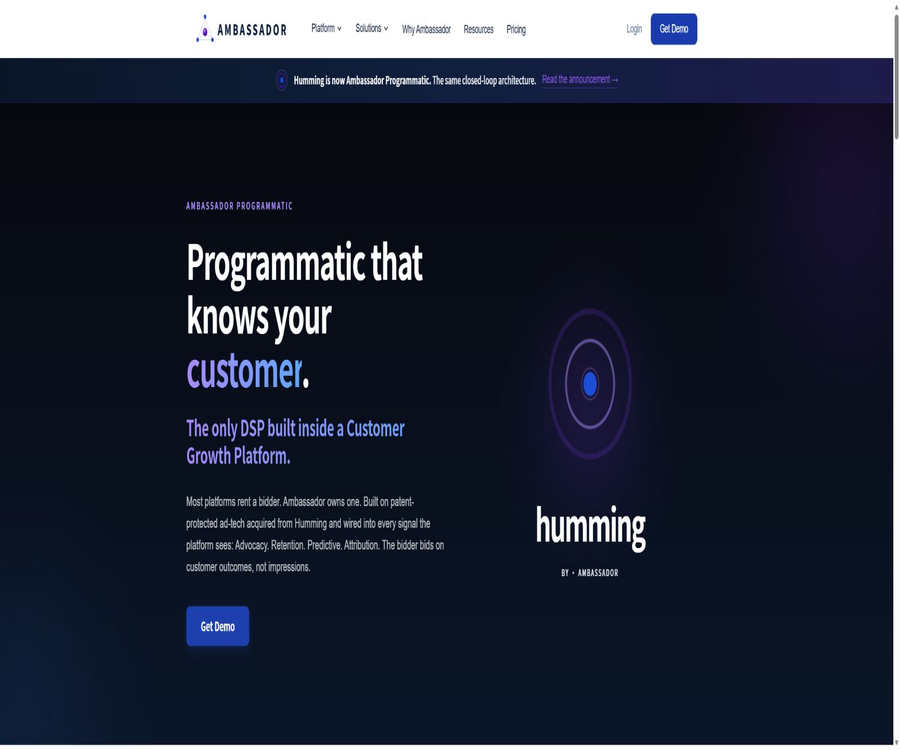
Tags:AI design toolsAmbassador Programmatic is a programmatic advertising DSP that is integrated into the customer lifecycle platform; it evolved from the original Humming advertising technology. It connects audience data, ad bidding, creative testing, campaign execution, and revenue attribution within a single customer data loop.
What is the Ambassador Programmatic?
This product is designed for corporate marketing teams that need to purchase media across various channels and measure the outcomes related to their customers. Unlike ordinary advertising tools that are optimized solely based on impressions and clicks, it focuses on making use of signals related to recommendations, customer retention, predictions, and attribution, so as to align bidding objectives more closely with goals related to customer retention, business expansion, and revenue generation.
Changes in the Humming brand
The former Humming programmatic advertising platform has been renamed Ambassador Programmatic; its core architecture has been integrated into Ambassador. The old name may still appear in examples, user interfaces, or media reports, but when making purchases it is necessary to rely on the current contracts and the capabilities of the platform.
Main functions
- Carry out programmatic media bidding using its own DSP.
- Access to first-party customer and behavior signals.
- It covers display, CTV, audio, video, and native ads.
- Supplies are obtained through more than 30 media partners.
- Build an audience by partnering with over 70 data providers.
- Use AI to generate and test creative variations.
- Adjust the audience, bids, and budget in real time.
- Unified management of conversion and retargeting tags.
- Check performance in a mobile-friendly console.
- Link advertising touchpoints to retention, expansion, or churn outcomes.
Proprietary DSP architecture
Ambassador states that it has its own advertising bidding system, rather than relying on third parties for such capabilities. Having an in-house DSP allows customer data to be used directly in the bidding process; however, aspects such as the actual coverage provided, transparency in bidding, and service fees still need to be clarified as part of the plan.
Closed-loop customer signaling
The recommendation system can identify the characteristics of high-value customers, the retention model can detect the risk of customer churn, and the prediction model can determine the likelihood of conversion. Programmatic tools utilize these signals to carry out advertising campaigns, and then record the results of those campaigns as regression variables along with customer data.
Omni-channel media
- Display shows advertisements.
- Connected TV: online advertising for television.
- Digital audio advertising.
- Online video ads.
- Native content ads.
- Social media advertising.
- Search ads.
Command Center console
The console is used to provide a centralized view of various campaigns, channels, and real-time performance, thereby reducing the need to switch between multiple advertising accounts. Companies should also verify the data latency, the way in which metrics are calculated, the capabilities for creating custom reports, and the possibility of exporting raw data.
AI-driven creative optimization
The platform allows users to upload existing ideas, generate variations using AI, or have design partners create materials; it then automatically tests different versions. AI optimization helps to speed up the iteration process, but brand, copyright, factual accuracy, and advertising policies still require manual review.
Audience management
Audiences can be created by combining first-party signals from Ambassador’s various engines with third-party data, and they can be reused across different channels. When customer data is involved, it is necessary to obtain explicit consent regarding data management, usage restrictions, data retention, and regional privacy regulations.
Campaigns activity management
The platform allows for the creation of display, CTV, audio, video, and native advertising campaigns within a single environment, with the Ambassador media team handling everything from start to finish. It is more of a hosted enterprise service rather than a lightweight tool that enables individual users to upload content and start publishing ads right away after making a payment.
Tracking monitoring
Conversion and retargeting tags can be managed through a unified plugin, thereby reducing the need to deploy multiple pixels repeatedly. Before going live, the technical and legal teams should verify Cookie settings, Consent Mode, server-side events, and the boundaries for data sharing.
Analysis and Attribution
The analysis page presents the performance of Programmatic along with data related to recommendations, user retention, and attribution. Companies should examine the attribution window, cross-device identification, incremental testing, and rules for repeated attribution, in order to avoid mistaking correlation for true incremental value.
HiroAI and the nine major engines
Ambassador uses HiroAI as its orchestration layer, linking together nine different engines: Advocacy, Prospect, Programmatic, Retention, Incentive, Communication, Predictive, Attribution, and Finance. Programmatic is just one of the engines used for ad execution.
Which users are it suitable for
- Medium and large enterprises with a clear growth budget.
- Brands that wish to manage multi-channel advertising in a unified manner.
- Companies that need to use first-party customer signals for their advertising campaigns.
- Teams that simultaneously manage recommendation, loyalty, and retention initiatives.
- Market leaders who need to link ad performance to revenue.
- Companies that wish to have their advertising managed by a professional media team.
- Organizations that operate in industries such as telecommunications, fintech, and SaaS.
Typical use cases
- Find new audiences similar to existing high-value customers.
- Run retention ads for customers at risk of churning.
- Execute brand campaigns across displays, CTV, and audio.
- Automatically test ad creatives and audience combinations.
- Link ad exposure to retention and additional purchase outcomes.
- Unified management of conversion and retargeting tags.
- Generate revenue attribution reports for management.
It’s not very suitable for which situations
- Individual creators with only a very limited advertising budget.
- Businesses that wish to set up everything entirely on their own and make small daily top-ups.
- Users who only need to create designs for single advertisement images.
- Early projects that lacked first-party data as a foundation.
- Open-source DSPs and technical teams for autonomous deployment are required.
- Companies that focus only on organic search or content management.
- Organizations that are unable to complete the reviews regarding privacy and advertising compliance.
Apply for a demonstration tutorial
- Organize existing advertising channels, monthly budgets, and target customers.
- Prepare a representative activity or sample of the audience.
- Submit the company’s demonstration request through the official website.
- Specify the media channels and regions you wish to enable.
- The team is required to demonstrate the bidding, audience, attribution, and reporting processes.
- Request the ROI model, cost structure, and implementation plan.
- Make a purchasing decision only after completing the reviews of security, privacy, and contracts.
Tutorial on creating a campaign plan
- Define the goals regarding customer acquisition, retention, upselling, or brand building.
- Define the target audience, excluded groups, and conversion events.
- Confirm the availability scope of first-party data and user consent.
- Choose from display, CTV, audio, video, or native channels.
- Upload compliant creatives and generate a limited number of test variants.
- Set the budget, bid amount, frequency, and timing of delivery.
- After a small-scale launch, expansion is carried out gradually based on the incremental results.
Creative testing tutorial
- Identify the only creative variable that needs to be verified.
- Keep the audience, budget, and timing of the campaigns as consistent as possible.
- Prepare the basic materials required for passing the brand review.
- Use AI to generate titles, images, or size variations.
- Manually verify facts, trademarks, individuals, and disclaimers.
- Run until sufficient exposure and conversion of samples is achieved.
- The winning version is determined by incremental revenue and customer quality.
Attribution Verification Tutorial
- Define display, click, conversion, and revenue events in a unified manner.
- Verify that the tags and server-side events are triggered correctly.
- Set an attribution window that is appropriate for the business cycle.
- Check for duplicate postings across channels and self-attribution.
- Establish reserve groups or areas to experimentally measure increments.
- Match media reports with financial revenue data.
- Document the model assumptions and review them regularly.
Programmatic pricing
Ambassador does not announce any fixed packages specific to Programmatic advertising; the official website requires scheduling a 30-minute demonstration for media teams, and an ROI model is developed based on the event, target audience, advertising engines used, and the size of the client. The costs related to advertising budgets, platform fees, data processing fees, creative services, and implementation fees need to be specified separately in the quote.
Public price reference for Ambassador
| Module or package | Public starting price | Main scope | Important notes |
|---|---|---|---|
| Advocacy/Loyalty Professional | $ | Over 500 contacts, 1 to 3 activities | A one-time initiation fee of $500 is also required. |
| Advocacy/Loyalty Enterprise | $ | Over 10,000 contacts, unlimited activities | A one-time initiation fee of $1,500 is also required. |
| Communication Professional | $ | Automation of emails and messages | The amount of data sent is purchased separately based on usage. |
| Communication Enterprise | $ | High-volume sending, SSO, and governance | The amount of data sent is purchased separately based on usage. |
| Incentive Professional | $ | Management of reward funds and their distribution | The cost of rewards is calculated separately. |
| Incentive Enterprise | $ | Multiple vaults and enterprise approval processes | Configure by project and scale |
| Predictive | $ | Predictions, ratings, and recommendations | Used as a platform capability |
| Programmatic | Contact sales | DSP, media execution, and attribution | Quotations are provided based on goals, engine type, and customer scale. |
Cost composition
- Actual media procurement budget.
- DSP or platform service fees.
- Third-party audience and data fees.
- Creative production and AI-generated services.
- Tracking, attribution, and data integration implementation.
- Customer success or media hosting services.
- Other Ambassador engine subscriptions.
Free trial and demonstration
The official website offers personalized demonstrations, rather than a public, free self-service trial. These demonstrations are suitable for testing workflows and ROI models, but they cannot replace controlled pilot tests conducted with real data.
Media and Data Partners
The official website states that there are more than 30 media partners and over 70 data partners connected to it. The number of partners does not mean that coverage is available in every country and industry; therefore, it is necessary to obtain a list of actual suppliers in the target region before making any purchases.
Corporate security and compliance
Ambassador highlights the corporate requirements such as SOC 2 Type II, GDPR, CCPA, and PCI DSS, and provides a Trust Center. Companies still need to verify the scope of the certifications, subcontractors, data residency, incident response procedures, and deletion processes.
APIs and Integration
The Ambassador platform lists the REST APIs, Webhooks, as well as the integration capabilities with platforms such as Salesforce, HubSpot, Shopify, and BigCommerce. The specific activities, target audiences, and reporting interfaces that can be made available through Programmatic need to be determined as part of the enterprise solution.
GitHub and the open-source status
No official open-source repositories for Ambassador Programmatic’s core DSP, bidding algorithms, or the HiroAI orchestration platform were found. The availability of public APIs and integration capabilities does not equate to the making available of the source code for advertising platforms or their model weights.
First-party data and privacy
The value of a platform depends on factors such as customers, referrals, customer retention, and conversion rates; therefore, data governance is a crucial task prior to launching the platform. Teams should adopt practices such as data minimization, explicit consent, hierarchical access controls, and auditable deletion mechanisms.
Advertising compliance
Different regions and media outlets impose varying restrictions on advertisements related to finance, healthcare, politics, children, as well as on ads with specific targeting or sensitive content. AI-generated ideas and automated audience expansion methods must undergo human approval; policies cannot be bypassed under the pretext of improving performance.
Product advantages
- The proprietary DSP is connected to customer lifecycle data.
- It covers display, CTV, audio, video, and native ads.
- At the same time, utilize first-party and third-party audience signals.
- Supports AI-driven creative variations and real-time optimization.
- End-to-end execution is provided by the media team.
- Link ad results to retention and revenue.
- It forms a closed loop with recommendation, loyalty, and prediction engines.
- It offers enterprise-level security and integration capabilities.
Usage restrictions
- Programmatic does not have a fixed public price.
- It is more suitable for businesses and those with medium to large budgets.
- A reservation is required for demonstrations and sales assessments.
- Cross-channel attribution can still be affected by model assumptions.
- The coverage of third-party data varies by region.
- AI-generated creativity must be manually checked for compliance and copyright issues.
- First-party customer data imposes higher governance requirements.
- The core DSP and algorithms are not open source.
Basic information
| Project | Content |
|---|---|
| Tool name | Ambassador Programmatic |
| Original brand | Humming |
| Product type | Enterprise programmatic advertising DSP |
| Platform affiliation | Ambassador Customer Lifecycle Operating System |
| Core channels | Display, CTV, audio, video, and native ads |
| Core competencies | Bidding, audience, AI creativity, tracking, and attribution |
| Service method | Media team hosting and corporate presentations |
| Price pattern | Quotation based on the plan and ROI model |
| Whether API is provided | The platform provides APIs; specific permissions need to be confirmed. |
| Is it open source? | No |
Recommendation score
The comprehensive recommendation score is 4.0 out of 5 points. It is suitable for companies that wish to integrate programmatic media, customer signals, and revenue attribution within a single platform; however, the value of this solution depends on the size of the budget, the quality of the data, and the ability to measure actual improvements.
Frequently Asked Questions
What is the Ambassador Programmatic?
It is an enterprise DSP integrated into the Ambassador platform, used for programmatic media purchasing across various channels and for attributing customer outcomes.
Is Humming still around?
Humming has been renamed and integrated into the Ambassador Programmatic; older materials may still use the original brand name.
Which advertising channels are supported?
It supports the display of content, CTV, audio, video, and native ads; moreover, the platform includes social media and search functions within its multi-channel approach.
Can I open an account by myself?
The official website primarily offers corporate demonstrations and services for media teams; it does not provide a public option for individuals to top up their accounts on their own.
How much is Programmatic?
There is no fixed public price; a quote must be requested based on the objectives of the campaign, the size of the customer base, the engines to be used, and the budget allocated for media advertising.
Is there a free trial available?
The official website offers scheduled demonstrations, but there is no public, free self-service trial available.
Does the platform generate ad ideas?
AI can be used to generate creative variations and conduct automatic testing; it is also possible to upload materials or work with design partners.
Is an API provided?
The Ambassador platform offers REST APIs and Webhooks; specific permissions for programmatic use need to be confirmed through the enterprise plan.
Is Ambassador Programmatic open source?
It is not open-source; the core DSP, bidding algorithms, and HiroAI platform are part of commercial services.
Tools similar to the Ambassador Programmatic



 Guigong Network Security Registration No. 45132202000164