






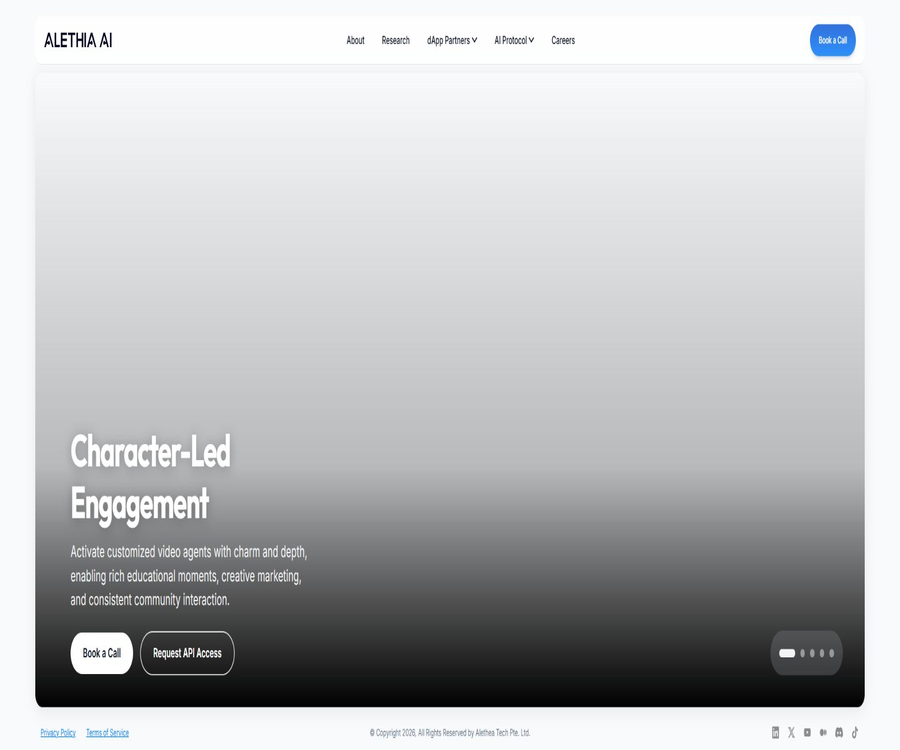
ALETHIA AI
ALETHIA AI: an intelligent tool dedicated to AI design.
Tags:AI design toolsWhat is ALETHIA AI?
ALETHIA AI is a company that focuses on researching ways to integrate generative AI with blockchain, with the goal of creating AI characters and digital avatars that are capable of real-time communication and expressing emotions. It places emphasis on Sovereign AI Agents, which allow the creators or users to retain control over the identity, assets, and permissions of such characters.
The platform’s focus has shifted from early smart NFTs to enterprise-level real-time video agents. Brands, creators, and public service organizations can use them to create digital characters that are available 24/7 and capable of interacting with audiences in real time.
Core products and technologies
| Products or technologies | Main function | Suitable scenarios |
|---|---|---|
| EMOTE-1 | drives real-time expressions, actions, emotional voice output, and video interactions | Live digital avatars, brand characters, digital twins |
| CharacterGPT | Generate AI characters with memory, personality, and autonomy based on natural language descriptions. | Character archetypes, interactive content, digital IPs |
| AI Protocol | Provide open protocols and verifiable ownership mechanisms for AI characters and assets. | AI assets on the chain, protocol applications, community ecosystem |
| Enterprise video agent | Combine role models, knowledge, voice, and workflows into continuously running services | Customer interaction, education, marketing, public services |
EMOTE-1 Real-time Multimodal Engine
EMOTE-1 is used to enable AI characters to display facial expressions, voices, and body movements that are consistent with the semantics and emotions in real-time conversations. Its goal is not to generate a pre-recorded video, but rather to allow these characters to respond to users continuously within live broadcasts or interactive interfaces.
- Generate facial expressions with emotional changes in real time.
- Expressions are delivered by taking into account speech tone and character personality.
- Generate body movements that match the content of the dialogue.
- It supports multi-language characters and interaction across regions.
- Maintain consistency in the character’s appearance, voice, and personality.
- Enterprise-level scalability for handling a large number of concurrent interactions.
CharacterGPT text generation character
CharacterGPT is capable of transforming descriptions of a character’s appearance, background, personality, and purpose into interactive digital characters. The results generated include not only a visual representation but also the ability to assign memories, a personality, and autonomous interaction capabilities to such characters.
It is more suitable for creating character prototypes intended for long-term use, rather than generating individual avatars. Its practical usability depends on the character design, the available knowledge resources, content safety rules, and the platform through which it is deployed.
Digital avatar
ALETHIA AI can create digital avatars for creators, experts, or public figures, enabling them to continue interacting with their audience even when they are not online. These avatars reflect an individual’s style of expression, expertise, and established boundaries, but they should not be seen as a complete replacement for the original person.
- Continuously answer common questions and introduce personal projects.
- Real-time voice and video interaction is provided on the live streaming page.
- Serve different audiences in a more consistent manner of expression.
- Expand reach for education, career guidance, and fan management.
- Leave repetitive communications to the agent to handle.
- Transfer complex or sensitive issues to a human.
Brand Roles and Interactive Narratives
Companies can transform their brand’s visual identity, tone of voice, and relevant knowledge into named AI characters, allowing these characters to maintain a consistent approach in events, live broadcasts, or service interfaces. Compared to traditional text-based customer service, this method places more emphasis on memorability, emotional feedback, and coherent storytelling.
- Create brand ambassador characters that can operate on a long-term basis.
- Provide real-time explanations during product launches or online events.
- Increase engagement with interactive storylines.
- Have the character use a tone and knowledge approved by the brand.
- Reuse the same character settings across channels.
- Provide localized interactions based on the audience’s language.
24/7 video streaming
Video agents can continuously appear on the live broadcast screen, generating responses, audio, and actions in real time based on the questions posed by the viewers. Before going live, it is necessary to define the topics allowed for discussion, set targets for response latency, establish procedures for handling anomalies, and define how human operators should take over in such situations.
Enterprise-grade agent workflows
The official website combines an AI engine with a scalable intelligent framework to automate task execution and generate multi-modal outputs. Corporate projects typically require connecting the front-end interfaces to knowledge bases, business APIs, approval systems, and data analysis processes.
- Issues with receiving text or voice messages.
- Identify user intent and session context.
- Retrieve the basis for answers from the approved knowledge.
- Generate responses based on the character’s personality.
- Synchronize sound, expressions, and movements.
- Record interactions and evaluate the quality of responses.
- Reject the request or transfer it to a human agent under risky conditions.
Multilingual interaction
EMOTE-1 emphasizes expressive multilingual speech, which can be used for cross-lingual education, public services, and brand communication. The availability of a particular language does not guarantee accurate cultural expression; therefore, a team of local users is still needed to review the pronunciation, terminology, and etiquette.
Role in public services
ALETHIA AI introduces NADI, a bilingual virtual assistant designed for public services in Malaysia, to provide 24/7 information on government facilities and procedures. Such assistants are suitable for guiding users through information that is available frequently, but the interpretation of policies and the assessment of eligibility requirements must be carried out in coordination with authoritative systems.
Education and career guidance
Digital characters with a consistent identity and the ability to engage in dialogue can serve as guides for courses, provide explanations of knowledge, answer questions related to careers, and host events. When giving individual advice, it should be clear that such advice is of a general nature, and professional review should be sought for important decisions.
Which users are it suitable for
- Companies that wish to create branded AI characters.
- Teams that need real-time video digital humans.
- Creators and experts who wish to increase interaction with their fans.
- A content team dedicated to creating interactive narratives and digital IPs.
- Public institutions that provide bilingual information services.
- Developers who study generative characters and AI assets on the blockchain.
- There is a need to organize training for role-based educational assistants.
Typical use cases
- Interactive digital ambassadors on the brand’s official website.
- 24/7 product explanations and live streaming hosting.
- Digital avatars of creators and community Q&A.
- Navigation for public service facilities and processes.
- Guided tours of exhibitions, museums, and themed spaces.
- Interactive courses, career guidance, and knowledge dissemination.
- Games, stories, and characters in virtual worlds.
- On-chain AI roles that can verify ownership.
It’s not very suitable for which situations
- Only individuals with ordinary text chat robots are needed.
- Small teams that request to view the fixed low-price packages immediately.
- Projects that involve creating one-time short videos only and do not require any interaction.
- Organizations that lack role definition and content governance capabilities.
- Developers who require all core models to be fully open source.
- Projects that cannot afford the computational power required for real-time video processing as well as the associated operational costs.
- Organizations that wish to use AI agents to make high-risk decisions independently.
Tutorial on creating a brand AI character
- Define the target audience and business objectives of the role-based service.
- Define name, appearance, sound, personality, and forbidden areas.
- Organize authorized brand knowledge and materials.
- Confirm the roles and deployment plan with ALETHIA AI.
- Create prototypes and test typical questions and answers.
- Verify expressions, movements, voice, and response latency.
- Set up mechanisms for rejecting calls, reviewing them, and having a human take over.
- After a limited rollout, adjustments are made continuously based on the data.
Tutorial on planning digital avatars
- Determine the specific scope for which the digital avatar represents the individual.
- Obtain permission for the use of portraits, voices, and content.
- Collect high-quality materials that reflect one’s own style.
- Create lists of questions that can be answered and those that cannot.
- Test identity disclosure, factual accuracy, and consistency of personality.
- Indicate in a prominent position that the user is interacting with AI.
- Regularly update knowledge and remove outdated content.
Enterprise pilot tutorial
- Choose an interactive scenario with a clearly defined quantitative value.
- Prepare desensitization knowledge and actual test questions.
- Confirm the language, concurrency, latency, and channel requirements.
- Complete the connection between the role prototype and the business system.
- Evaluate the accuracy rate, interaction completion rate, and rate of transfer to human agents.
- It has passed security, legal, and brand audits.
- Launch with controlled traffic and monitor for anomalies.
Developer integration approach
Developers can explore AI assets, ALI Agents, and the mechanisms related to ownership on the blockchain by studying the smart contracts and open documentation provided by the AI Protocol. The current scope of public access and the interface requirements for ALETHIA AI’s commercial video agents need to be confirmed with the team.
AI Protocol
AI Protocol is an open protocol for AI assets and agents; its earlier versions enabled decentralized applications and tokenized assets to utilize CharacterGPT. The protocol is currently continuing to explore aspects such as AI agents, asset layers, ownership models, and community collaboration mechanisms.
Records on the chain can prove asset relationships or demonstrate the execution of certain protocol actions, but they cannot automatically confirm that the model’s responses are accurate, secure, or free from bias. Applications still need to carry out independent evaluations of the models, ensure proper data management, and protect users.
Smart NFTs and ALI Agents
In their early stages, ecological use of iNFTs referred to smart, non-homogeneous tokens that provided access to services on the smart layer; these tokens were combined with compatible assets through Intelligence Pod. As protocols evolved, the concept of ALI Agent emerged, and developers should rely on the documentation for the current version when working with contracts, assets, and various capabilities, in order to avoid using outdated methods.
Open source and GitHub status
AI Protocol makes the documentation and code related to smart contracts available, and the third-party ecosystem also provides integration plugins for other agent frameworks. Nevertheless, ALETHIA AI’s CharacterGPT, EMOTE-1, and the full enterprise video agent platform do not constitute fully open-source products.
| Components | Open state | Be careful when using it. |
|---|---|---|
| AI Protocol documents and contracts | Public | Verify using the current protocol version and contract address. |
| Ecological integration plugin | Partially open source by third parties | It is not equivalent to the official core product source code. |
| CharacterGPT | The core model has not been fully open-sourced. | Usage permissions are determined in accordance with product or agreement rules. |
| EMOTE-1 | The core engine is not fully open-source. | Quotation is required for enterprise deployment and licensing. |
| Enterprise video agent | Business services | The interfaces, SLAs, and data terms are determined in accordance with the contract. |
Pricing method
The ALETHIA AI official website does not currently specify the standard monthly fees or pricing per call for EMOTE-1, CharacterGPT, or enterprise video agents. The partnership options are differentiated based on consumer needs and enterprise-level requirements; the specific prices shall be determined by considering factors such as the number of characters, concurrency levels, video length, language, as well as the scope of integration and support provided.
| Plan | Public price | Quotations usually involve |
|---|---|---|
| Consumer experience | Fixed amount not disclosed | Character abilities, usage count, and available entry points |
| Enterprise video agent | Custom quote | Concurrency, duration, language, channel, and SLA |
| Digital avatar project | Custom quote | Material collection, character training, authorization, and operation |
| Brand Role Project | Custom quote | Image design, knowledge, workflows, and system integration |
| AI Protocol ecosystem | There are on-chain fees and a token mechanism. | Network fees, protocol assets, and rules for using services |
It needs to be confirmed at the time of purchase.
- How are one-time construction costs and ongoing service fees divided?
- Real-time video is billed by minute, based on concurrency, or according to the number of requests.
- To whom do role models, materials, and generated content belong?
- How to revoke portrait and voice permissions.
- Are the training data used to improve the shared model?
- Available regions, languages, latency, and service levels.
- Methods for exporting and deleting data after the project is terminated.
Data and Privacy
Digital twin projects may handle audio, portraits, conversation data, and behavior data; companies must obtain clear authorization before collecting such data and limit its use. Privacy policies, the locations where data is stored, the retention period, sub-processors, and mechanisms for deleting data should all be taken into consideration as part of the procurement process.
Identity and authorization risks
Highly realistic characters may lead viewers to believe that real people are speaking; therefore, the identity of AI should be clearly indicated on pages and during live broadcasts. When real persons are involved, it is also necessary to specify rights related to portraits and voices, the scope of content that can be generated, and what happens once the authorization is revoked.
Content security
- Set refusal rules for sensitive topics.
- Restrict characters from claiming the identities and qualifications they possess.
- Provide verifiable evidence for the knowledge answers.
- Detection indicates prompt injection attacks and unauthorized tool calls.
- High-risk sessions are recorded for manual review.
- Provide stricter protection for minors and public services.
- Prepare mechanisms for stopping and switching in case the character gets out of control.
Product advantages
- Combine voice, expressions, actions, and personality to create real-time characters.
- Emphasis is placed on ongoing interaction rather than a single video creation.
- It supports brand characters, digital avatars, and public service cases.
- CharacterGPT can quickly create character prototypes from natural language.
- EMOTE-1 emphasizes emotional expression and multilingual communication.
- It can be integrated with enterprise workflows and knowledge systems.
- AI Protocol offers pathways for exploring open assets and ownership.
Usage restrictions
- The official website does not disclose the standard subscription or invocation prices.
- The core business model and platform are not fully open source.
- Real-time video requires high computing power and a stable network.
- The credibility of a character depends on knowledge, cues, and ongoing evaluation.
- Highly realistic content poses risks of deception and misguidance.
- A digital twin of a real person requires a complete portrait and permission for the use of their voice.
- On-chain ownership cannot replace the verification of content authenticity.
- Implementing a business solution usually requires custom integration and ongoing operation.
Basic information
| Project | Content |
|---|---|
| Tool name | ALETHIA AI |
| Tool type | Real-time video agents and generative AI character platforms |
| Core technology | EMOTE-1, CharacterGPT, and AI Protocol |
| Key capabilities | Digital avatars, brand characters, live streaming, and multimodal interaction |
| Primary users | Enterprises, creators, public service organizations, and developers |
| Price pattern | Quotations are mainly customized based on projects and enterprises. |
| Whether API is provided | The scope of commercial interfaces needs to be confirmed with the team. |
| Is it open source? | The protocols and some of the ecological code are made public, but the core platform is not open source. |
Recommendation score
The comprehensive recommendation score is 4.2 out of 5 points. ALETHIA AI is suitable for brands and organizations that need highly expressive real-time digital characters; however, its price, interfaces, and scope of delivery lack transparency, so it is better to first test it through corporate pilot projects.
Frequently Asked Questions
What is ALETHIA AI mainly used for?
It focuses on the development of real-time video agents, digital avatars, and generative AI characters with memory and personality.
What is EMOTE-1?
EMOTE-1 is a multimodal engine used for generating real-time character expressions, emotional voices, and body movements.
What is CharacterGPT?
CharacterGPT can create digital characters with appearances, memories, personalities, and the ability to interact, based on natural language descriptions.
Is it possible to create a digital twin of a real person?
Yes, official digital avatars for creators already exist, but the project must obtain licenses for the portraits, voices, and content used.
Is it suitable for corporate customer service?
It is suitable for providing brand explanations and handling common inquiries; however, for high-risk or complex tasks, a human operator should take over.
How much is ALETHIA AI?
The official website does not disclose standard prices; enterprise video avatars, digital twins, and brand characters usually require quotes based on specific requirements.
Is ALETHIA AI open source?
The core product is not fully open source; only some of the contracts, documentation, and ecosystem code related to AI Protocol are made available publicly.
Is it necessary to use blockchain?
Real-time video agents do not necessarily require end-users to directly operate the blockchain; the capabilities associated with the blockchain are primarily used in scenarios related to assets and ownership.
What is the greatest risk when using it?
The main risks include impersonation, issues related to the authorization of images and voices, incorrect information, privacy concerns, and characters crossing boundaries during real-time interactions.
Tools similar to ALETHIA AI



 Guigong Network Security Registration No. 45132202000164