






AI Recruiting Platform for High-Volume Hiring
An AI recruiting platform for large-scale hiring, featuring intelligent tools designed with AI.
Tags:AI design toolsWhat is Humanly?
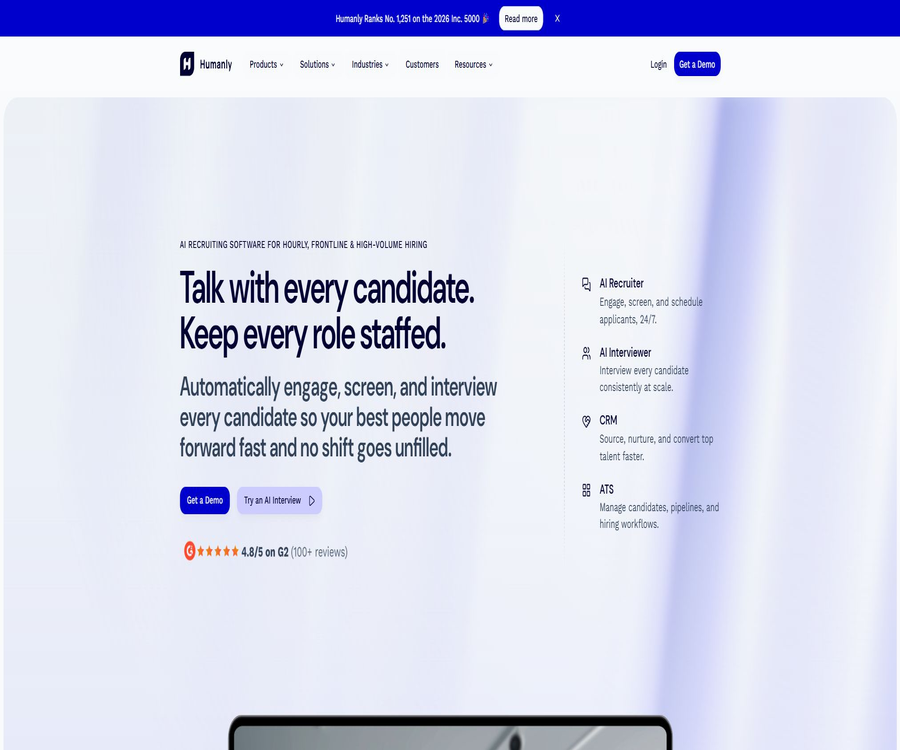
Humanly is an AI-based recruitment platform designed for temporary workers, positions in frontline roles, and large-scale hiring; it is operated by HumanlyHR Inc. The company was founded in Seattle and San Francisco in 2020, and its product focuses on using structured conversations to replace the manual questioning, screening, and scheduling processes that were used in earlier stages.
The platform includes AI Recruiter, AI Interviewer, a talent CRM system, and an ATS. It can be integrated with existing recruitment systems, and it also provides an integrated workspace for managing jobs, candidates, and process analysis.
A one-sentence summary
Humanly reaches out to candidates around the clock via text messages, emails, chats, voice calls, and video conversations; it handles the processes of screening, ranking, scheduling interviews, and then syncs the relevant records and results to the recruitment system.
Core functions
- Candidate engagement: Provide quick responses via text messages, emails, and chat after a application is submitted.
- Automatic filtering: Asks questions regarding qualifications, experience, and available time based on the job requirements.
- Intelligent sorting: Determines the degree of fit between candidates based on pre-set criteria.
- Automatic scheduling: Makes available calendar slots to eligible candidates.
- AI interviews: Structured preliminary interviews conducted via chat, voice, or video.
- Transcription and summary: Save the conversation text, the criteria for scoring, and key information.
- Talent CRM: Re-discover past candidates and carry out ongoing development of them.
- Recruitment ATS: Manage positions, sources, stages, notes, and team operations.
- Data analysis: Monitor reach speed, churn, sources, and recruitment cycle.
- System integration: Write the filtering, scoring, and elimination processes back into the existing ATS.
AI Recruiter
- A welcome message along with instructions for the next step are sent within a few seconds after the application is submitted.
- Answer common questions regarding positions and processes around the clock.
- Collect information on qualifications, location, shift schedule, and certifications according to the job workflow.
- Based on the candidate’s responses, the process is either approved, subject to manual review, or terminated.
- Automatically send reminders, rescheduling messages, and follow-up communications.
- Send qualified candidates straight to the scheduling process to reduce waiting time.
- Let recruiters dedicate their time to valuable conversations and hiring decisions.
AI Interviewer
AI Interviewer conducts structured interviews via chat, voice, and video, and it transcribes, summarizes, and scores the responses. The developers emphasize that the questions, evaluation criteria, and pathways for advancement are set by the recruitment team, and the AI’s results should be reviewed by human recruiters.
- Use consistent structured questions for the same position.
- Candidates can conduct asynchronous interviews at a time that suits them.
- Convert voice and video responses into searchable text.
- Generate candidate summaries, scores, and explainable reasons for recommendations.
- Keep a record of the conversations to facilitate review by the recruitment team.
- Enable high-capacity positions to cover more candidates in the initial round.
Talent CRM and Candidate Development
- Save candidate information, communication records, interview details, and past job history.
- Rediscover candidates who reached the later stages but were not hired.
- Create talent pools based on skills, location, intent, and interaction status.
- Send brand development activities via text messages and emails.
- Activate previous candidates when new positions become available.
- Reduce the need to acquire traffic from scratch for each recruitment process.
Humanly ATS
- Manage positions by team, role, or location.
- View the candidate stage, notes, and operation records in one place.
- Post job openings and track applications from various channels.
- Signals such as red, yellow, and green are used to indicate the degree of compatibility with the candidate.
- Set up process automation and real-time risk alerts.
- View application volume, first contact, churn, and recruitment cycle.
- Standardize the recruitment process for teams across multiple stores and locations.
Supported communication and interview methods
| Channels | Primary uses | Suitable scenarios |
|---|---|---|
| SMS | Immediate access, filtering, reminders, and confirmation | Part-time workers and candidates via mobile devices |
| Send instructions, cultivation, and formal notifications | Communication that requires more complete information | |
| Web chat | Apply for consultation and Q&A on qualifications | Career sites and job detail pages |
| Voice | Automated oral interview | Positions that require communication skills |
| Video | Asynchronous structured interview | Positions that require manual review of performance |
Tutorial on creating automatic filtering processes
- Choose a pilot position with a high number of applications and clear eligibility criteria.
- Identify the necessary requirements, additional points that can be awarded, and sensitive information that should not be asked about.
- Rephrase the question into a concise, structured query that is directly related to the work.
- Set rules for approval, review, rejection, and promotion for each response.
- Connect to the recruitment calendar and specify the available times and locations for appointments.
- Complete the SMS, messaging, and scheduling processes using an internal test account.
- Check whether the fields, scores, and status written back to ATS are correct.
- Launch on a small scale and review the churn rate and errors due to elimination on a weekly basis.
Configure AI interview tutorial
- Define job competencies and the observable behaviors for each competency.
- Set consistent core questions and limits for follow-up questions for all candidates.
- Develop a scoring scale and specify the criteria for high, medium, and low scores.
- Configure options for informing candidates, obtaining their consent, switching to a manual process, and handling appeals.
- Test the accent, noise, network interruptions, and accessibility scenarios separately.
- Have the recruiters conduct a blind review of the sample transcripts, summaries, and ratings.
- After calibrating the threshold, connect it to automatic scheduling or subsequent processes.
- Based on the results of ongoing random checks, AI scores are not considered the sole criterion for employment.
Deployment and go-live steps
- Count the number of positions, the monthly number of applications, the locations, and the existing tools.
- Apply to the authorities for a demonstration and provide the target process along with a list of integrations.
- Confirm that the scope of procurement includes AI Recruiter, AI Interviewer, CRM, ATS, or a combination thereof.
- Conduct assessments regarding security, privacy, accessibility, and employment laws.
- Connects ATS, calendars, email, and SMS channels.
- Import job rules, brand copy, and candidate notifications.
- First, conduct a controlled pilot on a single position or location.
- Expand the scope gradually based on candidate feedback and audit results.
Main integration
The integrated solutions that are currently in use and listed on the official product filtering page include Workday, iCIMS, Greenhouse, SAP SuccessFactors, UKG, Dayforce, Oracle Taleo, Avature, and Employ. The filtering results, scores, and any actions related to exclusion can be saved as system records; however, the specific fields involved in this two-way data exchange and the relevant versions need to be confirmed during the demonstration.
- ATS and HR systems: synchronize positions, candidates, statuses, and processing results.
- Calendar: Automatically reads the recruiter’s available hours and schedules appointments.
- Emails and text messages: used for reaching out, providing reminders, nurturing relationships, and rescheduling.
- Career Station: Offers chat and instant filtering at the application entry point.
- Analysis tools: Export recruitment funnels and operational metrics.
- Custom interfaces: Whether APIs or Webhooks are provided should be confirmed as part of the enterprise solution.
Which teams are suitable?
- Recruitment of part-time workers for multiple stores in retail, food service, and hospitality industries.
- Large numbers of job positions in logistics, transportation, warehousing, and aviation ground services.
- Recruitment of front-line staff for medical and home care.
- Production, cleaning, security, and on-site service teams.
- Companies with a limited number of recruiters but a high volume of applications.
- A recruitment operations team is needed to standardize the selection criteria across multiple locations.
- Companies that wish to activate past candidates rather than repeatedly purchasing traffic.
Typical use cases
- Candidates received an invitation for the screening shortly after submitting their applications late at night.
- Conduct a preliminary screening based on location, shift, credentials, and working hours.
- Qualified candidates can schedule an interview directly, without any back-and-forth communication via manual means.
- Handle hundreds or thousands of applications at the same time for seasonal hiring.
- Use a unified set of questions to conduct the initial interviews with candidates from multiple locations.
- It sends automatic reminders for interviews and reduces the rate of no-shows.
- Recontact previous high-quality candidates when new positions become available.
Scenarios that are not suitable for complete automation
- Final decision-making for executive, research, and highly specialized positions.
- Recruitment where the job requirements are vague or the criteria for success cannot be clearly defined.
- There are stages that require work evaluation, hands-on operation, or analysis of complex cases.
- Decisions that may involve accommodations for disabilities, medical needs, or other sensitive circumstances.
- Automatic elimination without any manual review, appeal, or alternative process.
- The laws in the region restrict processes that involve automated decision-making in employment matters.
Pricing method
The Humanly official website does not disclose a fixed monthly fee, nor the prices for the free version or standard packages; the way to place orders is through scheduling demonstrations. The cost is usually determined based on the modules required, the number of requests, the number of positions and locations, as well as the scope of integration, implementation, and support.
| Plan or module | Public price | Key capabilities | Purchasing tips |
|---|---|---|---|
| AI Recruiter | Contact sales | Reaching out, filtering, sorting, and scheduling | Confirm the monthly request volume and message costs |
| AI Interviewer | Contact sales | Structured interviews via chat, voice, and video | Confirm the number of interviews, storage, and transcription. |
| Talent CRM | Contact sales | Talent pool, rediscovery, and development | Verify the contact capacity and communication channels. |
| Humanly ATS | Contact sales | Positions, applicants, processes, and analysis | Confirm the number of users and the scope of implementation. |
| Combined or corporate solutions | Custom quote | Multiple modules, integration, and enterprise support | Compare the annual total cost with the minimum commitment amount |
What should be confirmed when requesting a quote?
- The fees are calculated based on the applicant, the interview, the position, the location, or the recruiter.
- Is there an additional charge for text messages, voice messages, video transcription, and storage?
- Are there a minimum annual fee, a minimum usage requirement, or multi-year contracts?
- Does the integration of ATS with the calendar include implementation costs?
- Are data migration, customized workflows, and training charged?
- How is billing handled when the number of candidates increases sharply?
- The process for exporting and deleting data after the contract ends.
- It supports response time, time to deployment, and service levels.
Suggestions for version selection
| Demand | Priority modules | Reasons |
|---|---|---|
| The existing ATS is available, but the initial screening process is too slow. | AI Recruiter | Retain system records and automate front-end processes |
| There are too many interviews in the first round. | AI Interviewer | Unify the issues and save the transcripts and scores. |
| Low utilization rate of historical candidates | Talent CRM | Establish a talent pool and provide ongoing training. |
| Lack of a recruitment system | Humanly ATS | Centralized management of positions, candidates, and analytics |
| End-to-end recruitment across multiple locations | Combination scheme | Reduce tool switching and data interruptions |
Fairness and human oversight
Humanly emphasizes issues such as consistency, identity masking, transparent scoring records, bias detection, and oversight of recruiters, drawing on Microsoft’s Responsible AI framework. Even if a product provides these mechanisms, employers remain responsible for setting job standards, making automated decisions, and respecting the rights of candidates.
- The issues must be directly related to job responsibilities and competencies.
- Protected features or their proxy variables must not be used for screening.
- Recruiters should be able to view transcripts, evidence, and reasons for scoring.
- For high-impact decisions, manual review and override permissions should be retained.
- Regularly compare the pass rates and error rates among different groups.
- Models, scales, or job roles should be re-validated after any changes.
- Explain the uses of AI to the candidates and provide contact persons.
Candidate privacy and data
Recruitment conversations may include resumes, contact information, work experience, recordings, videos, transcripts, and ratings; these constitute highly sensitive employment data. Before proceeding with such purchases, companies should examine the B2B privacy policy, processing agreements, sub-processors involved, rules regarding cross-border data transfer, retention periods, and mechanisms for data deletion.
- Only the information necessary for making a recruitment decision is collected.
- Do not ask about health, family, religion, or any other information that is not necessary for the job.
- Clarify the information provided and consent obtained for recording, video recording, transcription, and AI analysis.
- Restrict the access rights of recruiters, managers, and suppliers.
- Determine the retention and deletion schedules for candidate data that are to be eliminated.
- Establish procedures for accessing, correcting, deleting, and filing appeals.
- There should be notification and response mechanisms in place in the event of a security incident.
Product advantages
- Connect outreach, screening, scheduling, and interviews into a continuous process.
- It supports multiple communication methods such as text messages, emails, chat, voice, and video.
- Designed for part-time workers, as well as recruitment in field settings and across multiple locations.
- Structured questions and transcription help to review recruitment decisions.
- It can synchronize data with mainstream ATS and HR systems.
- Talent CRM enables the reuse of historical candidate assets.
- An ATS option is available for teams that wish to reduce the number of tools they use.
Product restrictions
- The official website does not disclose prices; a quote must be obtained from the sales team.
- The effectiveness of implementation depends on job rules, system integration, and process governance.
- AI scores can be affected by training data, questions, and speech recognition errors.
- Voice and video interviews may pose barriers for candidates with disabilities or those with limited equipment.
- Excessive automation can reduce candidates’ trust in the process.
- Employment, privacy, and AI-related regulations vary from region to region.
- Complex positions still require professional recruiters and business managers to make judgments.
- There are no standard free packages available in public resources that allow for self-testing.
APIs and open capabilities
The official website focuses on showing enterprise integration and result feedback; it does not provide information regarding the prices of public APIs or options for self-service key generation for all developers. Companies that need APIs, Webhooks, single sign-on functionality, or connections to data warehouses should include the required interfaces in the demonstration and contract confirmation lists.
GitHub and the open-source status
No official open-source code repository that can be verified in conjunction with HumanlyHR Inc. and its products was found. The chatbots and individual projects with the same name that appeared in the search results have no relation to this recruitment platform; therefore, they should be classified as proprietary SaaS solutions.
Basic information
| Project | Content |
|---|---|
| Tool name | Humanly |
| Operating company | HumanlyHR Inc. |
| Date of establishment | 2020 |
| Location of establishment | Seattle and San Francisco |
| Tool type | AI recruitment, AI interviews, talent CRM, and ATS |
| Primary users | High-capacity, front-line, and hourly worker recruitment teams |
| Price pattern | Schedule a demo and get a customized quote |
| Free package | Not disclosed |
| Public API | No self-service entry was found. |
| Open-source status | Not open source |
Recommendation score
Recommendation score: 4.2 / 5. Humanly is suitable for medium to large recruitment teams that need rapid access to candidates, structured screening, and automated scheduling; however, its pricing is not transparent, and the requirements related to fairness, privacy, accessibility, and human oversight in employment-related AI systems significantly increase the costs associated with procurement and governance.
Frequently Asked Questions
What does Humanly do?
It helps companies to automatically reach out to candidates, screen them, conduct interviews, and arrange appointments, while also providing CRM and ATS functionalities for talent management.
Is Humanly suitable for ordinary job seekers?
This section introduces enterprise recruitment platforms, whose main users are recruitment teams rather than individual job seekers.
Is there a free version of Humanly?
The official website does not offer a standard free version; companies usually need to schedule a demonstration and request a quote.
How much is it for humans?
There is no unified public price; the cost depends on the modules, the scale of recruitment, integration, as well as the scope of implementation and support.
Can it be connected to an existing ATS?
Yes, the official website lists various integration solutions that are in use, such as Workday, iCIMS, and Greenhouse.
Can AI directly eliminate candidates?
The system can carry out process actions according to the configured settings, but companies should maintain transparent standards, human oversight, and channels for candidates to file complaints.
Are voice and video interviews supported?
Yes, AI Interviewer enables structured interviews via chat, voice, and video.
Are interview records kept?
The platform will generate transcripts, summaries, and rating records; the specific retention period is determined by the company’s contract and privacy policy.
Are public APIs available?
No public self-service API interface was found; for enterprise interfaces, it is necessary to get confirmation from the authorities.
Is Humanly open source?
It is not open source, and there is no verifiable official repository for the product’s source code.
Tools similar to AI Recruiting Platforms for High-Volume Hiring



 Guigong Network Security Registration No. 45132202000164