






Docalysis
Docalysis – makes AI-based document processing more efficient and simpler.
Tags:AI document toolsWhat is Docalysis?
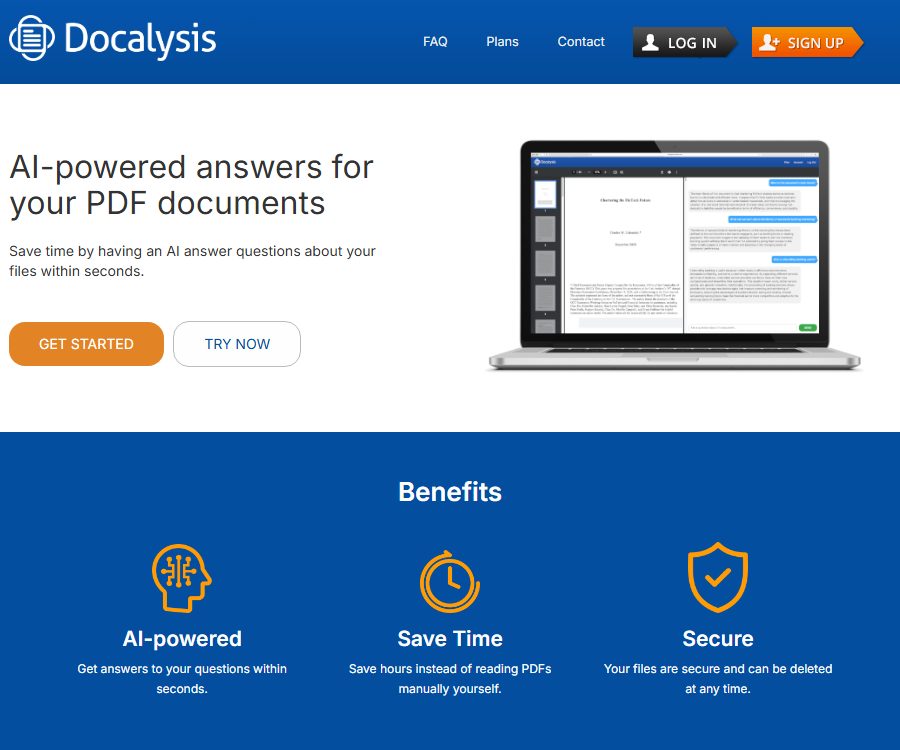
Docalysis is an AI-based document Q&A platform operated by a startup based in Mountain View, California, United States. After users upload a file, they can pose questions in natural language, and the system generates answers by drawing on the content of that document.
It is intended for those who need to read reports, contracts, research materials, and business documents quickly. The current service is powered by ChatGPT, but its responses may still overlook context or contain errors; it should not replace professional judgment.
Overview of main functions
| Functions | Enter | Output | Suitable for tasks |
|---|---|---|---|
| Single-file Q&A | PDF, TXT, CSV, DOCX | Natural language responses | Identify facts, understand terms, and extract information |
| Multi-file chat | Multiple files in the folder | Comprehensive answers across files | Compare reports and aggregate data |
| Public sharing | Files that are explicitly set to public. | A shared page available for others to ask questions on | Interpretation of public information and self-service inquiries for customers |
| Web embedding | Public documents or folders | Embedded component with document-based Q&A | Interactive knowledge resources on websites |
| Batch processing | A large number of files and persistent issues | CSV or ZIP containing TXT | Large-scale information extraction |
| API | API requests, files, and issues | Document operations and responses available in the program | Integration with internal processes and websites |
Document upload and AI Q&A
For regular Q&A, PDF, TXT, CSV, and DOCX formats are supported. After the file is uploaded and preprocessed, users can ask questions directly; the system will select the document context that is most relevant to the question and provide it to the model to generate an answer.
- Extract key information from financial reports such as revenue, risks, and management discussions.
- Search the contract for clauses regarding payments, renewal, termination, and liability limits.
- Ask about the research methods, sample, conclusions, and limitations of the paper.
- Classify, interpret, or perform targeted searches on the text records in CSV.
- Ask about the steps, conditions, and troubleshooting methods in the operation manual.
The accuracy claims made by Docalysis should not be regarded as guarantees of results. When making decisions related to law, finance, medicine, or compliance, it is necessary to refer back to the original text in order to verify the key figures, constraints, and context.
Multi-file chat
Users can move multiple files into the same folder and then initiate a chat for that folder. This allows for searching and comparing documents across them, without having to repeat the questions for each one individually.
- Create folders by project, client, or topic.
- Upload the documents that require joint analysis and wait for the preprocessing to be completed.
- First, inquire about the scope, date, and main content of each document to confirm that the system is identifying them correctly.
- Ask further questions related to comparison, summarization, or differences.
- Check each important answer against the corresponding original text.
The greater the number of files and the more similar their content is, the higher the likelihood that the response will mix up the files, dates, or entities involved. It is best to specify the document names, years, fields, and the desired output format in the question.
Public sharing and web embedding
By default, documents are accessible only to the account owner; others can ask questions about them through sharing pages only if the user decides to make them public. Public files or folders can also generate embed code that can be used on blogs or websites, and it’s possible to hide the content of those files.
- Suitable for public reports, product manuals, event materials, and help documents.
- Customer contracts, identification documents, unreleased financial reports, and internal strategies should not be uploaded publicly.
- Hiding the content of a file does not mean that the file itself becomes private; its public status still needs to be checked separately.
- After sharing is completed, the public access should be removed, and it should be checked to ensure that anonymous access is disabled.
Embedding capability is a feature of web components; it does not equate to providing native mobile applications or browser extensions. The main way in which it is currently used is on web pages within browsers.
Batch file processing
Batch services are designed for unified Q&A tasks involving hundreds or thousands of files. Customers upload the files and their questions using cloud storage services such as OneDrive and Google Drive, and the team processes them to provide structured results.
| Project | Current rules | Precautions |
|---|---|---|
| Enter | Common formats such as PDF, CSV, TXT, DOC, etc. | The specific format and scanning quality need to be confirmed in advance. |
| Problem | Run one or more fixed checks on each document. | The number of issues affects the quote. |
| Output | CSV, or a ZIP with one TXT file for each input. | It is necessary to specify the fields, missing values, and abnormal formats. |
| Scale | It can handle hundreds or thousands of files. | Services that are part of the coordinated team effort. |
| File suggestions | About 50MB, up to 1500 pages | It’s not a strict upper limit; very large documents make it more difficult to provide answers. |
| Price | Custom quote | It depends on the number of files, the number of issues, and the custom logic. |
Batch processing is not simply a self-service option for unlimited uploading. For real projects, it is necessary to first use representative samples to test field definitions, accuracy, error handling, and rules for rework.
API integration
Docalysis offers APIs for programs, scripts, and websites. Developers can use API keys to carry out operations such as file creation and uploading, chatting, deletion, information retrieval, listing, updating, as well as directory-based chatting and batch queries.
- Register an account and create an API key on the key management page.
- Store the keys securely on the server side; do not include them in the frontend code or in public repositories.
- First, upload the test file and record the file identifier and processing status returned.
- Send chat requests and handle errors, timeouts, and insufficient quotas.
- Set concurrency, retry counts, and cost limits for directory or multi-task operations.
- After the processing is complete, delete the files that are no longer needed and record the results of those deletions.
Points used by API accounts: 1 point is consumed per query, and points are deducted based on the number of queries. Monthly points can be obtained through subscription, or additional points can be purchased; enterprises with high usage levels should contact the team to discuss commercial solutions.
The capabilities boundaries of the API
- The public documentation describes the network API; it does not mean that an official SDK exists.
- The fact that example code is available for reading does not mean that the Docalysis product is open-source.
- The caller is still responsible for implementing permissions, auditing, rate limiting, and result verification.
- Interfaces, quotas, and error formats may change; monitoring and fallback mechanisms should be in place for production integration.
Language support
Docalysis understands multiple languages, including English, Spanish, Portuguese, French, Italian, Chinese, Japanese, Korean, Arabic, Indonesian, Hindi, and Urdu. Once the user starts a conversation in the target language, the system will attempt to switch automatically.
\"Support for multiple languages\" does not mean that all languages, technical terms, and documents with mixed languages will be handled in the same way. Before actual use, it is necessary to test the accuracy of responses, the format of numbers, and proper nouns using real samples.
Prices and packages
| Package or version | Price | Billing cycle | Core benefits or quota | Suitable for users |
|---|---|---|---|---|
| Free | $ | Refreshed monthly | 5MB per file, 600 pages per month, 150 pages per file, 50 Q&A points per month, multi-file chatting | Light experience and occasional viewing |
| Plus | 14 dollars per month | Monthly or annual payment | 20MB per file, 3,000 pages per month, 600 pages per file, 500 Q&A points per month, multi-file chatting, email support | Individual professional users |
| Ultimate | 35 dollars per month | Monthly or annual payment | 50MB per file, 8,000 pages per month, 1,800 pages per file, 1,500 Q&A points per month, multi-file chatting, email support | High-frequency document analysis |
| Business | Custom quote | Negotiation | Customize file, page, and Q&A quotas; team management, shared storage, and phone support | Organizations and large-scale projects |
Each successful document chat message costs 1 point; warnings or error messages do not deduct any points. The monthly point balance is updated on the date the free account was created or on the date of the paid subscription. Once the points are used up, one can wait for an update, upgrade the account, or purchase additional points.
The page offers an annual payment option and indicates the overall discount, but the section showing the price for annual payment varies across different displays. The prices, taxes, annual discount, and the value of additional points should be based on those shown on the settlement page after logging in.
Subscription, cancellation, and refunds
Paid plans can be modified, upgraded, or replaced; these changes take effect immediately, and the corresponding fee difference will be charged or deducted. Upon cancellation, the plan is downgraded to the free version at the end of the current billing cycle. Existing files remain intact, but uploading more files may not be possible if it exceeds the new limits.
The terms of service state that, unless required by law, purchases are generally non-refundable. Before making a payment, it is necessary to verify the renewal date, the annual payment commitment, any unused credits, and the consumer rights applicable in the respective region.
Privacy, security, and data retention
By default, the file is accessible only to the person who uploaded it; users can choose to make it public. FAQ states that the documents are stored in Amazon S3, but security measures cannot eliminate all risks of leakage, misconfiguration, or account theft.
- By default, documents are stored indefinitely, and users can delete them manually at any time.
- Organizations that require a fixed retention period must contact the team separately to confirm this.
- SOC 2 is still in the process of being obtained; it cannot yet be said that compliance certification has been achieved.
- The privacy policy covers the collection of information such as account details, device information, browser details, IP addresses, server logs, and usage patterns.
- Payment card information is stored by Stripe; Docalysis does not store the full details of the cards directly.
- In cases involving mergers and acquisitions, legal actions, or service providers, some information may be transferred or disclosed.
The date indicated on this page of the privacy policy is March 2023; it does not provide detailed information regarding how the document content will be stored, which data will be excluded from training processes, and what measures will be taken in terms of data handling after it is handed over to the model provider. Before uploading sensitive or regulated data, it is necessary to obtain the latest data processing agreement, a list of sub-processors, proof of deletion, and statements confirming compliance with relevant regulations.
Copyright, Content, and Commercial Use Notes
The user or the respective rights holder retains ownership of the concepts, opinions, and rights contained in the uploaded content, and must ensure that they have the authority to submit such materials. These terms grant Docalysis a permanent, global, non-exclusive, and royalty-free license to reproduce the content for the purpose of providing, displaying, utilizing, or promoting its services; sensitive commercial materials must first undergo legal review.
- It is not allowed to upload content that is infringing, illegal, fraudulent, malicious, or intended to harm others.
- Reverse engineering, interfering with the service, making excessive automated requests, or studying the platform for competitive purposes are not allowed.
- It is prohibited to resell or redistribute the platform’s services and content without permission.
- Users should verify the answers generated by AI on their own and assume the business risks associated with relying on those results.
- The platform can suspend or close accounts, and important documents and results need to be backed up separately.
Platform, API, and open-source status
| Project | Current status | Explanation |
|---|---|---|
| Web application | Already provided | The main entry points for uploading, asking questions, sharing, and account management |
| Web embedding | Already provided | Public documents or folders can be embedded on a website. |
| API | Already provided | Use API key and account credits |
| Official SDK | Not confirmed yet | Having example code does not mean that the SDK is released. |
| Native mobile or desktop apps | Not confirmed yet | Currently, web services are the main focus. |
| Browser extensions | Not confirmed yet | No verifiable official extensions were found. |
| Product source code | Not disclosed | Commercial cloud services are not open-source products that can be identified as such. |
Suitable for users and scenarios
- Financial analysts: Quickly locate data and risks in financial statements, 10-K reports, and research studies.
- Lawyers and contract team: Identify the relevant clauses, compare different versions, and prepare a preliminary review checklist.
- Researchers: Extract the methods, conclusions, limitations of papers, as well as the differences among various documents.
- Accounting and Insurance team: Extracts fixed fields from large volumes of business documents.
- Content and support team: Embed the public manual on the website to allow visitors to ask questions.
- Development team: Integrate document Q&A into internal tools or customer workflows via APIs.
Advantages and usage limitations
Main advantages
- It supports single files, multiple files, public sharing, embedding, batch processing, and APIs.
- It supports four common document formats and multiple dialogue languages.
- The free version allows you to test the core document chat functionality without the need for a subscription.
- Batch processing can organize the fixed-issue results of a large number of files into CSV format.
- Account packages and APIs share the same points, facilitating small-scale integration.
Main limitations
- AI responses may contain omissions, misinterpretations, or fabrications, and should not be used as final conclusions.
- The free version offers fewer files, a limited number of pages, and less points for questions.
- There is no clear and public explanation regarding the OCR capabilities for scanned documents, image understanding, and handling of complex tables.
- By default, files are stored indefinitely, which makes them unsuitable for uploading sensitive data without first conducting an evaluation.
- SOC 2 has not yet been completed, and the version of the privacy policy is outdated.
- No official SDKs, native applications, extensions, or open-source code for the product have been identified.
Frequently Asked Questions
Is Docalysis free?
There is a free version that provides 600 pages for uploading per month as well as 50 Q&A credits; however, there are limits on the size of individual files and the number of pages. For higher quotas, one needs to opt for the Plus, Ultimate, or Business plans, or acquire additional credits.
Which file formats are supported?
Regular document chatting clearly supports PDF, TXT, CSV, and DOCX formats. The batch processing service also lists common formats such as DOC; it is necessary to verify whether the specific files can be parsed reliably before starting a project.
Can multiple files be queried at the same time?
Yes. By placing the files in the same folder, it’s possible to conduct multi-file chats using that folder.
Can I put the Q&A on my own website?
Yes, but the file or folder must first be set to public before the embedding code can be obtained. Sensitive content should not be embedded in a public manner.
How are APIs priced?
The API uses account credits; 1 credit is consumed per query, and additional credits are deducted for each further query. It is possible to subscribe to packages, purchase extra credits, or contact the company for a quote.
How long are uploaded files stored?
By default, the data is stored indefinitely; users can delete it manually. If automatic deletion or a fixed retention period is required, written confirmation from the team must be obtained prior to uploading.
Has Docalysis achieved SOC 2 certification?
It cannot be expressed in that way. The current situation is that compliance with SOC 2 is being achieved, and if necessary, customers can be provided with proof of participation in this compliance process.
Is Docalysis an open-source project?
It is not an open-source product that can be confirmed as such. The provision of APIs and example code does not mean that the platform’s source code, SDKs, or models are made available.
Can I get a refund after making the payment?
The terms state that, unless required by law, purchases are generally non-refundable. Before subscribing, it is necessary to check the payment cycle, the effective date for cancellation, and the consumer rights in the relevant region.
Is it suitable for uploading confidential contracts or customer data?
It should not be assumed to be suitable outright. First, verify the retention period, model data processing, sub-processors, access controls, deletion proof, and organizational compliance requirements before deciding whether to use it.
Summary
Docalysis is suitable for individuals and teams who need to quickly read documents through dialogue, and who wish to handle multiple files, batch tasks, or use APIs. Before adopting it, it is important to verify the accuracy of the responses, the limits set by the subscription plan, the permissions for sharing content publicly, and the data-related risks associated with indefinite storage by default.
Tools similar to Docalysis



 Guigong Network Security Registration No. 45132202000164