






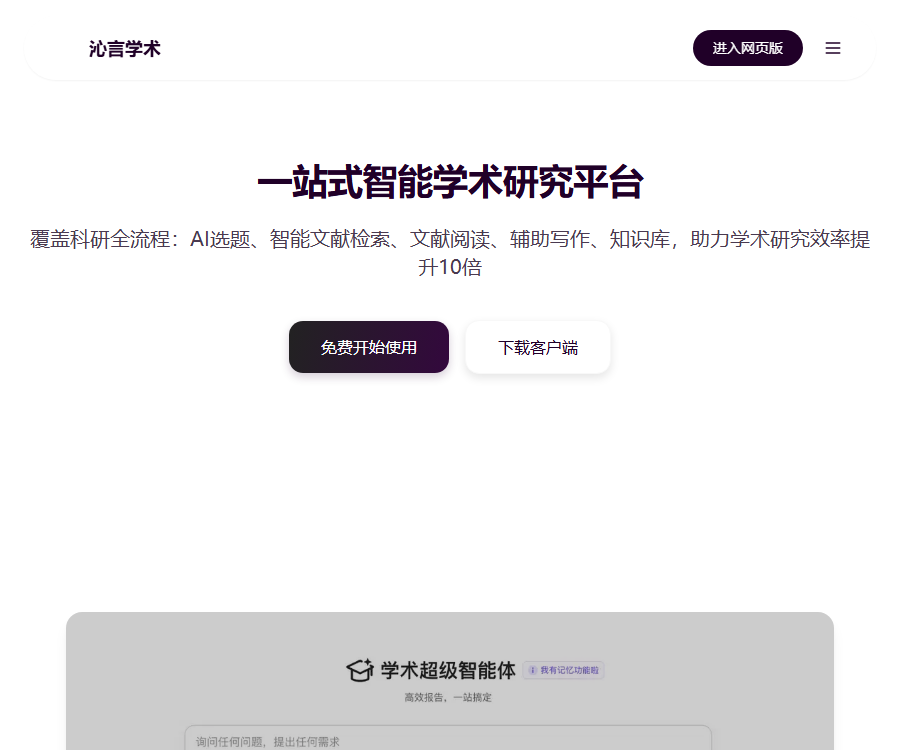
Qinyan Academic
It integrates various functions such as document management, literature analysis, writing assistance, and intelligent collaboration, with the aim of helping users efficiently carry out the entire academic process, from data collection and organization to analysis and final drafting.
Tags:AI document toolsWhat is Qinyan Academic?
Qinyan Academic is a one-stop AI academic research platform operated by Beijing Jiansheng Technology Co., Ltd.
It connects topic selection, retrieval, reading, knowledge management, writing, citation, and result presentation into a complete research workflow.
Main functions
- Use academic super-intelligences to plan tasks.
- Generate topic directions and research questions.
- Search for academic literature in Chinese and English.
- Read PDFs and answer questions related to the literature.
- Create an AI cloud drive and a personal knowledge base.
- There are quite a number of papers and research methods.
- Manage citation and reference formatting.
- Assist with writing, editing, and translation.
- Generate academic charts and AI PPTs.
- Conduct patent searches and provide insights into emerging trends.
- Use team collaboration and document comparison.
- Measure AI function consumption through QinDian.
Academic Super Intelligence Agent
After the user describes their research needs, the agent can plan the steps for retrieval, analysis, and organization of content, as well as coordinate different academic capabilities.
| Expert role | Main tasks | Human liability |
|---|---|---|
| Literature search | Multiple rounds of searching for candidate literature | Verify the database and the original text |
| In-depth research | Analysis of problems and research directions | Evaluating the rationality of theories and methods |
| Innovative topic selection | Identify new issues and cross-cutting perspectives | Confirm innovation and feasibility |
| Method learning | Evaluate samples, data, and statistical approaches | Ultimately designed by the researchers. |
| Academic polishing | Improve language and paragraph cohesion | Maintain the original meaning and authorial responsibility |
| Simulated peer review | Point out the advantages, disadvantages, and issues. | It cannot replace genuine peer review. |
AI topic selection and research design
The topic selection module allows one to start from disciplines, keywords, and research interests in order to analyze possible directions, existing gaps in research, and potential methods.
- Indicate the discipline and the specific subject of study.
- List the existing theories and core concepts.
- It explains the data and samples that are available.
- It is necessary to distinguish between hot topics and genuine research gaps.
- Search for recent reviews and representative original articles.
- Assess the innovation and feasibility of the problem.
- The topic will be determined after discussion with the supervisor or collaborators.
- Save the reasons for selecting the topic and the records of modifications.
Intelligent literature search
The platform allows for the search of literature based on research questions, and it filters potential results using tags, relevance, and academic information.
- Use both Chinese and English keywords simultaneously.
- Add synonyms, abbreviations, and keywords.
- Set the year, discipline, and document type.
- Give priority to reviewing systematic reviews and high-quality studies.
- Record the database, search query, and search date.
- Open the original text to check the title and author information.
- Do not rely solely on the list of documents generated by AI.
Literature reading and Chat PDF
Users can ask questions next to the literature, and the AI will summarize the research questions, methods, results, limitations, and relevant excerpts.
| Reading task | Suitable for asking questions | Key points for verification |
|---|---|---|
| Quick Overview | What are the research questions and the main conclusions? | Original abstract and conclusions |
| Method extraction | How to design samples, variables, and models | Methods section and supplementary materials |
| Result understanding | What are effects, significance, and margins? | Tables, charts, and statistical units |
| Restricted analysis | The author acknowledges which limitations exist. | Discussion and Limitations Section |
| Quote excerpt | On which page can I find the relevant discussions? | Page numbers, context, and original text |
| Cross-literature comparison | What are the similarities and differences between methods and conclusions? | Check the evidence piece by piece. |
AI cloud storage and knowledge base
AI cloud storage is used to save documents, notes, and research materials, turning them into a searchable personal academic knowledge base.
- Create separate folders for each topic and project.
- Standardize file names and version dates.
- Add DOI, author, and journal information.
- Add page number notes to the key evidence.
- Distinguish between raw data and processed results.
- Remove duplicate or incorrect versions of the literature.
- Important documents should still have a local backup.
Literature review workflow
AI can help classify topics, compare viewpoints, and generate structures, but the conclusions of a review must be based on original documents verified by researchers.
- Define the review questions and inclusion criteria.
- Record the complete search query and the database.
- Remove duplicate and irrelevant results.
- Read the original text and extract the unified fields.
- Classify by theory, method, or results.
- Let AI identify consensus, conflicts, and gaps.
- Review each item in turn and summarize the corresponding evidence.
- A critical synthesis is carried out by the researchers.
- Organize citations and references in accordance with the standards.
Assisted writing
The writing area allows for the creation of outlines, the organization of paragraphs, expansion of content, polishing of text, and adjustments to the way it is expressed, all with the help of a knowledge base and reference materials.
- First, the researcher determines the core argument.
- Each paragraph addresses only one clear issue.
- Answers are required to cite existing materials.
- Do not let AI generate an entire paper at once.
- Verify each piece of data, fact, and citation.
- Preserve personal analysis and original contributions.
- Document the scope and manner of AI involvement.
Citation management
The platform offers citation management and various reference formats, making it suitable for organizing bibliographies and reducing the need for manual formatting adjustments.
| Stage | Purpose of the tool | Key points of inspection |
|---|---|---|
| Catalog import | Collect author, title, and publication information. | Verify the DOI and document type. |
| Text citation | Insert the corresponding citation. | Whether the citation truly supports the argument |
| Format switch | Adjusting the standards of different journals | Follow the submission guidelines. |
| References list | Unified sorting and punctuation | Check for missing items and duplicates. |
| Export migration | Connect to other literature tools | Test character and field integrity |
Translation and academic polishing
Translation and polishing can help improve grammar, terminology, and the flow between paragraphs, but they cannot alter the experimental results or the author’s original intent.
- Create a unified glossary of terms.
- Retain the original wording of the key concepts.
- Check the numbers, units, and symbols sentence by sentence.
- Avoid changing cautious conclusions into definitive ones.
- Check the reference and figure numbers.
- Submissions that are not in the native language can be reviewed by a professional.
- Comply with the AI usage policies of the target journal.
Data analysis and academic plotting
The platform offers tools for data analysis and image generation, which can help in understanding trends, creating charts, or designing schematic diagrams.
- Retain the original data as it is, without any modifications.
- Explain the meaning of the variables, their units, and missing values.
- Clearly state the purpose of the analysis and the statistical hypotheses.
- Let AI explain each processing step.
- Use independent tools to verify the key results.
- Check the legend, coordinates, and significance markers.
- Save scripts, parameters, and data versions.
- Do not allow AI to generate fictitious experiments or statistical results.
AI PPT and result presentation
AI PPT is suitable for organizing the research background, methods, results, and conclusions into presentations for project introductions, team meetings, or defenses.
- Only one key piece of information is displayed on each page.
- Charts take precedence over long paragraphs of text.
- The methods correspond to the results.
- All data indicate the necessary source.
- Avoid using unverified AI-generated images.
- Before the defense, check the logic and terminology page by page.
- Prepare the original evidence that may be questioned.
Qinyan Academic Usage Tutorial
- Register via a web page, client, or mobile device.
- Upon first login, you will receive free Qi points and storage space.
- Create project folders and a knowledge base.
- Use the topic selection module to generate potential research directions.
- Use Chinese and English search terms to find literature.
- Save important original texts to the AI cloud storage.
- Extract structured notes through literature Q&A.
- Evidence and methods from a relatively large number of studies.
- Create an outline for the paper as confirmed by the researchers.
- Use assisted writing to progress through the draft section by section.
- Standardize citations, terminology, charts, and formatting.
- Complete fact verification and academic integrity checks.
Prices and official website membership packages
The official website offers five plans: Free, Plus, Pro, Max, and Ultra. The main differences lie in the number of touch points, cloud storage options, and collaboration features.
| Plan | Monthly fee for the official website | Qin Dian | Cloud storage | Collaboration |
|---|---|---|---|---|
| Free | Free | 100 points for the first login | 2GB | Basic functions |
| Plus | ¥49/month | 1000 points/month | 60GB | Personal use |
| Pro | ¥99/month | 2,000 points/month | 100GB | Professional competence |
| Max | ¥249/month | 5,000 points/month | 200GB | Team collaboration |
| Ultra | ¥999/month | 20,000 points/month | 1TB | Team collaboration |
QinDian is the platform’s universal points, used for functions such as AI-driven writing, academic searches, Chat PDF, and translation; different operations require different amounts of these points.
In-app purchase prices on the App Store in China
The Apple channel also offers quarterly, annual, trial, Qindian, and cloud storage plans for individual purchase; the prices for these are not exactly the same as those of the monthly plans available on the website.
| Project | App Store reference price | Explanation |
|---|---|---|
| Pro experience membership for three days | ¥9.90 | Short-term trial |
| Plus Monthly Membership | ¥49 | Monthly usage |
| Plus Quarterly Membership | ¥99 | Three-month plan |
| Plus Annual Membership | ¥239 | Annual plan |
| Pro monthly membership | ¥99 | Professional monthly plan |
| Pro Annual Membership | ¥699 | Professional annual plan |
| 1000 Qindian | ¥50 | Add points separately |
| 1GB of cloud storage for half a year | ¥12 | Storage expansion |
| Expert Edition Annual Pro | ¥5988 | The specific benefits are subject to those stated on the purchase page. |
How to choose a membership
| User information | Suggested solution | Key points for judgment |
|---|---|---|
| Check literature occasionally | Free | First, assess the consumption of Qi points. |
| Regular courses and papers | Plus | Storage and monthly usage |
| High-frequency scientific writing | Pro | Advanced features and Qindian |
| Project team | Max | Member collaboration and permissions |
| Large-scale long-term projects | Ultra | High credit limit and 1TB of storage |
| Institutional users | Consult universities or companies for solutions | Unified authentication and resource permissions |
Supported platforms
| Platform | Support status | Explanation |
|---|---|---|
| Web page version | Support | Complete scientific research workstation |
| Desktop client | Support | The specific system requirements are listed on the download page. |
| iPhone | Support | Requires iOS 13.0 or higher |
| iPad | Support | Requires iPadOS 13.0 or higher |
| Mac with Apple chip | Supports mobile apps | Requires macOS 11.0 or higher |
| WeChat Mini Program | Support | Suitable for use as a helper on mobile devices |
Boundaries of academic integrity
The official disclaimer explicitly states that AI-generated content should be used only as a reference and cannot be submitted as academic work.
- The research questions and conclusions are the sole responsibility of the author.
- AI must not generate fake data, experiments, or interviews.
- Each reference must be checked by consulting the original source.
- The citation must accurately reflect the original author’s views.
- Record the tasks in which AI is involved and the scope of the modifications.
- Comply with the disclosure policies of schools, funds, and journals.
- Polishing cannot conceal plagiarism or academic fraud.
Verification of the reliability of sources
Even though the platform emphasizes tracing the sources, users still need to verify the correspondence between the bibliographic references, the original text, page numbers, and the conclusions.
- Check the author, title, journal, and year.
- Open the original text via DOI or a database.
- Confirm the page number and context where the cited content is located.
- Distinguish between preprint versions and officially published versions.
- Check the records of withdrawals, corrections, and expressions of concern.
- Do not cite entries that cannot be obtained or verified.
- Save the version of the document that will be used in the end.
Privacy and research data
The official privacy policy states that the platform may process registration information, device logs, documents uploaded by users, and research data.
- Unpublished papers and experimental data are anonymized first.
- Do not upload personal identification or patient information.
- Ethical approval is required when dealing with data from human subjects.
- Project collaboration documents require authorization from the team.
- Check cloud disk sharing and team member permissions.
- Important data is also saved as an encrypted local backup.
- Export and delete unnecessary data before disabling the account.
API and open-source status
The privacy policy mentions the use cases for SDKs and APIs, but so far no interface documentation intended for the public, key application pages, or official SDKs have been found.
| Project | Open status | Explanation |
|---|---|---|
| Qinyan Academic Platform | Not open source | Managed research services |
| Public API | Not yet made public | The developer console was not found. |
| Official SDK | Not yet made public | Mention in the privacy policy does not equate to public access. |
| Official GitHub | Not confirmed yet | No verifiable repository found. |
| Institutional integration | Contact the official authorities. | Subject to the agreements between the school or company. |
Which users are it suitable for
| User | Typical requirements | Recommended features |
|---|---|---|
| Undergraduates | Course paper and introductory search skills | Free and basic tutorials |
| Master’s student | Topic selection, review writing, and paper drafting | Search, reading, and citation management |
| Doctoral student | Cross-literature comparison and long-term knowledge base | In-depth research and AI cloud storage |
| University teachers | Presentation of topics, papers, and results | Agents, writing, and AI PPT |
| Research team | Data sharing and team collaboration | Max or Ultra |
| Institutional libraries | Unified scientific research tool services | Consulting agency collaboration plan |
Product advantages
- It covers the entire research process, from topic selection to the presentation of results.
- Combining literature search, reading, and knowledge bases.
- It provides collaboration among multi-role academic intelligent agents.
- It supports citation management and document comparison.
- It is available in web, client, and mobile formats.
- The feature set ranges from the free version to the team version, with a complete set of functions in all tiers.
- The authorities provide free tutorial courses for all sections.
Usage restrictions
- AI-generated content cannot be submitted as academic work.
- The literature and citations still need to be checked against the original sources.
- Different AI operations consume different amounts of energy.
- There is a difference in prices between the website and Apple’s channels.
- Uploading research documents involves risks related to privacy and confidentiality.
- The institutional rights are influenced by the scope of school collaborations.
- No public APIs or official open-source code have been identified.
Frequently Asked Questions
What can Qinyan Academic mainly do?
It covers AI topic selection, literature search and reading, Chat PDF, knowledge bases, writing assistance, translation, citation management, data analysis, and AI PPTs.
Is Qinyan Academic free?
The Free plan is free of charge; upon first login, users receive 100 Qian points and 2GB of storage. For frequent use, users can choose from the Plus, Pro, Max, or Ultra plans.
How much is the membership fee for Qin Yan Academic?
The monthly fees for the official website are 49 yuan for Plus, 99 yuan for Pro, 249 yuan for Max, and 999 yuan for Ultra; the Apple channel offers quarterly and annual plans as well.
What is Qindian?
QinDian is the platform’s universal points, used for functions such as AI-driven writing, academic searching, Chat PDF, and translation; different tasks require different amounts of these points.
Can Qinyan Academic write papers on behalf of clients?
No, officials require that AI-generated content be used solely as a reference for research; it cannot be submitted as an academic work on its own. The final version of the content must be verified and taken responsibility for by the researcher.
Which platforms does Qinyan Academic Support cover?
It is supported on the Web, desktop clients, WeChat mini-programs, iPhone and iPad; Macs with Apple chips can also run compatible mobile applications.
Does Qinyan Academic provide APIs or open-source code?
To date, no public API documentation, official SDK, or verifiable GitHub repository has been found; therefore, the platform should be considered a non-open-source service.
Tools similar to Qinyan Academic.




 Guigong Network Security Registration No. 45132202000164