






Digital Ark, LLC
Digital Ark, LLC – makes AI-driven document processing more efficient and simpler.
Tags:AI document toolsWhat is AskMyDocs currently?
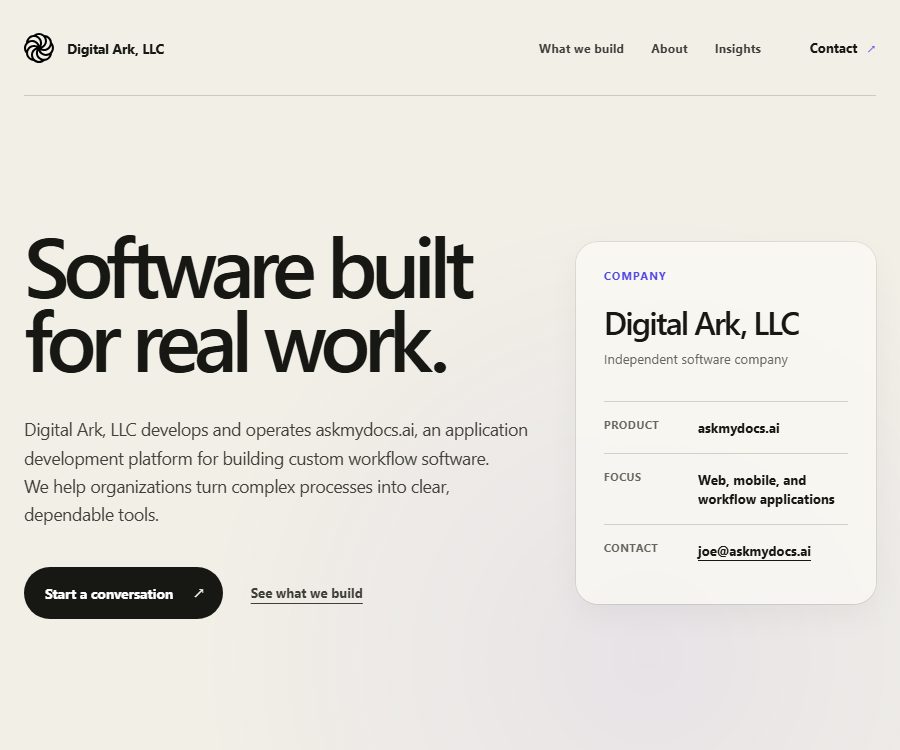
AskMyDocs is an application development platform currently developed, owned, and operated by Digital Ark, LLC. Its focus is on converting operational procedures, business rules, and technical processes into customized workflow software. Its target users include laboratories, testing operations teams, those responsible for system record management, as well as teams involved in scientific instrumentation and process-intensive activities.
The current site no longer describes the product as a public-facing AI Q&A tool; instead, it offers workflow design, web and mobile tools, as well as system integration. The company names in the database and the product domain names point to the same operating entity, but users tend to use AskMyDocs when searching.
What changes have occurred in the product’s status?
The old search results still show information on document Q&A, Slack, Zendesk, knowledge base bots, and self-service subscriptions, but these pages are no longer part of the current product structure. The existing homepage does not provide access to log in to the older versions of these bots, upload documents, use the free Q&A service, or purchase packages.
- The old version of AI’s document Q&A capability cannot be considered as something that is still being sold or in use today.
- Historical prices and features in third-party catalogs cannot serve as a basis for making a purchase decision.
- Older Slack or Zendesk app pages do not indicate that the integration is still supported.
- Customers with needs related to account migration or historical accounts should contact Digital Ark directly for confirmation.
Current main services
| Service direction | Receive information | Delivered results | Suitable scenarios |
|---|---|---|---|
| Workflow applications | Operating procedures, business rules, roles, and exception handling processes | Software developed around practical steps | Approval, sampling, testing, and operational processes |
| Web and mobile tools | User tasks, usage environment, and permission requirements | Custom web pages or mobile apps | On-site operations, internal systems, and customer tools |
| System integration | Application, instrument, database, and interface information | Reliable data exchange and state synchronization | Connection between laboratory instruments and recording systems |
| Process optimization | Repeated data entry, errors, and manual workarounds | Verification, automation, and traceable status | Reduce operational errors and communication costs |
Workflow design methods
Digital Ark emphasizes understanding first how the work is to be carried out, before deciding on the pages and functions needed. For a project, it is usually necessary to identify the inputs, the final results, the person responsible for each step, the information required, the boundaries of the system, and the points where responsibilities are transferred.
- Determine where the process begins with respect to its inputs, and what state represents true completion.
- List the actions, decisions, information needs, and system permissions for each role.
- Log abnormal situations such as missing information, duplicate records, equipment failures, and additional audits.
- Set clear statuses, responsible persons, and next steps for normal and abnormal paths.
- First, create the smallest complete process that can operate end-to-end, and then expand it gradually.
- Test speed, accuracy, and recovery paths through real-user testing.
This approach is suitable for scenarios with many rules, numerous exceptions, and clear boundaries of responsibility. Teams whose requirements are not yet fixed or those that simply want to use standard SaaS solutions right away may need to compare existing products first.
System and instrument integration
In laboratories and process-oriented organizations, data may pass through instruments, internal applications, system records, and manual reviews. AskMyDocs’ current services focus on maintaining identity, context, responsibility, and traceability across systems, rather than merely copying fields.
- It is necessary to determine which system is responsible for creating the data, which system manages the processes, and which system stores the final records.
- Maintain a consistent correspondence between sample, request, equipment, personnel, and task identifiers.
- It saves the data creation time, original location, as well as the status of modifications and approvals.
- Design recovery procedures for network disruptions, offline devices, delayed data, and duplicate records.
- Use safe retries, repeated detection, visible error status, and manual handling options.
How to reduce operational errors
The current product philosophy is not to simply add warning boxes and approval steps, but rather to make the correct actions clearer and easier to carry out. Different control methods should be employed for errors that can be prevented, errors that require verification, and anomalies that are unavoidable but can be resolved.
- Reduce unnecessary input by offering limited options and automatic filling.
- Connect to existing systems to avoid re-entering data repeatedly across labels, tables, and applications.
- Verification is completed at the time of making the decision, along with an explanation of the reasons for the errors and the methods to correct them.
- Turn exceptions into explicit states; do not hide them in free-text or chat records.
- Allow the team to see at any time what has been completed, what is still pending, who is responsible for the next steps, and the reasons for any delays.
Typical project workflow
- Contact Digital Ark to describe the organization, existing systems, user roles, and business challenges.
- Work together to outline the complete workflow, exception paths, data ownership, and compliance requirements.
- Determine the minimum deliverable scope, integration boundaries, acceptance criteria, and timeline.
- Build and validate the end-to-end process, then integrate it with real instruments or systems.
- It is tested by actual operators, with errors, delays, and manual workarounds being recorded.
- Go live after completing permissions, security, backup, recovery, and operational handover.
- Add features based on operational data, rather than stacking all requirements at once.
Price and procurement methods
| Package or version | Price | Billing cycle | Core benefits or quota | Suitable for users |
|---|---|---|---|---|
| Custom workflow software and integration | Custom quote | By project or contract | The scope, deliverables, support, and hosting methods are determined through negotiation. | Organizations with clear process requirements and needs for system integration |
At present, there is no public free version, trial quota, fixed subscription price, or standard corporate package available. The prices for the older version of AI document Q&A may no longer be valid; when making a purchase, it is necessary to rely on the current written quotes, service specifications, and contract terms.
The contract should specify changes to requirements, third-party costs, ownership of the source code, methods of deployment, acceptance procedures, defect correction, maintenance response times, conditions for termination, and refund policies. Features or timelines that are not mentioned in the contract should not be assumed to be included.
Platform, API, and open-source status
| Project | Current status | Explanation |
|---|---|---|
| Web application development | Available for provision | Customized according to the specific workflow |
| Development of mobile tools | Available for provision | The specific platform and method of publication need to be discussed. |
| System and instrument integration | Available for provision | Depends on the target system’s interfaces and permissions. |
| Public platform APIs or SDKs | Not yet made public | No documentation for self-service developers was found. |
| GitHub source code | Not yet made public | Product code repository not confirmed |
| Open-source status of the product | Closed-source open-source products | The rights related to customized delivery should be specified in the contract. |
| Native applications or extensions of one’s own | Not confirmed yet | Do not confuse it with custom mobile tools. |
The fact that a system can be connected does not mean that there is a public API available for use by all developers. The specific interfaces, data models, deployment code, and reuse rights must be specified in the project plan.
Privacy and security considerations
The current website’s privacy policy applies only to the contact form: names, email addresses, and messages may be collected in order to respond to inquiries and discuss potential projects. Digital Ark states that it does not sell personal information; infrastructure providers may use limited technical data and contact information for operational, security, and messaging purposes.
- Do not submit patient, sample, customer, or proprietary data in the initial contact form.
- Before the project begins, it is necessary to identify the data controller, processors, sub-processors, and the locations where the data will be stored.
- Specify the retention periods for production data, test data, logs, backups, and support replicas.
- Use accounts with the minimum required permissions and auditable credential management for connecting systems to instruments.
- Laboratories or regulated projects should have clear requirements for validation, electronic record-keeping, change control, and auditing.
- At the end of the contract, procedures for data export, provision of deletion certificates, and revocation of access rights should be specified.
The website’s privacy page does not provide a complete description of the data processing and security measures applied to customized projects. When sensitive or regulated information is involved, separate agreements regarding data processing and security must be signed.
Suitable for users and typical use cases
- Laboratories and testing facilities: Manage samples, instrument results, audits, and handling of abnormalities.
- Process-intensive enterprises: Replace fragmented processes that rely on tables, emails, and manual handovers.
- Teams that require systematic recording: synchronize their status between workflow applications and authoritative record-keeping systems.
- Organizations that possess scientific instruments: retain the identity of the measurement results, their location of generation, and the context in which they were reviewed.
- Companies that need custom internal tools: develop specialized software based on roles, rules, and exceptions.
Advantages and capabilities boundaries
Current advantages
- Start from the actual workflow and abnormal paths, rather than just delivering isolated pages.
- It focuses on data identity, responsibilities, status, and recovery paths, making it suitable for complex operations.
- It covers application development, system connectivity, and operational accuracy at the same time.
- It can be designed in accordance with the organization’s existing instruments, record-keeping systems, and division of responsibilities among staff.
Constraints that need to be taken into account
- It is not a standard AI document Q&A SaaS that can be registered and used immediately.
- There are no public demonstrations, standard packages, delivery timelines, or fixed prices.
- The API, SDK, source code licensing, and technology stack are not yet available publicly.
- The website’s privacy policy is not sufficient to address the data processing related to specific customer projects.
- The success of custom projects depends heavily on the clarification of requirements, user involvement, and acceptance criteria.
Frequently Asked Questions
Can AskMyDocs still be used to upload documents for AI-driven Q&A?
The current site does not offer this self-service interface, nor is it positioned as a document Q&A service anymore. Whether the older versions of these functions will be retained for existing customers must be confirmed directly with Digital Ark.
What is the relationship between AskMyDocs and Digital Ark?
Digital Ark, LLC is the legal entity that develops, owns, and operates AskMyDocs; AskMyDocs is the name of its website and application development platform.
What services are offered mainly at the moment?
It mainly provides customized workflow software, Web and mobile tools, system and instrument integration, as well as process design focused on operational accuracy.
Is there a free version or a trial available?
There are currently no available public free tiers or trial programs. The old free plans listed in the search results cannot be considered valid options at present.
What is the price?
Currently, custom quotes are used, and the costs depend on the scope, integration, deployment, support, and compliance requirements. These details must be confirmed through a written proposal and contract.
Is a public API available?
Currently, no API or SDK documentation for the self-service platform is available. The system interfaces required for the project will be discussed as part of the custom integration process.
Is AskMyDocs an open-source project?
At present, no open-source code or open-source license has been confirmed. The source code, rights to deployment, and rights to reuse that the customer receives must be specified in the contract.
Is it possible to develop a mobile app?
The current services include mobile tool design, but it depends on the specific project to determine whether it will be a native app, a cross-platform app, or a mobile website. This does not mean that there is already a downloadable native AskMyDocs app available.
Is it suitable for small personal projects?
If only general Q&A or simple forms are needed, standard SaaS solutions may be less costly. AskMyDocs is more suitable for organizations that require specialized solutions for handling processes, exceptions, and system boundaries.
What do I need to prepare before getting in touch?
You can prepare the current flowchart, user roles, existing systems, major error points, abnormal cases, and expected results. Do not send any real sensitive data during the initial communication.
Summary
AskMyDocs has evolved from the old document-based AI Q&A service to a customized workflow software and system integration platform provided by Digital Ark. When evaluating it, it is necessary to focus on the current capabilities of the system, contract terms regarding delivery, and data responsibility; there is no need to rely on the old functions and historical prices available in search indexes.
Tools similar to Digital Ark, LLC



 Guigong Network Security Registration No. 45132202000164