






DEChiper AI
DEChiper AI: an intelligent tool specialized in AI documents.
Tags:AI document toolsA one-sentence summary
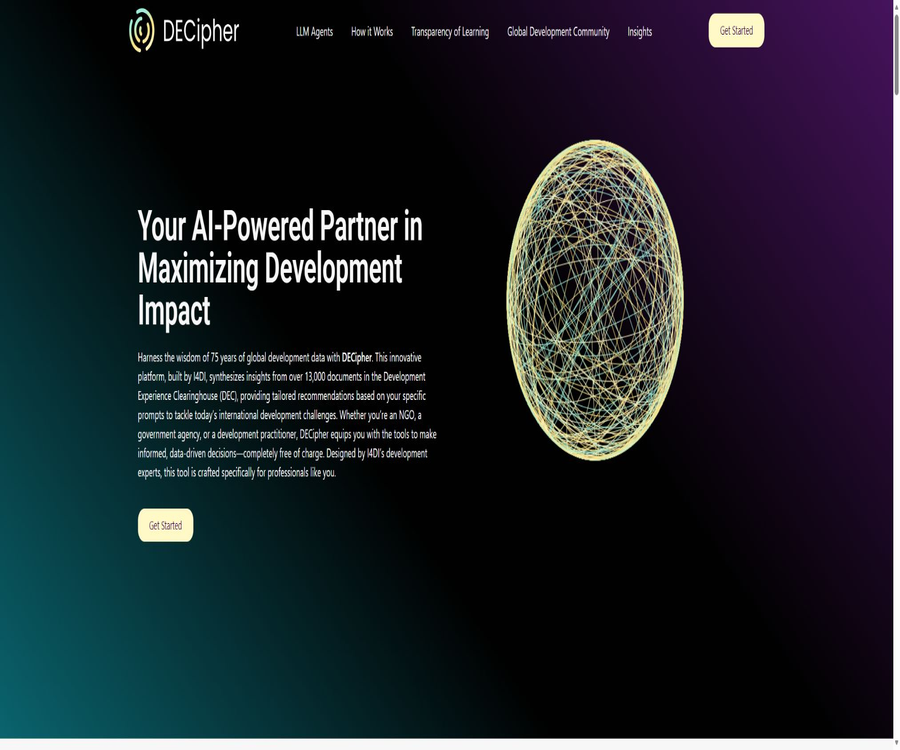
DECipher is a multi-agent research tool developed by I4DI for the international development sector; it utilizes historical evaluations and project data from the USAID Development Experience Clearinghouse to provide customized recommendations for method design, project implementation, monitoring and evaluation, compliance with rules, and dissemination tasks.
Tool Introduction
DECipher was developed by the Institute for Development Impact; its official website describes it as a free public tool intended for non-governmental organizations, government agencies, and professionals in the field of development. It focuses on international aid and development projects, rather than being a general-purpose chatbot for all topics.
According to the official description, the platform takes advantage of 75 years of global development experience as well as over 13,000 DEC documents; it utilizes multiple specialized large language model agents to handle various tasks. Users should regard the responses provided as a starting point for their research and verify important conclusions by referring to the original assessments, policies, and regulations.
Current access status
As of August 22, 2026, DECipher’s official product page is still accessible, but the “Get Started” link on that page returns a 404 error; it is therefore not possible to access the original online application through this link. The official page does not provide any information regarding a date for restoration, any announcements related to migration, or a new official entry point to the application.
I4DI’s existing DECfinder is another knowledge archive service developed by USAID; it offers Decipher Lite to assist with advanced search and previewing, and marks Q&A entries for individual documents as soon to be available. This does not indicate that all of the multi-agent functions of the original DECipher have been transferred or restored.
| Services | Current status | Primary uses | Misconceptions to be avoided |
|---|---|---|---|
| DECipher Introduction Page | Still online | Understand positioning, databases, and agents | The introduction page does not equate to the availability of the application. |
| The original Get Started app | A 404 error is returned currently. | Original multi-agent interaction interface | It cannot be written in a way that allows normal registration at the moment. |
| DECfinder | Independent services are accessible. | Search for and save documents on development knowledge | It is not the same as the original Decrypt application. |
| Decipher Lite | Auxiliary search preview for logged-in users | Explain the query and return relevant channel records. | It is not a complete replacement for the six types of agents. |
| Single-document Q&A | Page tagging is about to be launched. | In the future, answers will be based on the full text and page numbers. | The preview feature cannot be indicated as already available. |
Knowledge materials and working methods
USAID development experience materials
The core source of data for DECipher is the USAID Development Experience Clearinghouse; according to its official description, its analysis covers more than 13,000 evaluations and related development documents. The information available includes data on long-term project experiences, but it does not cover all countries, institutions, or the most recent policies in their entirety.
Multi-agent collaboration
The authorities refer to the core system as CREW AI; it is composed of multiple large language model agents that have been optimized for specific tasks. The main DEC agent first uses a database to create a general background, after which the domain-specific agents rewrite the responses into suggestions that are more suitable for the particular task at hand.
Model information
The product page lists model names such as Llama 3.1, Llama 3.1 Instruct, and Mistral Mamba-Codestral-7B, but it does not disclose the exact routing in the current production environment, the parameter sizes, or which model is associated with each type of agent. The model names merely indicate the technical directions presented by the developers; they cannot be used as a guarantee for the actual configuration in use.
Generate suggestions based on prompts
Users provide clues such as the project background, region, target audience, development challenges, and tasks that need to be addressed; the system then retrieves relevant information from past experiences, synthesizes it, and offers tailored suggestions. The quality of the responses depends heavily on whether sufficient context and clear constraints are provided in the input.
Six types of specialized intelligent agents
| Agent | Main tasks | Typical output | Key points of manual verification |
|---|---|---|---|
| Methodology | Research and evaluation method design | Recommendations for sample size, methods, tools, and evaluation matrices | Statistical assumptions, ethics, and feasibility |
| Technical | Technical analysis in the field of development | Theory of change, development theory, and intervention recommendations | Local evidence and industry standards |
| Project Implementation | Project execution plan | PMP, RACI, resources, SOW, and team recommendations | Budgets, contracts, and organizational permissions |
| MEL | Monitoring, Evaluation, and Learning | KPI, PIRS, CLA, and quality assessment recommendations | Indicator definitions and data quality |
| Rule and Regulation | USAID Rules and Compliance | Rules checks and clues related to compliance issues | Current official regulations and contract terms |
| Communication | Knowledge dissemination and expression | Agenda, summary, report, and plain-language explanation | Audience, facts, and sensitive expressions |
Methodological agent
The Methodology agent can discuss the calculation of sample size, research methods and tools, research questions, evaluation matrices, as well as the advantages, disadvantages, and suitability of different methods. It cannot replace statistical experts in carrying out formal calculations regarding power, sampling frames, design effects, and missing data.
Technical agent
The Technical agent provides recommendations regarding development industries, theories of change, development theories, and intervention methods. When using it, it is necessary to take into account the national context, societal factors, institutional environment, and implementation constraints, in order to avoid simply applying experiences from other regions verbatim.
Project implementation agent
The Project Implementation agent is used to organize project management plans, budgets, RACI matrices, resource allocation, operational procedures, work instructions, and team composition. The content generated must be in line with actual rules regarding funding, procurement, human resources, and contracts.
MEL Agent
The MEL agent is used for monitoring, evaluation, and learning; it can assist in establishing KPIs, developing mechanisms for collaborative learning, providing reference tables for indicators, and offering approaches for quality assessment. Before adopting any indicator, it is necessary to check its definition, unit, denominator, frequency, data source, and the person responsible for it.
Rules and Regulations Agent
The Rule and Regulation agent is designed to address rules and compliance issues related to USAID, but the AI-generated summaries may overlook exceptions, revisions, or project-specific provisions. Procurement, cost, warranty, branding, and reporting requirements shall be governed by the current official documents and the opinions of the relevant authorities.
Dissemination Agent
The Communication agent can rephrase complex concepts for non-specialist audiences, design meeting agendas, organize the structure of reports or blogs, and generate summaries. Before publishing publicly, it is necessary to verify numbers, institutional positions, citations, as well as any information that could reveal the identity of individuals or communities.
Main functions
- Search for and consolidate long-term project and evaluation experiences related to international development issues.
- Select a dedicated agent based on methods, techniques, execution, MEL, rules, and dissemination tasks.
- Transform broad issues into more specific research, project, or evaluation recommendations.
- Compare the advantages, limitations, and applicable scenarios of different methods.
- Assist in developing the preliminary versions of the change theory, indicators, responsibility matrix, and work instructions.
- Establish a content structure for reports, agendas, blogs, and easy-to-understand explanations.
- Research articles generated by DECipher and accompanied by source information are presented through the official Insights.
Complete research workflow
- Define development issues, decision-making subjects, countries/regions, and target populations.
- It outlines the project phases, timeline, budget, data, and institutional constraints.
- Assign the tasks to methodology, technology, implementation, MEL, rules, or communication agents.
- The response is required to list hypotheses, evidence clues, unknown information, and alternative options.
- Extract the conclusions that require verification against the original DEC documents from the responses.
- Add the latest national data, local knowledge, policies, and stakeholders’ opinions.
- It is reviewed jointly by the methods, industry, ethics, compliance, and project leaders.
- Record manual modifications and the final decision; do not treat the AI-generated text as an approved document.
Prompt writing tutorial
Establish a complete background.
- First, specify the country, region, industry, and target audience of the project.
- Describe the problem to be solved, the expected outcomes, and the current stage of the project.
- List the available budget, time, personnel, data, and partners.
- It outlines the funding agency, ethical, procurement, and reporting requirements that must be followed.
- It is clear that a comparison table, steps, matrix, indicators, or a list of risks are desired.
- It is requested to indicate the contents that cannot be confirmed from existing information.
Break a large problem into multiple rounds
- In the first round, the Technical agent is tasked with analyzing the structure of the problem and identifying possible interventions.
- In the second round, the Methodology agent is used to design research or evaluation approaches.
- In the third round, the MEL agent is responsible for defining the outcomes, metrics, and learning mechanisms.
- In the fourth round, the Implementation agent is transformed into responsibilities, resources, and an execution plan.
- In the fifth round, the Rule and Regulation agent lists the compliance items that need to be verified.
- Finally, have the Communication agent rephrase it for the decision-makers or the community audience.
Verify the answer
- List each number, regulation, project example, and causal conclusion separately.
- Find the complete context and page numbers in the original assessment report.
- Check whether the date, country, sample, and implementation conditions of the materials are similar.
- Update historical data with the latest policies, statistical figures, and interviews with stakeholders.
- Keep both contradictory pieces of evidence, rather than selecting only those that support the preconceived hypothesis.
- The final recommendations are approved by professionals with local experience.
Examples of actual tasks
| Task | Recommended agents | Desired results | It cannot be used as a direct substitute. |
|---|---|---|---|
| Design project evaluation | Methodology plus MEL | Comparison of problems, matrices, indicators, and methods | Statistical design and ethical approval |
| Developing change theory | Technical | Causal chains, hypotheses, and risks | Co-creation with stakeholders |
| Planning and Execution Team | Project Implementation | RACI, role, and resource recommendations | Human resources and procurement decisions |
| Create a study plan | MEL | Learning issues, pacing, and feedback mechanisms | Real-world data governance |
| Check USAID requirements. | Rule and Regulation | List of compliance items to be verified | Legal or contractual advice |
| Prepare policy briefs | Communication | Audience-oriented structure and summary | Fact verification and institutional approval |
| Compare historical experiences | Main DEC Agent | Cross-project mode and case clues | Systematic review and causal demonstration |
Which users are it suitable for
- NGO project staff: Identify similar project experiences and refine the intervention design.
- Government agencies and policy teams: quickly generate evidence related to development issues.
- MEL professionals: draft indicators, evaluation matrices, and learning mechanisms.
- Researchers and students: Discovering cases of historical evaluation and methods used by USAID.
- Project Manager: Organize responsibilities, resources, processes, and work instructions.
- Communicators: Convert technical content into reports, agendas, and easy-to-understand summaries.
- Sponsors and consultants: Compare project experiences and prepare further due diligence questions.
Typical use cases
- During the conceptual phase of a new project, historical intervention models and their common reasons for failure are examined.
- Before the baseline or final assessment, draft the research questions, methods, and matrix.
- At the start of the project, a preliminary version of the RACI matrix, team composition, and resource allocation is established.
- During implementation, design CLA activities and adaptive management feedback cycles.
- When preparing the report, historical experience is extracted and reorganized for different audiences.
- Before discussing the policy, quickly identify the assessments and points of contention that need to be reviewed.
- During the compliance preparation phase, list the issues that need to be clarified with contract or regulatory experts.
Product advantages
- It focuses on the international development sector; it has a better understanding of MEL and project-related terminology than general chat tools.
- By using long-term evaluation data as a knowledge base, it is possible to identify historical experiences rather than merely generating general suggestions.
- The six types of agents correspond to the actual project roles, with clear division of tasks.
- It covers research design, technical approach, implementation, learning, compliance, and dissemination at the same time.
- It is officially classified as a free public good; the original design did not require any paid subscription.
- I4DI combines elements of development assessment with practical technical applications, and its product context is clear.
- The officially generated articles demonstrate the format in which the output is presented along with the original source information.
Usage restrictions and precautions
- The original application entry currently returns 404, so it is not possible to ensure that users can register or start a conversation.
- The product descriptions available on the introduction page may not reflect the current state of the backend model and its functions.
- More than 13,000 documents focus on the historical evaluations conducted by USAID DEC, and there is a bias in the scope of coverage regarding certain institutions.
- Experience with historical projects may not be applicable to new political, climate, financial, and technological environments.
- AI may incorrectly combine sources, miss counterexamples, or misrepresent correlation as causation.
- Regulations and funding provider rules are subject to updates; it is necessary to consult the current official versions.
- The sample size, indicators, and evaluation design still require review by statisticians, ethicists, and local experts.
- The official website does not provide detailed information on data retention and model training for the original DECipher.
- Do not submit sensitive personal and project information to access points that are unavailable or whose policies are unclear.
- DECfinder’s new preview feature cannot be considered part of the same complete product as the original DECipher.
Prices and free options
The official product page describes DECipher as a completely free service, available as a public resource for the global development community; it does not mention any options for membership subscriptions, purchases with points, or corporate packages. Since the access to this application is currently not available, the fact that it is free does not mean it can be used normally at the moment.
| Project | Public price | Billing cycle | Current rights or status | Suitable for users |
|---|---|---|---|---|
| The original DECipher product | Free | No subscription period required | According to the official description, it is a public good; the original entry point is no longer functional. | International development practitioners |
| Paid Personal Version | Not provided | None | There are no public packages available. | Not applicable |
| Enterprise Edition | Not provided | None | There is no public information regarding the company’s pricing. | For institutional cooperation, please contact I4DI. |
| DECfinder account | Free | No subscription period required | Independent archive service; some research functions require login. | Document retrieval users |
| Decipher Lite | Free preview | The limit has not been disclosed. | Record queries to improve quality and coverage. | Logged-in DECfinder users |
Differences between old and new services
| Comparison items | Original DECipher | DECfinder and Decipher Lite |
|---|---|---|
| Core positioning | Recommendations for international development involving multiple agents | Knowledge archive search and enhanced deep retrieval |
| Data description | Over 13,000 DEC assessments and documents | Over 110,000 multi-collection archives |
| Main interactions | Select a specialized agent and pose project questions. | Search, filter, save, and provide supplementary explanations for queries |
| Current entry point | The original application link is no longer valid. | Independent websites are accessible. |
| Q&A for a single document | The original page did not provide a separate explanation. | Currently marked as upcoming. |
| Level of privacy disclosure | No detailed policies specific to this product were found. | Public accounts, query periods, and retention durations |
| Is it interchangeable? | It cannot be confirmed. | It cannot be migrated as a complete original version. |
Privacy, Data, and Copyright
The DECipher introduction page does not provide sufficient detail regarding the specific privacy policies applicable to this product; as a result, it is not possible to determine how the original application stores prompts, responses, project details, or account information. Once access is restored, users should still first locate the policies in effect at that time before submitting their actual data.
The privacy policy of DECfinder applies only to this standalone application and Decipher Lite; it cannot be automatically applied to the original DECipher. According to its policies, queries made through Decipher Lite are stored in connection with the account for 180 days, in order to understand usage patterns, improve service quality, and investigate any issues, but the text of the responses or document excerpts generated is not saved.
- Do not enter the beneficiary’s name, contact information, health status, or exact location.
- Remove undisclosed budgets, bidding information, and confidential details of partners from the project background.
- Use only the minimum necessary context, and retain the de-identified version prior to upload.
- When citing the original assessment, check the author, institution, public domain status, and licensing.
- Free access does not change the copyright ownership of individual documents within the archive.
- Before releasing an AI-generated summary, verify the page numbers, context, and the original author’s wording.
- Before an organization uses it, data processing, cross-border transmission, and supplier evaluation must be completed first.
Result reliability and manual review
| Risk | Possible manifestations | Verification method | Final responsible person |
|---|---|---|---|
| The information is outdated. | Adopt the historical policies or project conditions. | Query current regulations and national data | Project and Compliance Officer |
| Incorrect reference | The conclusion does not match the original text. | Open the full report and check the page numbers. | Researchers |
| Exaggeration of causality | Treat the changes over the same period as the outcomes of the project. | Check and evaluate designs and counterfactuals | Evaluation expert |
| The method is not applicable. | Ignore the sampling frame or on-site constraints. | Recalculate the parameters and consult the local team. | Method experts |
| Compliance omission | Omitting the terms specific to the project | Check the main agreement and the latest official rules. | Contract or legal professionals |
| Cultural bias | Cross-regional replication approach | Promote community participation and local verification | Local stakeholders |
| Sensitive information | Prompt words reveal personal or organizational information. | Anonymize and restrict the scope of submissions. | Data Protection Officer |
Supported platforms
| Platform | Support status | Primary uses | Notes |
|---|---|---|---|
| Web introduction page | Support | View the location and functions of DECipher. | No full interaction is provided. |
| Original Web application | Currently unavailable | Original multi-agent dialogue | The entrance returns 404. |
| DECfinder Web | Independent services are available. | Search archives and use Lite preview | It’s not the original application. |
| Windows and macOS Apps | No findings were detected. | No native desktop applications | The original design was centered around the Web. |
| iOS and Android Apps | No findings were detected. | No native mobile apps | There is no official store page. |
| Browser extensions | No findings were detected. | No expansion | Do not confuse products with the same name. |
| APIs and SDKs | No findings were detected. | No public developer access available. | Contact I4DI to confirm. |
APIs, GitHub, and open source status
As of the time of verification, DECipher’s official website does not provide any public APIs, SDKs, developer documentation, or an official GitHub repository containing source code. There is no evidence indicating that it is possible for organizations to use programs to call these six types of agents on a bulk basis.
The fact that the product page mentions the Llama model and multi-agent architecture does not mean that the DECipher product itself is open source. The underlying models may have their own licenses, but the platform code, knowledge retrieval, prompt routing, and service deployment all lack publicly available licenses.
| Project | Public status | Correct conclusion |
|---|---|---|
| DECipher product source code | Not disclosed | The product should be labeled as non-open source. |
| Official GitHub | No findings were detected. | Projects with the same name cannot be considered official. |
| Public API | No findings were detected. | There is no verifiable way to make the call. |
| Official SDK | No findings were detected. | There are no language packs or installation instructions. |
| Llama 3.1 model | Listed on the product page | Model licensing is not the same as platform open source. |
| CREW AI architecture | Concept made public | The specific code and deployment details are not disclosed. |
Basic information
| field | Content |
|---|---|
| Official name | DECipher |
| Original database name | DEChiper AI contains spelling errors. |
| Development agency | Institute for Development Impact |
| Tool type | International Development Multi-Agent Research and Recommendation Tool |
| Knowledge base | Information from the USAID Development Experience Clearinghouse |
| Scale of public data | Over 13,000 documents |
| Dedicated agent | Methods, techniques, implementation, MEL, rules, and dissemination |
| Price pattern | It is officially classified as a free public good. |
| Current availability | The introduction page is available online; the original application link no longer works. |
| Main platforms | Web |
| Chinese support | The model may support multiple languages, but there is no guarantee of a Chinese interface. |
| Registration requirements | The original application cannot be verified at the moment. |
| Public API | No findings were detected. |
| Official SDK | No findings were detected. |
| Official GitHub | No findings were detected. |
| Is it open source? | No |
Recommendation score
The recommendation score is 3.4 out of 5. DECipher offers significant value in terms of its vertical context for international development, historical evaluation data, and six types of specialized intelligent agents; it is particularly useful for developing initial drafts of research questions, MEL frameworks, and implementation plans.
The rating is significantly affected by the current availability, as the original entry point to the application is no longer functional, and there is no public information available regarding migration or restoration. At this stage, it is better to use the introduction page as a product profile and to rely on accessible official documentation services in order to find the original information.
Frequently Asked Questions
Are DECipher and DEChiper AI the same tool?
DEChiper in the database is a spelling error; the official name is DECipher. This article focuses only on the international development research products developed by I4DI.
Can DECipher still be used?
The official introduction page is still online, but the link to the actual application returns a 404 error; as a result, it’s not possible to determine whether the registration and messaging functions are available. Do not assume that the service is working properly based on the old introduction pages.
Is DECipher free?
The authorities describe it as being completely free and available as a public good, with no paid subscription plans offered. Since the original application is not currently accessible, the fact that it is free does not mean it can be used in practice at this time.
What data does DECipher use?
Officials state that it combines more than 13,000 assessment and development documents from USAID DEC, covering extensive experience in international development; however, the answers still need to be verified against the original reports.
What agents does it have?
The authorities have identified six types of agents: Methodology, Technical, Project Implementation, MEL, Rule and Regulation, and Communication; these agents are responsible for handling tasks related to methods, technology, execution, learning, compliance, and communication respectively.
Can it provide legal or compliance advice?
AI responses should not be regarded as formal legal or contractual advice. Rule-based agents can only help identify issues that need to be verified; ultimately, it is necessary to consult the current policies, the main agreement, and authorized personnel.
Is DECfinder the new version of DECipher?
It cannot be concluded in this manner. DECfinder is an independent knowledge archive service provided by I4DI; it includes Decipher Lite for previewing content as well as a single-document Q&A feature that will be released soon. However, the developers have not stated that it will completely replace the original six intelligent agents.
Is Chinese supported?
The product page mentions Llama 3.1’s multilingual capabilities, but it does not provide any explicit guarantee regarding a Chinese interface or the availability of content in Chinese. Even if Chinese text can be generated, it is still necessary to check the use of professional terms and to refer to the original English materials.
Are APIs or SDKs available?
No public APIs, SDKs, or developer documentation were found. If an organization needs to conduct bulk research or achieve system integration, it should contact I4DI directly to determine the available capabilities.
Is DECipher open source?
It is not open source; no official source code repository or product license has been found. The list of underlying model names on the page does not mean that the entire retrieval and multi-agent platform is open source.
Can the generated results be used directly for project decision-making?
It is not recommended. It is necessary to review the original report, the latest policies, local data, and the opinions of stakeholders, before obtaining approval from the persons in charge of methods, the industry, compliance, and the project.
Summary
DECipher presents a vertical multi-agent model designed for international development work, utilizing historical evaluation data for methods, technologies, implementation, MEL, rules, and communication tasks. It is best suited to help users identify evidence and develop drafts, rather than serving as a substitute for formal research and project decision-making.
The most important information at the moment is that the original entry point for accessing the application is no longer functional; it cannot be considered ready for use as described in the previous information. Users can still consult the official descriptions and the findings of I4DI research, as well as search for relevant materials in the separate DECfinder tool. However, it is essential to clearly distinguish between the existing archive functions, the Lite preview option, and the Q&A feature, which is still in the preview stage.
Tools similar to DEChiper AI




 Guigong Network Security Registration No. 45132202000164