






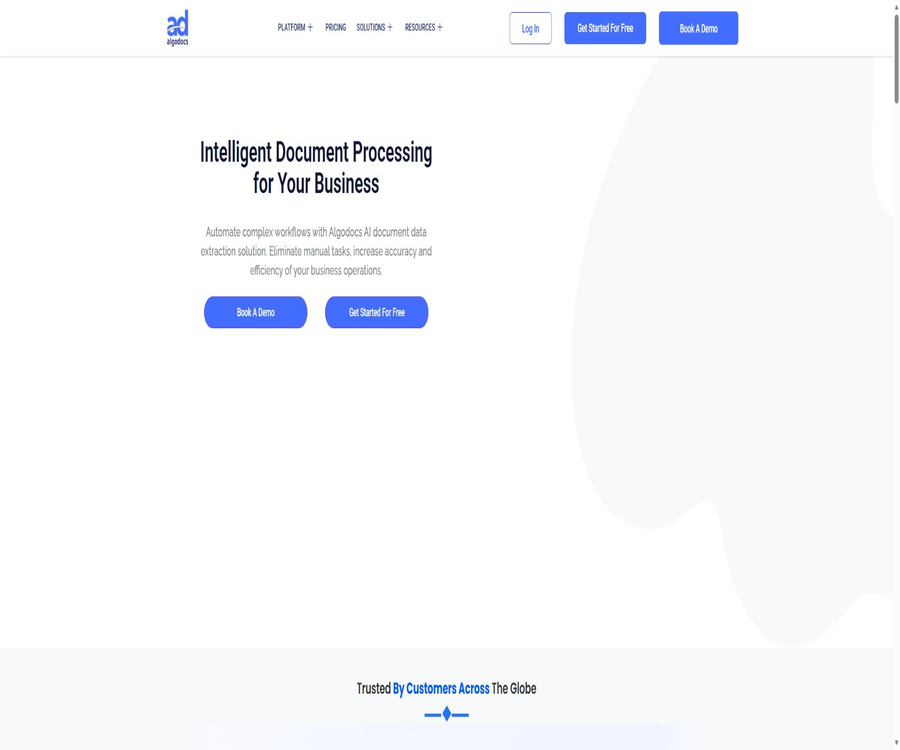
Algodocs
Algodocs, an intelligent tool focused on AI-driven document processing
Tags:AI document toolsWhat is AlgoDocs?
AlgoDocs is an intelligent document processing and data extraction platform that converts fields, tables, and handwritten content from PDFs, scans, images, Word, and Excel files into structured data suitable for use in business systems. It is ideal for scenarios involving repetitive data entry, such as invoices, bills of lading, bank statements, forms, and large volumes of documents.
The platform offers code-free extractors, document classification, automatic splitting, data format processing, manual review, as well as API and third-party integration capabilities. The enterprise version also supports local deployment or private cloud, to meet requirements related to data localization, brand customization, and tailored integrations.
Core functions
- Extract data from scanned PDFs and text PDFs.
- It can recognize image files such as JPG, PNG, TIFF, etc.
- Process Word and Excel business documents.
- Extract key-value fields, detail rows, and complex tables.
- Recognize handwritten text, checkboxes, and signatures.
- Automatically classify and split mixed documents.
- Extract or summarize non-fixed content through prompts.
- Manually review results with low confidence.
- Export or push the data to the business system.
Supported file types
| File type | Support methods | Appropriate content |
|---|---|---|
| Both scanned documents and text generated by the system can be processed. | Invoices, contracts, reports, and archives | |
| JPG, PNG, TIFF | Automated OCR application | Photo forms, image scanning, and invoice processing |
| Word | It can be imported as a business document. | Reports, forms, and written materials |
| Excel | It is possible to enter the document processing workflow. | Table files and business lists |
| Ultra-long files | Supports hundreds to thousands of pages | Litigation files, transaction records, and batch reports |
OCR text recognition
AlgoDocs uses OCR automatically whenever it is necessary to scan documents and images, and then passes the results of that recognition to the field or table extraction tools. According to the official documentation, more than 200 languages are supported; however, the accuracy of the recognition depends on factors such as resolution, layout, font type, language, and scanning quality.
Handwritten content recognition
The platform offers a handwriting recognizer that can convert handwritten text in forms, invoices, and other documents into machine-readable text. The average accuracy rate for handwriting extraction stated on the official website is 97%; this figure should be viewed as a marketing figure only, as companies still need to use their own samples for verification.
- Identify handwritten fields in tables.
- Process manually filled out application forms.
- Extract information from handwritten invoices or bills.
- Convert paper records into digital fields.
- Low-confidence results are corrected through manual review.
Key-value field extraction
Users can define invoice numbers, dates, suppliers, total amounts, or other business-related fields, and then have the system locate the corresponding values in different formats. The extraction rules should be trained and tested using actual sample formats, to ensure they perform well not just with one single template.
Table and detail row extraction
AlgoDocs can identify automated tables, structured tables, and financial detail rows, and it combines multiple pages of results into one. It is suitable for purchase orders, bank statements, invoice items, logistics lists, as well as reports that contain repeated row structures.
- Identify column names and detail rows.
- Merge the same table across pages.
- Merge multiple tables horizontally or vertically.
- Delete unnecessary columns or rows.
- Copy, swap, and replace columns.
- Add the header field to each detail entry.
- Split large tables into multiple result tables based on certain conditions.
- Perform arithmetic operations on logarithmic fields.
Checkbox and signature detection
The platform can identify selected and unselected checkboxes, as well as detect the signature area. Signature detection merely indicates that a certain area appears to contain a signature; it cannot, on its own, prove the identity of the signer or the legal validity of the signature.
Generative AI prompt extraction
For files with irregular layouts or those that require semantic understanding, users can use prompts to extract fields, generate summaries, compare content, or create reports. Generative extraction is more flexible, but it also needs format constraints, evidence verification, and certainty rules as supplements.
Document classification
AlgoDocs enables the training of custom classification models to identify mixed files as invoices, contracts, bills of lading, or other categories. The classification results determine which workflow a file should be sent to, thereby triggering the appropriate extractor.
- Automatically identifies document categories.
- Route the files to the correct workflow.
- Automatically split files that contain multiple documents.
- Select different field rules for various categories.
- Reduce manual sorting and naming tasks.
Automatic document splitting
Long PDFs or scanned batches can be split into separate files based on the document boundaries, after which they can be categorized and extracted individually. According to the official pricing guidelines, uploading, viewing, and splitting files do not consume any page credits; charging applies only when extraction at the page level is performed.
Data review and verification
Users can view the original documents and the results of the extraction on the platform, correct erroneous fields, and thus implement a human-in-the-loop process. The official website states that each correction contributes to the improvement of the model, but companies need to determine how the corrected data will be used and what measures will be taken to isolate the model from external influences.
Data post-processing
After extraction is complete, users can use rules to convert the fields into the desired format and then send them to Excel, accounting systems, or other applications. This reduces the need to reprocess dates, currencies, column names, and detail rows within the business system.
Data export format
| Format | Suitable uses | Precautions |
|---|---|---|
| CSV | Data analysis and bulk import | Complex nested structures need to be expanded. |
| Excel | Review by financial and operational staff | Check the format of number and date cells. |
| JSON | API and application integration | Retain field names and hierarchy. |
| XML | Exchange in traditional enterprise systems | Verify against the target system’s schema. |
Document import method
- Manually upload files via the web page.
- Receive attachments via a dedicated email address.
- Import from Google Drive.
- Import from Dropbox or SharePoint.
- Connect to other apps using Zapier.
- Submit documents using the REST API.
- Retrieve files from FTP or the monitoring folder.
Automated workflows
The workflow connects file import, classification, splitting, data extraction, validation, and export. Teams can create separate processes for different document types and configure input or output connections in the integration area.
- Monitor for new files in email accounts or cloud storage.
- Determine the document category and select the extractor.
- Split long files that contain multiple documents.
- Extract fields, details, and tables.
- Send results with low confidence to manual review.
- Clean the data in accordance with business rules.
- Write the results to the target system.
- The processing status is notified via Webhook.
API and Webhook
All public packages include API access, allowing developers to import documents, check processing status, and retrieve the extracted data. Webhooks are useful for notifying applications automatically once processing is complete, thereby avoiding the need for continuous polling by the client side.
Official SDK
The official GitHub repository of AlgoDocs provides clients for Python, PHP, and .NET to connect to REST APIs. While the SDK simplifies interface calls, production systems still need to handle authentication keys, retries, idempotency, file sizes, and error statuses.
| SDK | Uses | Public status |
|---|---|---|
| Python client | Import documents in a Python application and read the results. | Official public repository |
| PHP client | Provides REST API integration for PHP systems. | Official public repository |
| .NET client | Connect to.NET business applications | Official public repository |
| REST API | Available for direct invocation by other languages and platforms | All packages include |
Which users are it suitable for
- Financial teams that need to enter invoices and purchase orders in bulk.
- Logistics companies that handle bills of lading, packing lists, and waybills.
- Legal teams that need to organize a large amount of case documents.
- Auditors who extract details from bank statements and invoices.
- Operations departments that require digital handwritten forms.
- Software teams that wish to automate file processing through APIs.
- For enterprise customers who require a private cloud or on-premises deployment.
Typical use cases
- Extract the supplier, tax amount, and detail lines from the invoice.
- Extract the shipper and consignee information from the bill of lading.
- Create a standard transaction table from the bank statement.
- Convert the handwritten application form into database fields.
- Create index data for lengthy legal documents.
- Automatically classify attachments in shared mailboxes.
- Synchronize the document results with accounting or ERP systems.
- Generate summaries, comparisons, and structured lists for reports.
It’s not very suitable for which situations
- Only individuals who occasionally need to copy a segment of ordinary text.
- Teams that require to be completely offline and do not purchase enterprise deployments.
- Tasks in which the source files are so blurred that they cannot be recognized even by the human eye.
- A process to verify the authenticity of a signature or its legal validity.
- High-risk transactions with critical fields cannot be scheduled for manual review.
- Developers who hope for a fully open-source core cloud platform.
- Users who only need to edit the PDF layout without extracting data.
Tutorial on creating extractors
- Collect various real versions of documents of the same type.
- List the fields and table columns that must be extracted.
- Create the corresponding extractor within the platform.
- Upload the sample document and label the target data.
- Choose between AI, rule-based, or prompt extraction methods.
- Use the test results from files that were not involved in the configuration.
- Set manual review for fields with low confidence.
- Continue to record the error type after it is published.
Tutorial on creating automated workflows
- Determine the source of the document and the ultimate business system.
- Configure email, cloud storage, FTP, or API import.
- Add classification and splitting steps for mixed files.
- Bind verified fields and table extractors.
- Add data format conversion and validation rules.
- Configure the audit queue and exception notifications.
- Connect the export integration and test repeated submissions.
- Run in small batches first, then increase the volume of processing.
API Integration Tutorial
- Create API credentials in the account and store them securely.
- Choose the official SDK or call the REST API directly.
- Upload the test file and save the document number returned.
- Check the status or configure Webhooks to receive completion notifications.
- Obtain structured results and verify field types.
- Implement retry and idempotency for timeouts, failures, and duplicate requests.
- Restrict key permissions and rotate them regularly.
Accuracy testing tutorial
- Create representative test sets based on document type.
- Calculate the accuracy for fields, tables, and the entire document separately.
- Record missing values, wrong column positions, and OCR errors.
- Set different thresholds for fields based on business risk.
- Compare the costs of automatic processing with those of manual review.
- Continuously add new formats and error samples to the test set.
Processing speed
The reference speed provided in the official FAQ is around 2 seconds per page for text PDFs; for scanned images with OCR, the time per page may be up to 20 seconds. Actual performance is influenced by factors such as the complexity of the files, the queue, the network connection, the steps in the workflow, and the way in which it is deployed.
Page scoring rules
AlgoDocs charges based on the number of pages that are actually extracted; typically, one point is required for each page. If 100 PDF pages exist and only one of them is extracted, then just one point will be used. Uploading, splitting, and viewing files do not consume any extraction points.
- The monthly limit becomes invalid at the end of the period.
- Unused points will not be carried over to the next period.
- The annual subscription provides access to the page quota for the entire year at once.
- The annual limit can be used flexibly over 12 months.
- There is no fixed maximum number of pages for long files.
- Each page processed is counted as one point.
Price packages
| Package | Monthly payment | Annual payment | Page quota | Number of users |
|---|---|---|---|---|
| Free | $ | $ | 50 pages per month or 600 pages per year | 1 person |
| Starter | 35 dollars | 385 dollars | 500 pages per month or 6,000 pages per year | 1 person |
| Professional | 84 dollars | 924 dollars | 1,500 pages per month or 18,000 pages per year | 3 people |
| Business | 175 dollars | 1925 dollars | 3,500 pages per month or 42,000 pages per year | 10 people |
| Enterprise | Custom quote | Custom quote | Customized by scale | No restrictions on users |
The capabilities included in all packages
- An unlimited number of extractors is available.
- OCR and pre-built document models.
- Custom AI models and generative prompts.
- Extraction of fields, tables, and rules.
- Manual review and data verification.
- Export in CSV, Excel, JSON, and XML formats.
- APIs, Webhooks, and common integrations.
- Classification, automatic splitting, and role-based access.
- Multi-factor authentication and 60 days of data retention.
- The ability to handle large files of thousands of pages.
Enterprise edition features
- Set prices based on the actual scale.
- An unlimited number of users can be provided.
- Choose an AWS or Microsoft Azure storage region.
- Develop custom system integration.
- Extend the retention period for document data.
- Assign dedicated account managers and advanced support.
- White-labeling capabilities are provided.
- Supports local deployment or installation in a private cloud.
Safety and compliance
AlgoDocs states that cloud data is transmitted over encrypted connections, making use of infrastructure such as Microsoft Azure and Google Cloud. The official website provides information regarding compliance with standards such as GDPR, HIPAA, ISO 27001, and ISO 9001; when making a purchase, it is necessary to verify the certification body, its scope, validity period, and the target deployment location.
Data retention
The standard package page indicates a 60-day data retention period; the enterprise version allows for an extension upon negotiation. Teams should determine the shortest necessary retention period based on financial, legal, and privacy requirements, and ensure that deletion also affects backups, logs, and exported files.
Local deployment and private cloud
Enterprise clients can request local installation or deployment on a private cloud, which is suitable for organizations whose data cannot be placed in a shared SaaS environment. When making a purchase, it is necessary to clarify the responsibilities related to hardware, model updates, upgrade periods, monitoring, backup, and technical support.
Open-source status
The Python, PHP, and .NET API clients for AlgoDocs are available on GitHub, but the full document processing platform, OCR models, and extraction engines are not open source. The publicly available SDKs merely allow for the review and reuse of the integration code; they do not enable free privatization of the core products.
Product advantages
- It covers the entire process of import, classification, extraction, review, and export.
- It supports both fixed-format and non-fixed-format documents.
- It can recognize fields, tables, handwriting, checkboxes, and signature areas.
- It supports large files of hundreds to thousands of pages.
- All packages include API and core extraction capabilities.
- It offers a variety of cloud storage options, email services, FTP, as well as automation integration.
- The price is calculated based on the actual page retrieved.
- Companies can choose to deploy locally or on a private cloud.
- Multiple official open-source API clients are provided.
Usage restrictions
- The accuracy of promotional tests cannot replace the company’s own sample testing.
- Handwritten texts and low-quality scans may require more manual verification.
- Unused monthly page quotas are not carried over.
- By default, data in the standard package is retained for only 60 days.
- Extracting generative prompts may yield uncertain results.
- Signature detection cannot verify the authenticity of a signature.
- Complex tables and new layouts require continuous maintenance of the extractor.
- The core platform and models are not open-source software.
Basic information
| Project | Content |
|---|---|
| Tool name | AlgoDocs |
| Tool type | Intelligent document processing and data extraction platform |
| Core competencies | OCR, field and table extraction, classification, review, and workflows |
| Supported languages | Over 200 species |
| Primary users | Finance, logistics, legal, operations, and software teams |
| Price pattern | Free version, page-based subscription, and enterprise pricing |
| Whether API is provided | Yes |
| Is private deployment supported? | Enterprise edition support available |
| Is it open source? | The SDK is open source, but the core platform is not. |
Recommendation score
The comprehensive recommendation score is 4.6 out of 5 points. AlgoDocs offers a complete set of functions, with transparent pricing and page limits; it is suitable for teams that need code-free document automation and API integration. However, it is necessary to evaluate the accuracy and the cost associated with manual review using actual documents before making a formal purchase.
Frequently Asked Questions
Can AlgoDocs be used for free?
Yes, the free version provides a processing limit of 50 pages per month or 600 pages per year.
Which files are supported?
It supports PDF, JPG, PNG, and TIFF formats, and can import common business documents such as Word and Excel.
Can handwritten content be extracted?
Yes, the platform offers handwriting recognition, but the actual accuracy should be verified using one’s own sample forms.
Can it handle PDF files with thousands of pages?
Yes, the platform does not impose a strict limit on the number of pages per file, and it offers capabilities for preprocessing large files.
How is page pricing calculated?
Charging is applied only to the pages where actual data extraction takes place; typically, one point is consumed per page that is processed.
Is the unused quota carried over?
No, the monthly quota becomes invalid at the end of the period, while the annual quota can be used over 12 months.
Does AlgoDocs provide an API?
It provides REST APIs, Webhooks, as well as official clients for Python, PHP, and .NET.
Is local deployment supported?
Business clients can opt for local installation or deployment in a private cloud.
Is AlgoDocs open source?
The entire platform is not open source; the developers have only made several API client repositories available.
Tools similar to Algodocs



 Guigong Network Security Registration No. 45132202000164