






Baidu Orange Chapter
Baidu’s platform for understanding long texts, conducting in-depth research, and creating professional content
Tags:AI document toolsWhat is Baidu Orange Chapter?
Baidu Orange is an AI-based reading and content creation tool offered by Baidu Wenku, designed for integrated tasks such as searching, creating, and editing content. It can process long documents and various materials uploaded by users, generating summaries, answering questions, and organizing the content; it can also create longer articles based on themes, materials, or outlines, and further carry out tasks such as rewriting, proofreading, formatting, and multi-modal content creation.
Orange Chapter relies on the capabilities of Baidu Wenku, Baidu Academic, Baidu Search, and the Wenxin large model to address the processing of long-form content such as papers, reports, proposals, and course materials. Its main difference from ordinary chat assistants is that it focuses on handling very long contexts, allowing the input of multiple files, and delivering complete documents, rather than just providing a few short replies in a chat format.
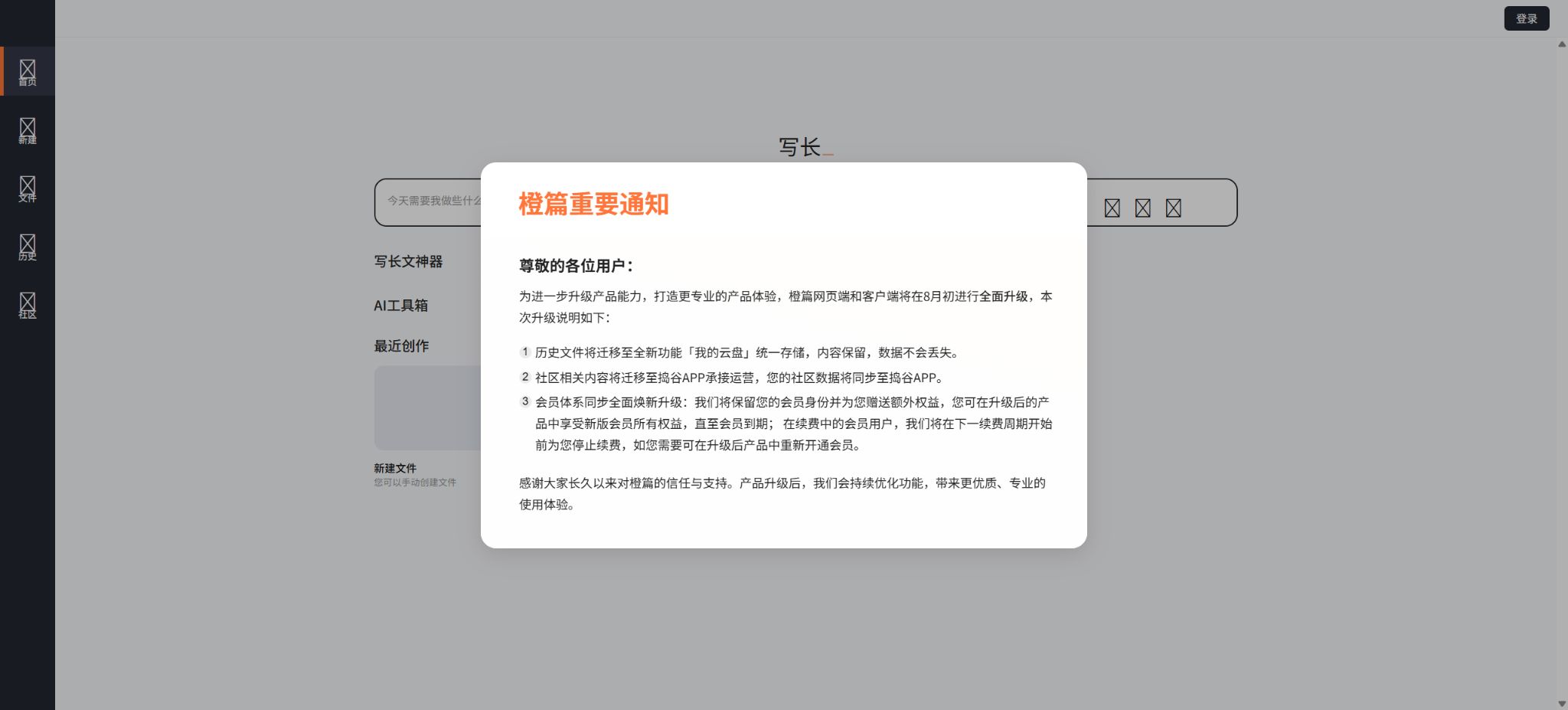
Current product status: The web version remains available, while the original app has been renamed.
As of this verification, the official website of the Orange Page version is still accessible normally, and Baidu’s product catalog continues to list “Orange Page” as one of Baidu’s products; the page title remains “Orange Page AI – With Orange Page, it’s all possible”. It is worth noting that the original Orange Page mobile app was upgraded to “Dao Gu” on November 28, 2025, with its focus shifting to designing and creating content for fans of the anime genre, as well as providing a community for such enthusiasts.
This means that the AI tool for handling long texts on the Orange Pages website and the mobile version of this service have been separated. To carry out tasks such as reading long articles, using AI for writing, and performing professional searches on Orange Pages, one should use the website version of Orange Pages.
The “Dao Gu” app available in app stores is not a mobile client with the same functions as the online version of Chenguan; moreover, the membership features, grain production options, and community functions associated with Dao Gu should not be included in Chenguan’s pricing or product descriptions.
Core functions
1. Reading and summarizing very long documents
The Orange version allows the import of long PDF files, Word documents, images, web pages, and other supported formats; it can extract key information, generate summaries, and answer questions. At the time of its release, the developers highlighted that it can process up to 100 files at a time, with each file having a maximum size of 200 MB, and that it is capable of handling around 2 million words of text. It is thus suitable for processing large quantities of papers, research reports, policy documents, textbooks, and project materials.
These limits are capacity metrics that are announced during the product launch phase; the actual number of files that can be uploaded, as well as the format, size, and context in which they can be uploaded, are influenced by factors such as the account used, system load, file structure, and version. It is necessary to check these limitations within the current upload interface before using a large volume of files, and one should not treat the figures mentioned in previous promotions as fixed quotas that are always available for each task.
2. Multiple file comparison and Q&A on documents
Users can pose questions regarding multiple documents, and the AI can then identify the common points, differences, conclusions, as well as relevant evidence. This capability is useful for dealing with various versions of a system, different solutions from various manufacturers, several research papers, or consecutive annual reports.
When asking a question, it is best to specify the document name, time range, comparison dimensions, and output format, in order to prevent the model from using mixed materials.
For numbers, citations, formulas, and tables, it is necessary to indicate the source document from which they come and to check the original text. Blurry scans, rotated pages, complex two-column layouts, footnotes, and nested tables can lead to parsing errors.
\"Uploaded\" does not mean that every page has been read without any loss.
3. Professional knowledge retrieval
For the orange section, information retrieval can be carried out using Baidu Wenku, Baidu Academic, as well as various resources available on the internet. It is suitable for finding industry-related knowledge, background information for research, explanations of concepts, and materials for writing. Compared to relying solely on files uploaded by users, online retrieval allows for the inclusion of new information and external perspectives.
Unlike regular web searches, the system organizes the results into content that can be further edited.
Library and academic search results may only display abstracts, metadata, or limited previews; the full texts of the documents are still subject to copyright, subscription, and access restrictions. References generated by AI might contain errors regarding authors, journals, page numbers, or links, and official papers must be verified in the original databases.
4. Generation of long texts of around 100,000 words
When it was released, Orange Edition focused on the generation of texts of up to 100,000 characters, which could be used for essay outlines, research reports, stories, plans, knowledge guides, and other structured, long-form content. Users could start by specifying a topic, or they could provide reference materials, writing guidelines, and an outline so that the system could generate the content chapter by chapter.
The ability to produce long texts does not mean that such texts inherently possess academic or publishable quality. The longer a text is, the more likely it is to contain repeated sections, contradictions, shifts in concepts, distorted citations, and conclusions that precede the evidence.
A more reliable approach is to first determine the scope of the research and its outline, then create and review each chapter separately, and finally standardize the terminology, data, and references.
5. Outline and in-depth editing
Before creation, an outline can be developed around the theme; after it is created, further expansion, contraction, refinement, rewriting, and proofreading are possible. For reports and proposals, the outline allows one to determine the hierarchy of sections, the target audience, the tone, and the length of the document.
For existing manuscripts, editing tools can help improve the wording and structure.
In-depth editing is useful for improving efficiency, but it should not override the author’s judgment. Legal texts, interpretations of policies, medical advice, financial data, bidding documents, and academic findings must be reviewed by professionals, and the original version should be retained before any modifications are made.
6. AI PPT and text/image content
The Orange version for the web allows users to organize themes or materials into presentations, and it supports the use of images, charts, and other elements. It is ideal for quickly converting research materials into a presentation format, thereby reducing the need to reorganize information repeatedly from long texts into slides.
The automatically generated pages still require verification regarding the hierarchy of information, chart data, layout overflow, font licensing, and company template standards.
7. Multimodal creation
Orange Edition used to offer functions for creating images from text, combining multiple images into one composition, as well as tools for producing picture books and other visual content, thereby converting textual information into visual forms. As the mobile app was later transformed into Danggu, some of the features related to 2D design, Guzi-style designs, and community-based creation have been integrated into the new product; the available creation tools in the web version should be determined based on the tool list displayed after logging in.
8. Online editing and export
The generated content can be further adjusted in the web page editor, after which it can be exported in the currently supported document or presentation format. Before exporting, it is necessary to check the hierarchy of headings, the table of contents, pagination, tables, formulas, and the clarity of images.
For important projects, it is recommended to keep a backup in plain text or as a local document, to avoid relying solely on the version edited in the cloud.
Typical usage process
- Define the task objectives, such as “compare three industry reports and produce an analysis of 5,000 words”;
- Upload files for which you have permission to use, and remove duplicate versions as well as irrelevant attachments.
- First, let the AI generate a list of files, along with their dates and topics, to verify that the data has been read correctly;
- It is requested to generate an outline with comparison dimensions, rather than the full text directly;
- Generate chapter by chapter and verify the numbers, citations, examples, and conclusions;
- Uniform terminology, redundancy reduction, polishing, and formatting are carried out;
- Export and publish only after manually performing checks for facts, copyrights, compliance, and format.
Is the Orange edition free?
The online version of Orange Section can be accessed using a Baidu account, allowing users to experience certain AI-powered reading, writing, and creation functions. The homepage does not currently provide a fixed, permanently available \"Orange Section membership price list\" that can be independently verified; the specific features may be related to the benefits associated with Baidu Wenku memberships, Baidu account privileges, promotional offers, or individual services.
Therefore, the price categories listed in the catalog are better labeled as “Free trial / Some advanced features or library access may require payment”; the in-app purchase prices from the original OrangeApp or Tōtani should not be used to represent the prices on the web version. Before creating lengthy documents, checking for plagiarism, downloading library materials, using specific templates, or generating functions that involve high costs, it is necessary to check the real-time prompts and the payment page after logging in.
Different channels, promotional offers, and Baidu Wenku memberships may result in varying prices and benefits. Before making a purchase, it is necessary to determine whether the payment is intended for Orange Edition features, a Baidu Wenku membership, a single document, or other Baidu services, and to review the rules regarding automatic renewal and refunds.
Supported platforms
The currently available platform for Orange Edition is the web version; it allows for file uploading, editing of long texts, and export operations using a desktop browser. The original Android and iOS apps for Orange Edition have been upgraded to “Dao Gu”, and their new purpose differs from that of Orange Edition’s AI tool for handling long texts.
If you need to handle Baidu documents and AI-related tasks on mobile devices, you can check the capabilities offered by Baidu Wenku, Wenxin, or other Baidu applications; however, the account privileges, file storage space, and membership options of these products may not be exactly the same as those of Chengpian.
Model, API, and open-source status
The Orange version provides its services by leveraging Baidu’s Wenxin large language model, as well as its content library and search functions. The specific versions of these models and the internal retrieval processes are not listed on this page as a set of publicly available options for selection. The capabilities of this product evolve as Baidu’s models and library services are updated; therefore, it is not appropriate to determine the current model version based only on information from earlier releases.
OrangePaaS is a proprietary cloud service intended for end-users; the developers have not made the complete front-end and back-end source code available, nor do they offer an open-source version of OrangePaaS that can be deployed independently. Projects such as Wenxin, search functions, or other open-source projects in Baidu’s GitHub repository do not equate to an open-source version of the OrangePaaS product.
At present, there is no set of universal interfaces available for ordinary developers, with defined pricing and comprehensive documentation under the name “Chengpian API”. If enterprises need services for document parsing, large-model generation, or access to knowledge base APIs, they should look at Baidu Smart Cloud’s corresponding products; the interfaces offered by Smart Cloud should not be confused with the capabilities provided by Chengpian personal accounts.
Baidu Orange Chapter Usage Guide
Create reusable professional workflows
- Create a brand term list, prohibited expressions, and approved sample texts;
- Turn the reading and summarizing of extremely long documents, the comparison of multiple files as well as question-answering related to information, and the retrieval and organization of specialized knowledge into fixed processes.
- Designate responsible persons for research, the first draft, editing, and fact-checking respectively;
- Randomly check whether the model fabricates numbers, sources, or examples;
- Compare readability, conversion rates, search performance, and rework time;
- The templates and rules are continuously updated based on actual outcomes;
Which users is it suitable for?
- Students and researchers:Reading papers, organizing literature, creating review frameworks and research notes;
- Consulting and marketing staff:Compile multiple industry reports, prepare analyses of competitors and presentation materials;
- Teacher:Organize course materials, create lecture outlines and teaching PPTs;
- Content creator:Complete topic research, drafting the initial version of the text, restructuring it, and preparing the visuals;
- Administrative and operational staff:Extract key points from systems, meeting materials, and project documents;
- Author and editor:Manage the processes of outlining, structuring chapters, rewriting, and proofreading long-form content.
Product advantages
- Designed for processing long Chinese texts and multiple files, suitable for formal document scenarios;
- Leveraging Baidu Wenku, Baidu Academic, and search resources from the entire web;
- It forms a complete process that includes reading, Q&A, outlining, generation, as well as editing and exporting;
- It supports the creation of long-form content of up to 100,000 characters in segmented sections;
- The content of the document can be further converted into formats such as PPT or images and text;
- You can access the web version using a Baidu account, without the need to deploy local models.
Usage restrictions and precautions
- The answers generated by the Orange version may contain incorrect facts, fabricated citations, repeated paragraphs, and logical inconsistencies;
- In particular, the “Professional Search” and “Academic Writing” tags cannot replace searches in specialized databases, experimental verification, and peer review.
- When citing formally, it is necessary to verify that the source material indeed exists, and to check the author, title, year, journal, volume and issue number, as well as the page numbers.
- Before uploading a file, it is necessary to verify the copyright and confidentiality rights.
- Corporate contracts, customer data, unpublished financial information, personal identification details, examination materials, and restricted papers should not be uploaded without permission.
- Using materials from Baidu Wenku does not mean that one can copy, publish, or distribute them for commercial purposes at will;
- Generating long texts exacerbates the issue of context consistency in models;
- It is recommended to divide the final delivery into three stages: outline, chapters, and review, and to create a list of facts along with a glossary of terms.
- Generating tens of thousands of words at once and then releasing them all in one go carries a much higher risk than reviewing each chapter separately.
- The renaming of the original app is currently the main source of confusion.
- Do not install the so-called “latest version of Orange Edition” from third-party download pages, nor expect Togaya to provide the same tools for reading papers and writing long texts.
- To use the Orange version, you should access it through Baidu’s official website.
Frequently Asked Questions
Is the official website for Orange Edition still available?
Yes. The official website of the Orange Edition in web format is still accessible, and Baidu’s product catalog also retains a link to the Orange Edition.
After logging in, you can view the current available reading, writing, and creation skills.
Why can’t the Orange Chapter app be found in the app store?
The Yuancheng Edition app was upgraded to “Dao Gu” on November 28, 2025, and shifted focus to 2D character design as well as community-related services. The AI tool for writing long texts in the Cheng Edition should now be available primarily in web format.
Is \"Togayu\" the same as \"Orange Chapter\"?
It evolved from the Mōgaya Yuhara Orange Version app, but its target audience and main functions have changed. They can no longer be considered identical AI tools for handling long texts; the web version of Orange Version and the mobile version of Mōgaya should be viewed as separate entities.
How many files can be uploaded at once in the Orange section?
During the release phase, the officials stated that up to 100 files in various formats could be uploaded, that each file could be no larger than 200 MB, and that the system had an understanding capacity of around 2 million characters. The actual limits are determined by the instructions provided on the upload page and in the account settings.
Can the Orange version generate an article of 100,000 words?
Generating texts of around 100,000 characters was one of the core capabilities when Orange Edition was launched. The actual length of the generated text, as well as its stability and the available quota, can be affected by the specific task and the account used; long texts must be reviewed chapter by chapter.
Can a paper be written on oranges?
It can assist with searching for information, creating outlines, summarizing literature, and producing drafts, but it cannot replace the research process nor ensure the accuracy of citations. It is necessary to comply with the requirements set by schools or journals regarding the use of AI and citation practices.
How much is the Orange version?
On the web version, it is possible to try out some features for free; currently, the home page does not display a fixed price list. Advanced generation options, plagiarism checks, library downloads, and member benefits may incur fees, as indicated on the page after logging in.
Is Orange Chapter open source?
It is not open source. OrangeChapter is an online service operated by Baidu, and there is no complete open-source version that can be deployed independently by officials.
Baidu’s other open-source models or projects do not imply that the source code of OrangeArticle is also open.
Tools similar to Baidu’s Orange Article feature




 Guigong Network Security Registration No. 45132202000164