






Multidimensional Vision
One-stop AI audio and video intelligent analysis workstation
Tags:AI audio toolsWhat is a multidimensional perspective?
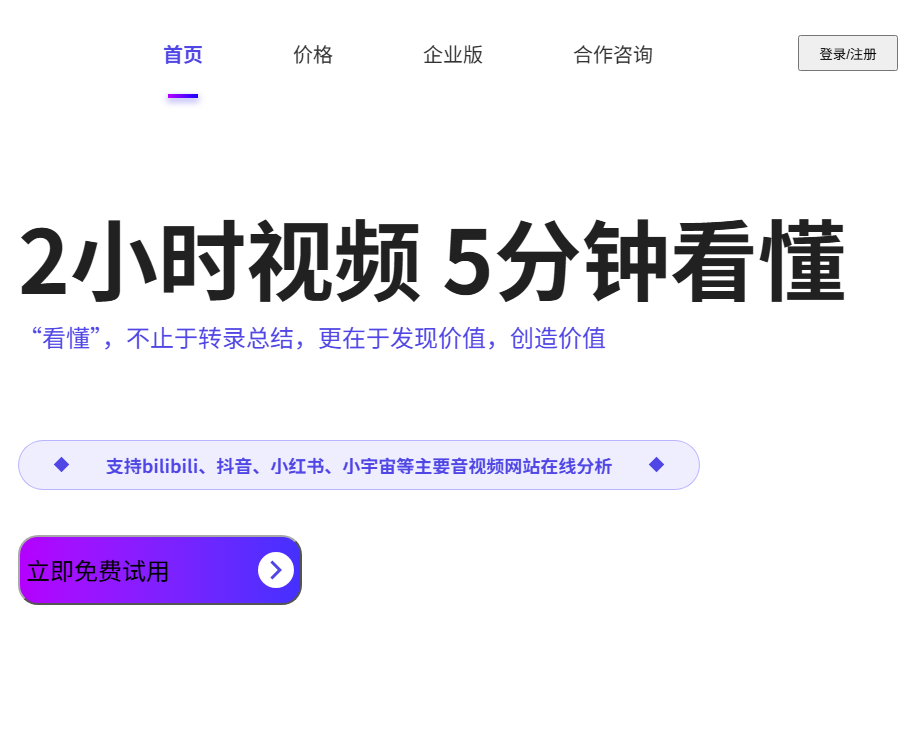
MultiView is a one-stop AI platform for audio and video analysis, transcription, understanding, and content recreation.
Users can upload local files or paste links from public platforms, in order to convert long videos into text, summaries, chapters, and a structured knowledge framework.
Main functions
- Identify the speech in audio and video and generate editable text.
- It supports recognition and translation of more than 100 languages and dialects.
- Automatically generates full-text summaries, chapter overviews, and thematic analyses.
- Convert the content into mind maps and knowledge graphs.
- Multiple rounds of AI Q&A are conducted based on the parsed content.
- Extract keywords and automatically classify them based on their content.
- Distinguish between speakers and generate speaker summaries.
- Identify text, faces, and image content in a scene.
- Generate learning cards and knowledge quizzes.
- Rewrite the material into articles for public accounts or posts for Xiaohongshu.
- Generate subtitles and embed them in the video footage.
- Reuse the analysis process through templates and custom prompts.
Supported input methods
| Input method | Suitable scenarios | Use reminders |
|---|---|---|
| Local audio | Interviews, podcasts, recordings, and courses | Confirm the format, duration, and upload permissions. |
| Local videos | Meetings, lectures, training, and content for social media | Large files require time allocated for uploading. |
| Public video link | Analyze content on public platforms | Affected by link status and platform rules. |
| Enterprise directory scanning | Batch processing of internal media files | It relates to the enterprise’s deployment capabilities. |
| Live stream | Continuous analysis of audio and video streams | It needs to be confirmed according to the enterprise’s configuration. |
The sources of links listed on the official website include Bilibili, Douyin, Xiaohongshu, Kuaishou, Weibo, Zhihu, and Xiyuan, among others.
The rules of third-party platforms may change; if a link cannot be resolved, local files can be used instead once authorization is obtained.
Speech recognition and multilingual translation
The platform supports over 100 languages, including Chinese, English, Japanese, French, Korean, Spanish, and Arabic.
The range of dialects also includes Minnan, Wu, Shanghainese, Wenzhou dialect, and Sichuanese; the accuracy of transcription depends on the quality of the recording.
| Factors affecting it | Possible problems | Optimization methods |
|---|---|---|
| Background noise | More missing or incorrect characters. | First, reduce noise and improve the clarity of the human voice. |
| Multiple people speaking at the same time. | The speaker’s affiliation is unclear. | Reduce interruptions and use a separate microphone. |
| Technical terms | Proper nouns are misspelled. | Manual verification of terms after completion. |
| Dialects and mixed languages | The recognition results are unstable. | Select the appropriate language and process it in segments. |
| Low-bitrate audio | Abnormal punctuation and sentence segmentation | Try to use original, high-quality files. |
Abstract, Chapters, and Knowledge Structure
The system can break down long texts into sections, and generate a summary of the entire text, topic summaries, keywords, and content classifications.
- A summary of the entire text helps to quickly determine whether the material is worth reading in detail.
- A chapter overview is useful for identifying a particular section of discussion or topic.
- Mind maps are suitable for viewing the hierarchical relationships between topics.
- Knowledge graphs are suitable for organizing the relationships between people, concepts, and events.
- The speaker summary is suitable for reviewing meetings and interviews with multiple participants.
- Thematic analysis is suitable for organizing large quantities of similar audio and video materials.
The structured results are generated automatically by AI; the key conclusions should be verified against the original audio/video and the corresponding time points.
AI Q&A based on audio and video
Once the parsing is complete, users can ask continuous questions based on the material, without having to read the entire transcript again and again.
- First, let the AI list the main topics covered in the content.
- Requests for answers must include the corresponding chapter or time range.
- Continue to ask about the person’s viewpoints, arguments, and conclusions.
- Compare the positions and evidence of different speakers.
- Review the original footage for numbers, quotes, and proper nouns.
- Organize the confirmed information into a report.
The ability to ask AI questions indefinitely does not mean that the answers will always be accurate, nor does it mean that the original sources can be ignored.
Image and visual analysis
| Ability | Uses | Risk warnings |
|---|---|---|
| OCR text recognition | Extract course materials, subtitles, and on-screen text. | Small text and blurry images may be misidentified. |
| Face detection | Locate the people in the image. | It is necessary to comply with the rules regarding portraits and personal information. |
| Facial feature analysis | Auxiliary content classification | The results should not be used for high-risk decisions. |
| Image understanding | Describe the content of the image and the scene. | Complex contexts may be misinterpreted. |
| Content security detection | Screening for suspected illegal content | It cannot replace human final review. |
| AIGC and deep fake detection | Assist in identifying signs of synthesis or manipulation. | The detection probability is not equivalent to judicial expertise. |
When dealing with facial features, voice prints, and identity verification, legitimate authorization must be obtained and a manual review process should be in place.
Study cards and knowledge quizzes
After analyzing course materials, lectures, or training content, the system can generate study cards and quiz questions.
- Use cards to review definitions, figures, events, and key points.
- Use quizzes to check whether the key concepts have been understood.
- Regenerate more focused titles by chapter.
- Manual verification of the answers and explanations is carried out.
- Do not use automated questions in official exams.
Content recreation
Multi-dimensional vision can reorganize the information in audio and video into text content suitable for various distribution channels.
| Output format | Typical uses | Check before publishing |
|---|---|---|
| WeChat official account articles | Transform interviews or lessons into longer articles. | Facts, quotes, titles, and copyright |
| REDnote copywriting | Extracting key points and creating concise content structures | Avoid exaggerating and inventing experiences. |
| Meeting minutes | Organize topics, decisions, and tasks | Confirm the responsible person and deadline. |
| Subtitle file | Editing, translation, and accessible dissemination | Proofreading timeline and proper nouns |
| Video with suppressed subtitles | Generate a finished video with subtitles directly. | Check for screen obstructions and clarity. |
Rewriting does not automatically grant permission to reproduce or adapt the original work; it is still necessary to check the copyright status before using it for commercial purposes.
Templates and custom prompts
The platform includes built-in templates for courses, interviews, content creation, and meeting minutes, making it easy to get started quickly.
Paid users can also use custom templates and prompts to define the output sections, tone, and key points.
- First, determine who the results are intended for and in what context they will be used.
- List the fields that must be retained and the information that cannot be fabricated.
- It is required that numbers, quotes, and conclusions retain their verification positions.
- Use short snippets to test whether the template misses any key information.
- After it becomes stable, it can be used for longer or larger volumes of content.
Multidimensional Vision Tutorial
- Go to the official website and register or log in to your account.
- Choose to upload a local file or paste a public link.
- Confirm that you have the permission to analyze and process this material.
- Select the language, dialect, or appropriate task template for recognition.
- Submit the task and wait for the transcription and structured analysis to be completed.
- First, proofread the titles, names, numbers, and technical terms.
- View chapters, summaries, mind maps, and knowledge graphs.
- Trace viewpoints, evidence, and timing locations through AI-powered Q&A.
- Generate cards, quizzes, articles, or subtitles as needed.
- Review the original footage before publishing and carry out manual fact verification.
- Export the required results and remove any sensitive files that are no longer in use.
- Compare membership packages only when the remaining time is insufficient.
Free quota and member prices
The prices listed on the official website were checked on August 31, 2026; promotional prices, benefits, and the dates on which products are taken off the market may change.
| Plan | Current price | Analysis duration | Validity period | Main explanation |
|---|---|---|---|---|
| Free version | 0 yuan | 60 minutes | Long-term account | 20 theme points, files are saved for 30 days |
| Monthly card | 19 yuan | 10 hours | 30-day membership | The original price was 39 yuan; advanced features are now available. |
| Half-year card | 99 yuan | 60 hours | 180-day membership | The original price was 199 yuan; advanced features are now available. |
| Annual pass | 189 yuan | 120 hours | 365-day membership | The original price was 389 yuan; advanced functions are now available. |
| Lifetime card | 4999 yuan | No time limit | Long-term members | The page indicates that it is about to be taken down. |
| Enterprise solutions | Contact sales | In accordance with the contract | In accordance with the contract | Private deployment and customization capabilities |
The original price and the discounted price displayed on the page are for reference only; the actual cost shall be based on that shown on the payment page.
How to choose a package
| Usage requirements | A more suitable solution | Reason for selection |
|---|---|---|
| Occasionally transcribe short texts. | Free version | First, verify the identification and summarization capabilities. |
| Concentrated organization of materials in the short term | Monthly card | The threshold for making payments is low. |
| Continue to conduct courses or interviews for half a year. | Half-year card | 60 hours can be used in batches |
| Stable output throughout the year | Annual pass | The average duration cost is low. |
| Prolonged use of extremely high frequencies | Lifetime card | It is necessary to first assess service continuity and the payback period. |
| High demands for internal data and compliance. | Enterprise solutions | Local deployment and permission systems can be negotiated. |
Lifetime cards are expensive; before purchasing them, it is necessary to assess the actual usage level, the duration of service, and the refund policies.
Membership validity period and duration validity period
The membership duration and the amount of analysis time purchased are two distinct concepts; one should not rely solely on the name of the monthly or annual subscription.
| Project | Current rules | Way of understanding |
|---|---|---|
| Member validity period | Calculated on a 30-day, 180-day, or 365-day basis | Decide on the deadline for making advanced features available |
| Analysis duration | It remains valid for a long time after purchase. | The remaining time after the membership expires is not reset. |
| Package stacking | Supports overlaying | Total number of membership days and total analysis time |
| Theme score | It is not reset at the end of the month and can be accumulated. | Consumed according to task rules |
| Automatic renewal | Auto-renewal is not enabled at the moment. | It is necessary to purchase it proactively upon expiration. |
| AI Q&A | There is no limit on the number of times at present. | It remains subject to service rules and fair use policies. |
File retention period
| User type | Rules for saving audio and video files | Suggestions |
|---|---|---|
| Free users | Save for 30 days | Export the required results before expiration. |
| Paid members | Retained during the membership validity period | Check the files before the membership expires. |
| Lifetime member | Long-term storage | One’s original backup should still be retained. |
| Enterprise deployment | Configured according to deployment and contract requirements | Define retention, backup, and destruction policies. |
The retention period specified by the platform does not equate to a guarantee of backup; users must themselves back up the important original files and transcription results.
Enterprise privatization deployment
The enterprise version supports pure software containerized deployment, all-in-one systems, as well as single-machine, multi-machine, or cluster configurations.
- It is compatible with mainstream CPUs, GPUs, and certain domestic software and hardware environments.
- It supports offline files, live streaming, and directory scanning tasks.
- Provides user, role, permission, and system management.
- Manageable resource libraries, analysis templates, and algorithms.
- It allows the integration of proprietary or third-party algorithms as well as custom models.
- The identifiers can be configured according to the enterprise’s brand requirements.
Private deployment is suitable for scenarios that require internal processing, such as education and training, media, content moderation, and financial risk management.
Comparison of corporate capabilities
| Capability group | Included content | Confirm at the time of purchase |
|---|---|---|
| Visual analysis | OCR, face recognition, image understanding, and security detection | Algorithm metrics and review mechanism |
| Speech analysis | Noise reduction, track separation, voice recognition, and multilingual recognition | Language scope and concurrent performance |
| Content understanding | Abstract, translation, diagramming, and rule customization | Model version and private domain adaptation |
| Video processing | Frame extraction, cover creation, enhancement, and subtitle suppression | Resolution and hardware requirements |
| Operational management | Tasks, resources, templates, users, and permissions | Audit logs and role granularity |
| Deployment delivery | Software, all-in-one devices, or clusters | Installation, upgrading, maintenance, and SLA |
How to understand performance marketing?
The company’s page states that the all-in-one device can handle up to 30 videos simultaneously, with the analysis of each video taking approximately 1 minute.
These figures represent performance characteristics under specific configurations; not all file and hardware setups can achieve them.
- Ask the supplier to provide test samples that are similar to the actual documents.
- Specify the video duration, resolution, language, and algorithm combination.
- At the same time, test peak concurrency, queuing, and failed retry attempts.
- Include requirements regarding availability, response time, and recovery in the contract.
- Verify whether model upgrading requires additional hardware or costs.
API and open-source status
| Project | Current verification result |
|---|---|
| Web version of the product | Officially hosted online services |
| Public developer API | No official documentation available for regular developers at the moment. |
| Enterprise algorithm integration | Supports integrating proprietary or third-party algorithms by project. |
| Official open-source repository | The corresponding product warehouse has not been identified yet. |
| Is the product open source? | It should not be marked as open source. |
The fact that a company can integrate such algorithms does not mean that any user can directly use the public API; the method of integration must be confirmed with the sales team.
Privacy and data security
Audio and video content may include sound, images, meeting materials, and trade secrets; therefore, a rights assessment and risk evaluation must be carried out before uploading it.
- Ensure that recording, uploading, transcribing, and republishing all have a legal basis.
- Do not upload passwords, ID cards, medical records, or customer data that has not been anonymized.
- When a meeting is involved, inform the participants in advance about recording and AI processing.
- Higher levels of protection are applied to voice prints, facial features, and information related to minors.
- Sign a confidentiality and data agreement before using the company’s data for testing.
- Specify the location where the data is stored, its retention period, and the method of deletion.
- Delete the cloud files that are no longer needed once the task is completed.
- For important projects, priority is given to evaluating local or privatized deployment options.
The security information available on the official website does not replace the privacy policy, corporate contracts, or the compliance obligations that fall on the users themselves.
Copyright and Content Publication
- Videos that are available for public viewing may not allow downloading, transcribing, or adapting.
- Republishing the complete transcript may violate rights related to written works or audiovisual recordings.
- When quoting others’ views, retain the accurate context and include any necessary information.
- AI rewriting does not automatically remove the copyright and licensing restrictions of the original material.
- The facts in subtitles, summaries, and diagrams still need to be verified manually.
- Check licenses for portraits, trademarks, music, and materials before commercial release.
Usage restrictions
- Noise, overlapping accents, and low-quality recordings reduce the accuracy of recognition.
- Mistakes may occur in distinguishing the speakers in multi-person scenarios.
- Summaries and Q&A sections may omit constraints or attribute things incorrectly.
- Link resolution is affected by changes in the technologies and rules of third-party platforms.
- Visual and AIGC detection can only be used as a supplementary means for judgment.
- The free quota, promotional prices, and expiration dates may change.
- Enterprise performance depends on the combination of hardware, models, and tasks.
Frequently Asked Questions
What is Multi-View primarily used for?
It is used to convert audio and video into text, summaries, chapters, mind maps, and knowledge graphs, and it supports Q&A, subtitles, and content recreation.
Can Multi-dimensional Vision be used for free?
Yes, the official website offers 60 minutes of free analysis time and 20 theme points; free users can save audio and video files for 30 days.
How much does it cost to become a Multi-dimensional Vision member?
The current monthly plan costs 19 yuan, the half-yearly plan 99 yuan, the annual plan 189 yuan, and the lifetime plan 4999 yuan; for corporate privateization solutions, please contact the sales team.
Will the remaining analysis time expire when the membership ends?
No, the official website states that the purchased analysis time is valid for an extended period; it remains in effect even after the membership expires, and additional packages can be added later.
Which languages are supported by Multi-dimensional Vision?
The platform supports over 100 languages and dialects, including Chinese, English, Japanese, Korean, French, Spanish, Arabic, as well as Minnan, Wu, and Sichuan dialects.
Does MultiDimensional Vision provide public APIs or open-source code?
To date, no public API documentation intended for ordinary developers nor any verified official open-source repository has been found; for enterprise-level algorithm integration, it is necessary to seek consultation separately.
Is the Multi-dimensional View suitable for handling sensitive meetings?
Before uploading online, it is necessary to verify the rules regarding authorization, storage, and deletion; for materials that require high levels of confidentiality, it is recommended to consider a private deployment within the enterprise.
Tools similar to multi-dimensional views




 Guigong Network Security Registration No. 45132202000164