






Dubbing and AI
Dubbing and AI – making AI audio processing more efficient and simpler
Tags:AI audio toolsDubbing and AI actually correspond to Deepdub.
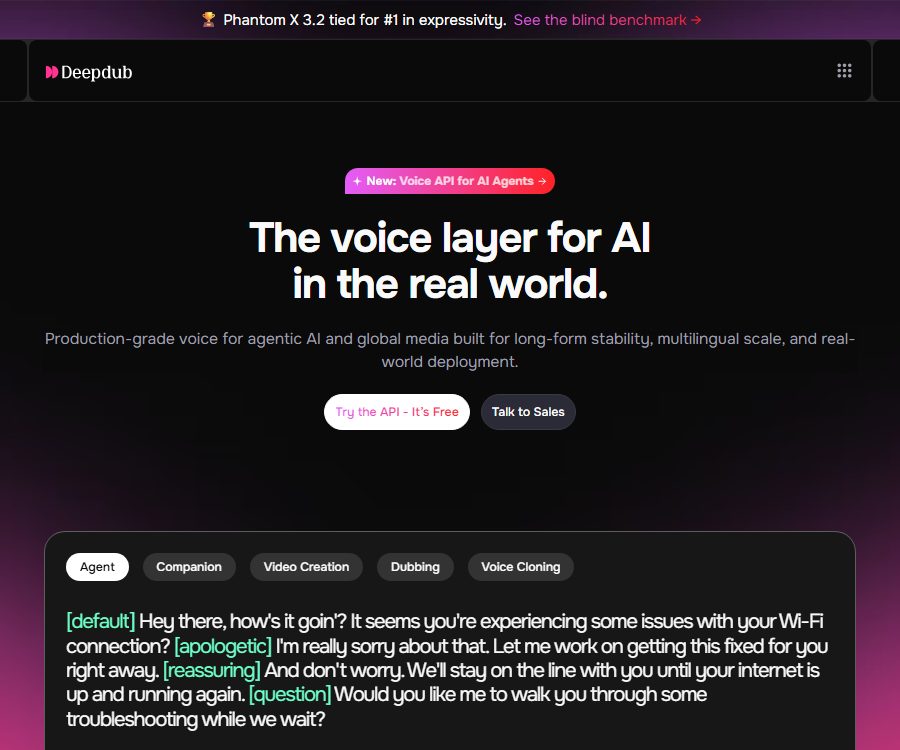
The entry “Dubbing and AI” in the database comes from the title of the product page; the actual brand name is Deepdub. It represents an enterprise-level AI-based voice synthesis and audio infrastructure designed for use in media, broadcasting, post-production, and voice robotics.
Deepdub offers emotional text-to-speech conversion, voice cloning, Voice-to-Voice transcription, dubbing for videos and films, real-time broadcasting dubbing, as well as developer APIs. It is not a one-click short-video translation tool intended for ordinary users; many of its professional services require contacting the team for setup.
Key product capabilities
| Ability | Enter | Output | Suitable scenarios |
|---|---|---|---|
| Emotional TTS | Text, language, sound, and emotion parameters | Speech with rhythm, emphasis, and expression | Agents, narrators, customer service, and training |
| Voice cloning | Authorized voice samples | Digital audio that can be used across different languages | Expansion of brand voice, actors, and hosts |
| Voice-to-Voice | The complete performance of the actor or voice actor | A new voice that preserves the tone and rhythm. | Film and television characters and highly emotional content |
| Media narration | Videos, audio tracks, scripts, and terminology | Translation, dubbing, and quality control of the final video | Movies, series, FAST channel and streaming services |
| Deepdub Live | Live programs or live audio streaming | Low-latency multilingual audio streams | Sports, news, esports, and live events |
| Voice API | Real-time or batch text and audio configuration | Audio formats such as WAV, MP3, ULAW, etc. | Voice agents, phone calls, and in-app voice functionality |
| Term and accent control | Glossary, pronunciation, and regional requirements | More consistent professional terminology and regional accents | Brands, products, and international content |
Emotional text-to-speech
Deepdub’s eTTS technology focuses on rhythm, pauses, stress, and emotion, rather than simply reading out the text. Users can choose the voice, language, and style of delivery, and can generate complete audio files or receive audio segments in a streaming format through the API.
- Suitable for customer service chatbots, telephone systems, courses, narrations, and interactive characters.
- It is possible to adjust the accent, speed, pitch, and intensity of emotion; the specific parameters vary depending on the model.
- It supports generating audio for a specified duration, which facilitates synchronization between the subtitle timeline and the video footage.
- SSML phoneme tags can be used to control proper nouns and special pronunciations.
- You can choose from existing licensed sounds, or create sound references if you have the rights to do so.
- For long texts, it is still necessary to check for audio drift, sentence segmentation, consistency of numbers, and consistency across different sections.
The current homepage demonstration uses Phantom X 3.2, while the quick-start example makes use of dd-etts-3.0. The product names do not always correspond exactly to the API model numbers; developers should refer to the models available in their accounts as well as the latest documentation.
Voice cloning and Voice-to-Voice
Voice cloning creates digital voices based on short audio samples, in order to maintain a consistent identity across different texts and languages. Voice-to-Voice, on the other hand, preserves the original rhythm, emotions, and subtle nuances of an actor’s performance before converting it into another authorized voice.
- The audio samples must come from the individual themselves or from performers who have given explicit permission.
- The authorization should cover training, generation, language, region, duration, and business channels.
- When uploading a sound file, it is necessary to specify attributes such as language, age, gender, and speaking style.
- The API provides functions for uploading, listing, reading, and deleting audio files.
- Film and television projects can expand from the performances of a small number of actors to include voices for more characters.
- Brand initiatives can maintain a consistent voice and identity across advertising, marketing, and channels.
Deepdub implements a licensing and royalty system for voice talents, but the terms of each individual project must be confirmed separately. A sound that can be cloned technically does not necessarily mean it can be used legally.
Audio dubbing processes for films, TV shows, and media
Media localization involves identifying speech in audio and video, generating scripts, handling translation and pronunciation, and then using sound libraries, cloning techniques, or voice-to-voice technology to create audio tracks in the target language. For professional projects, adjustments to suit the native language, a dedicated production team, and quality control are available.
- Provide the team with the content type, duration, source language, target language, and release region.
- Confirm the scope of rights for videos, scripts, actor voices, music, and sound effects.
- Upload media or existing scripts to generate transcriptions and split the dialogue.
- Establish requirements for characters, terminology, pronunciation, accent, and style.
- Select licensed sounds or authorized sound references for each character.
- Generate sample clips and review the translation, performance, character consistency, and timing.
- Revise key sections, working on music and effects, volume, and mixing.
- Complete quality checks for language, creativity, technology, and compliance.
- Deliver the audio tracks and the final footage in accordance with the broadcasting or platform specifications, and retain the approval records.
The automatic transcription page supports over 130 languages, while the pages related to voiceovers and audio APIs cover more than 100 languages and accents. The range of languages supported by different modules is not exactly the same; it is necessary to determine the specific language pairs, voices, and regional accents before starting a project.
Deepdub Live – real-time voiceover
Deepdub Live is designed for sports, news, esports, and live channels; it converts live audio into multilingual audio streams. It supports broadcasting workflows such as SRT, HLS, and MPEG-DASH, and can provide an output at 48kHz.
- It automatically adapts to the speaker and retains the host’s voice identity from short samples.
- Emotional matching adapts to the pace, intensity, pauses, and changes in events in real time.
- The initial audio time indicated on the page is around 125 milliseconds, but the actual end-to-end latency depends on the entire transmission path.
- Cloned sounds or pre-licensed broadcast sound characters can be used.
- The production configuration offers permissions, data isolation, and support for continuous operation.
- Names, scores, breaking news, and sensitive statements during live broadcasts still require manual monitoring.
The Live Solutions page specifies an SLA of over 99.9%, while the general terms for APIs state that paid APIs should maintain 99.95% availability on a monthly basis; the scope of these measurements is different. The contract should clearly define the service boundaries, maintenance windows, latency targets, failover procedures, and methods of compensation.
Voice API integration method
| Method | Main features | Suitable for tasks | Precautions |
|---|---|---|---|
| REST API | One request returns binary audio. | Batch narration, asynchronous tasks, and file generation | It is necessary to control timeouts, retries, and repeated charges. |
| WebSocket | Continuously connected, stream-based reception of audio blocks | Voice agents and real-time interaction | It is necessary to handle disconnections, buffering, and sequencing. |
| Python SDK | Synchronous and asynchronous streaming interfaces | Python backend and AI applications | The production environment should have a locked version. |
| Node SDK | JavaScript buffering and chunking callbacks | Node.js services and real-time applications | The key must remain on the server side. |
| Playground | Audio samples and parameters in the account | Sound selection, model comparison, and rapid verification | The test results do not represent the entire production load. |
Quick start with API
- Register using an enterprise email address for a 14-day trial, and complete the invitation and verification code process.
- Go to Playground and check the API key that was generated automatically for your account.
- Listen to the sound presets and save the desired voice prompt ID.
- Install the deepdub Python package or the Node.js client, or you can also send network requests directly.
- Select the model, language, target text, voice, and output format.
- For batch tasks, REST is used; for low-latency conversations, WebSocket streaming generation is prioritized for testing.
- Store the key in the server-side key management system, rather than on web pages or mobile clients.
- Test empty text, extremely long text, special characters, numbers, SSML, and network interruptions.
- It records the request for generation, audio permission, model version, output file, and the result of manual approval.
- Before the trial period ends, confirm with sales the billing plan, retention mode, concurrency limits, SLAs, and business terms.
Input, Language, and Output
| Category | Supported content | Boundary |
|---|---|---|
| Text | Plain text, pronunciation control, and some SSML features | Length, character, and language restrictions are determined by the interface and package. |
| Sound samples | Authorized voice clips uploaded or recorded on-site | Involves biometric data, personality rights, and actor contracts |
| Audio and video | Media, live streaming, and localized content | The file size, storage requirements, and project format must be confirmed in writing. |
| Language | Over 100 languages and accents | The API locale and the specific sounds covered are fewer than what is advertised in general. |
| Automatic transcription | Over 130 languages | The transcription scope does not mean that all languages have the same dubbing capabilities. |
| Audio output | WAV 48kHz, MP3, ULAW, and uncompressed audio | The specific sampling rate and format vary depending on the interface and the application scenario. |
| Live streaming output | SRT, HLS, MPEG-DASH workflows | Professional broadcast integration and network redundancy are required. |
Free trial and pricing
| Package or version | Price | Billing cycle | Core benefits or quota | Suitable for users |
|---|---|---|---|---|
| API trial | $ | 14 days | Up to 10,000 characters, approximately 10 minutes; Playground and API keys | Development verification and sound selection |
| API time package | Not yet made public | According to the selected time package | After the trial period, choose the duration of use; any additional usage will be charged at a fixed price. | Voice AI agents and content creation |
| Media narration | Contact sales | Project or contract | Translation, audio, production, quality control, and delivery | Movies, streaming services, and FAST channels |
| Deepdub Live | Contact sales | Custom contract | Real-time multilingual audio, broadcast integration, SLA, and operational support | Live streaming and broadcasting organizations |
| Enterprise deployment | Custom quote | Contractual agreement | Concurrency, support, security, retention, and licensing can be configured as needed. | Large-scale voice platforms |
The public page does not specify the cost for the trial period, the price per additional unit of usage, any minimum commitment requirements, or the enterprise service fees. It is therefore not possible to determine the pricing based on the assumption that 10,000 characters correspond to about 10 minutes of usage.
The details regarding taxes and fees, automatic renewal, cancellation, refunds, unused credits, failed creations, as well as charges related to concurrency limits are not clearly specified. Before making a purchase, it is necessary to refer to the actual settlement page, the subscription package, and the documents signed by both parties.
Sound licensing and output rights
The Deepdub sound library features sounds that are licensed, traceable, and suitable for use in broadcasting and commercial applications; however, these rights apply only to the specific sound assets and within the scope of the contract. Users still need to possess all the necessary rights for the scripts, videos, music, characters, and any custom sound samples they use.
- The region, channel, deadline, and brand usage for the preset sounds must be specified in the order.
- Licenses for using actors’ voices must cover training, synthesis, translation, and reuse.
- Uploading third-party materials does not mean that the resulting content can be distributed to others.
- The general terms of the API impose strict restrictions on the output generated from inputs that are not entirely under the control of the customer.
- Film, television, and advertising projects should retain the actors’ consent, copyright information, and approval for the final use.
- The obligation to label synthetic voices depends on the regulations of the country where it is released and the rules of the platform.
According to the API terms, if the input data is not entirely owned by the customer, the resulting outputs can generally only be provided to related parties for internal, non-commercial use. For complex projects that require third-party licenses, the scope of coverage must be specified through a separate contract; it is not sufficient to rely on standard trial accounts.
Privacy, security, and data retention
The data processing appendix for Deepdub covers the data of customer representatives and actors with whom the processor comes into contact, including names, contact details, and voice recordings. Sub-processors include AWS, Google, and WeTransfer, and the processing takes place in the European Union and the United States.
- The platform has passed SOC 2 Type II certification, and in the media sector it is labeled as TPN Gold or TPN certified.
- AES-256 is used for the static storage of personal data, while TLS 1.2 or a higher version is employed for encrypted transmission.
- The solution page states that customer data is isolated by default and is not used for training models.
- Customers can choose not to retain the data, so that the processed data is not saved anymore.
- Customers can request that their personal data be deleted, except for those portions that are required to be retained by law.
- In the event of, or suspicion of, a security incident, DPA requires that customers be notified within 48 hours.
- The data subject’s request will be communicated to the customer within 72 hours, and assistance will be provided in handling it.
Unless otherwise specified in writing, Deepdub is not obligated to retain the input materials on a long-term basis; it may set limits on file size as well as on storage and processing capacity. Users must keep their own backups of the original materials, scripts, sound licenses, and the final output.
API SLA and production reliability
The general terms for paid APIs guarantee a monthly availability of 99.95%, excluding planned maintenance carried out without prior notice; this guarantee does not apply to free services. High availability does not ensure that there will be no delays, issues with sound quality, or inaccuracies in the content generated each time.
- Enable idempotency control for REST requests to prevent duplicate audio files and associated costs from arising as a result of retries.
- WebSocket should handle disconnection reconnection, fragment order, and incomplete audio.
- Real-time services provide backup audio options or a fallback to traditional TTS.
- Monitor the initial audio duration, total generation time, error rate, and audio quality.
- Include model or API updates in compatibility testing and release approval processes.
- The live streaming contract must separately specify delays, SLAs, support hours, and incident response procedures.
GitHub, SDKs, and open-source status
| Project | Current status | License |
|---|---|---|
| Deepdub platform and models | Proprietary services | Unpublished product source code license |
| Python SDK deepdub | Official public repository | MIT |
| AudioSample | Official audio processing library | MIT |
| deepdub-api | Official API documentation and example repository | No license detected at the moment. |
| Node SDK | It can be installed using the package manager. | Subject to the license included in the package. |
| Other official integrations | Some warehouses are publicly accessible. | MIT, Apache, and others are all different. |
The Python SDK and AudioSample are licensed under the MIT license, which only specifies the conditions under which these code libraries can be used. The model weights, sound libraries, production platform, or commercial voice-over services of Deepdub are not made available.
Suitable for users and scenarios
- Voice AI Team: Develops voice interfaces for customer service, medical guidance, and finance.
- Film and streaming companies: produce multilingual series, movies, and catalog content.
- Broadcasting agencies: provide real-time audio tracks for sports, news, and major live broadcasts.
- Language service providers: Integrate emotional voice and voice cloning into existing localization processes.
- Post-production team: Uses the Deepdub Go control panel to adjust accent, emotion, and character voice.
- Brand and training team: Maintain consistency in voice identity and terminology across different markets.
- Developer: Generate speech using REST, WebSocket, Python, or Node SDK.
Advantages and main limitations
Main advantages
- It offers a range of products spanning from API TTS to film and television production as well as live broadcasting.
- Emotions, rhythm, accent, and Voice-to-Voice are more suitable for performative content.
- It offers a large selection of licensed sounds as well as a royalty system for actors.
- It supports integration with REST, WebSocket, Python, and Node.js.
- SOC 2, TPN, GDPR, encryption, and an optional no-retention mode are available.
- Professional projects can include mother tongue adaptation, a production team, and quality control.
Main limitations
- The specific price after the trial period has not been made public; an account selection or a sales quote is required.
- Language, the number of emotions, and SLA are calculated using different methods on different product pages.
- The languages available for APIs are not exactly the same as those used for overall transcription or media services.
- High-quality media dubbing still requires translation, performance, and review by technical staff.
- The output generated by third-party input is subject to strict restrictions on distribution and commercial use.
- The core platform and models are closed-source; an open-source SDK does not mean that the entire product is open-source.
Summary
Deepdub is suitable for voice intelligence agents, media, and broadcasting projects that have high requirements regarding audio performance, commercial licensing, real-time processing, and corporate security. Before starting to use it, it is necessary to determine whether to use the API, Deepdub Go, media production tools, or Live services; at the same time, the price, languages supported, audio rights, data retention policies, and scope of output distribution must be clarified in writing.
Frequently Asked Questions
Are “Dubbing and AI” product names?
It is the title used on the Deepdub page; the actual brand is Deepdub. The functions, APIs, and services mentioned in this entry all belong to Deepdub.
Can Deepdub be tried out for free?
Yes, the current API is available on a 14-day trial period; it allows for up to 10,000 characters, which is roughly equivalent to about 10 minutes of content. Registration is required using an enterprise email address.
How much will it cost after the trial period?
The public page only indicates that time-based packages are available for purchase, with a fixed price applied to any additional usage; no specific amounts are listed. For media and live broadcasting solutions, it is necessary to contact sales.
How many languages are supported?
In general, the product is available in over 100 languages and accents; automatic transcription as well as on certain technical pages, it is available in more than 130 languages. The specific API locales, voices, and target language capabilities need to be checked one by one.
Is real-time voice support available?
Yes, the WebSocket API enables stream-based generation, and Deepdub Live is also designed for real-time broadcasting of voiceovers. The actual latency depends on the model, the network connection, the encoding method, and the overall media transmission pathway.
Can sound be used for commercial purposes?
The Deepdub sound library offers commercial licenses, but the scope of these licenses depends on the selected sounds and the terms of the contract. Users must still obtain the necessary rights for any scripts, videos, characters, and sound samples they use.
Will customer data be used for training?
The solution page indicates that customer data is isolated by default and not used for training, and an option to not retain such data is available. Enterprises should still confirm the specific settings for a particular project in the contract and DPA.
Does Deepdub have Python and Node SDKs?
Yes, the Python package is deepdub, while the Node package is @deepdub/node. It is also possible to use REST or WebSocket interfaces directly.
Is Deepdub open source?
The core platform and models are not open source. The official Python SDK and AudioSample are licensed under the MIT license, but this does not apply to the sound libraries, model weights, or hosted services.
Will the input be saved permanently?
No guarantee is provided. Unless otherwise agreed in writing, Deepdub has no obligation to retain the input materials for an extended period; users must keep their original files, permissions, and backup versions on their own.
Tools similar to Dubbing and AI




 Guigong Network Security Registration No. 45132202000164