






Dubly.AI
Dubly.AI – makes working with AI audio more efficient and simpler.
Tags:AI audio toolsWhat is Dubly.AI?
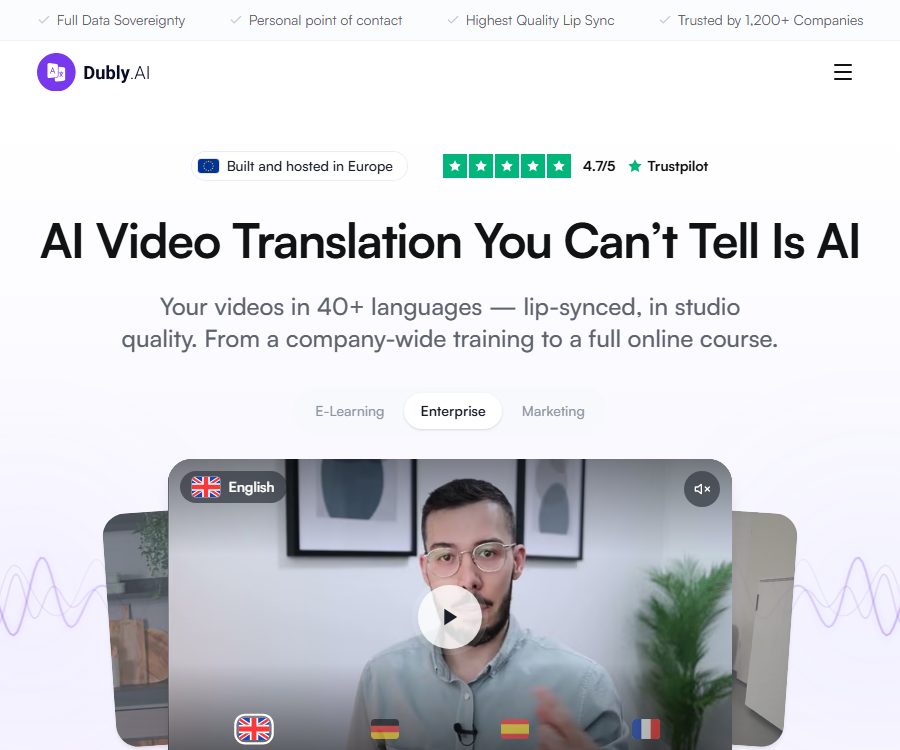
Dubly.AI is a platform for corporate video translation and AI voice synthesis, developed by the German company Dubly.AI GmbH. It combines speech recognition, translation, voice cloning, subtitles, and optional lip-syncing into a single web-based workflow, serving primarily multinational marketing, training, and content teams.
The platform is designed to process the actual speakers in existing videos; it is not a general-purpose video editor, an AI avatar generator, or a simple text-to-speech tool. It should also not be confused with browser extensions for real-time voice narration that have similar names, nor with external voice-over services.
Overview of main functions
| Functions | Enter | Output | Specific value |
|---|---|---|---|
| Video transcription and translation | MP4, MOV, or YouTube videos | Transcription divided into segments and translation in the target language | Convert long videos into localizable projects that can be reviewed. |
| Voice cloning | The voice speaking in the original video | Target-language dubbing that preserves the speaker’s characteristics | Reduce the effort required to find and record new voice actors. |
| Multi-speaker processing | Videos with one, two, or more speakers | It can automatically identify and allocate sound to each segment. | Handling interviews, courses, and multi-person presentations |
| Translation Editor | Automatic translation, terminology, and tone requirements | Manually revised segment-by-segment translation | Correct proper nouns, numbers, tone, and industry-specific expressions. |
| Brand glossary | Do not translate words, use fixed translations and pronunciations. | Consistent terminology for cross-video multiplexing | Maintain consistency in brand, product, and regulatory terminology. |
| Lip-syncing | Videos with dubbed audio completed | Videos whose lip movements match those of the audio track in the target language better | Improve the coherence of positive messages, advertisements, and course content. |
| Export in multiple formats | Reviewed translation projects | MP4, MP3, and SRT | Deliver the video, mix, vocals, background sound, and subtitles separately. |
| Team collaboration | Project members, external auditors, and permissions | Share projects, review links, and provide centralized feedback | Have the translation, branding, and release teams conduct a joint review. |
Video upload and input requirements
The platform supports MP4 and MOV formats; the size of a single file cannot exceed 5GB, and it can handle videos in up to 4K resolution. YouTube links can also be imported, making it suitable for localizing content from existing channels.
- There is no fixed upper limit on the length of videos that can be made public; however, longer videos require more points and take longer to process.
- Background music and ambient sounds can be kept, as long as the voice is clear enough.
- Multi-person videos can automatically detect speakers and allow for reassignment by segment.
- Lip-syncing is more suitable for shots with a clear view of the face and mouth, good lighting, and a frontal angle.
- Hands, microphones, and subtitles that cover the mouth can reduce synchronization; backlighting, fast speaking, and loud noise also impair synchronization.
- The original video, script, and lossless audio track should be kept before uploading; the platform does not assume any responsibility for the user’s long-term backup of such files.
Automatic translation and manual control
After the video is uploaded, the system first identifies the speech and generates translated versions for each segment. Users can modify the content of each segment individually, without having to accept the entire translation provided by the model at first.
- Create a list of terms that should not be translated, including brand names, product names, and technical terms.
- Assign fixed translations and pronunciations to specific terms.
- Set the level of formality, titles, and writing style.
- Apply the same modification to multiple target language versions.
- Preview replacement sounds, upload your own sounds, or use cloned sounds.
- Redo the voiceover after modifying the original text; there is no need to recreate the entire project.
- Each video can be revised for translation an unlimited number of times.
Advanced features such as segment splitting, skipping, and timing adjustment are still listed as upcoming on the current pricing page; they cannot be considered fully available yet. Videos containing legal, medical, financial, or security-related information must be reviewed by personnel with the appropriate language skills and expertise.
Voice cloning and voice replacement
Voice cloning involves extracting the vocal characteristics of the original speaker and then using them to generate a voice synthesis in the target language. Users can also choose alternative voices from a database or upload their own voices that they have permission to use.
Cross-lingual dubbing may retain certain tonal and expressive features, but it cannot guarantee that the emotion, stress, and accent of each word will be exactly identical to those in the original version. Before official release, it is necessary to listen to segments containing names, numbers, abbreviations, brand names, and sensitive expressions one by one.
How to use lip-syncing
Lip synchronization is an optional step following standard dubbing; the system adjusts the speaker’s mouth movements to match the new audio track. It costs 1 additional point per minute and for each target language, so standard dubbing combined with lip synchronization totals 2 points.
- First, complete the standard transcription, translation, and dubbing in the target language.
- Check the length of each segment, the speaking pace, pauses, and the allocation of speakers.
- Ensure that the mouth is not covered, the face is clearly visible, and the lighting meets the requirements for processing.
- Enable lip-sync in the target language version and check the estimated score.
- Wait for the processing to be completed, and check for fast speech, side views, obstructions, and camera angle changes.
- When obvious issues are detected, adjust the translation or audio track first, then regenerate the required section.
The processing speed depends on resolution, duration, and the number of languages. As a reference, it takes about 10 minutes to process full HD video in each language, while 10 minutes is required for 4K video in each language; however, these are not fixed time limits for the service.
Complete localization process for videos
- Create a corporate account and verify that the user falls within the category of enterprises or business owners permitted by the terms.
- First, use the 1-minute free trial version to check the quality of the language, audio, and camera; the output generated for free is intended solely for internal evaluation.
- Upload MP4 or MOV files, or import YouTube videos for which you have permission to edit.
- Select one or more target languages, and the system will generate drafts for transcription, translation, and dubbing.
- Check speaker recognition and adjust the attribution of voices based on segments.
- Revise the translation in the editor, and configure brand terms, fixed translations, pronunciation, tone, and titles.
- Listen to the cloned sound or the replaced sound to confirm your consent and the scope of use.
- Enable lip-sync when necessary, and check the points consumed before starting.
- Invite internal members or external reviewers to review the content, and use a PIN to protect the sharing link.
- Export as MP4, MP3, or SRT, and complete language, compliance, and release validation in the target market.
Language support and differences in wording
The current pricing page lists 100 source languages and 37 target languages and dialects, and allows the creation of an unlimited number of versions in target languages for a single video. On the public page, figures such as over 32 or around 38 languages are also shown; this may be due to differences in the timing of page updates, regional variations, and methods of calculation.
- English includes variants from the United States, the United Kingdom, Australia, and Canada.
- French includes French and Canadian variants.
- Portuguese includes Brazilian and Portuguese variants.
- Spanish includes Spanish and Mexican variants.
- Arabic includes variants from Saudi Arabia and the UAE.
- Chinese, Japanese, Korean, German, Hindi, Vietnamese, and others are listed in the current list of target languages.
The number of languages available does not mean that all language pairs have the same quality, nor does it guarantee that specific accents, dialects, or technical terms are optimized. Before purchasing a large number of credits, it is necessary to select the desired language pairs in the account selector and test them using your own representative materials.
Output format and delivery
| Output | Format or options | Suitable uses |
|---|---|---|
| Translate video | MP4, optional lip-sync | Websites, social media, courses, and internal communications |
| Complete mix | MP3 | Podcast-style release and post-production editing |
| Only target voice | MP3 | Give it to the editor to remix it. |
| Only background sound | MP3 | Keep the music and ambient sounds for post-production. |
| Subtitle file | SRT | Player subtitles and further proofreading |
| Burn subtitles | Two styles and custom accent colors | It does not rely on the distribution channels of the subtitle track in the player. |
The platform allows for adjusting the volume of the original audio in the final mix, while striving to preserve the background music and ambient sounds. Maintaining the input resolution does not mean that there will be no compression differences in each scene after processing; it is still necessary to check the image quality, bitrate, and audio peaks before delivery.
Teams, workspaces, and reviews
The current package description includes unlimited users, multiple workspaces, as well as projects and folders as part of all purchase options. The available roles are Owner, Admin, Member, and external Reviewer; reviewers can participate by sharing a project without requiring their own separate account.
- Use workspaces to isolate the assets and budgets of different customers, brands, or departments.
- Restrict who can purchase points, create API keys, and export sensitive content.
- Gather feedback from native speakers, legal experts, and customers through external reviewers.
- Set a PIN for sharing the link, and revoke access once the review is complete.
- Indicate the language, version, review status, and release date in the project name.
- Retain the original text, translation, consent form, and final approval record.
Rules for calculating integrals
For standard dubbing, 1 point is assigned per minute for each target language; if the time is less than one minute, it is rounded up. Lip synchronization adds another 1 point per minute, so for the same video, both dubbing and lip synchronization require 2 points per minute.
| Task | Example | Points consumption | Explanation |
|---|---|---|---|
| Standard dubbing | Translate 10-minute videos into 1 language | 10 points | 1 point per minute for each language |
| Multilingual dubbing | Translate 10-minute videos into 3 languages | 30 points | Each target language is calculated separately. |
| Dubbing with lip-syncing | Create a 10-minute video in 1 language | 20 points | 10 points for each of the standard voice recording and lip synchronization. |
| Not a full minute | Each time, it processes a portion of minutes. | Round up | Calculated per processing operation |
If a task fails due to the platform’s fault, it is possible to request a refund of the points that were used through the available support channels. There may be additional rules applicable to reprocessing tasks and certain independent functions; therefore, it is necessary to refer to the estimated amount of points that will be used as indicated on the page before starting a task.
Prices and packages
| Package or version | Price | Billing cycle | Core benefits or quota | Suitable for users |
|---|---|---|---|---|
| Free trial | 0 euros | Once | The first 1-minute video test requires no credit card; it is intended only for internal evaluation. | Quality verification |
| One-time points | Displayed along with the selected quantity | One-time use | There is no automatic renewal, and the points do not expire. | Single-project and variable usage amounts |
| 25 points per month | Currently 89 euros | Monthly | 25 minutes for standard dubbing or about 12 minutes for the task requiring accurate lip synchronization; points are updated on a monthly basis. | Ongoing small-scale localization |
| Annual payment plan | Displayed along with the number of credits and the settlement method. | One year | The page shows the relative discount for monthly payments, with points carrying over throughout the validity period of the contract. | Predictable annual usage amount |
| Enterprise | Custom quote | Contractual agreement | Invoices, bulk pricing, custom terms, and high-volume configurations | Large enterprises and high-frequency production |
For the monthly subscription of 25 points, the page shows both the marked price of 99 euros and the current price of 89 euros; this means that each point is worth 3.56 euros. All prices listed are in euros, exclusive of taxes, and value-added tax will be added at the time of settlement, depending on the country where the bill is issued.
The dynamic prices for one-time, monthly, and annual subscriptions change depending on the number of points selected; therefore, a single price cannot represent all options. Bank cards and PayPal are used for regular payments, while for annual subscriptions, corporate accounts, and individual contracts, SEPA transfers or invoice-based payments can also be used when applicable.
Validity period of points and renewal
- Points purchased in a single transaction or through additional top-ups do not expire.
- The points from the monthly subscription are valid only for the corresponding monthly billing period, and they expire without any compensation at the end of that period.
- Annual points are issued on a monthly basis and can be carried over across months as long as the contract is in effect; they become invalid upon termination of the contract.
- Monthly contracts are renewed on a monthly basis, and cancellation usually takes effect at the end of the current billing period.
- For an annual contract, the initial period is one year; under the current general terms, cancellation is required three months in advance at the end of that contract period.
- Old packages and corporate contracts may have different prices, validity periods, and cancellation terms.
Conditions for refund
For the first purchase of a paid package, a refund can be requested in written form within 30 days after the contract is established; however, the points used for this request must not exceed 20% of the value of the package, and a brief explanation of the reasons for dissatisfaction is required. This right to voluntary refund is available once only per customer.
The 30-day refund policy does not apply to one-time credits, additional top-up packages, or corporate contracts negotiated separately. Specific refund terms, legal rights, and special contract conditions are subject to the documents confirmed at the time of purchase.
APIs and developer capabilities
The current package description lists API access as one of the included features; the terms also specify that API keys, quotas, rate limits, and interface documentation are applicable. It is suitable for integrating video uploading, task processing, and localized results into an enterprise content pipeline.
- Verify the API permissions and current plan limits in the account.
- Create a dedicated key and store it in the server-side key management system.
- Upload, select the language, and submit tasks in accordance with the documents provided for the account.
- Record the task number, estimated points, processing status, and reason for failure.
- Provide reliable handling for rate limiting, insufficient quotas, duplicate submissions, and long-running tasks.
- Download the output and carry out language and compliance audits in your own system.
- Rotate keys and revoke them immediately when a member leaves or there is a suspicion of a data leak.
At present, no complete API endpoints, rate limits, or official SDKs that can be verified without logging in have been found, nor are any public example projects available. The development team should request the current documentation from the service provider and conduct small-scale integration tests before making a purchase.
Open-source status of the product
| Project | Current status | Explanation |
|---|---|---|
| Platform API | Already provided | Subject to account, plan, document, and usage limits. |
| Official SDK | Not confirmed yet | No list of public software packages was found. |
| Official GitHub | Not confirmed yet | No product warehouse that corresponds explicitly to the company’s identity was found. |
| Product source code | Not disclosed | Dubly.AI is a hosted SaaS solution. |
| Open-source components | May contain | Components are used under their respective licenses, which does not imply that the platform is open source. |
| Product open-source license | Not yet made public | It has not been confirmed whether copying, modifying, or redistributing the platform’s source code is allowed. |
Privacy, security, and data retention
The platform is operated by a German company, and customer data is processed in data centers located in the European Union or the European Economic Area; the product page indicates that the servers are in Germany. The service provides data processing protocols, and technical and organizational measures as well as a list of sub-processors can be provided upon request.
- The product page indicates the use of AES256-GCM encryption as well as account-level data sandboxing.
- The platform states that penetration testing has been completed, but ISO 27001 is still in the preparation phase.
- Customer videos, audios, and outputs will not be used for training platforms or third-party AI models, unless both parties agree in writing otherwise.
- The data of different customers is isolated within account sandboxes and not combined to serve as general training data.
- Before sending personal data for the first time, enterprises should sign a DPA and examine the sub-processors as well as the cross-border safeguards.
- Website server logs are typically retained for a maximum of 14 days, while logs related to security incidents can be kept for a longer period.
- A free request for an export of the customer content in machine-readable format can be made within three months after the contract ends.
- Three months later, the content is deleted or anonymized in accordance with the DPA, except for those records that are required to be retained by law.
The privacy policy outlines the way in which data is processed regarding websites, accounts, contacts, payments, and various external services. Companies should not rely solely on a statement of compliance; instead, they need to assess the DPA, TOM, sub-processors, retention periods, and access controls based on the sensitivity of the data involved.
Copyright, Sound Permissions, and AI Disclosure
The customer retains the right to upload content, as well as the right to use the translated and dubbed versions within the limits permitted by law. The platform only has limited permission to process, copy, modify, transmit, and back up the content necessary for providing services during the term of the contract.
- The uploader must possess the necessary rights for video, audio, music, subtitles, and translation.
- It is necessary to obtain the consent of the relevant individual or have another legal basis before cloning voices, faces, or portraits.
- It is prohibited to use outputs to impersonate others, engage in fraud, phishing, harassment, or create false political information.
- When publishing deep-fake or AI-generated content that is subject to regulatory restrictions, users must fulfill the applicable obligations regarding transparency and labeling.
- The watermarks, markers, or machine-readable metadata that have been added by the platform to ensure compliance must not be removed.
- The content generated from free evaluation points can only be used for internal assessment and must not be utilized for production or commercial release.
- The outputs of the paid plans can be used for commercial purposes, but the users remain responsible for the rights to the content, its accuracy, and compliance with relevant regulations.
AI-generated translations may contain errors, inaccuracies, or deviations from the original text; therefore, the platform requires users to review them before using or publishing them. For contracts, health-related documents, financial materials, employee training materials, and public statements, approval must be given both by native language experts and by the person in charge of the business.
Suitable for users and scenarios
- Marketing team: Create product videos, advertisements, and social media content in multiple languages.
- Learning and Development Department: Provides training for employees on translation, operational procedures, and compliance issues.
- Online education platforms: localized course libraries, lectures, and teaching demonstrations.
- Corporate Communications Team: Creates management speeches and internal updates for the international offices.
- Media and creators: Expanding the target audience for interviews, segments, and knowledge videos.
- Software and manufacturing companies: tutorials, demonstrations, and customer training to maintain term consistency.
- Development team: Integrates voice-over tasks into the content management and publishing process via APIs.
Advantages and capabilities boundaries
Main advantages
- Bring translation, voice cloning, editing, subtitles, and lip-syncing together on the same platform.
- It supports parallel processing of multiple target languages as well as project-specific brand glossaries.
- Segment-by-segment editing and unlimited revisions enable professionals to control the final text.
- Team roles, external audits, multiple workspaces, and PIN sharing are suitable for corporate processes.
- It is possible to export the video, voice, background sound, and subtitles separately, which facilitates further post-production work.
- The data is processed in Europe, and DPA, sandboxing, as well as contractual provisions ensuring it is not used for training are provided.
Main limitations
- For each additional target language, points are consumed again based on the number of minutes of video.
- Lip-sync increases the total score per minute from 1 to 2.
- Noise, occlusion, side views, fast speech, and complex speech pairs can affect the results.
- AI translation and text-to-speech synthesis cannot replace native language and domain expertise in review.
- The output from the free trial cannot be used for production or commercial release.
- The complete API documentation, SDKs, GitHub repository, and source code of the product are not publicly available.
- The number of languages and pricing options vary depending on the page, account, and package selected.
Summary
Dubly.AI is suitable for organizations that wish to convert existing corporate videos into versions with multilingual voiceovers, subtitles, and optional lip-syncing, and that require team review, use of brand-specific terminology, as well as compliance with European data processing regulations. Before making a purchase, it is necessary to test the language pairs and facial footage using representative samples, while also taking into account the number of target languages, the costs associated with lip-syncing, taxes, the duration of the contract, and the expenses related to manual review.
Frequently Asked Questions
What does Dubly.AI do?
It automatically transcribes and translates existing videos, redubs them by using cloned or alternative voices, and can also generate subtitles as well as videos with synchronized lip movements.
Is it possible to try it for free?
Currently, the first 1-minute test video can be processed for free, without the need for a credit card. The content generated using these free credits is intended only for internal evaluation and cannot be used for production or commercial release.
How many videos can one integration handle?
One point allows for one minute of standard dubbing in the target language; if the duration is less than one minute, it is rounded up to one full minute. Enabling lip synchronization requires an additional point per minute.
How much is the monthly plan with 25 points?
The current price is 89 euros per month; the page also shows 99 euros as a marked price. The price does not include value-added tax. It is necessary to check the local taxes and any ongoing promotions before making a payment.
Do one-time points expire?
No, the points acquired through a one-time purchase or by making additional top-ups do not expire at the moment. Monthly points become invalid at the end of that month, while annual points are carried over only as long as the contract remains in effect.
Is Chinese voiceover supported?
Chinese is included in the current list of target languages. Before proceeding with a formal purchase, it is still necessary to test the quality of the translations and the sound quality using one’s own voice, specialized terminology, and content types.
Can I keep the background music?
Yes, the platform will isolate the main voice while trying to retain the background sounds and music. If it is difficult to distinguish between the human voice and the noise, the quality of the isolation and voice-over may suffer.
Will customer videos be used to train AI?
No, unless the customer gives written consent to do so. The product terms and data security guidelines stipulate that the customer’s content and outputs shall not be used for training platforms or third-party models.
Is it possible to clone anyone’s voice?
It is not allowed. Users must obtain consent for the use of the speaker’s voice, portrait, and related personal data; it is prohibited to impersonate others or create deceptive content without such consent.
Does Dubly.AI have an API?
Yes, the current package includes API access, but the full documentation and usage limits need to be confirmed within the account or through the procurement process. No official SDK has been made public yet.
Is Dubly.AI open source?
The source code of the product is not made public, and there is no confirmation regarding an official GitHub repository or an open-source license for the product. The platform may use open-source components, but this does not mean that the SaaS solution itself is open-source.
Tools similar to Dubly.AI




 Guigong Network Security Registration No. 45132202000164