






Brain Pod AI
Brain Pod AI – makes AI-based audio processing more efficient and simpler.
Tags:AI audio toolsWhat is Brain Pod AI at the moment?
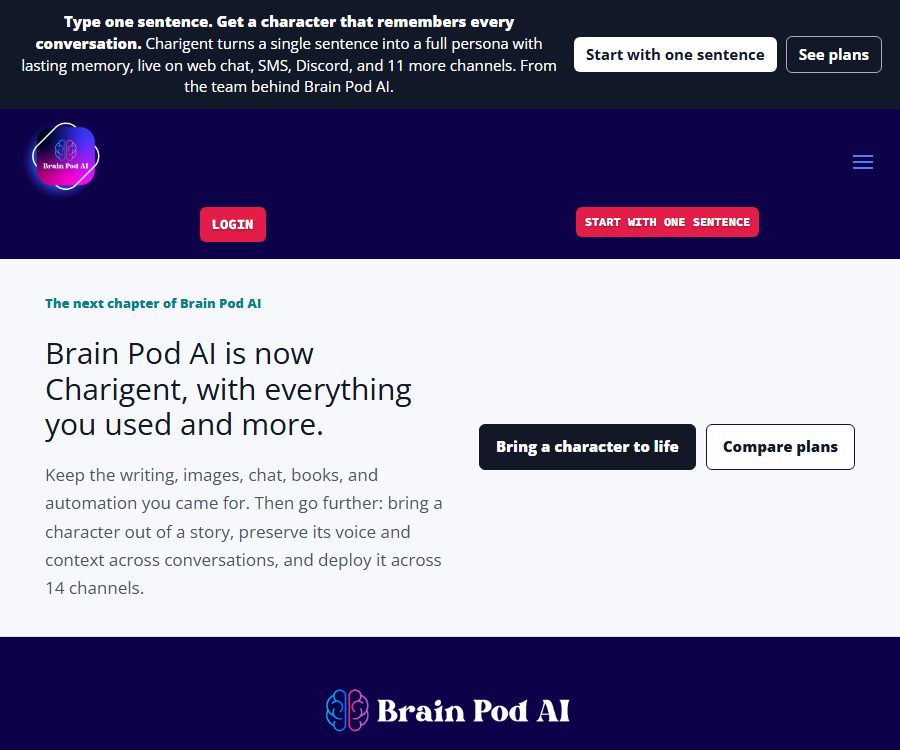
Brain Pod AI has been upgraded and renamed Charigent; its previous capabilities in areas such as AI-driven writing, image processing, chatting, book management, and automation have been integrated into the new connected AI workspace.
The old brand page is currently used to explain the migration process and to introduce the existing features; for actual registration, accounts, pricing, and new features, the Charigent platform is the authoritative source.
Core product structure
- AI Chat: It enables ideation, writing, analysis, and Q&A in a unified conversation area. The Standard package for regular conversations is included in the plan for paid subscribers, but it is subject to reasonable daily usage limits.
- Image Studio: It accepts text prompts to generate images and supports various quality levels; partial redrawing and image editing are available starting from the Pro version.
- Content Engine: It connects keyword research, content opportunities, article summaries, drafts, review processes, and publishing into a cohesive workflow; WordPress publishing is available as part of the Pro plan.
- Charigents: It allows for the creation of task-oriented Agents or characters with their own identities, and it enables the configuration of knowledge, voice, variables, memory, and deployment methods.
- Flow Builder: It allows users to combine 33 different types of nodes, conditional branches, Webhooks, and over 300 integration options via a visual canvas, making it suitable for turning repetitive tasks into reusable processes.
- Voice AI: Allows Charigent to engage in real-time voice conversations or make calls; voice hosting is available starting from the Pro plan, while advanced voice features and voice cloning are available in the Business plan.
- Book Maker and Fiction Writer: Organize non-fiction books and novels by chapter or scene; after reviewing them, it is possible to export them in PDF, EPUB, or DOCX format.
- Social tools: Social Inbox, Content Strategist, AI Social Video, along with various levels of automation, are used for planning, creating, reviewing, and publishing social content.
- Neural Memory: It retrieves the saved context based on semantics, allowing relevant information to be reused in subsequent creations or conversations, rather than relying solely on exactly matching keywords.
The difference between Agent and Character
| Type | Main goal | Configurable content | Typical tasks |
|---|---|---|---|
| Agent Charigent | Complete business tasks and provide answers based on reliable information. | Documents, FAQs, rules, variables, routing, and workflows | Customer support, sales FAQs, internal knowledge, and operational automation |
| Character Charigent | Maintain a recognizable personality and continuous interaction. | Character design, voice, relationship memory, background knowledge, and sharing methods | Story characters, virtual creators, interactive companionship, and brand personality |
Both types of Charigent can be tested in a private environment first, and then deployed to websites, messaging channels, voice services, or APIs as part of a package.
Input, output, and model usage
| Functions | Main inputs | Main output | Features of the quota |
|---|---|---|---|
| Chatting and writing | Hints, conversation context, files, and saved memories | Answers, articles, abstracts, plans, and structured text | Standard chats are billed based on reasonable usage, while higher-level models and content-related tasks require the use of credits. |
| Image | Text description, dimensions, and the area of the image to be edited | New images, variants, and results of local edits | The quality level and editing capabilities are determined by the package, with points being consumed based on the operations performed. |
| Knowledge-based Charigent | Documents, frequently asked questions, business rules, and variables | Answers with business context, handover information, and process results | The number of knowledge sources, the number of Charigents, and the deployment channels are limited by the package. |
| Books and novels | Theme, outline, chapters, characters, worldview, and scenes | It is possible to review manuscripts as well as files in PDF, EPUB, and DOCX formats. | Non-fiction starts at Starter, while Fiction Writer starts at Pro. |
| Workflow | Triggers, form data, Webhooks, conditions, and external service data | Automatically generate content, notifications, integration actions, and review tasks | The number of flows and the approval nodes are limited by the package. |
The platform offers model selection with six speed levels and different quality settings; the availability of specific models as well as the energy consumption per integration may vary depending on the configuration and the system settings.
The usage process from registration to deployment
- Go to the current Charigent registration page, review the information regarding the 14-day trial period, card binding, automatic conversion, and available points, and then create an account.
- Choose AI Chat, Image Studio, Content Engine, Charigent, or Flow Builder as a starting point for your work.
- If an Agent is created, authorized documents and common questions should be uploaded; if a Character is created, settings for personality, voice, and relationship memories need to be added.
- Select the model level, enter the instructions, variables, and output requirements, and decide whether to allow saving of the context.
- Test the results using normal questions, boundary questions, and questions without answers, in order to check for knowledge retrieval accuracy, hallucinations, sensitive information, and manual intervention.
- When automation is needed, add conditions, Webhooks, integration nodes, and review nodes in Flow Builder, then check the execution results one by one.
- According to the plan, these components are deployed to websites, collaboration tools, messaging channels, voice services, or APIs, and identity, context, and permissions are tested one by one.
- After going live, check the points, session, and workflow records, update the knowledge base, and require manual approval before performing high-risk operations.
Deployment channels and platforms
| Channel category | Current support methods | Package or configuration requirements |
|---|---|---|
| Web workspace | Chats, content, pictures, books, Charigent, and Flow Builder | It is used for browser login, with various models and functions made available according to the specified plan. |
| Core collaboration channels | Email, Slack, Discord, Telegram, Google Chat | Starter is available for use. |
| Business news channels | WhatsApp, Messenger, Instagram, LINE, WeChat | Starting from the Pro version, a corresponding service provider account and authorization are still required. |
| Website components | Embed Charigent in verified websites | 3 for Pro, 10 for Business, customized for Enterprise |
| SMS and phone calls | Hosted numbers, custom SMS accounts, voice sessions, and calls | Capabilities vary depending on the Pro, Business plans and the communication service provider. |
| Developer integration | REST API, Webhooks, and external integrations | Programmatic APIs start with Business. |
| Native mobile apps | Not confirmed yet | No official app available on the App Store or Google Play. |
The fourteen deployment channels represent the different types of access listed by the platform; they do not mean that every package or region can be activated without the need for additional accounts.
Suitable for users and typical use cases
- Content and SEO team: Draft articles are created based on keyword opportunities and briefs, and after manual review they are published on WordPress.
- Marketing and social media team: Converts brand materials into copy, images, short videos, and a content calendar, while also setting up the processes for approval and publication.
- Customer Service Team: Utilizes product documentation and policies to assist agents, answers common questions on the website and through messaging channels, and refers complex issues to human agents.
- Creator and author: Plan non-fiction books, novel characters, scenes, illustrations, and export versions within the same project.
- Institutions and agents: Store knowledge, brand variables, and workflows for different clients, thereby reducing the need to copy context across various tools.
- Development team: Integrate Charigent into existing products or internal processes via REST APIs, Webhooks, BYOK, and visual flows.
Main advantages
- Chat, knowledge, content, images, characters, and automation share the same workspace, reducing the need to transmit background information repeatedly.
- With Agent and Character designed separately, it is possible to handle factual business tasks as well as maintain memories of personalities and relationships.
- From web components to messages, voice, and APIs – multi-channel deployment enables the same Charigent to be reused at various touchpoints.
- Flow Builder offers code-free nodes, Webhooks, and manual review, making it suitable for gradually expanding the scope of automation.
- The package clearly lists the number of points, Charigent units, knowledge sources, Flow elements, and components, facilitating selection based on structural constraints.
Capacity limits and usage restrictions
- The generated results may be inaccurate, incomplete, biased, or outdated; professional review cannot be bypassed for regulated applications in fields such as law, medicine, and finance.
- Knowledge retrieval can only be based on materials that have been uploaded and are accessible; incorrect, outdated, or missing documents directly affect the quality of the responses.
- High-quality models, images, long texts, books, and audio content consume points, and the estimated amounts cannot be considered as fixed guarantees.
- The merging of cross-channel contexts relies on identity, memory, and channel settings; it cannot be assumed that all anonymous visitors will be identified as the same person automatically.
- Messages, text messages, voice calls, and social platforms are also subject to third-party oversight, as well as restrictions related to region, number, pricing, quotas, and content policies.
- Automated processes may carry out external actions; when it comes to publishing content, notifying customers, or making changes to data, audit nodes and the principle of minimum permissions should be applied.
- The old Brain Pod AI page still retains some old names and descriptions of functions; these should not be used to determine the current packages or models.
Price packages
| Package or version | Price | Billing cycle | Core benefits or quota | Suitable for users |
|---|---|---|---|---|
| 14-day assessment | Includes trial points | Once | Try out chatting, images, and books; paid features are marked. | Selection and functional verification |
| Starter | 19 dollars; 190 dollars per year | Monthly or annual payment | 10,000 points per cycle, 3 Agents, 3 Characters, 50 knowledge sources, 3 Flows, core channels | Individual creators and lightweight automation |
| Pro | 49 dollars; 490 dollars for annual payment | Monthly or annual payment | 25,000 points per cycle, 10 Agents, 10 Characters, 200 knowledge sources, 10 Flows, 3 components, voice functionality, and advanced publishing options | High-frequency content, small teams, and customer service |
| Business | $ | Monthly or annual payment | 50,000 points per cycle, 50 Agents, 25 Characters, unlimited knowledge sources and Flows, 10 components, API, BYOK, and advanced voice capabilities | Teams that require integration and control |
| Enterprise | Contact sales | Customization | Custom credit limits and carry-over rules, SSO, integration, training, account managers, and support terms | Large organizations |
The monthly rates equivalent to an annual payment are 15.83, 40.83, and 82.50 dollars respectively; the page indicates that these rates save 17% compared to monthly payments. Taxes and the actual currency amount are as specified on the settlement page.
Points rules
- The points for the Starter, Pro, and Business plans are updated at the end of each billing cycle, and any unused points are not carried over.
- Recharge credits purchased during an active subscription period will not expire, but the handling method after cancellation of the subscription should be confirmed before purchase.
- The estimation based on standard operations is influenced by the length of the text, the quality of the images, and the level of the model; higher-level models require more points for each operation.
- Under the paid plan, Standard does not deduct any package points for regular conversations, but there is still a reasonable daily usage limit.
There are conflicts in the trial information.
The current price page states that a card is required for a 14-day evaluation period, and the plan will switch to a paid version after that time; however, the current terms of service indicate that no card is needed and there is no automatic transition to a paid plan.
Before registering, it is necessary to refer to the actual registration steps, the settlement confirmation page, and the subscription status within the account; one should also check or cancel the subscription voluntarily if it is no longer needed.
API, BYOK, GitHub, and open-source status
| Project | Current status | Explanation |
|---|---|---|
| REST API | Business is open. | Charigent can be invoked from applications; the specific permissions and rate limits are specified in the account documentation. |
| Webhook | Already supported | Used for subscribing to events, Flow completion, and result generation, in order to build event-driven processes. |
| BYOK | Business and Enterprise | It supports connection to external model keys; the model service provider charges directly, while the platform adds a 5% routing fee. |
| Public SDK | Not yet officially confirmed | No official versioned client library has been identified at the moment. |
| Official GitHub source code | Not yet officially confirmed | Old GitHub accounts associated with the former brand do not show any public repositories corresponding to the current hosted products. |
| Open-source product | No | Charigent is a hosted business platform governed by terms of service; it does not offer open-source licenses for its products. |
The provision of embedding code for web components does not mean that the product is open source; likewise, API permissions do not give the right to copy, resell, or relicense the entire platform.
Privacy and security
- The platform stores account details, usage data, models, points, timestamps, notifications, uploaded files, knowledge documents, and outputs to enable workspace and team features.
- Bank cards are handled by payment service providers; the platform receives the customer’s identification and subscription details, but does not obtain the full card number.
- When using generation capabilities, prompts and relevant context may be sent to Google, OpenAI, or Anthropic; sensitive personal information should not be entered directly.
- When stored statically, BYOK keys are encrypted using AES-256, and they can be removed through the settings; transmission takes place over encrypted connections.
- When connecting to services such as Google, Meta, Slack, Discord, WordPress, etc., only grant the permissions required for the task at hand, and disconnect from them once they are no longer needed.
- Once core account data is deleted, it is removed or anonymized immediately; for manual deletion requests, the deadline is 30 days; backups can be retained for up to 90 days.
- Transaction data may be retained for 7 years due to accounting and legal requirements, while aggregated or anonymized data can be kept for an extended period.
- When handling customers’ personal data, Business and Enterprise can request a data processing addendum; for cross-border projects, it is necessary to verify the roles, sub-processors, and transfer terms.
Copyright, Commercial Use, Cancellation and Refunds
- Users retain the right to upload content and must ensure that they have the necessary permissions to do so, as well as to process and publish it.
- The generated output is made available to the user within the limits permitted by applicable law; however, the generated content may not be exclusive and might resemble results produced by others.
- Users are responsible for checking for factual errors, infringement issues, privacy concerns, and compliance risks; the outputs of the model should not be regarded as professional advice.
- Monthly and annual subscriptions are automatically renewed; once canceled, they can usually be used until the end of the currently paid period.
- Except as required by law, the platform generally does not offer proportional refunds for completed subscription periods; unused package credits are also not carried over automatically.
- Without written permission, it is not allowed to resell or relicense access to the platform, nor to extract data from the system or perform reverse engineering using methods other than the standard API approaches.
Summary
The current version of Brain Pod AI is Charigent; it is suitable for individuals and teams who wish to combine content, images, knowledge-based agents, character memories, and multi-channel automation in the same workspace.
Before official adoption, it is essential to carefully verify the trial settlement details, the costs associated with models and points, the terms related to third-party channels, API permissions, and the requirements for handling sensitive data.
Tools similar to Brain Pod AI




 Guigong Network Security Registration No. 45132202000164