






AutoContent API
The AutoContent API makes AI-based audio processing more efficient and simpler.
Tags:AI audio toolsWhat is the AutoContent API?
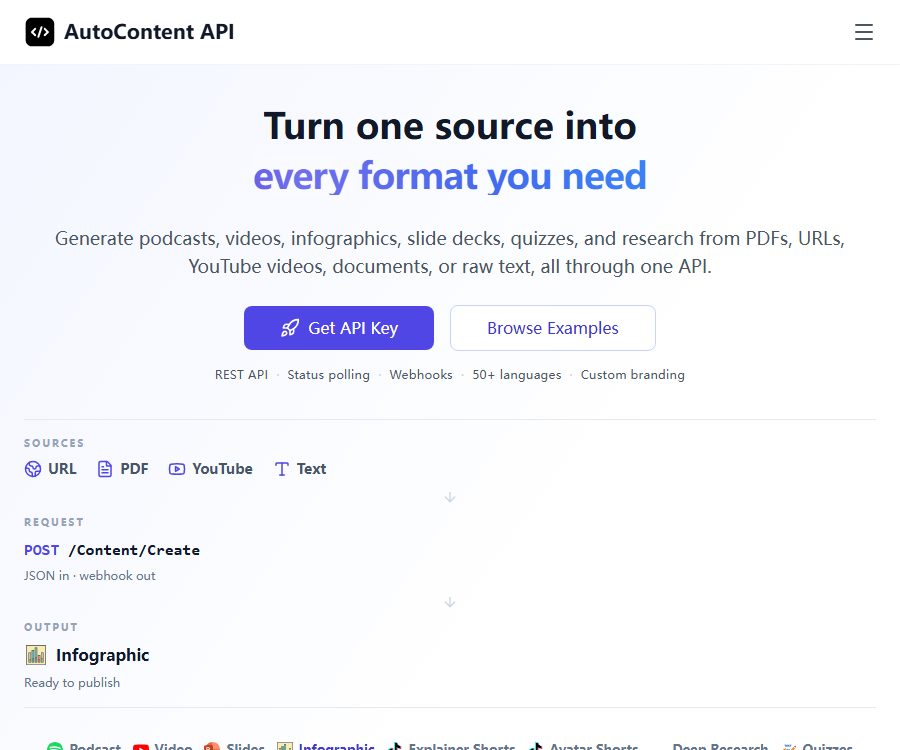
The AutoContent API is an AI-based content generation service operated by Amura Ventures SL in Spain. It uses APIs to convert web pages, YouTube videos, PDF files, plain text, topic prompts, and social media data into audio, video, and structured content that can be published.
Initially, the product focused on creating podcasts for two people, in a manner similar to NotebookLM; it has since been expanded to include the creation of explanatory videos, infographics, slides, quizzes, in-depth analyses, briefings, and short videos. It is particularly suitable for teams that need to generate content in bulk, on a scheduled basis, or to integrate such content into their own products.
Main functions of the AutoContent API
AI podcast generation
The interface enables the creation of multi-host podcasts from one or more sources of content, and it allows for setting the language, duration, style, and instructions for the hosts. The content can come from web pages, YouTube, PDF files, plain text, themes, saved feeds, or research results.
Custom sounds and podcast modifications
Users can choose hosts from standard voices or use authorized custom voices. Once a podcast is created, its voice, script, or instructions can be changed and reprocessed, but such modifications will result in a deduction of points.
Multilingual content
The official documentation lists over 70 languages, including Simplified Chinese, Traditional Chinese, English, Japanese, Korean, as well as various languages from Europe and South Asia. The language name used must exactly match the one specified in the interface documentation.
Videos and short videos
The platform can generate explanatory videos from web pages, videos, PDFs, or scripts; it can also select segments from existing podcasts to create short videos of up to one minute. Some options allow for the use of custom avatars, brand elements, as well as higher processing priority.
Infographics and slides
The same data can be used to create infographics and slidesheets for report summaries, teaching materials, and marketing content. The program allows you to save brand descriptions, logos, and colors for use in subsequent outputs.
Quizzes and structured documents
APIs can generate quizzes, FAQs, learning guides, timelines, briefings, text summaries, and data tables. Users can reuse a completed task as another type of output, thereby reducing the need to upload information repeatedly.
In-depth research
In-depth research tasks involve searching for and organizing information around a specific topic, with the resulting content being used in podcasts or other forms of media. The generated results may still contain inaccuracies or misrepresentations of the sources, so manual verification is necessary before they are published.
Social data Feed
The Professional and higher-tier plans support data feeds such as X and Reddit, which enable the capture of new posts and the creation of podcasts on a scheduled basis. The user remains responsible for determining the authorization status, deletion status, and authenticity of social media content.
Automatic distribution and RSS
Users can create podcast episodes and RSS feeds, then submit those RSS feeds to podcast platforms. When new episodes are added through the relevant interfaces, the subscription platform can use the RSS feeds to detect and display the new content.
Asynchronous tasks and Webhooks
Content generation is carried out using asynchronous tasks; after the request ID is returned by the interface, it is possible to monitor the status periodically or receive Webhook notifications. In a production environment, it is necessary to handle situations such as queueing, failures, timeouts, duplicate callbacks, and idempotent writes.
AutoContent API Usage Guide
- Select a package based on monthly usage, number of concurrent connections, and output type, and obtain an API key.
- Store the API key in the server’s confidential configuration; do not include it in the frontend or in public repositories.
- Prepare materials such as web pages, YouTube videos, text, or PDF files, and ensure that you have the permissions to work with them.
- Choose the output type, such as podcast, video, infographic, slides, quiz, or research.
- Set the language, prompts, duration, sound, brand elements, and callback data.
- Submit the task and save the returned request number.
- Poll via the status interface, or register a Webhook to receive completion notifications.
- Download the output and check the facts, pronunciation, brand elements, subtitles, and citations.
- Record the actual amount of credits consumed, and then adjust concurrency, retries, and the monthly budget.
Suggestions for development and integration
- Create separate keys or isolated accounts for testing, production, and different customers.
- Perform signature verification, deduplication, and retry handling for Webhooks.
- Check the 200MB file limit and request timeout before uploading large files.
- Cache the successful results to avoid wasting points due to repeated requests.
- Set a reasonable timeout for the queue status; avoid performing frequent polling.
- The source, prompt, request number, and manual review status are saved in the database.
Which users are it suitable for
- A content platform for mass-producing programs, courses, and knowledge podcasts.
- The marketing team that converts reports into videos, slideshows, and infographics.
- A media team that creates programs automatically based on news and community data.
- Educational products that require multilingual audio and custom hosts.
- Podcast operators who wish to distribute AI-related programs on a continuous basis via RSS.
- Integrate content generation capabilities into the development teams of SaaS or internal systems.
Product advantages
- An interface framework covers audio, video, visual content, and structured documents.
- The same materials can be reused to create various forms of content.
- Supports over 70 languages and custom voices.
- Provides examples in various programming languages and comprehensive interface documentation.
- It supports asynchronous status, Webhooks, RSS, and scheduled generation.
- The project’s features allow for the reuse of brand assets and color schemes.
Usage restrictions and precautions
- The official platform does not offer a free trial at the moment; an API key is provided only after purchasing a package.
- Monthly points are not carried over, and any unused quota expires at the end of the period.
- Points are deducted only when the task is completed successfully; however, redoing, modifying, or creating derivative content may incur additional charges.
- The request priority, number of concurrent requests, and daily generation volume for the lower-tier package are lower.
- AI-generated results are not guaranteed to be accurate, reliable, or complete; important facts must be verified.
- You must obtain authorization before uploading third-party web pages, videos, files, and audio.
- The platform utilizes third-party AI and content processing services; sensitive data must be anonymized first.
- Generated files may have a retention period, so they should be downloaded promptly and backed up by oneself.
AutoContent API pricing
The prices shown on the official website’s annual euro payment page as of August 26, 2026, are listed below. Monthly payment rates, dollar-based prices, taxes, promotions, and available features may vary; the final amounts will be those indicated on the real-time plan and billing page.
| Plan | Annual price equivalent | Monthly points | Concurrency and daily limit | Main differences |
|---|---|---|---|---|
| Amateur | 24 euros per month, 288 euros for annual payment | 1,000 | 1 concurrency, 15 assets per day | Standard queue, basic content output, email support |
| Professional | 58 euros per month, 696 euros for annual payment | 5,000 | 5 concurrent tasks, 30 assets per day | High priority, 2 data feeds, 2 custom sounds, quotes, and video clips |
| Enterprise | 108 euros per month, 1296 euros for annual payment | 10,000 | 10 concurrent tasks, 60 assets per day | Highest priority, 8 feeds, dedicated support, brand videos and custom integrations |
| Private Notebooks | 99 euros per month | No integration terms included. | 200 questions, 6 audio files and 6 video summaries/scrolling available 24/7 | 1 dedicated account, 200 Notebooks, 100 sources per Notebook |
Private Notebooks come with a separate license and do not include points associated with content creation plans. The official statement is that activation is usually completed within one working day, and only those operations that have been marked as enabled and verified in the dedicated guidelines can be used through the API.
Points consumption
| Task | Points per time |
|---|---|
| Create standard podcasts, content, infographics, quizzes | 10 |
| Create a slide or obtain a transcript | 30 |
| Create an explanatory video | 50 |
| In-depth research | 100 |
| Custom script podcasts, modifying podcasts, separating speakers or using avatars | 200 |
| Custom sound podcasts | 210 |
| Create a video clip | 400 |
Some older FAQs on the official website still state that “10 points are awarded for creating a podcast,” while the latest page detailing points allocation indicates a higher consumption amount for custom scripts and custom audio podcasts. The budget should be determined based on the latest documentation related to the respective endpoints as well as the actual usage of the account.
Data and Privacy
The privacy policy was last updated on December 27, 2025. The service handles accounts, bills, support communications, device logs, inputted links, text, files, and media, as well as the audio, summaries, and transcripts that are generated.
This data may be handed over to services responsible for hosting, analysis, payment processing, as well as third-party AI processing providers. The policy does not specify a uniform deadline for deleting all such data; therefore, confidential information, personal data, medical data, and customer information must first undergo a compliance assessment.
Content generation and retention
The terms state that users have the right to create content, as long as they do not infringe on the rights of third parties or violate any laws. Podcasts and related content can be retained for a maximum of 30 days; users should download and save copies of those materials that they need to use over a longer period of time.
Is it open source?
No official server-side source code repository for the AutoContent API has been made available, so it should be considered a closed-source SaaS solution. The official documentation provides example codes in C#, Node.js, Java, PHP, and Python, but such examples do not mean that the core of the product is open source.
Frequently Asked Questions
Is there a free trial for the AutoContent API?
No. The official FAQ clearly states that a free trial is not available at the moment; users must opt for a paid subscription in order to obtain an API key.
What types of content can the AutoContent API generate?
It can generate podcasts, explanatory videos, short videos, infographics, slides, quizzes, in-depth analyses, briefings, and other structured content.
Does it support Chinese?
Supported. The list of official languages includes Simplified Chinese and Traditional Chinese; the language names in the interface must be entered exactly as specified in the documentation.
Will the points be carried over to the next month?
No. The remaining points for a month are not carried over at the end of that period; it is necessary to estimate the appropriate package based on the actual amount of work to be done before making a purchase.
Will the generated podcast be saved permanently?
No. According to the terms, podcasts and related content can be stored for a maximum of 30 days; users need to download them promptly and keep their own backups.
Is the AutoContent API an open-source project?
No. At present, no official server-side source code repository has been identified; public API documentation and code examples cannot be considered as open-source versions of the product.
Tools similar to the AutoContent API




 Guigong Network Security Registration No. 45132202000164