






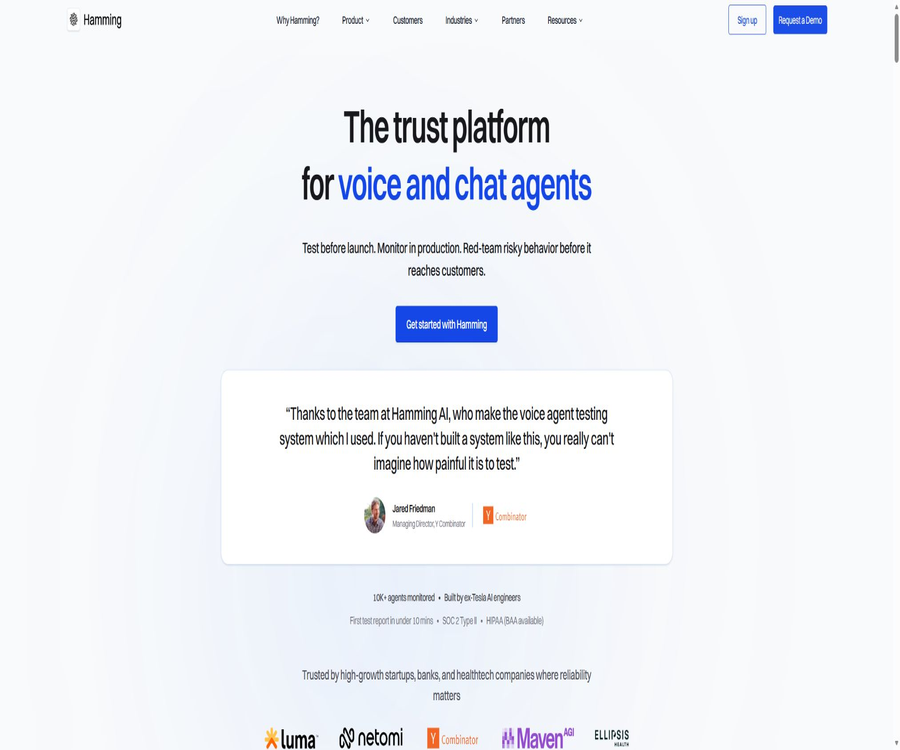
Hamming AI
Hamming AI: an intelligent tool specialized in AI-related audio processing.
Tags:AI audio toolsA one-sentence summary
Hamming AI is an enterprise-grade quality assurance platform that provides pre-launch testing, production monitoring, security red team testing, and regression testing for voice and chat bots.
Tool Introduction
Hamming’s main focus is not on creating customer service robots for companies, but rather on verifying whether existing intelligent agents are accurate, natural, stable, secure, and capable of achieving the desired business objectives. The team can connect to existing voice platforms or develop its own systems, generate test scenarios automatically, and then run these scenarios through actual call connections in order to assess their performance.
The platform integrates testing, monitoring, and issue resolution into a single cycle. Failures detected during actual calls can be turned into reusable regression test cases; these tests are run again after updates to prompts, models, or infrastructure, thereby preventing similar issues from arising again.
Product positioning
| Capability layer | Problems solved | Typical usage phase | Main output |
|---|---|---|---|
| Simulation test | Do agents fail in real conversations? | Development and Pre-release | Scenes, recordings, transcriptions, ratings, and evidence of failures |
| Regression testing | Does a version update break existing functionalities? | Every time there is a change in the prompt, model, or code | Version comparison and release access control |
| Stress testing | Is the system stable when concurrent usage increases | Capacity planning and before major launches | Latency, errors, throughput, and tail metrics |
| Security Red Team | Whether it can be jailbroken, injected with code, or manipulated to result in data leakage | Safety acceptance and continuous verification | Risk detection and reproducible use cases |
| Production monitoring | Were there any issues with the quality or compliance of actual customer calls? | Official operation phase | Alerts, trends, review queues, and evidence |
| Production playback | Does the fix resolve the actual failure? | Accident review and repair verification | Tests that preserve voice, timing, and intended intent |
Main functions
Automatically generate test scenarios
The team can paste prompts for the agent system or connect to existing platforms, enabling Hamming to generate a large number of normal paths, edge cases, adversarial inputs, as well as scenarios involving accents and noise. The results generated still need to be reviewed by business professionals to ensure they cover all necessary aspects and yield the expected outcomes.
Audio-native evaluation
Hamming not only analyzes the transcribed text but also examines, at the audio level, aspects such as pauses, interruptions, silence, long periods of speech by a single person, speech clarity, and tone. This allows it to identify cases where the text appears correct yet sounds poor when heard.
Multiple rounds of dialogue and cross-call workflows
Tests can cover multiple rounds of context, and it is also possible to create sequences in which the same character conducts several calls to make reservations, change dates, or cancel appointments. This capability is suitable for verifying state retention and cross-interaction business processes.
Generate call transfer back use cases
The team can convert actual failed calls into replayable tests with just one click, preserving the caller’s audio, the text generated by speech recognition, the timing details, and the intended intent. Running the test again under the same conditions after making the fixes makes it easier to verify the results compared to rewriting similar scripts from scratch.
Security and Compliance Red Team
The pre-set red team scenarios cover risks such as prompt injection, jailbreaking, social engineering, leakage of sensitive information, use of tools that grant excessive privileges, and actions that violate policies. Enterprises can also define industry-specific scripts, content that must be disclosed, and questions that are prohibited from being answered.
IVR and DTMF testing
Hamming can simulate traditional phone menus, generate DTMF tones, and verify whether an agent can navigate through the IVR correctly. It supports inbound, outbound, and direct WebRTC connections.
Production health check
The platform can replay a set of key calls every few minutes to detect changes in the model, infrastructure failures, or regressions in the prompt usage. When the metrics exceed certain thresholds, the team can be notified via email, Slack, or other alert channels.
Testing conditions and role simulation
- Languages, accents, and dialects in different regions.
- Office noises, street noise, crowd noise, and other background sounds.
- Speaking fast or slowly, long pauses, and accidental inputs.
- Users interrupt in the middle, speak over others, and agents talk for too long.
- Elderly callers, emotional outbursts, and abusive scenarios.
- API timeout, low speech recognition confidence, and loss of context.
- Business processes such as booking, payment, authentication, switching to a human agent, and cancellation.
- Hints for injection, jailbreaking, extraction of sensitive data, and policy bypassing.
Evaluation metrics
Hamming currently promotes more than 50 built-in metrics, and it allows for the definition of custom scoring rules using natural language. The evaluations are divided into three categories: conversation quality, expected results, and compliance safeguards; it is not sufficient to consider only an average score.
| Indicator category | Representative indicators | Problems that can be identified |
|---|---|---|
| Accuracy and relevance | Fact accuracy, intent recognition, relevance, and hallucinations | Incorrect answers, misinterpretation of requirements, or fabrication of information |
| Task completed | The goal has been achieved, field data has been collected, and tool calls were successful. | The verbal commitment was made, but the underlying actions failed. |
| Delay | First word time, round delay, p50, p90, and p99 | The average value is normal, but a small number of calls are very slow. |
| Dialogue flow | Number of turns, interruptions, silences, repetitions, and monologues | Mechanical feel, interruption of speech, or inability for the user to speak |
| Voice and audio | Clarity, noise, accent, and transcription quality | Decline in performance in certain groups of people or in specific environments |
| Emotions | Voice-level emotions and trends | Customer frustration or negative escalation |
| Compliance | Scripts, compliance, disclosure, PII, PHI, and payment information | Policy or regulatory risks |
| Custom scoring | Corporate rules and industry thresholds | Business requirements that cannot be covered by general metrics |
End-to-end latency decomposition
The latency analysis covers the entire workflow, including voice activity detection, automatic speech recognition, LLM processing, and text-to-speech conversion. This allows the team to assess the contribution of each component, rather than merely looking at the overall waiting time heard by the user.
AI scoring and manual calibration
Hamming uses AI to assess intentions and overall results, claiming that the accuracy of audio-based evaluations compared to human judgments is around 95% to 96%. These are figures provided by the manufacturer; companies should still conduct blind tests and carry out manual adjustments taking into account their own language, industry sector, and level of risk.
The difference between testing and production monitoring
| Project | Testing before going live | Production monitoring |
|---|---|---|
| Data | Synthetic characters and controlled scenarios | Actual customer calls or production evidence |
| Goal | A reproducible issue was identified before release. | Detect drift, accidents, and unknown failures |
| Risk | Side effects can be isolated in a sandbox. | It will come into contact with real personal and business data. |
| Operation mode | Triggered by plan, version, or CI | Ongoing or regular health checks |
| Results | Pass, fail, metrics, and regression differences | Trends, alerts, reviews, and incident evidence |
| Subsequent actions | Run it again after fixing and decide whether to release it. | Convert to regression test cases and adjust alerts. |
Both require shared metrics and use cases, but they cannot replace each other. Simulation tests cannot cover all real-world behaviors, and production monitoring should not serve as an excuse to make mistakes with actual customers.
Supported languages and accents
Hamming currently claims to support over 65 languages, including English, Spanish, Portuguese, French, German, Arabic, Hindi, Tamil, Japanese, Korean, and Chinese.
| Language or region | Publicly listed accents or variants | Testing suggestions |
|---|---|---|
| English | United States, United Kingdom, Australia, India, and New Zealand | Include local slang, names, and number formats. |
| Spanish | Latin America, Europe, and Spanish-speaking countries in the United States | Set expectations separately for each target market. |
| Arabic | Modern Standard, Gulf, Levantine, Egyptian, and Maghreb | Test dialect switching and mixed languages |
| Chinese | Simplified Mandarin, Traditional Mandarin, and Cantonese | Evaluate recognition, speech, and digital expression separately. |
| Tamil language | Indian and Sri Lankan variants | Add regional accents and a mix of English speech. |
| Portuguese | Brazil and European Portuguese | Do not mix scoring baselines. |
| Japanese and Korean | Standards and regional variants | Test honorifics, pauses, and proper nouns |
The number of languages does not mean that all languages have the same pronunciation, range of accents, or accuracy in evaluation. Before launching, it is necessary to create separate sets of speakers, domain-specific vocabulary, and manual benchmarks for each target market.
Integration capability
| Platform or protocol | Access method | Current public capabilities |
|---|---|---|
| SIP | Dial the test number or have the platform make the call. | Inbound, outbound, IVR, and DTMF testing |
| LiveKit | API key or direct WebRTC | Synchronized agents, test execution, and monitoring |
| Pipecat | Direct WebRTC or platform connection | Test the custom voice pipeline |
| Daily | WebRTC connection | Web voice agent testing |
| ElevenLabs | Connect account or API key | Importing agents and running evaluations |
| Retell | API keys and region settings | Automatically synchronize agents, recordings, and tool calls every 5 minutes |
| Vapi | Platform connection | Import the agent and carry out consistent metric evaluation. |
| Bland | Platform connection | Automatically test existing voice agents |
| Self-developed system | SIP, WebRTC, or REST API | Works with any combination of LLMs, ASRs, and TTS systems. |
| OpenTelemetry | Import traces, spans, and logs | Evidence related to calls, components, and infrastructure |
Retell integration example
The Retell connection allows the import of agents, regions, tool calls, transcriptions, and recordings; synchronization occurs automatically every 5 minutes by default. When conducting tests, it is necessary to use a separate project or test account to prevent any load or side effects from affecting the actual business operations.
Usage tutorial
Complete the first test of the voice intelligent agent
- Create a Hamming workspace or schedule a demonstration, and verify the amount of testing required as well as the data rules for the current solution.
- Choose LiveKit, Pipecat, ElevenLabs, Retell, Vapi, Bland, SIP, or a custom integration.
- Use a test-specific key to connect to the agent, and restrict the projects and environments that can be accessed.
- Import system prompts, tool definitions, and necessary documents to have the platform generate an initial scenario.
- Product, QA, and business team members review the scenarios, desired outcomes, and risk levels.
- First, run small-scale tests to check that calls can be connected, recordings are complete, and the scoring is accurate.
- Expand to accents, noise, interruptions, incorrect boundaries, and adversarial scenarios.
- Check the failed recordings, transcriptions, tool-related evidence, and component delays, then run it again after making the repairs.
Establish a CI/CD regression gate.
- Organize the stable normal paths, key boundaries, and historical incidents into versioned test sets.
- Use the REST API to trigger tests before each prompt, tool, model, or code deployment.
- Set minimum thresholds for task completion, accuracy, compliance, latency, and key use cases.
- Link test runs to specific agent versions, prompt hashes, and deployment submissions.
- Prevent deployment when key metrics decline or security tests fail.
- In the report, keep the recordings, transcripts, tool usage records, and reasons for scoring available for manual review.
- For occasional failures, repeat the runs and perform calibration; do not simply lower the threshold to cover up the problem.
- After going live, new production failures will be converted to permanent regression coverage.
Configure production monitoring
- Determine whether to import all calls, a sample of calls, or only the abnormal events.
- Define permissions for audio, original transcripts, sanitized transcripts, tool calls, and metadata.
- Set hierarchical thresholds for accuracy, compliance, latency, sentiment, and task completion.
- Send engineering issues to the engineering channel, and compliance issues to the channel with restricted review.
- Use Gold Call for regular health checks and to record baseline values.
- Establish processes for manual review, annotation, coverage, and calibration.
- Convert severe failures into regression tests and assign a person responsible for fixing them.
- Regularly review alarm noise, data storage, and user access permissions.
Production playback and accident closure
Traditional methods often rewrite a similar scenario based on the transcription, which can result in the loss of the original speech, pauses, noise, and timing elements. Hamming’s approach to production playback preserves these aspects, using the same failure evidence to test new versions.
- Mark production calls that have an impact on customers or involve high risk.
- Verify that the recording, transcription, tool calls, and intended intent are complete.
- Remove unnecessary personal data or use it in a controlled environment.
- Convert the call into a regression test case that includes version and owner information.
- Run the same scenario before and after the repair and compare the results.
- Include repair evidence in the release review and accident reports.
- Regularly check whether historical incidents are still being enforced.
Stress and concurrency testing
Enterprise load testing capabilities allow for the execution of over 50,000 concurrent test calls, covering inbound, outbound, and direct WebRTC connections. The default number of concurrent connections in a standard workspace is around 50, but this value can be increased to more than 100; the exact upper limit depends on the configuration used and the capacity of the platform being tested.
| Testing dimensions | Indicators to be observed | Common failures |
|---|---|---|
| Call establishment | Connection success rate, connection time, and error codes | Number, SIP, or regional throttling |
| Speech recognition | WER, latency, and low confidence ratio | Queueing or frame loss under concurrency |
| LLM | First Token, Completion Time, and Error Rate | Supplier throttling or context overload |
| Speech synthesis | First audio, lagging, and failure rate | Insufficient audio queue or quota. |
| Tool invocation | Success, timeout, retry, and idempotency | Repeated reservations or repeated writes |
| Overall conversation | p50, p90, p99 and task completion | Average is normal, but the tail collapses. |
| Cost | Cost per call, per minute, and per supplier | The scale of testing leads to unexpected costs. |
Load testing consumes Hamming, telephone, voice, model, and business API quotas simultaneously. Teams must set limits on maximum concurrency, budgets, sandbox environments, and emergency shutdown mechanisms to prevent direct impact on production customer systems.
Prices and packages
As of August 23, 2026, Hamming has not disclosed any fixed pricing for its packages. The costs are determined primarily based on the volume of testing and production use, rather than the number of members; the specific amounts and prices are provided during demonstrations and introductory sessions.
| Plan or phase | Public price | Basis for billing | Team Seats | Primary interests |
|---|---|---|---|---|
| Personalized demonstration | Free | It is a demonstration lasting about 25 minutes; it’s not a free trial of the product. | Not applicable | Combined with actual agents and scenario demonstrations |
| Startup solution | Contact sales | Hundreds of test cases or actual requirements | It is mainly not charged based on seat numbers. | The scope of testing, monitoring, and team collaboration is as specified in the quote. |
| Growth or regular team | Contact sales | Number of tests, number of proxies, and production calls | The entire team can be invited. | Higher test volume, integration, and support |
| Enterprise | Custom quote | Large-scale testing, production calls, and contractual requirements | Seats are not the main factor in determining the price. | Bulk discounts, custom integration, dedicated success support, and SLAs |
Is there a free trial available?
The current FAQ clearly states that no traditional free trial is available; instead, teams can experience the intelligent agents through personalized demonstrations and introductions. Some sections of the website still feature the old \"Start Free Trial\" button, and this cannot be used as an indication of the current free usage quota.
It should be confirmed before quoting.
- The number of tests, minutes, concurrent connections, and production monitoring calls included per month.
- Who is responsible for the costs of calls, voice services, models, and third-party platforms?
- Whether automatic scene generation, scorers, and repeated runs are charged separately.
- Are there additional fees for data storage, export, as well as for single-tenant and regional deployments?
- Whether API, MCP, Webhooks, OpenTelemetry, and CI/CD are included.
- Rules for excess unit prices, minimum contract duration, renewal, cancellation, and refunds.
- How is the severity level of enterprise support mapped to response times ranging from 10 minutes to 4 hours?
- Separate quotes and pre-requisite capacity requirements for 50,000 concurrent load activities.
Support and Services
| Support methods | Scope of application | Public explanation |
|---|---|---|
| Email support | All customers | Daily issues and tickets |
| Online chatting | All customers | Rapid assistance within the product |
| Exclusive Slack | New customers | Contact the engineering team directly. |
| Integrated support | Deeper engagement with all customers and businesses | Assist with SIP, WebRTC, platform, and API connections |
| Enterprise SLA | Enterprise | Response time ranges from about 10 minutes to 4 hours, depending on the severity. |
| Custom integration | Enterprise | Develop and maintain as needed |
| Customer Success Management | Enterprise | Regular inspections, training, and optimization |
API, MCP, and development tools
Hamming offers a REST API that enables scheduling tests, retrieving results, configuring agents, managing test cases, and accessing monitoring data. It can be integrated with GitHub Actions, Jenkins, and other CI/CD pipelines, and automation is facilitated through Webhooks.
The full document is currently accessible only with an access code, and it is intended primarily for customers who have already started using the service. The public marketing materials mention SDKs, MCP servers, and OpenTelemetry integration, but regarding interface stability, permissions, and versions, the information in the internal documentation should be taken as reference.
| Development capability | Current status | Primary uses | Precautions |
|---|---|---|---|
| REST API | Officially available, but the documents are restricted. | Running tests, managing use cases, and reading monitoring data | Customer account and credentials are required. |
| Webhooks | Officially available | Connect the test results and alerts to external processes | Event signatures and retry procedures are specified in the customer documentation. |
| CI/CD | Support | Execute quality checks before each release. | A stable test set and version association are required. |
| OpenTelemetry | Support | Import traces, spans, and logs | Sensitive attributes and sampling should be controlled. |
| MCP server | Official sources state that it is available. | Run tests, query calls, and search for transcriptions | The public installation documentation is limited. |
| Python SDK | The public package was last updated in 2024. | Call the early Hamming platform | Version 0.0.17 – compatibility with the current API needs to be verified. |
| JavaScript SDK | The public package was last updated quite some time ago. | Early Evals framework | It cannot be considered as a guarantee of the active status of the current primary interface. |
GitHub and open source
The Hamming platform is a commercial, closed-source service; the official website does not make the complete product code or evaluation models available as open-source projects. Early SDKs under the MIT or ISC licenses can be found in public package managers, but they only cover the client-side code.
| Project | Public status | License or maintenance | Conclusion |
|---|---|---|---|
| Hamming Business Platform | The complete source code is not publicly available. | Business services | Not open source |
| Evaluation models and operating systems | Not disclosed | Not disclosed | It is not an open-weight project. |
| Hamming-sdk Python package | Public | MIT, 0.0.17, updated in September 2024 | Early SDKs do not imply that the platform is open source. |
| Hamming-sdk JavaScript package | Public | ISC, 1.0.27, updated about two years ago | For the early versions of the SDK, its maintenance status needs to be verified. |
| Third-party C# SDK | Public, but maintained by tryAGI | MIT | It is not Hamming’s official product code. |
The new integration should make use of the current REST API documentation available in the customer’s workspace, rather than relying solely on the old SDK packages. When making purchases, it is necessary to clarify the supported API versions, any notifications regarding deprecated versions, the path forward for SDK development, and the methods for exporting data.
Privacy Policy
Hamming’s legal operating entity is Forward Inc; the current public privacy policy was last updated on December 14, 2024. This policy applies to websites, accounts, sales, marketing, and related services.
| Data or rules | Current policies |
|---|---|
| Account and contact information | Name, phone number, email address, address, position, username, and password, etc. |
| Payment | Payment tool information is stored by Stripe. |
| Automatic collection | IP, browser, device, usage time, Cookies, and analysis data |
| Sensitive information | Processing is carried out only after a BAA is signed with the customer. |
| Customer data training | It is not used for training, nor is it intended to benefit other customers. |
| Sale of user-generated data | Not for sale |
| Website analysis | Use Google Analytics |
| General storage | It is retained as long as the account is valid and it is necessary for business purposes; legal requirements may allow for an even longer retention period. |
| Backups that cannot be deleted immediately | Isolated for security until it can be deleted. |
| Minors | Do not collect data from or market to users under 18 years of age. |
The privacy policy does not specify a uniform and fixed retention period for all recordings, transcriptions, and test evidence. The FAQ states that test recordings are stored in an encrypted format, and the retention period can be set according to the customer’s requirements; the exact duration must be specified in the order or DPA before the materials are used in production.
Data rights
- Users who meet the criteria can request access to, export, correct, or delete their personal information.
- Users in some areas can restrict the use of sensitive information or object to certain types of processing.
- Users can opt out of marketing emails and withdraw any applicable consent.
- Upon terminating an account, the platform will delete or deactivate the information in the active database.
- To prevent fraud, conduct investigations, enforce terms, or meet legal requirements, some records may be retained.
- Privacy requests and complaints are handled via the official contact email address.
Safety and compliance
Hamming completed the SOC 2 audit in December 2025; the official website currently indicates SOC 2 Type II. Medical clients can sign a BAA to support HIPAA compliance, and the platform offers options for data storage in the United States, the European Union, and the United Kingdom, as well as a single-tenant setup.
| Control or capability | Current public status | Purchase verification |
|---|---|---|
| SOC 2 Type II | It has been completed and is displayed on the official website. | Request the current report, period, scope, and exceptions. |
| HIPAA | A BAA can be signed. | Sign the document before any PHI is entered into the platform. |
| Encryption | Encryption of recordings and data during transmission as well as in static state | Confirm the algorithm, keys, and backup scope. |
| RBAC | Support | Test by engineering, product, QA, and management roles |
| SSO | Supports enterprise identity services such as Okta. | Confirm SAML or OIDC, enforce scope, and revoke access upon departure |
| Audit logs | Supported and exportable to SIEM | Confirm event coverage and retention period |
| Data residency | United States, European Union, and United Kingdom options | Verify all subcontractors, backup, and support data |
| Single tenant | Enterprise options | Verify network, key, upgrade, and management interface isolation |
| PII detection | Testing and monitoring leakage risks | It cannot replace full data masking and access control. |
SOC 2 and BAA do not guarantee that a customer’s systems will automatically comply with all regulations. Matters such as recording consent, payment cards, medical information, data transfer across regions, marketing calls, and liability provisions still need to be configured, tested, and continuously monitored by the customer.
Recommendations for data security in production
- First, conduct the initial POC using entirely synthetic data, without uploading actual customer recordings.
- Review SOC 2 scope, DPA, BAA, subcontractors, data flows, and incident response.
- Set separate retention periods for audio, original transcripts, anonymized transcripts, metadata, and tool evidence.
- Configure SSO, MFA, RBAC, and the principle of least privilege, and regularly review access rights.
- Remove unnecessary PII, PHI, payment cards, and credentials before importing.
- Restrict the conditions under which human support staff can access real production evidence as well as audits.
- Verify the processes for exporting, deleting, backing up expired items, and terminating contracts.
- Reconduct the risk assessment each time a new model, platform, region, or subcontractor is added.
Which users are it suitable for
- Voice AI engineering team: Validates prompts, models, ASR, TTS, tools, and latency.
- QA team: Establish automated test scenarios, regression sets, and release controls.
- Product Manager: Defines business success and compares different versions of the agent.
- Customer service and operations: Identifying failures that occur during calls as well as the customer’s pain points.
- Security team: Performs tests on prompt injection, jailbreaking, PII leakage, and unauthorized use of tools.
- Compliance team: Checks scripts, authentication, disclosure, and audit evidence.
- Healthcare and financial institutions: Monitor high-risk voice processes after signing the applicable contracts.
- Platform manufacturers and system integrators: adopt uniform metrics for multiple voice service providers.
Typical use cases
- Verify creation, rescheduling, cancellation, and tool writing before the booking robot goes live.
- Compare quality, latency, and cost after replacing the LLM, ASR, or TTS.
- Run historical regression on the new prompt to prevent old issues from reappearing.
- Test accents, noise, interruptions, and complex calls lasting over 70 rounds.
- Evaluate a company’s peak capacity using over 50,000 concurrent activities.
- Continuously monitor for hallucinations, deviations from the script, and data breaches in the production environment.
- Reapply the failures of real customers to the fixed version and generate proof of release.
- Connect the test results to CI, Slack, SIEM, and OpenTelemetry.
Product advantages
- It covers the entire lifecycle, including testing, monitoring, red teaming, replay, and regression testing.
- By analyzing the audio directly, it is possible to identify interaction issues that are not apparent in the transcribed text.
- It automatically generates a large number of scenarios based on the prompts, reducing the cost associated with manual coding.
- It supports over 65 languages, regional accents, noise, and various speaking patterns.
- It natively connects to various major voice platforms, and it also supports SIP, WebRTC, as well as custom-developed systems.
- Over 50 built-in metrics plus an unlimited number of custom scorers.
- It supports CI/CD, REST API, Webhooks, and OpenTelemetry.
- The concurrent load that a company can handle can exceed 50,000 connections.
- SOC 2 Type II, BAA, data residency, SSO, and single-tenant solutions meet the requirements of enterprises in terms of procurement.
- Charging is based primarily on the amount of testing performed rather than on the number of seats; cross-team collaboration does not result in additional costs related to seats.
Main limitations
- There is no fixed public price for packages; the budget must be determined through a presentation and a quote.
- There is no traditional free self-service trial available, which makes it difficult for individual developers to get started.
- Public documents require an access code; API endpoints and permissions cannot be viewed in their entirety before purchase.
- The old Python and JavaScript SDKs have not been updated in about two years, so their compatibility needs to be verified.
- Even when AI scores are consistent with those generated by humans, they may still exhibit deviations in new languages or fields.
- High-concurrency testing incurs costs for calls, voice services, models, and business APIs simultaneously.
- Production monitoring involves handling actual recordings, transcriptions, and tool-generated evidence, which requires strict data governance.
- The manufacturer’s claims of 95% prediction accuracy, 95% to 96% consistency when using manual methods, and 90% success rate against competing products need to be verified in actual scenarios.
- The platform is designed for enterprise quality assurance purposes, and it is not intended to serve as a complete runtime environment for building voice intelligence agents.
Supported platforms
| Platform or method | Support status | Primary uses |
|---|---|---|
| Web console | Support | Configure tests, view recordings, generate reports, monitor trends. |
| SIP phones | Support | Inbound, outbound, IVR, DTMF, and traditional telephone connections |
| WebRTC | Support | LiveKit, Pipecat, Daily, and web agents |
| REST API | Supported, but customer documentation is limited. | Automated testing, results, and monitoring |
| Webhooks | Support | Connect pipelines, alerts, and external systems |
| CI/CD | Support | GitHub Actions, Jenkins, and other systems |
| OpenTelemetry | Support | Import tracking, metrics, and logs |
| MCP | Official sources state that support is available. | Query calls, analyze quality, and run tests |
| Native mobile apps | No findings were detected. | It is primarily used through web pages. |
| Browser extensions | No findings were detected. | No public extensions available |
Basic information
| Project | Content |
|---|---|
| Tool name | Hamming AI |
| Legal entity | Forward Inc |
| Date of establishment | 2024 |
| Founder and CEO | Sumanyu Sharma |
| Accelerator | Y Combinator S24 |
| Product type | Testing, monitoring, and security assessment of voice and chat bots |
| Key customers | Voice AI teams, corporate customer service, healthcare, finance, and high-growth companies |
| Language | Over 65 species |
| Built-in metrics | Over 50 |
| Enterprise load | Over 50,000 concurrent test calls |
| Pricing | Custom quotes are determined primarily based on the volume of testing and usage. |
| Traditional free trial | Not available; instead, personalized demonstrations and introductions are offered. |
| API | Yes, the complete document is available to customers. |
| SDK | There are early versions of Python and JavaScript packages; the current maintenance status needs to be verified. |
| Is it open source? | The product is not open-source; however, some older client SDKs are open-source. |
| SOC 2 | Type II |
| HIPAA | Supports signing of BAA |
| Data residency | United States, European Union, and United Kingdom options |
| Verification date | August 23, 2026 |
Recommendation score
Recommendation score: 4.7 / 5. Hamming offers a comprehensive set of functions including native audio evaluation, simulation of real-world scenarios, production monitoring, playback, and integration with CI access controls; it is particularly suitable for teams that are already using voice intelligence agents in their operations.
The prices and the complete documentation are not made public, and production monitoring involves highly sensitive data; therefore it is more suitable for organizations that have formal procurement, security, and QA processes, rather than individual users who merely want to try out a few phone bots for free.
Frequently Asked Questions
What is Hamming AI?
Hamming AI is a platform for testing and monitoring voice and chat bots; it is used to automatically simulate conversations, assess quality, carry out red-team testing, monitor live calls, and convert failures into regression test cases.
Will Hamming help me create a voice robot?
Its primary purpose is not to serve as an agent builder, but rather to connect and evaluate existing agents. Users need to already have Vapi, Retell, ElevenLabs, LiveKit, Pipecat, or a custom-developed speech system.
How much does Hamming AI cost?
The official website does not specify a fixed amount. The pricing is based mainly on the volume of testing and production usage, rather than on the number of team members.
Is there a free trial for Hamming?
The current FAQ indicates that there is no traditional free self-service trial available. Teams can schedule personalized demonstrations and use their own agents and scenarios to get started.
Does Hamming support Chinese?
Chinese testing is supported, with variants such as Simplified Mandarin, Traditional Mandarin, and Cantonese available. Actual recognition accuracy, audio evaluation, and performance with business-related terminology still require calibration by native speakers.
How does Hamming test for interruptions and delays?
The platform simulates behaviors such as interrupting speech, long periods of silence, varying speech speeds, and other real-world behaviors. It breaks down the latency into components related to VAD, ASR, LLM, and TTS, while also displaying values for p50, p90, and p99.
Does Hamming support production monitoring?
Supported. It can continuously evaluate actual calls, issue alerts when thresholds are reached, replay key calls, and convert production failures into permanent regression tests.
Can Hamming be used to test self-developed voice AI agents?
Yes. Self-developed systems can be integrated using SIP, WebRTC, or REST APIs, without relying on specific providers for LLMs, speech recognition, or speech synthesis.
Does Hamming comply with HIPAA?
Hamming can enter into a BAA with medical clients and provide the relevant security controls. It is necessary to first finalize the BAA and conduct a data review; PHI cannot be uploaded before such agreements are in place.
Will Hamming use customer data to train models?
The public privacy policy clearly states that customer data is not used for training purposes, nor is it utilized to benefit other customers, and user-generated data is not sold.
Is Hamming open source?
The entire platform is not open source. The early Python and JavaScript SDKs were available under open licenses, but just because the client packages are open source does not mean that the evaluation platform, the models, or the operating system are open source as well.
Does Hamming support MCP?
According to the official specifications for 2026, a Hamming MCP server will be available for carrying out tests, querying calls, and searching for transcriptions. Public installation information is limited; specific permissions must be confirmed through the customer documentation.
Summary
Hamming is suitable for upgrading voice agents from being used only a few times manually to a sustainable quality assurance system. It can generate scenarios automatically, listen to audio directly, simulate real-world interference, compare different versions, and turn production errors into regression tests.
Before making a purchase, it is necessary to confirm the pricing, the amount of testing required, the costs associated with third-party calls, the API version, data retention policies, as well as the enterprise contract terms. A best practice after deployment is to combine automatic scoring with manual verification, and to treat every high-risk failure as a condition that prevents the release of the product.
Tools similar to Hamming AI




 Guigong Network Security Registration No. 45132202000164