






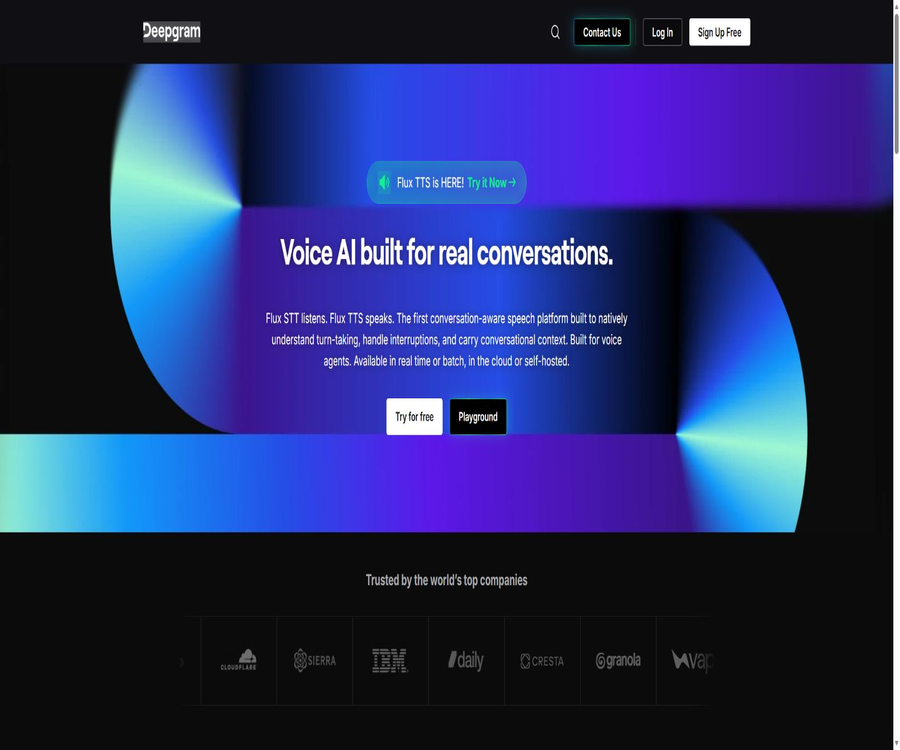
Deepgram
Deepgram: an intelligent tool specialized in AI-based audio processing.
Tags:AI audio toolsA one-sentence summary
Deepgram is a voice AI platform designed for developers and enterprises; it offers real-time and batch speech recognition, conversational speech synthesis, comprehensive Voice Agent orchestration, and audio understanding through APIs, and it supports deployment in cloud environments, dedicated setups, and on-premises.
Tool Introduction
Deepgram offers a comprehensive set of capabilities for real-world voice applications, covering the processes from listening to thinking and then to speaking. Developers can use Speech-to-Text or Text-to-Speech functions separately, or they can employ a WebSocket connection to create real-time voice agents that are capable of handling interruptions, turns in conversation, and various tool calls.
The current core models include Nova-3 for general transcription, Flux STT for dialogue sessions, Flux TTS for interactive conversations, and the Aura series of speech synthesis technologies. These products and models are part of commercial services; the fact that the official SDKs are open source does not mean that the model weights or the source code of the platform are also made available.
Product Capability Overview
| Products | Main inputs | Main output | Typical uses |
|---|---|---|---|
| Speech-to-Text | Real-time stream or recorded file | Text with time, speaker, and confidence level | Transcription, subtitles, and analysis |
| Text-to-Speech | Text and dialogue context | Flow-based synthesized speech | Customer service, assistants, and phone bots |
| Voice Agent API | Two-way real-time audio and configuration | Interruptible voice conversations | Customer service, scheduling, and outbound calls |
| Audio Intelligence | Audio transcription or text | Summary, theme, emotion, and intention | Quality inspection, insights, and routing |
| Self-Hosted | Enterprise GPU infrastructure | Private voice inference endpoint | Data retention and low latency |
| Playground | Microphone, file, or text | Results of the model trial | Prototype verification and parameter comparison |
Speech recognition model
Nova-3
Nova-3 is the currently recommended general-purpose, production-grade speech recognition model that can be used for real-time streams as well as pre-recorded audio. It supports multiple languages, automatic language detection, as well as handling of noise and audio from distant sources; moreover, Keyterm Prompting can be utilized to improve the recognition of brand, product, and industry-specific terms.
Flux STT
Flux STT is designed specifically for real-time Voice Agents; it not only recognizes text but also integrates functions such as detection of the end of a conversation turn and configurable dialogue pacing into its model. The English version and the multilingual versions are charged separately, with the multilingual version allowing language cues to influence the recognition process.
Nova-3 Medical and custom models
Nova-3 offers options tailored for medical terminology; companies can also contact sales to have Custom models developed to suit proprietary or specialized data. Professional models still need to be evaluated using actual accents, devices, scenarios, and vocabulary sets, rather than relying solely on general benchmarks.
Whisper Cloud and the older models
Deepgram still offers hosted Whisper Large, and it also retains Nova-2, Enhanced, and Base for existing deployments. For new projects, it is advisable to compare Nova-3 with Flux first, in order to avoid choosing Whisper, which has lower scalability, due to historical compatibility reasons.
Speech recognition feature
- Streaming is used for real-time, incremental transcription in calls, meetings, and Voice Agents.
- Pre-Recorded is used to upload recordings and generate complete text in an asynchronous or synchronous manner.
- Speaker Diarization identifies multiple people and specifies who said each segment.
- Smart Formatting automatically handles punctuation, case, dates, and currency.
- Keyterm Prompting improves the recognition of product names, abbreviations, and technical terms.
- Redaction is used to identify and remove certain sensitive personal information.
- Entity Detection extracts entities such as people, organizations, locations, and dates.
- Automatic Language Detection assists in handling situations where the language is unknown or when the context changes.
Text-to-Speech speech synthesis
Flux TTS
Flux TTS is a streaming, conversation-oriented model designed for real-time voice agents; it maintains consistency in tone, rhythm, and emotion by leveraging context across different turns in the conversation. It can provide feedback on the text that the user actually heard before any interruption, and it allows for adjustments to speed and style without interrupting the conversation.
Aura-2
Aura-2 is designed for professional, large-scale, low-latency speech synthesis, and can be used in customer service, notification, and dialogue applications. The existing Aura-2 models will not be forced to be migrated as a result of the release of Flux TTS.
Aura-1
Aura-1 remains an option for text-to-speech synthesis with lower costs. When making a choice, it is necessary to consider factors such as language, voice quality, latency, the ability to pronounce structured content, and the location of deployment, rather than focusing only on the cost per thousand characters.
Dialog-based voice control
At present, Deepgram designs speech synthesis as part of a dialogue framework, allowing for tracking of status, turn boundaries, and interruptions. For projects that require a specific brand voice or voice cloning, it is necessary to first check the capabilities of the current models and any relevant licensing options.
Voice Agent API
The Voice Agent API integrates speech recognition, LLM orchestration, and speech synthesis into a single real-time connection, thereby reducing the workload for developers who would otherwise have to combine multiple services. Users can also use their own LLMs or TTS systems, while making use only of Deepgram’s capabilities in terms of speech and orchestration.
- It includes built-in Barge-in detection, allowing users to interrupt the agent naturally.
- Turn-taking prediction helps the system determine when to listen, think, and speak.
- Function Calling allows querying business systems or running tools within a conversation.
- Mid-session control allows for the adjustment of configurations and behaviors during a session.
- Reusable Configurations facilitate the reuse of agent settings.
- The Multi-Agent Architecture supports the handover between dedicated agents.
- The Telephony capability is used to connect to incoming and outgoing telephone networks.
- The Browser Agent SDK enables the integration of real-time voice capabilities into web applications.
Audio Intelligence
Audio Intelligence is used to generate structured outputs such as summaries, themes, emotions, and intentions based on transcriptions. Certain features are charged separately based on the number of input and output tokens; they should not be considered part of the price for speech recognition, which includes those features at no cost.
| Ability | Results | Suitable scenarios | Main risks |
|---|---|---|---|
| Summarization | Dialogue summary | Customer service minutes, meeting recap | The restrictive conditions may have been omitted. |
| Topic Detection | Topic tags | Content categorization and routing | The boundaries between multiple themes are unstable. |
| Sentiment Analysis | Emotional tendency | Service quality inspection and trends | Context, culture, and ironic deviations |
| Intent Recognition | User intent | Automatic diversion and subsequent actions | Incorrect intentions may trigger erroneous processes. |
| Entity Detection | Characters, organizations, locations, and dates | CRM entry and retrieval | The spelling of the entity needs to be checked. |
| Redaction | Remove some sensitive text. | Privacy and compliance handling | It cannot replace comprehensive data protection measures to prevent leaks. |
Complete integration process
- Create a Deepgram account and project to obtain a free credit limit.
- Generate an API Key that possesses only the necessary permissions, and store it in secure server configurations.
- Choose Streaming or Pre-Recorded based on real-time conversation or audio recording processing.
- Choose Nova-3, Flux, or other models that are suitable for the language and context.
- Set audio encoding, sample rate, language, speaker, and formatting parameters.
- Run benchmark tests using real devices, noise, accents, and specialized terminology.
- Temporary segments, final segments, errors, timeouts, and reconnections in the processing results.
- Record audio duration, character count, additional features, and concurrency to monitor costs.
- Configure privacy, retention, region, quota, and failure degradation policies before going live.
Real-time transcription tutorial
- Obtain stable mono or stereo audio from a browser, phone, or audio device.
- Establish a WebSocket connection and perform short-term or long-term credential authentication on the server side.
- Specify the correct encoding, sampling rate, and number of channels to prevent the audio from being interpreted incorrectly.
- Use Nova-3 for general transcription, or Flux for dialogue turns.
- Enable Smart Formatting, Diarization, and Keyterm as needed.
- The intermediate results are used in the real-time interface, while the final results are used for persistence and business actions.
- A state machine is established for disconnection, silence, long pauses, reconnection, and repeated segments.
- Calculate the word error rate, entity accuracy, and end-to-end latency using a manually labeled dataset.
Tutorial for Building Voice Agents
- Define the agent’s tasks, the actions it is allowed to perform, and the conditions under which it must be handed over to a human.
- Configure Flux or Nova for speech recognition, LLM providers, and TTS voices.
- Create system prompts to restrict identities, scope of operations, and matters that cannot be promised.
- Execute the function call, and verify the parameters, permissions, and idempotency on the server side.
- Test for user interruptions, silence, repetition, background noise, and speaking simultaneously.
- Record what the user actually hears, in order to avoid inconsistencies in the system’s state after interruptions occur.
- Add authentication, verification steps, and manual intervention for sensitive operations.
- Monitor the duration of each call, latency, the rate of transfers to human agents, task success rate, and costs.
Production quality assessment
- Prepare a test set that covers major languages, accents, devices, noise, and industry terminology.
- Reliable reference transcripts are created manually, and scoring rules are established.
- Test the real-time and batch modes separately, without combining them to compare latency and accuracy.
- Compare Nova-3 single-language, multi-language, Flux, and existing suppliers.
- Key entities such as numbers, names, addresses, medications, and account numbers are scored separately.
- Calculate round judgment, first character delay, and final delay in addition to the word error rate.
- Estimate multi-channel, additional features, Audio Intelligence, and retry costs.
- Traffic is increased only after the business threshold is met.
Which users are it suitable for
- Voice Agent development team: Creating low-latency, interruptible real-time voice assistants.
- Call center platform: Transcribes calls, summarizes conversations, and identifies intentions.
- Meeting and subtitle products: generate real-time subtitles, speakers, and chapters.
- Healthcare and financial companies: utilize compliance through enterprise contracts as well as private deployment.
- Media and podcast platforms: batch transcription, searching, and understanding of recordings.
- Sales and customer service team: Converts voice data into CRM and quality inspection information.
- Platform engineering team: Integration is achieved using SDKs, regional endpoints, and self-hosting methods.
Typical use cases
| Scene | Recommendation capability | Key indicators | Risk control |
|---|---|---|---|
| Real-time customer service robot | Flux STT combined with Flux TTS or Voice Agent | Interruptions, delays, resolution rate | Switch to manual mode and authentication |
| Meeting subtitles | Nova-3 Streaming plus Diarization | Word error rate and speaker accuracy | The participants agreed. |
| Audio archiving | Nova-3 Pre-Recorded | Throughput, cost, and retrieval rate | Retention and access control |
| Medical records | Nova-3 Medical plus Redaction | Terms and key entities | BAA and manual review |
| Phone quality inspection | STT plus Audio Intelligence | Summary, emotions, and intentions | Avoid punishing solely based on emotional ratings. |
| Voice notification | Aura-2 or Aura-1 | Pronunciation, latency, and cost | Brand and accessibility checks |
| Local voice platform | Self-Hosted | Data residency and capacity | GPU, upgrades, and licensing management |
Price plan
The prices listed below are based on the information available on the official website as of August 22, 2026. Some of the prices for speech recognition services are part of time-limited promotions; the discounts applicable to Flux TTS and Voice Agent that make use of Flux TTS will expire on September 12, 2026. Therefore, it is necessary to check the prices again before launching the services.
| Plan | Price or threshold | Primary interests | Default scale | Suitable for users |
|---|---|---|---|---|
| Free Credit | $ | No credit card is required, and there is no fixed expiration date for the credit limit. | Use public models | Prototypes and evaluation |
| Pay As You Go | Based on actual usage | No minimum commitment required | STT stream support up to 150 concurrent connections. | Developers and startup teams |
| Growth | A prepaid fee of $4,000 per year or more is required. | Up to a 20% discount and higher concurrency | STT stream mode supports up to 225 concurrent connections. | Growing production applications |
| Enterprise | Contact sales | Large-scale, custom models, private deployment, and support | Custom concurrency and SLA | Large or regulated enterprises |
Speech-to-Text pricing
Streaming real-time speech recognition
| Model | Pay As You Go | Growth | Billing unit | Notes |
|---|---|---|---|---|
| Flux English | Currently 0.0065 dollars | Currently 0.0057 dollars | per minute | Flow promotional price |
| Flux Multilingual | 0.0078 dollars | 0.0068 dollars | per minute | Supports multiple languages in conversations |
| Nova-3 Monolingual | Currently 0.0048 dollars | Currently 0.0042 dollars | per minute | Flow promotional price |
| Nova-3 Multilingual | Currently 0.0058 dollars | Currently 0.0050 US dollars | per minute | Flow promotional price |
| Custom | Contact sales | Contact sales | contract | Proprietary or special data |
Pre-Recorded audio recognition
| Model | Pay As You Go | Growth | Billing unit | Suitable for tasks |
|---|---|---|---|---|
| Nova-3 Monolingual | 0.0043 dollars | 0.0036 dollars | per minute | Monolingual recording |
| Nova-3 Multilingual | 0.0052 dollars | 0.0043 dollars | per minute | Multilingual recordings |
| Whisper Large | 0.0048 dollars | 0.0048 dollars | per minute | Compatible with specific Whisper workflows |
| Custom | Contact sales | Contact sales | contract | Custom models |
Speech-to-Text additional features
| Functions | Pay As You Go | Growth | Real-time or recorded | Notes |
|---|---|---|---|---|
| Redaction | $ | 0.0017 dollars per minute | Both | Remove some sensitive information. |
| Keyterm Prompting | 0.0013 dollars per minute | 0.0012 dollars per minute | Both | Enhance key terms |
| Smart Formatting | Includes | Includes | Both | Punctuation and formatting |
| Entity Detection | 0.0017 dollars per minute | 0.0017 dollars per minute | Both | Extract entities |
| Speaker Diarization | Real-time rate: 0.0020 dollars per minute | Based on the page. | Real-time | The recording mode currently includes |
| Speaker Diarization | Includes | Includes | Recording | Multiple annotations |
Text-to-Speech pricing
Flux TTS will be available for free on a limited basis until September 12, 2026; from September 13, 2026, standard pricing will apply. The free period is not a permanent free offer.
| Model | Pay As You Go | Growth | Billing unit | Price status |
|---|---|---|---|---|
| Flux TTS | Free until September 12, then $0.0450 | Free until September 12, then $0.0405 | Every 1000 characters | Time-limited offer |
| Aura-2 | 0.030 dollars | 0.027 dollars | Every 1000 characters | Current standard price |
| Aura-1 | 0.0150 dollars | 0.0135 dollars | Every 1000 characters | Current standard price |
Voice Agent API pricing
Voice Agents are charged based on the duration of the conversation, and different tiers are applied depending on whether LLMs and TTS services provided by Deepgram are used. The following shows the current prices during the free Flux TTS promotion period and the standard prices after the promotion ends.
| Hierarchy | Current price of Pay As You Go | Price after the event | Current price of Growth | Suitable for configuration |
|---|---|---|---|---|
| Standard | 0.056 dollars per minute | 0.075 dollars per minute | $ | Use the full default voice stack. |
| Standard BYO TTS | 0.065 dollars per minute | The same as currently | $ | Built-in speech synthesis |
| Custom BYO LLM | $ | 0.065 dollars per minute | $ | Built-in language model |
| Custom BYO LLM plus TTS | $ | The same as currently | $ | Features its own language model and speech synthesis. |
| Advanced | $ | $ | $ | Higher-level LLM tiers |
| Advanced BYO TTS | $ | The same as currently | $ | Advanced LLM with built-in TTS |
Billing rules and cost traps
- Speech recognition is billed based on the actual number of seconds, without rounding up to fixed minutes.
- Multi-channel pricing is based on the total processing time for each channel; for 10 minutes of dual-channel audio, it is calculated as if it were 20 minutes.
- Redaction, Keyterm, Entity, and certain aspects of Diarization incur additional fees.
- Audio Intelligence is charged based on the number of input and output tokens, and this cost is not included in the price per STT conversion.
- If Growth exceeds the credit limit, the fee will be the original Growth rate plus 10%, and it will be calculated on a weekly basis.
- To enable excess usage in Growth, a valid credit card must be kept; otherwise, requests will be interrupted once the credit limit is exhausted.
- The concurrency limit is applied on a per-project basis; multiple API keys that share the same pool do not increase the available capacity.
- Creating additional projects to bypass rate limits violates the terms of service.
- After the promotional offers and the temporary free period end, the unit cost may change automatically.
Rate limiting
| Services | Default limits for Pay As You Go | Public restrictions on growth | Explanation |
|---|---|---|---|
| Voice Agent | Up to 45 concurrent connections | Up to 60 concurrent connections | Calculated by Project |
| Flux STT Streaming | Up to 150 concurrent requests | The plan page shows up to 225. | Regional documents need to be confirmed again. |
| Nova-3 Pre-Recorded | Up to 50 concurrent requests | The planned number is 50. | Batch tasks |
| Nova-3 Streaming | Up to 150 concurrent requests | Up to 225 | Real-time transcription |
| Speaker Diarization Streaming | Up to 50 in North America, up to 25 in Europe and Australia | According to the agreement | Below the normal flow rate limit |
| Text-to-Speech REST | Up to 15 concurrent requests per model | The plan overview provides an overview of the overall scale. | Model and regional constraints take precedence. |
| Audio Intelligence | Up to 10 concurrent requests | Up to 10 | Additional analysis |
Deployment method
| Method | Operation location | Operation and maintenance responsibilities | Data and applicable use cases |
|---|---|---|---|
| Hosted | Deepgram Multi-tenant Cloud | Deepgram is responsible for the infrastructure and updates. | Start development as soon as possible |
| Regional cloud | Endpoints in North America, Europe, or Australia | Deepgram is in charge of it. | Regional processing and data residency |
| Dedicated or VPC | Dedicated customer cloud environment | According to the corporate agreement | Isolation and custom capacity |
| Self-Hosted | Customer VPC or data center | The customer is responsible for the infrastructure, backups, and updates. | Strict privacy and low latency |
| Amazon SageMaker | Customer AWS VPC | AWS-hosted endpoints and customer configurations | Deploy models through Marketplace |
Requirements for self-hosting
Local deployment is supported on Docker, Podman, Kubernetes, bare metal, and certain cloud platforms; it is only available for Linux x86-64 or amd64 systems along with NVIDIA GPUs. Nova and Aura offer a wider range of support options, while the Flux model requires higher-end GPUs and more memory.
- A STT Engine typically requires at least an NVIDIA GPU with 16GB of video memory, a 4-core CPU, and 32GB of RAM.
- The Aura-class TTS Engine requires exactly 2 dedicated GPUs, an 8-core CPU, and 64GB of memory.
- Flux TTS uses a single GPU, but it can consume around 60 GB of system memory during loading.
- Self-hosted containers still require licensing and usage reporting; they are not completely offline automatically, except in the case of SageMaker’s isolation solution.
- The customer is responsible for monitoring, capacity, backup, updates, proxies, and TLS termination.
- Self-hosting Docker, Podman, or Kubernetes usually requires an Enterprise license.
Privacy, security, and model improvement
Deepgram relies on business agreements to determine how corporate customer data should be retained, stored, and deleted. According to the documentation for self-hosting, the audio, transcripts, and other recognition outputs associated with typical self-hosted requests are not sent to Deepgram; instead, only metadata such as duration, character count, functionality, and success status is transmitted.
Customers on the Pay As You Go and Growth plans can choose to join or leave the Model Improvement Program; leaving this program as of March 2026 will not affect the rates displayed on the official website. Before processing real personal data, it is still necessary to confirm the options available in the console, the region, the retention period, and the data processing protocols.
- Deepgram makes public the information regarding its SOC 2 Type I and Type II certifications.
- Enterprise medical clients can sign a BAA to handle electronically protected health information.
- The European regional endpoints are designed to meet the requirements regarding data processing and storage within the EU.
- API Keys should be stored only on the server, and organized by project, environment, and with the minimum level of permissions required.
- Redaction can only reduce some of the exposure risks; it cannot replace minimizing the data at its source.
- Avoid recording raw audio, full transcripts, and long-term valid keys in the logs.
- High-risk Voice Agents must provide notification, recording consent, manual intervention, and auditing.
SDK, GitHub, and open-source status
Deepgram maintains SDKs for JavaScript, Python, .NET, Go, and Java in its official GitHub repository, and it also provides packages related to the Voice Agent browser. The documentation for the JavaScript SDK lists version v5 as the current main version; those who are migrating their projects should refer to the relevant upgrade instructions.
Several official SDKs are licensed under the MIT license, allowing developers to view, modify, and distribute these client codes. However, the Deepgram cloud platform, its business model, model weights, and self-hosted containers are not considered open-source products as a result of this.
| Project | Maintainer | Status | License or instructions |
|---|---|---|---|
| JavaScript and TypeScript SDKs | Official Deepgram page | Public | MIT, current main version v5 |
| Python SDK | Official Deepgram page | Public | Subject to the warehouse license. |
| .NET SDK | Official Deepgram page | Public | MIT |
| Go SDK | Official Deepgram page | Public | MIT |
| Java SDK | Official Deepgram page | Public | MIT |
| Rust SDK | community | Public | It does not have the same level of official support. |
| Voice Agent SDK | Official Deepgram page | Public | MIT |
| Model weights and cloud platforms | Deepgram | Not open source | Commercial products |
Supported languages and platforms
| Ability | Language or platform | Public status | Precautions |
|---|---|---|---|
| Nova speech recognition | Over 45 languages | Support | The specific functions vary depending on the model and language. |
| Nova-3 Multilingual | Product descriptions in over 50 languages | Support | Automatic language detection |
| Flux STT Multilingual | 10 languages | Support | For real-time conversations |
| Flux TTS | Current English audio | Support | More languages are still in the planning stage. |
| Cloud API | Server and WebSocket | Support | The regional endpoints are different. |
| Self-Hosted | Linux x86-64 and NVIDIA GPUs | Corporate support | Hardware requirements vary depending on the model. |
| Mobile SDK | No separate consumer app | Through backend or Web integration | The key cannot be placed in the client. |
Product advantages
- It offers a cohesive voice stack ranging from STT, TTS to Voice Agents.
- Flux incorporates end-of-turn and interruption feedback into the dialogue model, thereby reducing the need for external concatenation.
- Nova-3 supports both real-time and batch transcription, and offers multilingual support as well as term enhancement.
- Charging by second avoids the waste caused by rounding up to fixed minutes.
- A free credit limit of $200 is provided, suitable for carrying out assessments of real-world data.
- There are a comprehensive range of deployment options: managed, regional, VPC, on-premises, and SageMaker.
- The official SDK supports a variety of mainstream server-side programming languages and offers its source code publicly.
- Enterprise security, medical agreements, and EU data residency options are well defined.
Usage restrictions and precautions
- The accuracy of the model is affected by language, accent, noise, device quality, far-field conditions, and overlapping speech.
- The promotional prices and the temporary free offers have a clear end date, while the long-term costs need to be estimated based on the standard prices.
- In multi-channel systems, the costs are calculated by adding up the duration of each channel, which can lead to an underestimation of the actual expenses.
- Some transcription enhancement features and Audio Intelligence require additional charging.
- By default, concurrency is limited by project, and this limitation cannot be overcome by creating more projects.
- When a Voice Agent performs external actions, it must verify permissions, parameters, and user confirmation.
- Emotion and intention models can be inaccurate, and therefore cannot serve as the sole basis for decision-making.
- Self-hosting requires a GPU, Linux, container operation and maintenance, licensed connections, and a corporate contract.
- The fact that the official SDK is open-source does not mean that the speech models or the platform can be deployed privately at no cost.
- Important medical, legal, financial, and identity information still requires manual verification.
Basic information
| field | Content |
|---|---|
| Tool name | Deepgram |
| Development company | Deepgram, Inc. |
| Tool type | Speech recognition, speech synthesis, and Voice Agent platform |
| Main models | Nova-3, Flux STT, Flux TTS, Aura-2 and Aura-1 |
| Main interfaces | REST API and WebSocket API |
| Free quota | New account with a credit limit of $200 |
| Price pattern | Pay-as-you-go, Growth annual prepayment, and Enterprise customization |
| Growth threshold | Starting at $4,000 per year |
| Main deployment | Hosted, Regional Cloud, VPC, Self-Hosted, and SageMaker |
| Chinese support | The Nova series is supported; for specific capabilities, please refer to the model language table. |
| Is registration required? | Yes |
| Whether API is provided | Yes |
| Official SDK | JavaScript, Python, .NET, Go, Java, and others |
| Official GitHub | Yes |
| Is the SDK open source? | Yes, multiple official SDKs use MIT. |
| Is the product open source? | No |
Recommendation score
Its rating is 4.7 out of 5 points. Deepgram covers the entire production process, from real-time transcription to conversational TTS and full-scale Voice Agents; it offers a wide range of options regarding models, documents, SDKs, as well as regional and on-premises deployment.
The difficulty in making a choice lies in the large number of product lines and billing factors; the end of a promotion, the number of audio channels, additional features, and concurrent usage can all affect the total cost. The most reliable approach is to use a credit limit of 200 dollars to determine the actual cost under real-world conditions, and then estimate the production budget based on the standard prices.
Frequently Asked Questions
Is Deepgram free?
New accounts receive a $200 free credit limit; no credit card is required, and the official website states that there is no fixed expiration date. Once this limit is exhausted, charges are applied based on actual usage.
How much does Deepgram speech recognition cost?
The current real-time pricing for Nova-3 in single language is $0.0048 per minute, while the price for pre-recorded audio is $0.0043 per minute. Different prices apply for multi-language options, Flux, and additional features.
Is Flux TTS permanently free?
No. Flux TTS is available for free only on a limited basis until September 12, 2026; starting from September 13, the standard pay-as-you-go rate is $0.0450 per 1,000 characters.
How is the Voice Agent API priced?
Charging is based on the number of minutes of conversation and the selected combination of LLM and TTS. The current price for the Standard plan is $0.056 per minute; it will rise to $0.075 after the promotion period ends.
Is Chinese supported?
The Nova series supports multiple languages including Chinese, but the specific recognition capabilities, model options, and regional availability are subject to the latest list of supported languages. For Chinese input, tests should still be conducted regarding accents, mixed use of English words, and specialized terms.
Can it be deployed locally?
Yes, Enterprise customers can host it on VPCs, bare metal servers, or container platforms, or they can deploy it using Amazon SageMaker. Linux and NVIDIA GPUs are typically required for the hardware.
Does Deepgram save audio?
The retention and deletion of customer data in the cloud are carried out in accordance with business agreements. Typical self-hosted requests do not send audio or transcripts to Deepgram, but they do provide metadata regarding usage levels.
Can I exit the model improvement program?
Yes, Pay As You Go and Growth customers can choose to join or leave; leaving the program as of March 2026 will not affect the prices displayed on the official website.
How is multi-channel billing handled?
It is calculated based on the total processing time for all channels. 10 minutes of stereo audio will be charged as if it were 20 minutes of processing time.
What SDKs are available?
The official team maintains SDKs for JavaScript, Python, .NET, Go, and Java, and provides browser packages related to Voice Agent. The Rust SDK is a community-driven project.
Is Deepgram open source?
The products and models are not open source. Several official SDKs are licensed under the MIT license, which only means that the client connection code is made available publicly.
Summary
Deepgram is suitable for development teams that need production-grade real-time speech recognition, conversational speech synthesis, and Voice Agents; it can also meet enterprise data and deployment requirements through regional endpoints and self-hosted services. Nova-3 is appropriate for general transcription, while Flux is better suited for real-time conversations that involve turns and interruptions.
Before going live, it is necessary to verify the accuracy, latency, concurrency, number of audio channels, additional functions, as well as the standard cost after the promotion ends. The open-source nature of the SDK lowers the barriers to integration, but the models, cloud services, and self-hosted containers remain commercial products.
Tools similar to Deepgram




 Guigong Network Security Registration No. 45132202000164