






Callin.io
Callin.io: a smart tool specialized in AI-powered audio.
Tags:AI audio toolsWhat is Callin.io?
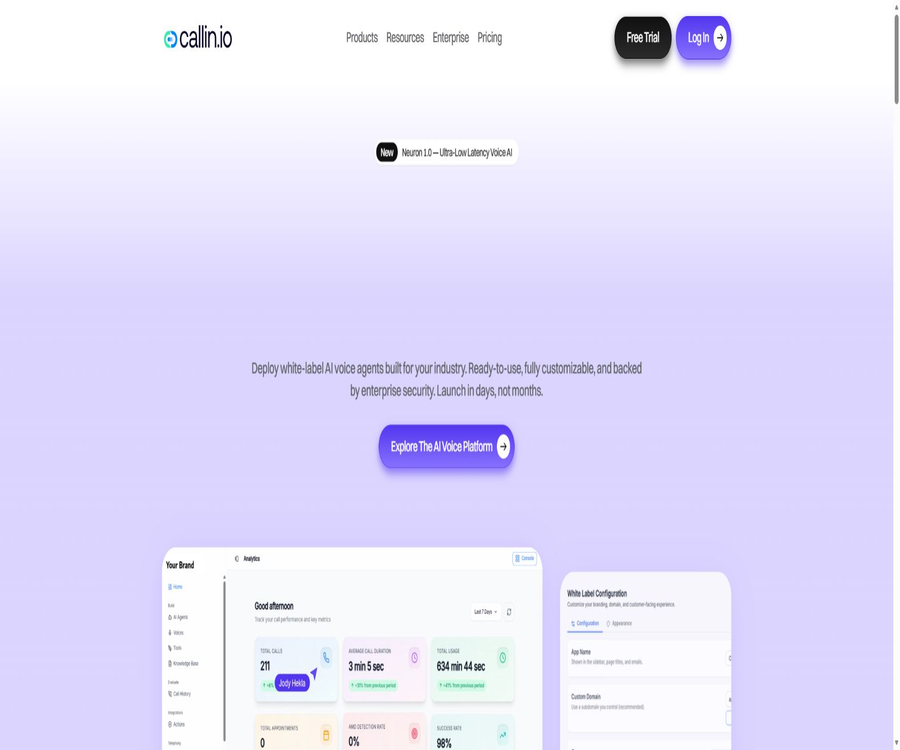
Callin.io is a cloud platform used for building, deploying, and reselling AI phone agents, operated by the American company Replacing Humans LLC. Companies can use these agents to automatically answer or initiate calls, answer questions, filter leads, schedule appointments, take certain actions, and transfer calls to human operators when necessary.
The platform serves enterprises that use AI-based front-ends directly, as well as developers and automation teams; it also caters to agents who wish to sell voice AI under their own brand names and to SaaS founders. It is not a traditional telephone system with human operators, but rather an infrastructure for voice automation built around dialogue agents, phone lines, knowledge bases, workflows, and APIs.
A one-sentence summary
Callin.io connects large language models, speech recognition, speech synthesis, and phone service providers, enabling businesses to deploy 24/7 AI-powered call handling and automated outbound calling solutions in a code-free manner, via APIs, or under a white-label format.
Product positioning and version
| Usage method | Core competencies | Suitable for users |
|---|---|---|
| Use directly | Create AI agents, connect to numbers, answer or make calls, view call history | Small and medium-sized enterprises, sales and customer service teams |
| White-label platform | Customize brand, features, prices, customer permissions, and subscription plans | AI agents, CRM vendors, and SaaS founders |
| API integration | Manage agents, sessions, knowledge bases, and custom workflows | Developers and enterprise integration teams |
| Industry solutions | Pre-configured processes for real estate, property management, IT support, smart cities, and scheduling, etc. | Vertical industries that wish to reduce the time required for implementation |
Main functions
1. AI answeres incoming calls
AI agents can answer customers’ calls around the clock, identify their intentions, and respond in accordance with business rules, collect information, or take further action. They are suitable for handling common questions, making appointments, assessing eligibility, routing tickets, and dealing with calls received outside regular working hours.
2. Automated outbound calling campaigns
The Campaigns module combines AI agents, contact lists, and execution plans to enable the initiation of outbound calls to hundreds or thousands of contacts, either immediately or at a specified time zone. Contacts can be selected from within the system or imported via CSV, and the messaging content can be personalized using dynamic variables such as names and email addresses.
Activity analysis includes the total number of calls, average call duration, number of appointments made, outcomes of calls, and the rate of voicemail detections. For large-scale outbound calls, it is necessary to first obtain consent from the contacts, use a DNC list, respect the local time limits for making calls, and comply with requirements regarding the disclosure of AI identity.
3. Prompt words and workflow
Each agent can be configured with conversation prompts, language settings, voice options, intelligent models, call directions, and workflows. Behavior rules should be included in the prompts, while business-related information ought to be stored in a separate knowledge base to facilitate maintenance and reuse.
4. Knowledge base
The knowledge base allows for the uploading of files or the inclusion of content from public web pages, and it enables documents to be managed in groups. Agents can use FAQs, product information, policies, and internal manuals to answer questions; the binding relationships can be updated after the relevant materials are revised.
5. Tools and Actions
The platform allows agents to use system tools or tools developed by their teams, in order to retrieve data during calls, create records, or initiate external processes. Call Actions are used to set up automatic actions for ending calls, making transfers, scheduling appointments, or handling other tasks.
6. Transfer to human agent and callback
When the AI is unsure, when the user requests it explicitly, or when rules related to high risk are triggered, the call can be transferred to a human operator, who is provided with the gathered context. If no one is available, the request can be recorded, a callback scheduled, and a text version along with a summary sent.
7. Appointments and calendar
Callin.io can be connected to Google Calendar to help in checking times and creating or managing appointments. The privacy policy states that calendar data may include names, email addresses, phone numbers, notes, event descriptions, and dates of birth; it is necessary to grant access only to the calendars that are truly required.
8. Multilingualism and Sound
The official website is currently available in 31 different languages; the About page highlights the native languages such as English, Spanish, Italian, Portuguese, French, German, Dutch, and Hindi. The quality of services provided by different language, accent, and voice providers needs to be tested separately.
9. Call history and analysis
The Call History can be filtered by number, agent, status, and date, and exported in CSV format; it also allows access to recordings, transcripts, summaries, key moments, and emotional information. This data is useful for quality checks and process improvement, but emotional assessments should not be used as the sole basis for making decisions.
10. Website voice components
The Agent configuration page includes a Website Widget that allows the addition of voice or conversation capabilities to a website. Companies need to inform visitors that they are interacting with an AI, and they must obtain appropriate consent for the use of microphones, as well as for the processing of personal data.
11. White-labeling and multi-tenancy
White-label platforms allow partners to set the brand, client entry points, plans, features, usage limits, language options, and permissions, as well as to manage clients through sub-accounts. Agent templates enable the replication of verified configurations across multiple clients, thereby reducing the need for repeated setup processes.
How AI phone agents work
- The phone call is established through Callin, Twilio, Telnyx, or the company’s own SIP lines.
- The voice recognition service converts the speaker’s words into text while preserving the context of the call.
- Large language models determine the next response or action by combining prompts, knowledge bases, tools, and workflows.
- The speech synthesis service converts the answer into sound and sends it back over the telephone line.
- The agent can continue to ask questions, use tools, make appointments, write to the system, or transfer the call to a human agent.
- After the call ends, a recording, a transcript, an outline, data on emotions and outcomes are generated.
- Webhooks, APIs, or automated connectors send data to CRM, calendars, and internal systems.
Create the first AI agent
- Create an account and choose a specific task from among inbound calls, outbound calls, appointments, customer service, or lead filtering.
- On the AI Agents page, you can set the name, prompt, language, voice, intelligence level, and call direction.
- Create a knowledge base by uploading FAQ, service rules, product information, and materials that are permitted to be answered, in organized groups.
- Configure workflows, tools, Call Actions, and conditions for human handoff.
- Purchase or obtain a test number, and check the documentation and regulatory requirements of the country to which the number belongs.
- Conduct multiple rounds of testing using normal, blurred, interrupted, noisy, rejected, and sensitive questions.
- Check recordings, transcripts, summaries, actions, and data written to external systems, and correct each failed case.
- Launch with a low traffic volume and set parameters for budget, concurrency, manual intervention, and anomaly alerts.
Create an outbound campaign
- Prepare a list of those who have been granted permission for legitimate contact, and standardize the international area codes, names, and custom fields.
- Create or import contacts, map phone numbers, names, and email addresses column by column, and check the preview.
- Select the tested AI agent, and use the verified dynamic variables in the prompt.
- Set to start immediately or within a specified time window, and limit calls according to the contact’s local time zone.
- First, run small-scale tests to check the connection, voicemail system, scripts, cancellation functions, and error handling.
- Once it is officially launched, concurrent usage, costs, failures, reservations, and complaints are monitored; the number of calls made is not used as a substitute for quality.
- After the event is over, export the results and remove invalid numbers, those that were rejected, and numbers with which further contact is not permitted.
Connect the number to BYOC
Each agent requires a telephone connection; you can purchase Twilio numbers in the workspace, import numbers from providers such as Telnyx, verify existing numbers, or connect to a SIP Trunk using a BYOC approach. Numbers in the United States and Canada are usually faster to obtain, while international numbers may require identification documents, an address, or business verification.
- Choose to purchase a new number, import an existing number, or use SIP BYOC based on national requirements as well as inbound and outbound call needs.
- Submit the identity, address, or company information required by the supplier, and wait for the number to be activated.
- Assign numbers to the appropriate AI agents, and configure caller ID, routing, and failure handling.
- Use a test phone to check two-way audio, latency, DTMF, voicemail, and call forwarding.
- If SIP is used, configure authentication, routing, codecs, SBCs, and media encryption.
- After going live, monitor both the operator’s billing statements and the minutes counted by Callin AI to avoid missing any of these dual costs.
Which users are it suitable for
- Small and medium-sized enterprises: Use AI to handle calls, FAQs, messages, and appointments outside regular business hours.
- Sales team: Automatically contacts new leads, evaluates their eligibility, and passes qualified customers on to human agents.
- Customer Service Team: Automatically routes repetitive inquiries and escalates complex or sensitive cases to agents.
- Real estate and property management companies: screen buyers, tenants, and those with maintenance needs, and arrange viewings or services.
- AI automated agents: Provide branded voice products to multiple customers through a white-label environment.
- CRM and vertical software vendors: integrate phone agent capabilities through APIs, MCP, or Webhooks.
- Development team: Uses REST APIs to manage proxies, sessions, and knowledge bases, as well as to connect with internal systems.
- Multilingual services: Providing coverage for multiple regions once authentic accents and line tests are successful.
Typical use cases
- AI front desk: Answers the company’s main phone line, identifies the purpose of the call and either transfers it or schedules a callback.
- Appointment Assistant: Reads available times from the calendar to create, reschedule, and cancel appointments.
- Lead screening: Ask about requirements, budget, location, and timeline, update the CRM, and schedule a sales call.
- Service reminders: Automatic notifications for expirations, appointments, renewals, bills, or maintenance tasks.
- Customer follow-up: Conduct satisfaction, after-sales, or feedback surveys in accordance with the authorized list.
- IT support: Handles level 1 issues based on the knowledge base, and creates or updates tickets.
- White-label SaaS: Creates templates, packages, usage limits, and client interfaces for specific industries.
- Smart cities and facilities: offer multilingual service inquiries and connect users to human operators in emergency situations.
Product advantages
- It supports direct use, API integration, and full white-label reselling, offering a variety of business model options.
- It can be connected to Twilio, Telnyx, custom SIP services, as well as multiple carrier lines, thereby avoiding restrictions imposed by a single numbering channel.
- Tips, knowledge bases, tools, actions, and workflows are managed separately, which is suitable for complex agents.
- It supports batch outbound calling campaigns, dynamic variables, scheduling windows, and campaign analysis.
- It offers connection options such as Google Calendar, Make, Zapier, n8n, Webhook, API, and MCP.
- The call history stores recordings, transcripts, summaries, key moments, and emotional information in one place.
- The concurrent processing capacity has been increased from 3 basic channels to 80 advanced channels for white-label use, and additional capacity can be purchased as well.
- The publicly available documentation provides references to testable REST APIs, rather than just marketing descriptions.
Usage restrictions and precautions
- The cost of phone calls consists of the minutes charged by the service provider and the minutes charged by Callin AI; it is not sufficient to consider only the subscription fee for the platform.
- The official website does not currently provide a fixed standard amount that applies to all industries and accounts; it is necessary to obtain a complete quote before making a purchase.
- AI may mishear, give incorrect answers, execute tools wrongly, or make wrong appointments; therefore, it is necessary to have a manual transfer and review process in place.
- The concurrent limit and the monthly minutes are different metrics; reaching either of these limits can affect calls.
- International numbers may require identification and address details; their activation and pricing are influenced by the service provider and local regulations.
- Batch outbound calls may give rise to TCPA, GDPR, anti-harassment, DNC, and AI identity disclosure requirements.
- Recording, calendars, knowledge bases, and CRM data are processed by various AI, voice, cloud, and telephone service providers.
- The so-called 31 languages do not mean that all accents, industry-specific terminology, and voice providers perform in the same way.
- White-label partners are still responsible for providing customer support, setting prices, managing data protocols, and ensuring compliance with regulations for end users.
- Automatic emotion and critical moment analysis are auxiliary signals that cannot be used directly for decisions related to high-risk individuals or credit assessments.
Prices and packages
As of August 21, 2026, the price information available on Callin.io’s official website varies depending on the language, industry, and sales context; there is no fixed, uniform price in dollars that applies to all users. Earlier official articles mentioned a starting price of 30 dollars, but this should no longer be considered the current pricing.
The public help documentation still specifies the concurrent usage capacity for the Basic plan and several branded plans; Unlimited Plus is indicated as having 15,000 minutes of such capacity. The table below compares only the verified capacities, and no estimates are made regarding subscription fees that are not publicly disclosed.
| Package | Concurrent calls | Public quota information | Price status | Suitable for users |
|---|---|---|---|---|
| Basic | Route 3 | The unified number of minutes is not specified in the current document. | Log in or contact sales for confirmation. | Use directly for low-flow testing |
| Starter White Label | 8 channels | Configured by white-label account and usage volume | Contact sales | Agents who manage a small number of clients |
| Premium White Label | Route 15 | Configured by white-label account and usage volume | Contact sales | Stable multi-client business |
| Unlimited White Label | Route 80 | It allows for an increase in concurrency; an additional cost of $7 per channel. | Contact sales | High-throughput multi-tenant services |
| Unlimited Plus | Route 80 | Includes 15,000 minutes; an additional $7 per concurrent connection. | Contact sales | Teams that require high capacity and predictable quotas |
| Enterprise or industry solutions | Customization | Minutes, integration, SLAs, and get-started procedures are determined on a project-by-project basis. | Custom quote | Large conglomerates and vertical software vendors |
Dual-minute billing
Each phone call consumes both the operator’s minutes and Callin AI’s minutes. For example, a 5-minute conversation typically results in 5 minutes of charge for the phone connection plus 5 minutes of usage for AI processing; using more advanced modeling algorithms may require slightly more AI minutes.
| Cost components | Who will charge the fee? | Covered content | Control method |
|---|---|---|---|
| Carrier minutes | Twilio, Telnyx, or your own carrier | Actual phone connection, country, number, and direction | Compare rates for different destinations and set a budget for the route. |
| Callin AI minutes | Callin.io | Speech recognition, model processing, speech synthesis, and proxy operation | Select models, reduce unnecessary conversations, and monitor usage. |
| Subscription or platform fee | Callin.io | Accounts, agents, white labeling, concurrency, and features | Choose the option based on the actual capacity. |
| Integration and implementation | Callin.io or third parties | Custom workflows, CRM, SIP, and customer migration | Obtain the scope and fixed price prior to making a purchase. |
Monthly fees for the number, recording storage, international calls, text messages, additional concurrent connections, and advanced models can also affect the total cost. During the trial period, it is necessary to export a complete record of usage; the monthly bill can be estimated based on the average duration of calls and the peak number of concurrent connections.
Trial, cancellation, and refunds
The official website provides a link for a free trial, but the public pages do not give clear information regarding the number of days and minutes available for each trial. Users should check on the registration and checkout pages to find out whether a payment method is required, when the payment will be due, and what the costs associated with the trial service will be.
To cancel an online subscription, one can fill out a cancellation form by logging into the account; the company states that it will process such requests within 3 working days. Cancellation after a trial period usually takes effect at the end of the current billing cycle. If the account is accessed or minutes of service are used during a paid billing cycle, it is generally not possible to get a refund, and the terms outlined in the contract apply in such cases.
REST API
Callin.io provides API references, which can be used by invoking the APIs with an API key or through the authentication methods specified in the documentation. The current references cover objects such as health checks, identities, Agents, Conversations, and Knowledge Base.
The Agents interface allows for listing, reading, creating, and updating agents. The listing interface provides functions for searching, sorting, and pagination using cursors; the number of items per page ranges from 1 to 100. API keys must be stored solely on the server side and cannot be embedded in web pages or mobile applications.
API integration process
- Create separate API keys in the Callin account, and differentiate between test and production credentials based on the environment.
- First, call the health or identity interface to verify authentication and account scope.
- Read the list of proxies and the existing configurations to verify pagination, fields, and permissions.
- Create proxies, knowledge bases, or session workflows in the testing environment; do not manipulate production numbers directly.
- Supports timeout, rate limiting, retry, idempotency, key rotation, and sensitive log masking.
- Before going live, verify the processes for deletion, revocation of permissions, version changes, and exception compensation.
SDK, Webhook, and MCP
The official website’s integration page states that SDKs for Python, Node.js, PHP, and Ruby are available, and that OAuth 2.0, sandboxing, and enterprise-level rate limiting are supported. However, no public packages, version pages, or official GitHub repositories related to these SDKs could be found; developers should seek detailed information on installation and maintenance from the official sources first.
Webhooks enable the real-time transmission of information about callers, extraction of entities, timestamps, transcripts, and call results; Make, Zapier, and n8n are used for visual automation. The product page for Italy currently lists the APIs and MCP support available, but the list of MCP tools and instructions for client configuration are still limited.
GitHub and open source
As of the time of verification, no official GitHub organization, core product repository, or open-source license maintained by Replacing Humans LLC or Callin.io was found. The product should be considered a closed-source commercial SaaS solution and a white-label platform.
It supports n8n, APIs, Webhooks, MCP, as well as the SDKs mentioned on the official website; however, this does not mean that the Callin.io platform itself is open source. When using third-party examples or community code, it is necessary to carefully examine the sources and licenses involved.
Platform support and integration
| Platform or integration | Support status | Explanation |
|---|---|---|
| Web management backend | Support | Create proxies, numbers, contacts, activities, and view history |
| Website Widget | Support | Add proxy interactions to the webpage |
| Standalone desktop application | No findings were detected. | It is primarily used via the Web. |
| iOS or Android app | No findings were detected. | No official app store client was found. |
| Twilio | Support | Purchase numbers and phone connections |
| Telnyx | Support | Import a number or connect to an operator |
| SIP BYOC | Support | Connects the own operator with PBX infrastructure |
| Google Calendar | Support | Query and manage reservations |
| Make, Zapier, n8n | Support | Connect workflows such as CRM, spreadsheets, and Slack. |
| REST API and Webhook | Support | Development and integration with real-time events |
| MCP | Listed on the official website | The range of publicly available configurations and tools is limited. |
Privacy and data processing
The infrastructure listed in the privacy policy includes OpenAI, Azure OpenAI, LangChain, Cartesia, ElevenLabs, PlayHT, Deepgram, Twilio, Redis, as well as cloud services such as AWS, GCP, and Azure. A single call may pass through multiple processors located in different countries.
The platform manages accounts, devices, usage data, calendars, call recordings, and content submitted by users. Call recordings are typically retained for 30 days, unless legal or operational requirements dictate a longer retention period. Enterprises should specify through contracts the actual duration for which recordings, transcripts, embedded vectors, and backups will be kept and when they will be deleted.
Safety and Compliance Statement
The official website provides information on transmission and static encryption, access control, auditing, GDPR, CCPA, SOC 2 Type II, as well as a 99.9% availability rate. Industries with high risk levels should request current certificates, DPA agreements, a list of sub-processors, options regarding data retention, and SLAs, rather than relying solely on the information presented on the website.
AI and audio notifications
In some areas, it is required to inform the other party that an interaction with AI is taking place, and to obtain consent from either one or both parties for recording. Companies should include instructions on how to disclose this information and how to stop the recording in their greeting messages, and they should switch to a human operator or pause the recording before sensitive information is presented.
Basic information
| Project | Information |
|---|---|
| Tool name | Callin.io |
| Operating entity | Replacing Humans LLC |
| Tool type | AI voice agents, automated outbound calls, and white-label voice platforms |
| Core competencies | Inbound calls, outbound calls, knowledge base, appointments, tools, transfer, call analysis, and campaigns |
| Phone connection | Callin, Twilio, Telnyx and SIP BYOC |
| Price pattern | Free trial, platform subscription, AI minutes, carrier minutes, and custom quotes |
| Public fixed current price | There is no unified and stable display; logging in or contacting sales is required. |
| Main platforms | Web and website widgets |
| REST API | Provide public references |
| Webhook | Support |
| MCP | The official website lists support, but there is limited public information available. |
| Official SDK | The official website claims to offer a multi-language SDK, but no public version has been found. |
| Official GitHub | No findings were detected. |
| Is it open source? | No |
Recommendation score
Its rating is 4.4 out of 5 points. Callin.io offers comprehensive features such as white labeling, support for multiple carriers, a knowledge base, outbound calling capabilities, concurrency handling, Webhooks, and public REST APIs; it is suitable for teams that wish to turn AI-based voice technologies into commercial products or integrate them deeply into their business systems.
The main drawback is that the current public pricing is not uniform enough; the cost per minute calculated by AI and by operators tends to be underestimated, and the information available for SDKs and MCPs is less comprehensive than that available for REST APIs. It is recommended to first use actual connection lines and a small number of contacts in order to test latency, accent issues, concurrency, compliance, and the accuracy of billing.
Frequently Asked Questions
Is Callin.io free?
The official website offers a free trial option, but the public pages do not provide clear information regarding the number of days and minutes available for testing with each account. It is necessary to confirm the payment method, credit limit, and terms of billing before starting the trial on the registration page.
How much is Callin.io?
The current official website does not display a fixed, uniform price that applies to all industries; the figure of $30 mentioned on the historical pages cannot be considered the current price. The total cost consists of the platform solution, Callin AI minutes, operator minutes, the phone number used, the number of concurrent connections, and implementation costs.
Why are there two different charges for a one-minute call?
The operator is responsible for establishing the actual phone connection, while Callin handles AI recognition, model processing, and voice generation; as a result, for the same duration of use, both Carrier minutes and AI minutes are typically consumed.
Does it support your own phone number?
It supports purchasing new numbers, importing numbers from providers such as Telnyx, verifying existing numbers, or connecting to one’s own carrier via SIP BYOC. International numbers may require additional documents.
How many concurrent connections are supported?
Basic offers 3 channels, Starter (white-label) provides 8 channels, Premium (white-label) offers 15 channels, while Unlimited and Unlimited Plus provide 80 channels. For advanced plans, the number of concurrent connections can be increased at a cost of $7 per channel; the actual purchase terms need to be verified.
Is it possible to make automatic bulk outbound calls?
Yes. Campaign allows for the import of contacts, the setting of dynamic variables and time periods, as well as the viewing of analysis related to calls and appointments. However, users must have a legitimate basis for contacting others and must comply with anti-harassment rules.
Is Chinese supported?
The official website claims to support 31 languages, but the list of the primary languages listed there does not include Chinese. Mandarin, regional dialects, numbers, addresses, and industry-specific terms need to be verified through actual use.
Is an API provided?
Available. The public REST API currently covers entities such as health, identity, proxies, sessions, and knowledge bases, and it uses authentication methods like API keys.
Is an SDK provided?
The official website claims to provide SDKs for Python, Node.js, PHP, and Ruby, but no public package repositories or version control systems have been identified. It is necessary to obtain accurate information regarding installation, support, and updates from the official sources before starting development.
Is MCP supported?
The official website lists the APIs and MCP support, but limited information is available regarding the addresses of MCP servers, the list of available tools, and the authentication settings; these details need to be confirmed through account management or sales support.
Is Callin.io open source?
No. No official core product code repository or open-source license was found; it should therefore be considered a closed-source commercial service.
How long are recordings saved?
The privacy policy states that data is typically retained for 30 days, but legal, operational, contractual, or account-related requirements may dictate a longer retention period. Companies should determine the applicable retention and deletion timelines prior to implementation.
Can I get a refund after cancellation?
If the account has been accessed or a certain number of minutes have been used after the trial period, no refund is usually provided for that cycle; cancellation is primarily used to prevent renewal in the subsequent period. Customers who place orders must comply with the terms of the contract.
Summary
Callin.io is suitable for companies that need an AI-based front desk for incoming calls, bulk outbound calls, scheduling functions, the ability to transfer calls to human agents, as well as integration with other systems. It is also appropriate for agents and software manufacturers who wish to sell voice AI as their own product. Its support for multiple carriers, white-labeling options, API access, and workflow capabilities make it more of a platform rather than a single robot.
When making a selection, priority should be given to calculating the cost per minute, the peak concurrent usage, and the total implementation cost; moreover, stress testing should be conducted using real-life scenarios, abnormal conversations, and compliance procedures. If the publicly available prices are insufficient, a written quote that includes details on all costs related to minutes, numbers, storage, APIs, support, and termination terms should be requested.
Tools similar to Callin.io




 Guigong Network Security Registration No. 45132202000164