






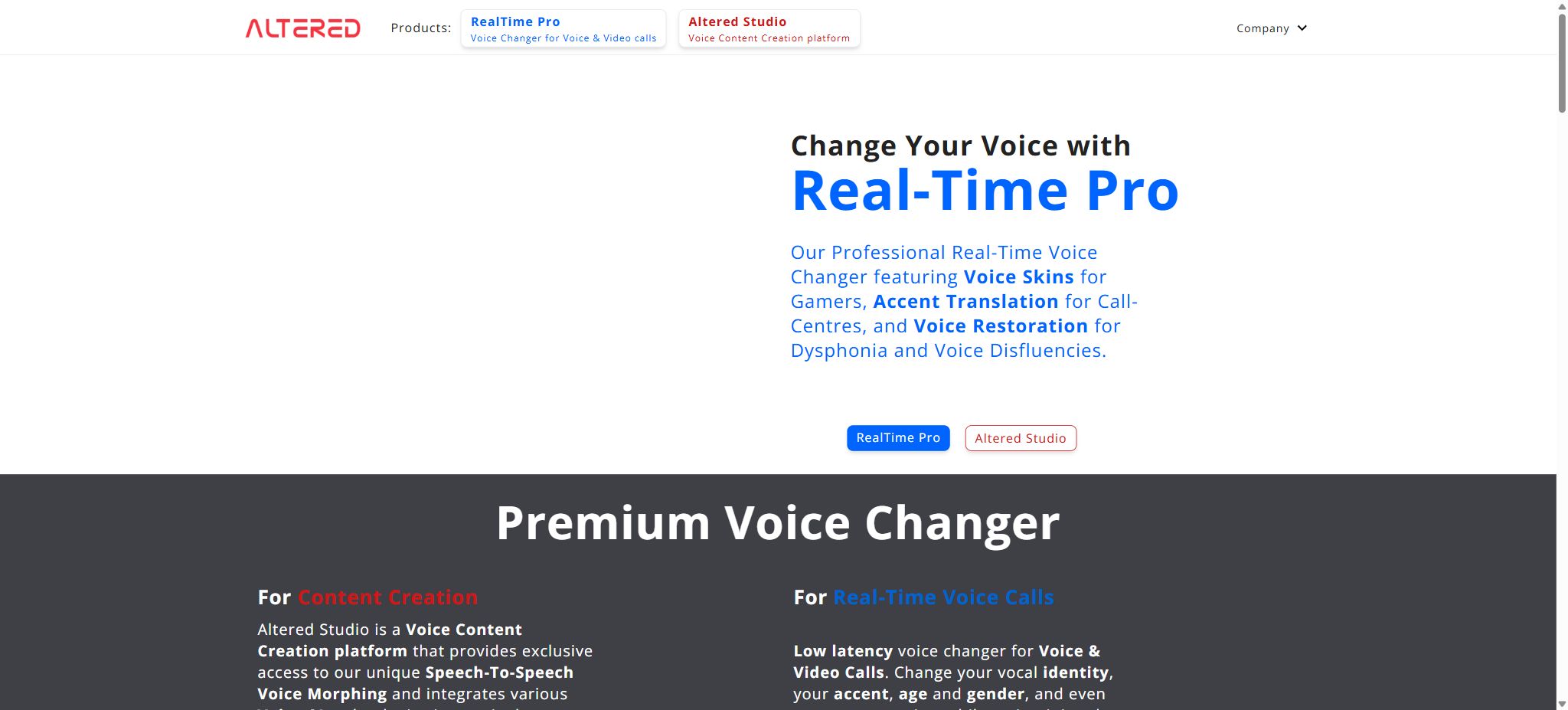
Altered Studio
An AI studio used for voice performance conversion, dubbing, and post-production.
Tags:AI audio toolsWhat is Altered Studio?
Altered Studio is an AI-powered voice content platform designed for media production. Its core technology is Speech-to-Speech Voice Morphing, which allows real-person performances to be transformed into another voice while preserving as much of the original rhythm, pauses, emphasis, and emotion as possible. It is suitable for use in film and television ADR, game characters, animated dialogues, advertisements, audio content, course narrations, and voice modification for privacy purposes.
The platform can be used in a web browser, and desktop applications for Windows and macOS are also available. The desktop version allows users to take advantage of local computing resources for tasks such as editing, real-time voice transformation, and certain local audio cloning operations.
Companies can also inquire about local servers, API solutions, and multi-seat options.
Core functions of Altered Studio
Voice-to-voice transformation
The user records or imports a performance, then selects the desired sound and model to create a new timbre. The Timbre model primarily alters the physical characteristics of the sound, while preserving much of the speaker’s accent and expression.
The Clone model will more closely resemble the target voice and its accent; the Performance and Style settings are used for more advanced control over the performance.
Compared to plain text-to-speech conversion, voice distortion allows for the preservation of the actor’s specific interpretation of the lines.
The platform deducts the minutes required for Voice Morphing based on the length of the input audio. After the first transformation of the same audio segment, attempting to use different voices or settings generally does not result in another consumption of that segment’s quota; thus, it is possible to compare various options related to character type, age, gender, and pitch.
Real-time AI voice transformation
Real-Time Voice Morphing allows Altered to be used as a virtual microphone for games, voice chats, or video conferences. According to the official documentation, this mode places emphasis on low latency; it typically utilizes 1 to 4 CPU cores, and it is recommended to use it on computers with 8 or more cores.
Users can choose the voice model and speaking style, and adjust parameters such as voice detection and automatic gain.
The real-time mode is different from the media production mode: real-time mode focuses on speed, while offline media production allows for higher-quality models and more detailed adjustments. Before starting a live broadcast, it is necessary to check the Realtime Factor, buffering, microphone noise, and the input devices used by the target application.
Voice cloning
Rapid Voice Cloning enables the quick creation of clones from just a few seconds of clean audio, which can be used for short content, character drafts, and ADR corrections. Higher-quality local clones can be generated using recordings of a single speaker that last from a few minutes to about an hour, with training taking place on the user’s own graphics card.
The minimum requirement specified by the officials is a GPU of the NVIDIA RTX 2080 class with 12 GB of video memory, while the RTX 3090 or 4090 models with 24 GB of video memory are recommended; the actual compatibility should be determined through testing with desktop applications.
It is necessary to obtain permission from the person whose voice is being cloned or from the rights holder before doing so. The sample should avoid music, background noise, reverb, and other speakers; it is best for the test file to be different from the training file, in order to determine whether the model can truly generalize.
Text-to-speech and multilingual voices
Altered Studio offers its own professional voices, as well as over 700 third-party voices from providers such as Azure, Google, AWS Polly, and IBM – covering more than 70 languages and accents. Users can choose voices, speaking styles, and pacing for generating scripts; they can also use TTS to create long passages first and then apply Speech-to-Speech technology to refine the key lines in those passages.
Transcription, translation, noise reduction, and audio editing
The platform combines text-to-speech, text translation, AI Denoiser, AI Voice Cleaner, and traditional DSP effects; it allows for cutting, arranging, mixing, and batch processing within the same project. Different services charge AI Tokens based on characters, seconds, or minutes, and these Tokens should not be mixed together with the minutes required for voice morphing.
API and enterprise deployment
The Enterprise plan offers API access, a quota pool for multiple users, customized voices, a dedicated account manager, as well as features related to business data protection; in addition, clients can benefit from local computing server services. The regular Creator or Professional plans do not include access to public APIs.
The core applications, sounds, and models of Altered Studio are not open-source software; as of the time of verification, there is no official open-source SDK repository that represents a complete product.
Comparison of prices and packages for Altered Studio
The official website shows the prices for different regions on a monthly, quarterly, and annual basis. The option in dollars is provided for verification; the figures for quarterly and annual payments represent the average monthly cost, with actual charges being calculated based on the respective period.
| Package | Monthly payment / Quarterly payment, average per month / Annual payment, average per month | Voice distortion and tokens | Authorization and key capabilities |
|---|---|---|---|
| Free | 0 dollars | 3 minutes per month; 10,000 Tokens | Signed license, Rapid Voice Cloning, basic voice processing and editing; attribution is required for non-commercial use |
| Creator | 40 / 36 / 30 dollars | 60 minutes per month; 325,000 Tokens | Creator License, local voice cloning, accent and speaking style modification |
| Professional | 120 / 108 / 90 dollars | 180 minutes per month; 1,000,000 Tokens; unlimited number of transformation directions locally | Commercial license, Flexible/Performance Voice Morphing, 48kHz output |
| Enterprise | Contact sales | No restrictions on voice variations and the customization of tokens. | Customized voices, APIs, multiple seats, dedicated manager, and business data protection |
For Creator and Professional accounts, any unused AI tokens can be carried over to the following month in accordance with the official rules, but the limit on the number of minutes for voice modification as well as the maximum amount that can be carried over are specified in the account interface. Free accounts use an Attribution License; such accounts are allowed to use the content for non-commercial purposes only, and it is required to indicate that the content has been altered.
The Creator License allows individuals or companies with no more than 5 members to use it for commercial purposes, provided that the revenue generated from such activities or the funding received in the past 12 months is less than 100,000 dollars. If those criteria are not met, or if standard commercial rights are required, then the Professional or Enterprise license should be chosen.
How are AI tokens deducted?
| Services | Billing unit | Example consumption on the official website |
|---|---|---|
| Text to speech | By character | Common suppliers charge 1 Token per character; Google Studio charges 8 Tokens per character. |
| Speech transcription | By second | Azure 14, with speaker separation 19, Google 20 tokens/second |
| AI Denoiser | By second | 12 Tokens/second |
| AI Voice Cleaner | By minute | 720 Tokens/minute |
The supplier and the consumption ratio may change; for longer projects, it is necessary to estimate the number of script characters and the audio duration before processing. Speech-to-Speech text transformation uses a separate minute quota, which is calculated based on the duration of the input material processed for the first time.
Altered Studio usage guide
- Select working mode:Studio is used for offline editing of bulk voiceovers, while Real-Time is employed when low latency is required for meetings or games.
- Prepare clean input:Record close to the microphone to reduce ambient noise, reverb, clipping, and overlapping voices.
- Import or record a performance:First, establish the rhythm, pauses, and emotions, and then have the model change the timbre; this is usually more natural than making corrections later on.
- Selecting a model:If you only want to change the timbre, try Timbre; if you need a sound or accent that is closer to the desired one, choose Clone or the appropriate style model.
- Comparison parameters:For the same input, it is possible to keep trying different target sounds, ages, genders, pitches, and styles, without using up the quota for the first transformation.
- Complete post-production:Use noise reduction, cleaning, equalization, and other effects, then export at the sampling rate required by the project.
Altered Studio usage guide
Create reusable professional workflows
- A test set is created using real noise, accents, and multi-person segments;
- Compare the differences in processing between voice-to-voice transformation, real-time AI voice changing, and voice cloning.
- Retain the original recordings and the unmodified transcripts;
- Arrange for a manual hearing before releasing it to the public;
- Statistically analyze processing time, error rate, and quota consumption;
- Regularly update the glossary, sound licensing, and deletion policies;
Which users are it suitable for
- A sound team responsible for creating audio for games, animations, films and TV shows, as well as character dialogues;
- Voice actors and content creators who need to portray multiple characters in a single performance;
- A studio that creates advertisements, audiobooks, courses, and marketing narration;
- Users who wish to change their voice with low latency in games, live broadcasts, or meetings;
- Organizations that place emphasis on local voice cloning, data control, APIs, and corporate workflows.
Advantages and precautions
- What sets AlteredStudio apart is its use of live performances as the core input, which helps to maintain the rhythm and emotions of the dialogue, rather than relying solely on TTS to read everything from scratch.
- With both real-time and high-quality offline options, local cloning, audio editing, and support for TTS providers from various vendors, it makes it more similar to a professional audio workstation.
- The model’s output may still exhibit a metallic tone, pronunciation errors, accent issues, or unnatural breathing.
- High-quality local models require significant graphics processing power, and the real-time mode is also affected by the CPU, drivers, and virtual audio settings.
- When the voices of public figures, actors, customers, or employees are used, written permission must be obtained and the audience must be informed that synthetic processing has been applied; it is not allowed to create content that is intended to deceive or provide false endorsements.
Frequently Asked Questions
Is Altered Studio free?
There is a free plan that includes 3 minutes of voice transformation per month and 10,000 tokens. Creator also offers a 7-day free trial, without the need for a credit card;
After the trial period ends, you can decide on your own whether to upgrade.
Will voice distortion result in additional charges for minutes?
For the same input segment, the quota is deducted based on its length only during the first morphing; subsequent attempts to use different voices or settings do not consume additional minutes from that segment.
Can it be used for commercial purposes?
Free offers only a non-commercial attribution license. Creator includes restrictions regarding income, funding, and the size of the team, while Professional provides a more comprehensive commercial license.
Formal business projects should select a solution based on their own scale.
Is local execution supported?
It supports desktop applications for Windows and macOS, and offers local sound cloning capabilities. High-quality cloning requires a compatible NVIDIA GPU;
Companies can consult local servers for further information.
Is Altered Studio open source?
It is not open source. The core applications, sound models, and services are all proprietary products, and the company’s APIs are not equivalent to open-source code.
Tools similar to Altered Studio


 Guigong Network Security Registration No. 45132202000164