






Typecast
A platform for creating content using emotional AI voices and virtual characters
Tags:AI audio toolsWhat is Typecast?
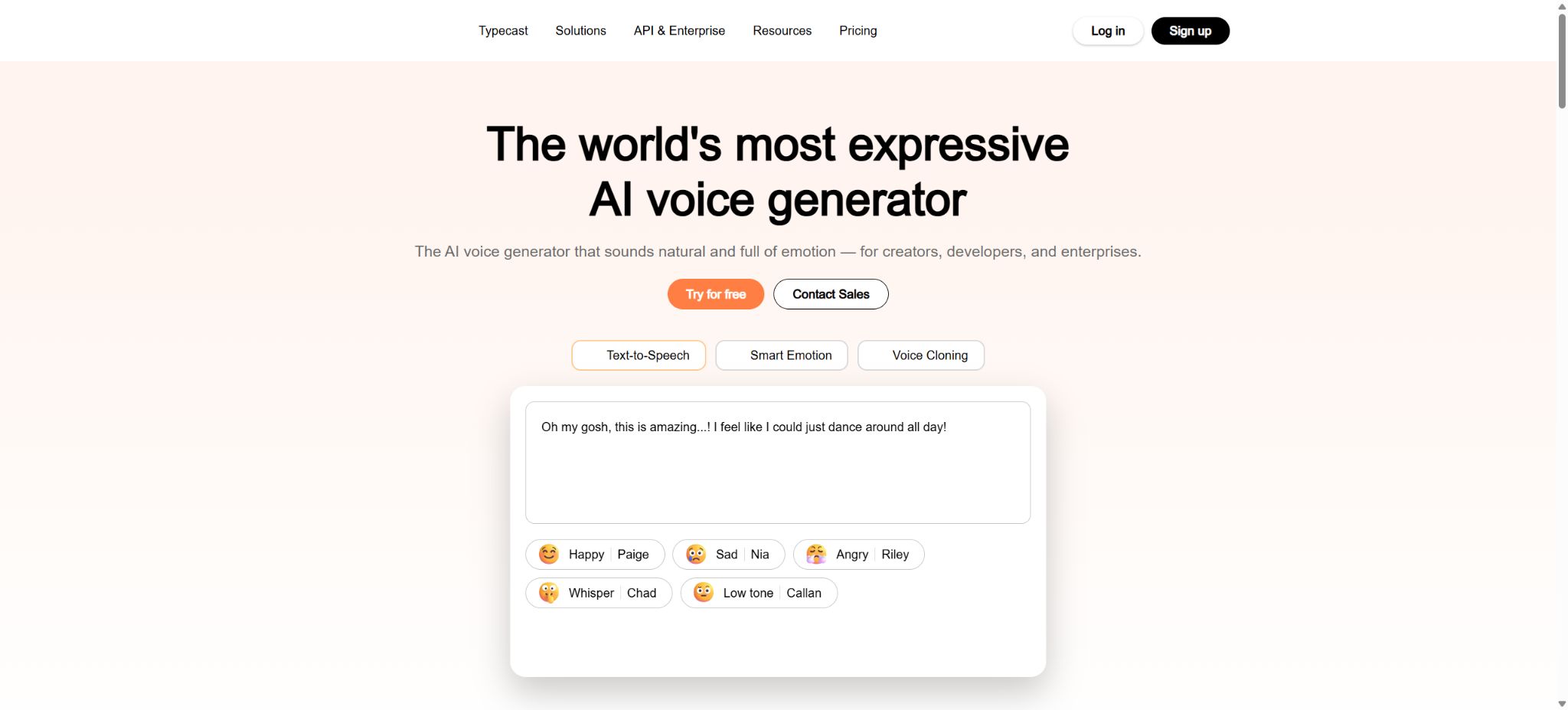
Typecast is an AI-powered voice and video creation platform developed by Neosapience, whose core function is to convert text into voices that possess a sense of character and emotional expression. Users can select voices in the web editor, enter scripts, adjust the pace and emotion of the speech, and then download the audio file.
It is also possible to create voice-over videos by combining images, subtitles, media assets, and Talking Avatars.
It is suitable for use in narrations, short videos, podcasts, advertisements, courses, audio content, and character dialogues in games. Typecast Studio and Typecast TTS API are two separate products with distinct pricing models: the former is intended for users who create content directly on web pages or mobile devices, while the latter is used to integrate speech capabilities into applications, websites, or automated systems.
Core functions of Typecast
Multi-role text-to-speech
Typecast offers hundreds of AI voices with different ages, tones, and character roles. Scripts can have various voices assigned to different segments, for use in narration, dialogue, advertisements, and game stories.
The official product page highlights over 700 different AI voices; the number of available voices varies depending on the region, model, and package.
Emotions and advanced voice control
Pro and Business offer emotion control and advanced sound settings, allowing adjustments to the intensity, rhythm, and tone of delivery based on the content. Plus and higher versions support speed control.
Not every voice comes with exactly the same emotional tone; it is necessary to listen first to determine whether the character and the language match.
Voice cloning
Typecast divides voice cloning into Instant Cloning and Professional Voice Cloning. The free version allows only access to instant cloning, without the possibility of downloading the results;
Basic supports instant cloning; Plus, Pro, and Business support both instant and advanced cloning.
Users must possess the audio samples and the necessary authorization to use them; they are not allowed to clone others’ voices to create content intended for deception or fraud.
AI videos and Talking Avatars
The platform includes a video editing tool that allows the generated narration to be combined with images, videos, subtitles, and digital avatars. Talking Avatar enables character avatars to create spoken-word videos based on scripts.
Under the rules in effect after August 2026, generating each Avatar video will cost 5,000 points; therefore, it is necessary to confirm the script, visuals, and audio beforehand to avoid wasting credits by generating the video multiple times.
Audio and video export
The paid plan allows access to all sounds and high-quality audio at 44.1kHz; it is suitable for commercial use without the requirement for attribution. The free version uses trial sounds and standard audio quality at 16kHz, and downloading content from it requires attribution.
The old version of the website’s instructions, which were based on time units, listed video resolution levels such as 720p, 1080p, and 4K; in the new version with point-based accounts, the export specifications shown by the editor should be taken as the standard.
TTS API and official SDK
Typecast offers a standalone text-to-speech API that enables the inclusion of natural, expressive voices in websites, applications, games, courses, or conversational products.
The official GitHub organization makes available SDKs for Python, JavaScript/TypeScript, C/C++, C#, Java, Kotlin, Go, Rust, Swift, Zig, PHP, Dart/Flutter, and Ruby; each of these SDKs is licensed under either the MIT or Apache 2.0 license.
What is open source is the client code required to call the interfaces, not Typecast’s speech models or the cloud platform. A complete service cannot be deployed using only a privately owned SDK.
Comparison of latest prices and packages at Typecast Studio
On August 1, 2026, Typecast officially changed the way Studio is credited: instead of counting minutes of download time, points are now assigned based on the number of characters – 1 character equals 1 point, with spaces and symbols also being taken into account. There are no limits on the number of times content can be generated or previewed; points are deducted only when a download is confirmed.
The following are the new monthly payment plans announced in the official update.
| Package | Price | Points limit | Main functions |
|---|---|---|---|
| Free | 0 dollars | 3,000 points per use | Trial version: audio, 3 items, 16kHz; instant cloning creates only a preview – signing is required for downloading. |
| Basic | 5 dollars per month | 30,000 points/month | All sounds, 44.1kHz, unlimited tracks, instant cloning, commercial license |
| Plus | 19 dollars per month | 40,000 points/month | Basic capabilities, speech pace control, instant and professional voice cloning |
| Pro | $ | 75,000 points/month | Plus capabilities, emotion control, and advanced sound settings |
| Business | 69 dollars per month | 200,000 points/month | Targeted at companies, organizations, and agents; includes Pro’s voice and business capabilities. |
According to official estimates, at a speaking speed of 1.0 times the normal rate, the download times for the above amounts in English are approximately 4, 38, 50, 94, and 251 minutes respectively; however, the actual time required may vary depending on the language and other parameters. Points that remain unused are not carried over to the next billing cycle.
The remaining download minutes and additional credits of existing users are automatically converted into points, and the prices are updated according to the new rates when renewing the subscription. Prices may differ in the mobile app store, and subscriptions purchased via mobile devices need to be managed within that respective app store.
Typecast API pricing
The API package and Studio must be subscribed to separately; the points cannot be used interchangeably. The API is also priced per character, with 1 point required for each character.
| API package | Price | Points are included each month. | Concurrency and cloning quotas |
|---|---|---|---|
| Free | $ | 30,000 | Concurrency 2 |
| Lite | 15 dollars per month | 200,000 | 5,500 instant cloning slots available concurrently; a surcharge of $0.09 per thousand points applied for excess usage. |
| Plus | $ | 4,000,000 | 15,800 instant cloning slots can operate concurrently; a surcharge of $0.08 per thousand points applies for exceeding this limit. |
| Enterprise | Customization | Customization | Dedicated account manager, unlimited instant cloning slots, and enterprise solutions |
For Lite, any excess usage is charged at a fixed rate of $9 per 100,000 points; for Plus, the charge is $100 per 1,250,000 points.
Different synthesis models can produce varying sounds, and in a production environment, packages should be selected based on the required concurrency level and latency.
Typecast usage tutorial
- Select the creation mode:To use only narration, go to the voice editor; if you need a character to speak, choose the video or Avatar workflow.
- Script organization:Split paragraphs according to their natural meaning, and remove unnecessary spaces and symbols in order to control the amount of points used.
- Select a sound:Listen to multiple voices based on language, age, role, and content type.
- Set expression:When the premium tier is available, it allows adjustments to the speech speed, tone, and various advanced parameters; different roles can be assigned to each segment of the dialogue.
- Preview proofreading:Creating and listening to recordings does not deduct Studio download credits; it is possible to correct polyphonic characters, names, numbers, abbreviations, and pauses first.
- Confirm download:Check the exact amount of points that will be used before downloading, and then select the format for exporting audio or video.
Typecast usage tutorial
Create reusable professional workflows
- A test set is created using real noise, accents, and multi-person segments;
- There are significant differences in the handling of text-to-speech for various characters, as well as in aspects related to emotions, advanced voice control, and voice cloning.
- Retain the original recordings and the unmodified transcripts;
- Arrange for a manual hearing before releasing it to the public;
- Statistically analyze processing time, error rate, and quota consumption;
- Regularly update the glossary, sound licensing, and deletion policies;
Which users are it suitable for
- Creators who produce short videos, narrations, advertisements, and social media audio content;
- Podcast, audiobook, and game teams that require multiple voiceovers and emotional expression;
- Education or marketing teams that create videos for courses, corporate training, and product descriptions;
- Developers who wish to incorporate TTS, voice cloning, or voice agents into their applications via APIs;
- It is necessary to identify the institutions and agents responsible for providing commercial licenses and enterprise usage plans.
Usage restrictions and precautions
- AI-generated voiceovers may contain multiple pronunciations for the same character, numbers, abbreviations, and errors in emotional expression; formal content requires human listening for review.
- The free version downloaded must include an attribution, while commercial projects should opt for a paid version that comes with a commercial license.
- Enterprises, organizations, agents, and those who share accounts should use the Business or enterprise version as required by the authorities.
- Subscriptions are renewed automatically; users who only need it for one month should cancel before the next billing date, and after cancellation they can usually continue to use it until the end of the current period.
- To clone a voice, it is necessary to obtain permission from the individual or the rights holder, and to clearly inform the audience of the purposes for which the synthesized voice will be used.
- It must not be used for identity fraud, false endorsement, or to circumvent the platform’s review processes;
Frequently Asked Questions
Is Typecast free?
There is a free plan available; the new version offers 3,000 points for one-time use. The free version is suitable for trials and testing, with limited options regarding sound, projects, and licensing, and downloaded content must be credited.
When are Typecast points deducted?
Voice generation and listening in Studio are free and available unlimited times; points are deducted based on the number of characters in the script when downloading. Spaces and symbols are also counted, and any unused points are not carried over.
Can Typecast be used for commercial purposes?
Basic, Plus, Pro, and Business offer commercial licensing options with an optional attribution requirement. The free version does not provide such commercial licensing and requires attribution;
Customer projects, organizations, and agents also need to select a solution that matches the user type.
Does Typecast have an API?
Yes, API and Web Studio come with separate subscriptions and billing options. Developers can make use of the official multilingual SDKs to integrate text-to-speech and other audio-related functions.
Is Typecast open source?
The core speech models and the platform itself are not open source. The official SDKs are made available under the MIT or Apache 2.0 licenses; their role is merely to call the cloud APIs.
Tools similar to Typecast




 Guigong Network Security Registration No. 45132202000164