






ElevenLabs
Generate natural speech, voiceovers, sound effects, and multilingual audio.
Tags:AI audio toolsWhat is ElevenLabs?
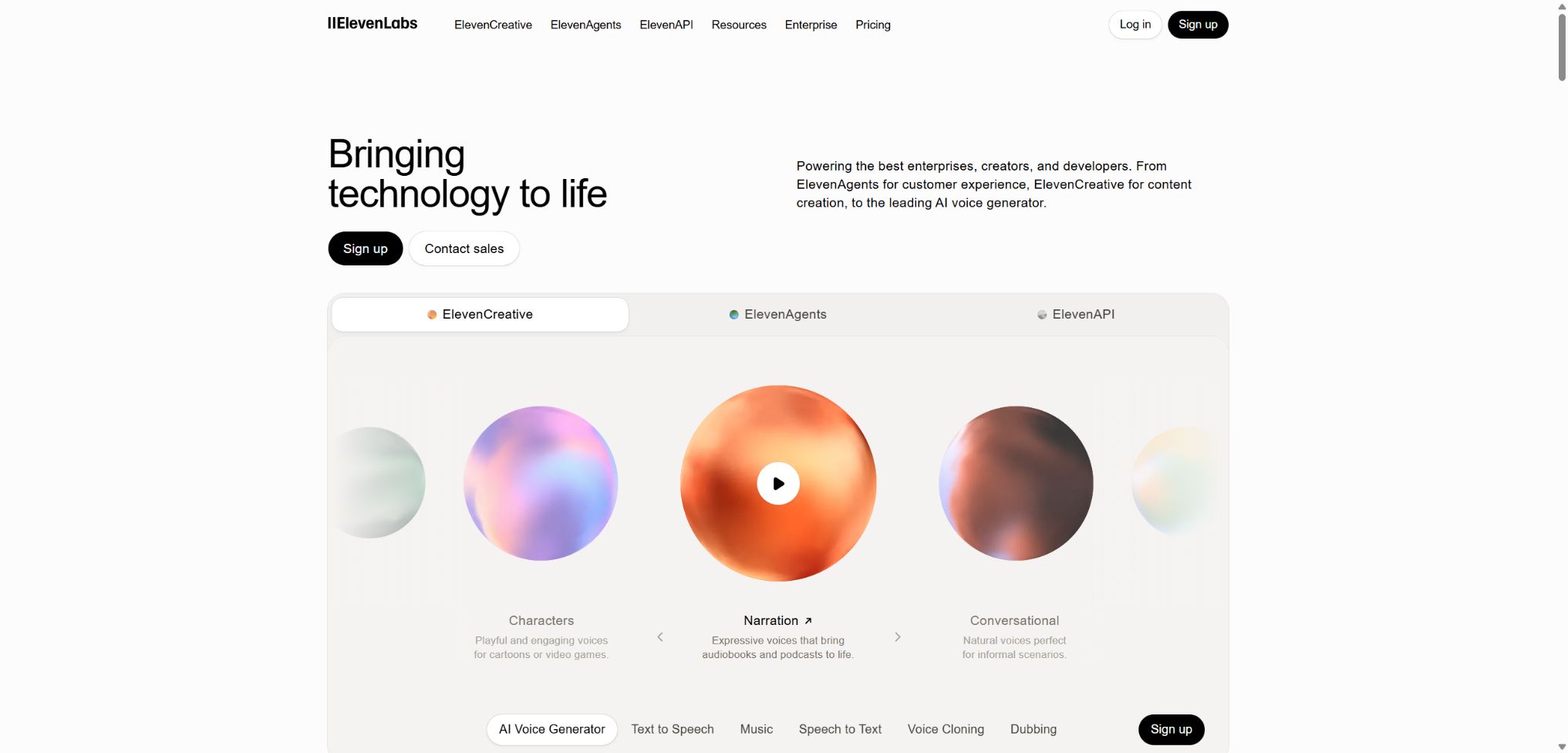
ElevenLabs is an AI audio platform that covers voice generation, transcription, dubbing, music, sound effects, and real-time voice agents. Users can carry out single-segment dubbing or the creation of longer content via the web interface, and they can also integrate voice capabilities into their applications through APIs.
The platform is currently divided into product lines such as ElevenCreative, ElevenAgents, and ElevenAPI. Creators can produce voiceovers, podcasts, audiobooks, and multilingual videos, while businesses and developers can build phone customer service systems, website voice assistants, and automated audio workflows.
Main functions of ElevenLabs
- Convert text into natural speech with tone, pauses, and emotion.
- Use Instant Voice Cloning to quickly replicate authorized voices;
- Train a highly consistent personal voice through Professional Voice Cloning;
- Use a Voice Changer to maintain the performance rhythm while changing the tone.
- Use Scribe for batch and real-time speech-to-text conversion;
- Translate videos and audio and create multilingual versions of them;
- Generate music, ambient sounds, sound effects, and other audio effects;
- Separate the human voice from background noise using Voice Isolator;
- Arrange long audio, music, and multi-track content in Studio;
- Create a real-time voice Agent that can connect to knowledge bases, telephones, and external tools.
Text-to-speech and model selection
After the user enters text and selects a voice and a model, audio files in formats such as MP3 or WAV can be generated. Eleven v3 places more emphasis on emotion and character portrayal, while Multilingual v2 is suitable for consistent, long-form multilingual content. The Flash and Turbo series are better suited for scenarios that require low latency and high throughput in terms of API usage.
The models differ in terms of the languages they support, the number of characters per message, latency, and pricing. Real-time conversations prioritize low latency, while longer narratives require consistency; dramatic performances, on the other hand, demand greater control over emotions.
Instant and professional voice cloning
Plans Starter and above offer Instant Voice Cloning, which is suitable for creating voices quickly using short audio samples. Plans Creator and above provide Professional Voice Cloning, which requires higher-quality, clean, and consistent recordings, as well as voice verification to confirm authorization.
Professional Voice Cloning does not allow the use of third-party voices to be disguised as one’s own voice for training purposes. Even when using instant cloning, explicit consent from the voice owner is required, and laws related to privacy, performance rights, and local regulations on deep synthesis must be obeyed.
Speech transcription and Scribe
Scribe can handle multilingual transcription, timestamping, speaker identification, and the recognition of certain non-verbal events; its real-time version is suitable for use in subtitles and dialogue agents. Accents, multiple speakers speaking at the same time, background music, and specialized terminology can still affect the accuracy of recognition.
Automatic voiceovers and Dubbing Studio
Automatic dubbing can identify the speaker, translate the script, and preserve the original voice characteristics as much as possible; Dubbing Studio, on the other hand, allows for manual adjustments to the text, timing, and segments. Free versions may include watermarks, while removing those watermarks or using the Studio mode requires more credits.
Translation with dubbing cannot replace review by a native speaker; brand names, jokes, numbers, and cultural expressions are prone to errors. Before publication, the subtitles, lip-sync timing, speakers, and volume should be checked in each language.
Music, sound effects, and Studio
Eleven Music and Sound Effects can generate music, ambient sounds, and sound effects based on text, while Studio is used for combining voices, music, and longer-duration projects. Plans starting at Starter include the right to use commercial music, but specific usage rules must still be followed in accordance with the platform’s terms and restrictions.
ElevenAgents
ElevenAgents combines speech recognition, language models, knowledge bases, tool calls, and text-to-speech functions to create a real-time dialogue system. These agents can be deployed on web pages, mobile applications, and phones, and it is possible to set up workflows, dynamic variables, retention periods, as well as decide whether recordings should be saved or not.
Comparison of core capabilities
| Ability | Enter | Output | Suitable scenarios |
|---|---|---|---|
| Text to Speech | Text and audio settings | Natural speech | Narration, courses, audiobooks |
| Voice Changer | Live recording | Retain the other timbre of the performance. | Characters, games, and films |
| Scribe | Audio or real-time voice | Text, timestamps, and speaker | Subtitles, meetings, and Agents |
| Dubbing | Video or audio | Multilingual dubbing and subtitles | Video localization |
| Music and SFX | Text description | Music or sound effects | Shorts, ads, and games |
| Agents | Real-time calls and knowledge base | Two-way voice conversation | Customer service, reservations, and sales |
ElevenLabs prices
ElevenCreative uses a shared credit pool; services such as text-to-speech, transcription, music, sound effects, and voiceovers all draw from the same monthly quota. The table below shows the current monthly pricing on the official website, with taxes and fees applied separately.
| Package | Monthly price | Monthly points | Primary interests |
|---|---|---|---|
| Free | $ | 10,000 | Basic voice, transcription, sound effects, music, 3 Studio projects – no commercial license required |
| Starter | 6 dollars | 30,000 | Commercial licenses, instant voice cloning, 20 Studio projects, Dubbing Studio |
| Creator | 22 dollars | 121,000 | Professional Voice Cloning, additional points; current discount for the first month is $11. |
| Pro | 99 dollars | 600,000 | API high-quality PCM and 192kbps audio |
| Scale | $ | 1,800,000 | 3 seats, team collaboration, and 3 professional voice clones |
| Business | 990 dollars | 6,000,000 | 10 seats, 10 professional voice clones, and lower latency TTS costs |
| Enterprise | Contact sales | Customization | DPA, SLA, HIPAA BAA, SSO, higher concurrency, and priority support |
An annual payment is equivalent to paying for 10 months: the Starter plan costs $5 per month, Creator is around $18.33 per month, Pro costs $82.50 per month, Scale is about $249.17 per month, and Business costs $825 per month. The promotional rate for the first month of the Creator plan does not apply to the monthly fees thereafter.
Common function integration consumption
| Functions | Official approximate consumption | Conversion units | Explanation |
|---|---|---|---|
| Text to speech | About 1 point | Per character | The Flash and Turbo APIs can drop as low as 0.5 points. |
| Speech to text | 330 points | per minute | In practice, the model and the request prevail. |
| Eleven Music | 900 points | per minute | The generation time has a direct impact on the cost. |
| Sound Effects | 200 points | Each time it is generated | Multiple variations will result in repeated charges. |
| Voice Changer and Isolator | 1,000 points | per minute | Calculated based on the length of the audio being processed |
| Automatic voiceover | 2,000 to 3,000 points | Per minute per language | Whether to remove watermarks affects consumption. |
| Dubbing Studio | 5,000 to 10,000 points | Per minute per language | Removing watermarks is more costly. |
Under the paid plan, unused points can be carried over for a maximum of two months; the upper limit for such carryover is twice the monthly quota, so the remaining balance can reach up to three times the monthly quota. With the free plan, no points are carried over, and unused paid points become invalid at the end of the billing period after the plan is downgraded or canceled.
ElevenLabs usage guide
Generate a natural Chinese narration.
- Organize the script and break long sentences into shorter ones that allow for pauses.
- Select a voice that supports Chinese and is suitable for the given scenario;
- Based on the models for expressiveness, stability, and latency selection;
- First, use a short segment to test names, numbers, and proper nouns;
- Adjust punctuation, speech pace, stability, and style settings;
- After confirmation, it is generated in segments while maintaining the same parameters;
- Download the audio, adjust its volume to be consistent across the entire video, and conduct manual review.
Create your own voice clone safely.
- Only use one’s own voice or a voice for which written permission has been obtained;
- Record samples in a quiet room, without reverb or background music;
- Maintain consistency in the microphone, distance, volume, and speaking style;
- Choose Instant or Professional Voice Cloning;
- Complete the voice verification and provide an accurate description of the purpose;
- Test similarity using sentences that have never appeared in the sample;
- When releasing to the public, disclose the identity of the synthesized voice in accordance with regulations.
Text-to-speech conversion via API
- Create a API Key with restricted usage within the account;
- Install the official Python or JavaScript SDK;
- Store the key in the server’s environment variables;
- Select the sound, model, output format, and voice settings;
- Split long texts into segments while maintaining consistency in context and parameters;
- Handle errors related to rate limiting, retries, timeouts, and insufficient credits;
- Record the request for generation, the source of authorization, and the actual cost.
Which users are it suitable for
- Video and podcast creators: producing narrations, opening sequences, and multilingual versions;
- Education and publishing: creating courses, audiobooks, and accessible audio content;
- Film, television, and games: designing character voices, sound effects, and temporary music;
- Marketing team: Creates advertisements, product demonstrations, and brand messaging;
- Localization team: translates subtitles and creates voiceovers for multiple speakers;
- Customer service and sales: Deploy real-time voice agents over phone or web;
- Developer: Embed TTS, STT, Agent, and audio generation via API.
The advantages of ElevenLabs
- The voice delivery is natural, and it offers various speed and quality options;
- Expanding from speech generation to transcription, voiceovers, music, and sound effects;
- Immediate and professional cloning meet different requirements in terms of quality and cost;
- Studio is suitable for creating long-form content and multi-track audio;
- ElevenAgents offers end-to-end real-time voice interaction;
- The API offers broad coverage and provides official SDKs in multiple languages;
- The enterprise supports SSO, BAA, data routing, and higher concurrency.
Usage restrictions and precautions
- Free does not include a commercial license, and cannot be used for commercial releases;
- All creation features share the same points, with voiceovers and longer audio files consuming more of them.
- A failed generation or unsatisfactory results do not necessarily guarantee a free redo;
- Cross-lingual dubbing may lead to misinterpretations of names, numbers, and cultural expressions;
- The quality of a cloned voice is influenced by the recording quality, accent, and style of the sample.
- Real-time agents are also affected by network, model, and telephone line delays.
- Music and sound effects still require checking for similarities and third-party rights risks;
- Synthetic voices cannot be used to impersonate others in order to carry out fraud or mislead people.
Copyright, Consent, and Privacy
Any voice cloning must be based on authorized sound recordings, and Professional Voice Cloning requires verification of the individual’s voice. Content related to politics, finance, healthcare, customer service, and public figures may be subject to stricter rules regarding disclosure and use.
Companies can apply for DPA, SLA, SSO, and HIPAA BAA, and they can also set options for recording and transcribing calls using certain agents. Before deployment, it is still necessary to determine the location where data will be processed, the sub-processors involved, the mechanisms for deleting data, and the rules regarding consent for call recording.
- Save records of sound licensing, actor contracts, and usage permissions;
- Public content should clearly indicate that the audio is AI-generated or synthesized;
- Do not upload training audio that contains unauthorized background figures;
- The voice agent states its identity and the recording details at the start of the call;
- API Keys are isolated by environment and project, and are rotated regularly.
API, GitHub, and open-source information
ElevenLabs offers official APIs that cover TTS, STT, voice services, voiceovers, Studio, music, sound effects, and Agents. It maintains SDKs for Python, JavaScript, Swift, Android, and Agents, as well as MCP and sample projects.
These SDKs are made available on GitHub under their respective open-source licenses, but ElevenLabs’ training models, audio platforms, and hosting services are not fully open source. Third-party SDKs with the same name may be outdated; it is preferable to use the projects provided by the official organization.
Frequently Asked Questions
Is ElevenLabs free?
A free trial is available; Free offers 10,000 points per month and includes basic voice functions, transcription, sound effects, and music. The free version does not provide a commercial license, and the points cannot be carried over.
What package is required for commercial use of ElevenLabs?
Plans starting with Starter include a commercial license, at a cost of $6 per month. The voices and music in the Voice Library are subject to the specific terms applicable to those resources and platforms.
Can ElevenLabs clone voices?
Yes, Starter supports instant voice cloning, while Creator and higher versions offer professional voice cloning. It is necessary to use one’s own voice or have explicit permission, along with completing the required verifications.
Does ElevenLabs support Chinese?
It supports Chinese speech generation as well as multi-language workflows. The choice of model, voice, and accent can affect the quality of the output; it is advisable to conduct short tests with names and numbers first.
Is ElevenLabs open source?
The core model and platform are not open-source products. Several official SDKs and examples are available on GitHub, which can be used to call the hosted APIs.
Tools similar to ElevenLabs



 Guigong Network Security Registration No. 45132202000164