






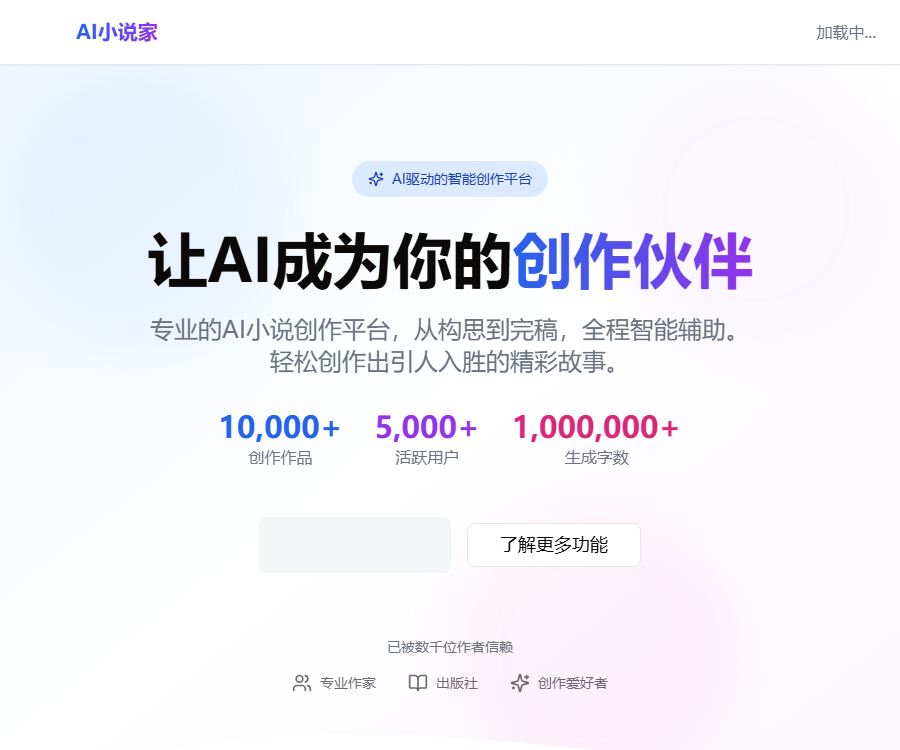
AI novelist
AI assists in writing novels, enabling the creation of long novels and short stories with multiple chapters, various characters, and different perspectives.
Tags:AI writing toolsWhat is an AI novelist?
AI Novelist is an online AI platform for creating novels, which handles everything from the conception of the story to the completion of its chapters.
It integrates the outline, characters, chapters, editing, versions, and export into the same project workflow.
Core functions
- AI intelligent ideation: Generates story settings, themes, worldviews, and plotlines.
- Character development: Refine appearance, personality, background, relationships, and the character’s growth trajectory.
- Chapter planning: Break down the overall outline into chapter objectives and key turning points.
- Content creation: Drafts are generated chapter by chapter, based on the outline and character profiles.
- Online editing: Modify paragraphs, formatting, word count, and content structure.
- Version management: Save historical versions for comparison or rollback.
- Quality check: Helps identify grammatical, logical, and narrative inconsistencies.
- Export in multiple formats: output files in Word, PDF, plain text, and others.
From concept to final draft
| Phase | Main tasks | Key points of manual inspection |
|---|---|---|
| Creativity | Enter the genre, theme, and core conflict. | Is there a clear differentiation? |
| Architecture | Create a worldview and overall outline. | Causality and climax location |
| Characters | Establish character backgrounds and relationships. | Consistency between motivation and behavior |
| Chapter | Plan the goals and turning points for each chapter. | Rhythm and information repetition |
| Generate | Draft the content chapter by chapter. | Facts, foreshadows, and character voices |
| Edit | Rewriting, polishing, and structural adjustment | Author’s style and original expression |
| Export | Generate delivery or release documents | Format, spelling errors, and platform rules |
Project management
The official guide classifies projects into seven states: pending start, basic information, outline, roles, chapters, content, and completed.
- The project overview shows the completion level of the outline, the number of characters, and the progress of the chapters.
- Saving to the cloud allows users to pause and then resume their creation.
- Versions can be created before making significant changes, allowing for a rollback in case of issues.
- Creation statistics help to view the word count, progress, and usage.
- Monthly budgets and reminders are used to control the costs associated with AI calls.
AI novel creation workflow
- Create a project and select the topic, language, target length, and audience.
- Enter the theme, world background, core conflict, and direction of the outcome.
- After the outline is generated, the chapter structure and key turning points are adjusted manually.
- Create the main characters, adding motivations, flaws, relationships, and arcs of growth.
- Plan the scene objectives, conflicts, information, and ending suspense chapter by chapter.
- Generate chapters in order to avoid context breaks caused by skipping chapters.
- Rewrite repeated expressions, vague paragraphs, and incorrect details in the editor.
- Check the consistency of power recovery, timeline, character titles, and settings.
- The file is exported and undergoes thorough manual proofreading before being published.
How to improve generation quality
- Provide the specific era, location, rules, and social context.
- Write down the desires, obstacles, and bottom lines for each main character.
- The chapter hints indicate the perspective, the objectives of the scene, and the events that must take place.
- Process only one section or chapter at a time to maintain control.
- Include the author’s own observations, language habits, and genuine materials in the draft.
- Create separate setting sheets, timelines, and character cards for longer works.
Prices of the free version and the paid version
As of August 30, 2026, the official pricing page lists three monthly subscription plans: free, professional, and enterprise.
| Plan | Price | Generate quota | Primary interests |
|---|---|---|---|
| Free version | 0 yuan, permanently free | 10 times per month | Basic template, editor, basic export, community support |
| Professional Edition | 29 yuan per month | 500 times per month | All templates, advanced editor, export in multiple formats, version and data analysis |
| Enterprise Edition | 99 yuan per month | The page indicates “infinite”. | Teams, white labeling, private deployment, API, dedicated manager, and SLA |
The price page states that annual payment saves 17%, which is equivalent to two extra months free, but the public page does not show the total cost of an annual payment.
Before making a purchase, refer to the account settlement page and confirm with the seller regarding the features of the enterprise version, usage levels, and scope of services.
Trial period and differences in team functions
- The homepage of the official website states that new users can enjoy a 30-day free trial.
- The demo page and the pricing page also show a 7-day free trial.
- Therefore, the specific number of trial days shall be as indicated in the account details after registration.
- The user guide states that it currently supports individual creation primarily, with team collaboration still under development.
- The pricing page also lists team collaboration as one of the benefits of the enterprise version.
- Before making a group purchase, it is necessary to ask the sales representative to confirm whether the feature is already available.
API, models, and open-source status
- The feature page indicates that the platform uses advanced models such as GPT-4.
- The privacy policy states that third-party AI services such as OpenAI are used.
- The enterprise version includes API access, but the complete development documentation is not available publicly.
- Private deployment is part of corporate solutions; it does not mean that users can download the model weights.
- No official open-source code repository that can be attributed to the product was found.
- Online services, enterprise APIs, and underlying third-party models should be understood separately.
Copyright and content rights
The terms of service state that the copyright to novels, characters, plotlines, and other content created by users through the platform belongs to those users.
The platform obtains the necessary licenses to provide storage, processing, and display services.
- A copyright statement does not imply that the created content necessarily possesses legal originality.
- Users must still ensure that their works do not infringe on others’ copyright, trademarks, or personal rights.
- There is a high risk associated with imitating the style of living authors and recreating existing characters.
- Before submitting, signing a contract, or entering a competition, check the requirements regarding disclosure of AI-assisted creation.
- Keeping drafts, prompts, edit history, and version records helps to illustrate the creative process.
Privacy and data processing
- The platform collects account information, content created, AI interactions, and usage statistics.
- The privacy policy states that the content created will not be used to train AI models or for any other commercial purposes.
- The platform makes use of third-party services such as OpenAI to provide generation capabilities.
- After the account is closed, personal information is usually deleted within 30 days.
- Important works should be exported regularly; one cannot rely solely on cloud backups.
- Do not submit unpublished contracts, true personal information, or materials that you do not have permission to handle.
Which users are it suitable for
- Web fiction authors: plan the structure of long-form works and assist with daily updates.
- Novel beginners: Start by learning about the world view, characters, and outline.
- Screenwriting and planning: Quickly develop drafts of the story, characters, and episodes.
- Editorial team: Checks for consistency in versions, structure, and plot.
- Students and enthusiasts: Practice different themes and narrative styles.
- Publishing house: For evaluating team or corporate proposals, manual peer review is still required.
Usage restrictions and precautions
- AI may generate formulaic plots, repetitive sentence structures, and vague descriptions.
- In longer works, it is common for there to be conflicts regarding character designs, timelines, and plot hints.
- So-called original creation does not mean that there are no copyright issues or that the content has been checked for plagiarism.
- The platform’s promotional data and user reviews should not be considered as guarantees of performance.
- Information on trials, team collaboration, and refunds is available on different pages.
- Thorough manual editing must be completed before official publication or commercial use.
Frequently Asked Questions
What creative tasks can AI novelists carry out?
It covers concept development, outlining, character creation, chapter generation, editing, version management, and export.
Is there a free version of the AI novel writer?
Yes, the official price page indicates that the permanent free version offers 10 AI-generated outputs per month.
How much is the professional version?
The current price is 29 yuan per month, with 500 generations per month; the specific benefits are indicated on the settlement page.
Does the Enterprise version include APIs?
The pricing page lists the API as a corporate benefit, but no development documentation is available; it is necessary to contact sales for confirmation.
How many days is the trial period for new users?
The official page shows both 7 days and 30 days; the actual duration shall be as indicated in the account registration details.
To whom does the copyright of the generated content belong?
The terms of service state that user-generated content belongs to the user, but the user is still responsible for verifying its originality and checking for any third-party rights.
Is the AI novel writer an open-source tool?
No verifiable official open-source repository was found; moreover, the fact that a product is used in a private corporate environment does not mean it is open source.
Tools similar to AI novelists




 Guigong Network Security Registration No. 45132202000164