






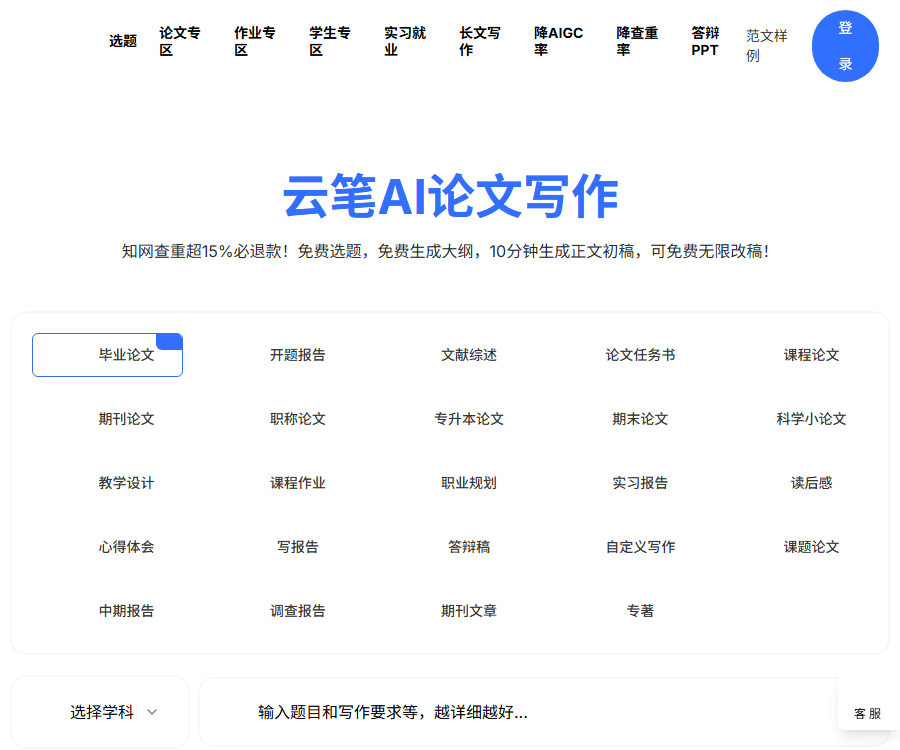
CloudPen AI—Paper generation
One-stop platform for generating high-quality original AI papers
Tags:AI writing toolsWhat is CloudPen AI?
Yunbi AI is an AI-assisted platform for drafting drafts of papers, course assignments, and longer texts.
It covers the selection of topics, outline, main text, references, revisions, and defense materials, but it cannot replace genuine research and the author’s responsibilities.
Core functions
| Functions | Main function | Suitable scenarios |
|---|---|---|
| Intelligent topic selection | Generate candidate questions and reasons based on the direction. | Determine the scope of the research |
| Free outline | Generate a secondary or tertiary paper structure | Create a writing framework |
| First draft of the full text | Generate content based on word count, educational background, and requirements. | Create a reference draft |
| Customize documents | Set the quantity, language, or enter your own literature. | Meet school standards |
| Feeding AI | Upload the specified materials to assist in generation. | Based on existing research materials |
| Unlimited revisions | Continue to adjust and rewrite the main text. | Language and structure optimization |
| Additional materials | Generate materials for project initiation, task assignments, defense, etc. | Complete paper workflow |
Supported writing types
- Graduation theses, theses for advancing from an associate to a bachelor’s degree, final exams papers, and course papers.
- Proposal, literature review, assignment sheet for the thesis, and interim report.
- Journal papers, papers for professional titles, research project papers, and journal articles.
- Teaching plans, course assignments, scientific essays, and investigation reports.
- Internship reports, career plans, book reviews, and personal reflections.
- Drafts for defenses, writing reports, creating custom long texts, and drafting monographs.
Intelligent topic selection
After the user enters a field of specialization or keywords, the system can generate candidate topics along with reasons for choosing them.
- The title should include a clear subject, question, scope, and research methods.
- First, check whether the chosen topic meets the requirements of the professional training.
- Confirm whether data, samples, literature, and research facilities are available.
- Avoid topics that are too broad, involve preset conclusions, or cannot be verified.
- Submit the AI suggestions to the supervisor for discussion before making a final decision.
- The degree of repetition and innovation of a research topic needs to be determined by searching real databases.
Outline generation and editing
The official website provides a free outline; it is possible to choose a hierarchical structure, as well as using a three-level outline or entering the details manually.
- Enter the full title, field of study, research subject, and writing requirements.
- Choose between levels such as associate degree, bachelor’s degree, graduate studies, doctoral degree, or MBA.
- Set the target word count, as well as the levels of the model and outline.
- After generating the outline, check whether the chapters are centered around the research question.
- Remove duplicate sections and add methods, data, discussion, and limitations.
- Adjust the title hierarchy and chapter proportions according to the school template.
- Generate the main text after confirming the outline to reduce overall rework.
How to choose a model
| Model | Official website instructions | Selection suggestions |
|---|---|---|
| Standard Model | The first draft of the foundational paper has been created. | Regular drafts and structure testing |
| 4.0 Genius Writer | Improve writing and real-time online connectivity | Tasks that require more information to be addressed |
| DeepSeek R1 Academic Enhanced Edition | Emphasize academic reasoning | Complex structures and draft arguments |
The model’s name and its ability to connect to the internet do not guarantee the accuracy of facts, references, or reasoning; important conclusions must be verified independently.
Custom references
The platform allows setting the number of documents, specifying whether English-language documents should be included, and also enables manual entry of one’s own documents.
- Intelligent literature is suitable for creating candidate lists, but it should not be considered truly reliable.
- For existing literature, the full title, authors, and publication details should be exported from the database.
- Check each item carefully: DOI, volume and issue number, page numbers, year, and the original text content.
- Verify that the arguments in the text are indeed supported by relevant literature.
- Follow the school’s requirements and use the GB/T 7714 format or another standard citation style.
- Literature that cannot be accessed in its original form should not be used as key evidence.
Uploading data and feeding it to AI
“Feed AI” allows the upload of specified materials, helping to make the draft more aligned with the existing project background and relevant information.
- Give priority to uploading papers, data, and project materials that you have the right to use.
- Remove names, student IDs, ID cards, account numbers, and any confidential customer information.
- Indicate which materials are used for facts and which are only used for stylistic reference.
- Let the system distinguish between original citations, rewrites, and the author’s own opinions.
- Uploading files does not guarantee that the model will read every page completely.
- Confidential projects and unpublished data must comply with the regulations set by the school or institution.
CloudPen AI Usage Guide
- Go to the paper writing page and first select the type of writing.
- Enter the topic, subject, educational background, word count, and specific requirements.
- Selection criteria: 4.0 or DeepSeek R1 Academic Enhanced Edition.
- A free outline is generated, which can then be modified according to the actual research plan.
- Set the number of documents and the language, or enter the already verified documents.
- Upload reference materials when necessary, and remove sensitive information.
- After confirming the prompt, a preliminary draft of the full text is generated, and the task waits to be completed.
- Check the facts, data, citations, methods, and logic chapter by chapter.
- Use the revision feature to improve the wording, but keep a record of the manual edits.
- Format it in accordance with the school’s guidelines, and use the designated system for self-checking.
- A thorough review is carried out by the author and supervisor before the final submission.
How to review the first draft of a paper
- Check whether the title, abstract, keywords, and the conclusions of each chapter are consistent.
- Check whether the research methods were actually implemented, rather than being fabricated by AI.
- Verify each sample, data point, formula, chart, and statistical conclusion individually.
- Open each reference to verify that it exists and supports the corresponding viewpoint.
- Remove vague, repetitive, evidence-free, and off-topic paragraphs.
- Complete one’s own experiments, research, interviews, and analysis processes.
- Explain the scope of AI use and human contributions in accordance with school rules.
Plagiarism check and AIGC detection
The official website claims that the plagiarism rate as measured by CNKI is around 10%; a refund is available if this rate exceeds 15%, and it is stated that a refund can also be given if the AIGC detection shows a rate above 25%.
- These figures are used for promotional purposes by the platform, and they do not guarantee the results of all papers.
- Different CNKI versions, subject databases, and testing times may yield different results.
- Refunds are usually subject to restrictions related to the verification system, submission deadlines, and document format.
- Before making a purchase, save the package details page, the refund policies, and any confirmation messages from customer service.
- Reducing word count cannot replace proper citation, nor can it conceal plagiarism or the use of someone else’s work to write one’s own.
- The school’s requirements regarding academic integrity take precedence over the platform’s marketing guidelines.
Free features and pricing
As of August 30, 2026, the official website offers free topic suggestions and outlines, as well as a first draft of at least 10,000 words for a fee of 38 yuan.
| Project | Official public price | Explanation |
|---|---|---|
| Intelligent topic selection | Free trial | The actual number is subject to the login page. |
| Paper outline | Free | Supports creation and editing. |
| First draft of a 10,000-word paper | Minimum 38 yuan | The specific model and rights shall be confirmed on the settlement page. |
| Longer length | Real-time pricing | Supports an option of up to 100,000 characters. |
| Additional services | Real-time pricing | Settle according to the currently selected items |
| API services | Not yet made public | No public prices or development documentation were found. |
“The minimum price of 38 yuan” does not mean that all orders with a length of 10,000 characters will cost this amount; the model and additional features may affect the price.
The final price, eligibility for refunds, and details of the services are subject to the settlement page, the order, and the current agreement.
Pre-payment checklist
- Verify the word count, model, outline hierarchy, and number of references.
- Check whether it includes an introduction, a task description, a defense PPT, or text-reduction services.
- View the handling methods for failed generations, duplicate content, and the number of revisions.
- Learn about the designated detection versions used for plagiarism checking and AIGC refund processing.
- Confirm the deadline, required documents, thresholds, and exclusion criteria for refund requests.
- First, use the free outline to determine whether the platform is suitable for the current project.
Academic standards and proper usage
The official website clearly states that the full text generated is merely a preliminary draft and cannot be used directly in graduation theses or published in journals.
- It is prohibited to submit AI-generated drafts under one’s own name or to present them as one’s own research results.
- The author must carry out genuine data collection, experiments, and validation.
- When citing others’ opinions, data, and charts, proper citation is required.
- When the school requires disclosure of the use of AI, it is necessary to accurately state the tools and the scope of their use.
- The specific rules set by supervisors, journals, and institutions take precedence over the platform’s functions.
- It is not allowed to use rewriting or AIGC reduction functions to circumvent academic integrity checks.
Privacy and data security
- The official website states that Alibaba Cloud’s encryption technology is used to protect the privacy of the papers.
- The agreement states that the user is responsible for the content they upload and use.
- Unpublished research, patents, and commercial data must be authorized before they can be uploaded.
- Do not upload account passwords, keys, ID cards, or complete student records.
- After downloading, the original manuscript, the AI-generated version, and the manually revised version should be stored properly.
- Promoting platform security does not mean it is suitable for storing all sensitive data.
API, SDK, and open-source status
- API: The user agreement mentions the API for the AI writing service.
- Development documentation: As of the time of verification, no public API documentation or application process was found.
- SDK: No verifiable official SDK has been found.
- GitHub: No official repository that corresponds specifically to CloudPen AI was found.
- Open source: The platform, models, and paper generation system do not come with an open-source license.
- When commercial access is required, contact the authorities to confirm the interfaces, billing terms, and data policies.
Which users are it suitable for
- Student: Organize the topic selection, outline, and structure of the initial draft of the paper.
- Graduate student: Organize the direction of the literature review and the logic of the chapters.
- Teacher: Create teaching plans, project outlines, and draft reports.
- Working professionals: Creating surveys, internships, career plans, and long-form reports.
- Beginners in essay writing: Learn about common structures and identify gaps in the material.
- All users must use AI as a helper, rather than a service that writes content for them.
Usage restrictions and precautions
- AI may fabricate literature, data, cases, methods, and research findings.
- Networked models may also misinterpret sources or cite outdated information.
- Automatic plagiarism reduction can alter the original meaning and undermine professional accuracy.
- The plagiarism rate and the AIGC rate can change depending on the detection system and its version.
- The generation speed is affected by the number of characters, the model, and the service load.
- The quality of a paper ultimately depends on genuine research and manual editing.
- Submitting an AI-generated draft directly may violate the rules of the school or journal.
Frequently Asked Questions
What can Yunbi AI do primarily?
It can assist with topic selection, outlining, drafting the paper, compiling references, revising the text, as well as preparing materials for the presentation and defense.
Is the outline for Yunbi AI available for free?
The official website currently offers free topic selection and free outlines; the actual number of times these services are available is indicated on the page after logging in.
How much does it cost to get a preliminary draft of an AI-related paper using Yunbi?
The official website states that a preliminary draft of 10,000 words can be generated for a minimum cost of 38 yuan; the specific model, word count, and additional features are indicated on the settlement page.
Does CloudPen AI support customizing references?
Supported: It is possible to set the number of documents and specify which ones should be in English; verified documents can also be entered manually.
Can content generated by CloudPen AI be used directly in a thesis?
No, the official website clearly states that the full text is only a preliminary draft and cannot be used directly in graduation theses or for publication.
Is a refund guaranteed if the similarity rate exceeds 15%?
It is necessary to comply with the platform’s current rules; before making a purchase, one should check the version to be used for testing, the deadline for submitting requests, the required materials, and any exclusion criteria.
Does CloudPen AI provide APIs or open-source code?
The agreement mentions API services, but no public documentation, official SDKs, code repositories, or open-source licenses are available.
Similar to CloudPen AI – a tool for generating papers




 Guigong Network Security Registration No. 45132202000164