






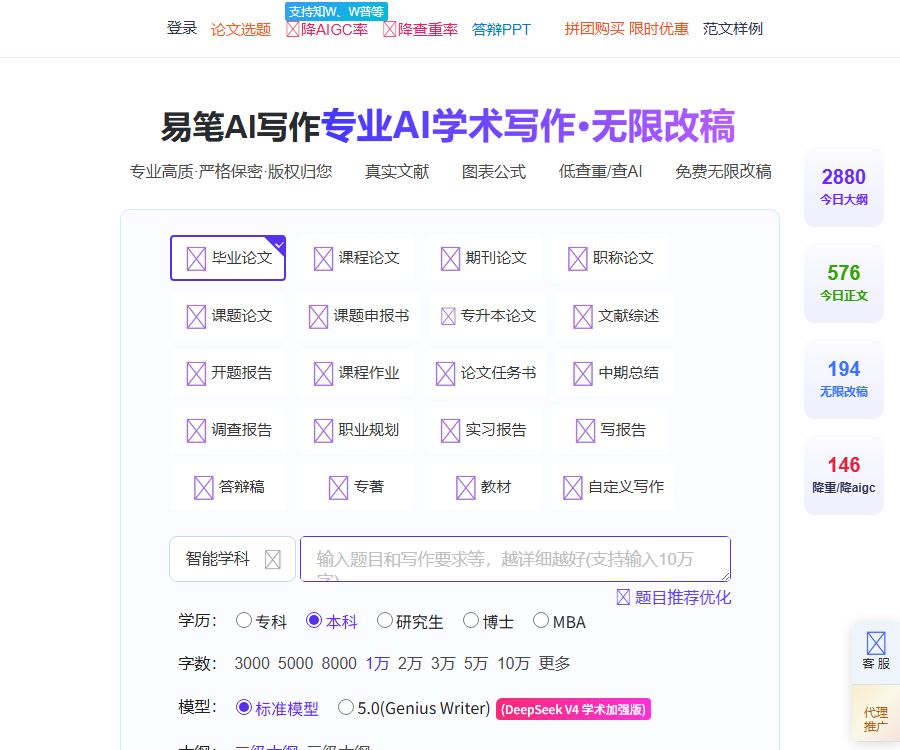
Yibi AI papers
It is possible to quickly generate various types of papers on different academic fields and topics, such as those in science and engineering or the humanities and social sciences. Users only need to provide the relevant requirements, such as the topic, keywords, and word count; the AI can then produce content that meets these specifications in a short time.
Tags:AI writing toolsWhat is an AI paper written with YiBi?
Yibi AI Paper is an online AI tool designed to assist with the drafting of long academic texts.
It covers topic selection, outline, main text, references, charts, revisions, and defense materials, but it cannot replace actual research.
It must be known before use.
The official website explicitly requires users to understand that the full text generated is merely a preliminary draft and is for reference only; it should not be used in graduation theses or published in any publications.
- Schools, journals, and research institutions may restrict or require the disclosure of AI usage.
- The core ideas, research methods, data, and conclusions must be developed and taken responsibility for by the author.
- AI-generated citations, references, charts, and code must be verified one by one.
- Reducing the plagiarism or AIGC rate does not mean that the requirements of academic integrity are met.
- Before submission, one must comply with the institution’s rules regarding citations, authorship, and AI disclosure.
Core functions
| Functions | Main function | Correct usage |
|---|---|---|
| Paper topic selection | Expanded research directions and topic proposals | Manual screening in combination with real-world problems |
| Level 3 outline | Generate chapter and argument structure | Reorganize by research method |
| First draft of the long text | Reference for generating chapter content | Verify section by section and rewrite. |
| References | Recommend and format literature | Return to the database to verify the original text. |
| Chart formula code | Auxiliary data and methods for expression | Re-calculate and verify using real data |
| Data feeding | Refer to the materials specified by the user. | Only upload materials for which you have permission to use. |
| Unlimited revisions | Iterative structures and languages | Retain records of manual modifications |
Supported writing types
- First drafts of graduation theses, degree theses, and course papers.
- References for journal articles, papers related to professional titles, and research project papers.
- Literature review, proposal letter, and project application form.
- Task assignment for the thesis, mid-term summary, and investigation report.
- Defense speech, career plan, internship report, and course assignments.
- Monographs, textbooks, and other custom long-form documents.
Different types have different specifications; before using a template, it is necessary to check the requirements set by the school, journal, or organization submitting the application.
Topic Selection and Three-Level Outline
The platform can generate a three-level outline for free, and it also allows users to enter and adjust custom outlines.
- First, clarify the research subject, questions, methods, data, and expected contributions.
- The scope of the topic should be controlled to avoid situations where there are only broad concepts without specific issues that can be studied.
- The outline should reflect the logic between the issues, evidence, analysis, and conclusions.
- In empirical research, the sample, variables, and analysis methods should be planned in advance.
- The generated structure can only serve as a draft; it should be revised after discussion with a supervisor or collaborator.
Long-text generation and revision
The platform supports the creation of long-form content and multiple revisions, making it suitable for developing a preliminary draft chapter by chapter.
- Before generating the full text, it is necessary to first confirm the objectives of each chapter and the sources of the materials.
- Long texts may contain repeated viewpoints, shifting terminology, and inconsistencies.
- When revising a text, priority should be given to addressing issues related to arguments and evidence, rather than simply replacing words with synonyms.
- For important versions, it is necessary to retain the date, the person who made the changes, and the reason for those changes.
- The so-called unlimited number of revisions and their scope are determined by the rights associated with the current order.
References
The official website claims to offer over forty authentic documents in both Chinese and English, giving priority to materials from the past three to five years.
- Verify each element individually: author, title, journal, year, volume and issue number, and page numbers.
- When a DOI is available, go to the publisher’s or database’s page to verify it.
- The quotations in the main text must be consistent with the views expressed in the original text; it is not sufficient to rely only on the titles for quoting.
- One cannot disguise second-hand accounts as primary sources that one has read oneself.
- The relevance of a document depends on the field of study; classic theories should not be discarded merely because they were developed in earlier years.
- The final format should be standardized in accordance with the requirements set by the school or journal.
Charts, formulas, and code
The platform allows the inclusion of data tables, charts, formulas, and code in the preliminary draft to help illustrate the research design.
- Numbers generated by AI cannot pretend to be real survey, experiment, or statistical results.
- Charts must indicate the actual source of the data, the methodology used, the units of measurement, and the sample size.
- The formula should have its symbol definitions, applicable conditions, and derivation process verified.
- The code needs to be run in a real environment, and the package version as well as the random seed should be checked.
- The charts should be consistent with the conclusions in the text; selective presentation is not allowed.
Feeding AI
Users can paste text or upload files in TXT, Word, and PDF formats; the current limit is 100,000 characters.
- It is suitable for providing research notes, guidelines, interview questionnaires, and authorized materials.
- Do not upload unpublicized personal information, confidential contracts, or the full contents of restricted databases.
- Scanning PDFs may result in recognition errors; it is advisable to check the extractable text first.
- Identify which materials serve as factual bases and which are merely references for the writing style.
- The output still needs to be verified against the original data; one cannot rely solely on the model’s summary.
Smart version and AI5.0 Advanced version
| Version | Differences disclosed on the official website | Selection suggestions |
|---|---|---|
| Smart version | Basic academic writing skills | First, test the outline and the regular draft. |
| AI5.0 Advanced Version | Enhances the model and supports real-time networking. | Consider it when more information is needed. |
AI5.0 is the name of a product category on the platform; it should not be used to infer the specific underlying models or to equate it to any particular version of a model.
Multilingual writing
- The official website officially supports languages such as Chinese, English, Korean, Japanese, and Russian.
- Multilingual drafts need to be proofread by someone who is proficient in that language.
- Professional terms, organization names, and regulatory names should be translated using authoritative versions.
- The English abstract should be consistent with the data and conclusions in the Chinese main text.
- Machine translation cannot replace professional language editing as required by the target journal.
EasyPen AI Paper Usage Guide
- First, read the regulations set by schools, journals, or projects regarding AI-assisted writing.
- Identify the genuine research question, the sources of materials, and the methods to be employed.
- Enter the topic and keywords to generate multiple possible directions for selection as a reference.
- Select a problem to study and manually modify the three-level outline.
- Upload materials for which you have permission to use, and indicate facts, opinions, and the sources of citation.
- Generate a draft chapter by chapter, rather than using the entire content as the final version.
- Verify facts, literature, data, formulas, and code section by section.
- Rewrite the argument using your own analysis and add actual research results.
- Complete citations, acknowledgments, AI disclosure, and format checks in accordance with the specifications.
- It is subjected to a final review by a supervisor, collaborator, or professional editor before submission.
Workflow for literature review
- Clarify the research question and the time period, language, and type of literature to be included.
- Develop reproducible search queries in official academic databases.
- Record the retrieval date, database, number of results, and filtering process.
- Read the full text and extract the research subject, methods, results, and limitations.
- Use AI to assist in categorizing topics, but do not let AI replace the actual reading of the text.
- The review is organized according to themes of controversy, methods, or theoretical frameworks, rather than by listing each article individually.
- Check each citation individually to identify the corresponding relationships, and then determine the research gaps.
Package price
As of August 30, 2026, the official website offers special prices for the sixth anniversary, with pricing based on the number of articles that can be generated.
| Package | Special price | Original page price | Validity period instructions |
|---|---|---|---|
| 1 article | 38 yuan | 119.8 yuan | The download is valid permanently. |
| Write 3 pieces arbitrarily. | 78 yuan | 199.9 yuan | Valid forever |
| Write 5 pieces arbitrarily. | 118 yuan | 389.9 yuan | Valid forever |
| Write 10 pieces arbitrarily. | 228 yuan | 599 yuan | Subject to the terms of the order. |
Discounts, the number of items included, and additional services may vary; the terms applicable are those stated on the payment page, in the order, and in the current agreement.
Additional services and refund conditions
- Data feeding is an optional service; no fee is charged if no files are uploaded.
- One-click plagiarism reduction and AIGC processing can be offered as separate additional services.
- According to the information on the official website, after selecting the option for reducing redundancy, the plagiarism rate is around 10 percent.
- The promise of a refund in cases where the similarity ratio exceeds 15% is subject to certain conditions.
- The refund promise of over 25% for AIGC also needs to comply with the rules.
- Before making a purchase, it is necessary to confirm the testing platform, report version, word count, and requirements for retesting.
- The test results vary, so a refund promise cannot be regarded as an assurance of academic compliance.
How to check for plagiarism and AIGC detection
- Test results may vary depending on the school, database, and time.
- A low repetition rate does not imply that the arguments are original, the data is accurate, or that the citations are proper.
- A low AIGC rate does not necessarily mean that the content was created entirely by the author.
- Deliberately avoiding detection may violate the rules of the school or the journal.
- The correct approach is to disclose the use of AI within permitted limits and keep records of the processes involved.
- No commitment can replace the final judgment of supervisors, journals, and institutions.
Privacy and data security
The official website states that encryption technology is used to protect the paper documents, and it allows users to delete their writing records.
- Identity cards, contact details, and interviewee information should still be removed before uploading.
- Unpublished data, patent materials, and trade secrets should be uploaded with caution.
- For multi-person projects, it is necessary to obtain the consent of the collaborators and the person in charge of the data first.
- After downloading the results, promptly delete any unnecessary cloud records.
- A platform security statement cannot replace an organization’s internal assessment of data compliance.
Supported platforms
- Web version: The main functions are currently accessible via a computer or mobile browser.
- Mobile version: The protocol broadly refers to mobile services; at present, no separate official download page has been found.
- Mini-programs: The agreement mentions the possibility of mini-program formats; the specific entry points shall be as indicated on the official website.
- Export: Once generated, the paper file can be downloaded; the specific format is determined by the project page.
- Account records: Task progress and writing history can be viewed in the current account.
API, SDK, and open-source status
- API: The user agreement refers, in a general sense, to the API for AI writing services.
- Public documentation: No public developer API documentation for Yibǐ AI papers has been found.
- SDK: No verifiable official public SDK has been found.
- GitHub: No official code repository that corresponds explicitly to the current product was found.
- Open source: Neither the platform nor the so-called AI5.0 model comes with an open source license.
- Enterprise integration: If batch processing or system integration is required, contact the platform to obtain authorization.
Which users are it suitable for
- Student: Helps with topic selection, outline creation, and initial draft ideas, but cannot write the paper or submit it on behalf of the student.
- Researchers: Organize materials, structure, and draft the text.
- Teacher: Develop a preliminary framework for the research topic, teaching materials, and instructional resources.
- Candidates applying for professional titles: Organize genuine achievements and relevant literature.
- Multilingual authors: Generate draft translations and have them reviewed by professionals.
- Author of lengthy texts: Plans the chapter structure of monographs and reports.
Usage restrictions and precautions
- AI may fabricate literature, data, cases, regulations, and experimental results.
- Real-time online access does not guarantee a reliable source or accurate citations.
- The detection rate advertised by the platform does not reflect the results of each individual test.
- Automatic rewriting should not be used to evade academic scrutiny or conceal ghostwriting.
- The copyright statement provided does not eliminate the risks related to third-party materials and factual rights.
- Different schools and journals have varying rules regarding the use of AI, so it is necessary to check these rules carefully.
- The author is responsible for the accuracy of the content submitted in the final version and for its academic integrity.
Frequently Asked Questions
What can the YiBi AI paper tool do?
It can assist with various aspects of academic writing, such as selecting topics, creating outlines, drafting texts, finding relevant literature, preparing charts and formulas, revising drafts, and preparing for defenses.
Can papers generated by YiBi AI be submitted directly?
No, the official website makes it clear that the full text generated is intended only as a preliminary draft for reference, and it cannot be used in graduation theses or published in any publications.
Are the references provided by YiBi AI reliable?
The official website states that the documents are authentic and verifiable, but users still need to check each item of the bibliographic information, the content of the original texts, and the correspondence between citations.
How much does YiBi AI charge for papers?
The current prices are 38 yuan per article, 78 yuan for 3 articles, 118 yuan for 5 articles, and 228 yuan for 10 articles; the price listed on the payment page applies.
Can YiBi AI ensure plagiarism checking and determine the AIGC ratio?
There is no absolute guarantee; the website’s refund promises are subject to conditions such as testing platforms, additional services, and order rules.
Which languages is YiBi AI capable of supporting?
The official website supports Chinese, English, Korean, Japanese, and Russian, among other languages; however, the final text still requires professional proofreading.
Does YiBi AI provide APIs or open-source code?
No current public API documentation, official SDK, code repository, or open-source license was found.
Tools similar to YiBi AI for writing papers




 Guigong Network Security Registration No. 45132202000164