






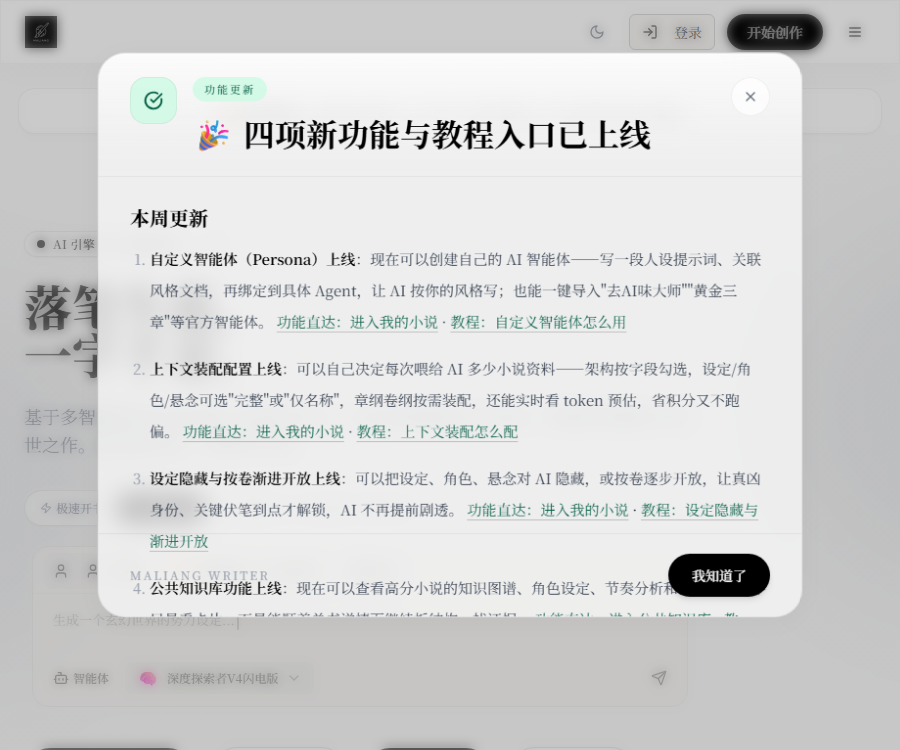
Ma Liang writes
Through the core technologies of \"multi-agent collaboration + AI-driven precise replication,\" an AI creation ecosystem that features \"low barriers to entry, coverage of all use cases, and high adaptability\" has been created.
Tags:AI writing toolsWhat is Ma Liang’s writing?
Ma Liang Writing is an AI creation platform with multiple intelligent agents, designed for Chinese web novels and long-form novels.
It assists in managing the complex contexts of long-running series through outlines, knowledge graphs, setting databases, and consistency checks.
Core functions
| Functions | Main function | Problems solved |
|---|---|---|
| Seven types of AI Agents | Task division, creation, verification, and refinement | It is difficult to manage long processes in a single conversation. |
| Level 3 outline | Organizational outline, volume outline, and chapter blueprint | The pace loses control in the middle and later stages. |
| Knowledge graph | Track characters, locations, items, and events | Setting up contradictions and inconsistencies in the narrative. |
| Worldview management | Management power, race, geography, and history | Complex settings are difficult to maintain. |
| Story canvas | Visualize the story outline, clues, and climax. | It’s difficult to organize multi-threaded narratives. |
| Multi-model switching | Select different large models for various agents. | It’s difficult to strike a balance between quality and cost. |
| Book deconstruction and imitation writing | Identify the rhythm, highlights, and narrative patterns. | Lack of structured learning methods |
Seven professional Agents
Ma Liang breaks down long-form writing tasks and assigns them to different AI agents, thereby simulating the way a editorial team works together.
| Agent | Responsibilities |
|---|---|
| Supervisor Agent | Assign tasks and coordinate other agents |
| Blueprint Agent | Create a chapter blueprint and plan the plot’s rhythm. |
| Generate Agent | Generate the main text of the chapter based on the outline and specifications. |
| Set Agent | Create characters, worlds, and power systems. |
| Consistency Agent | Check for conflicts between the plot and the settings. |
| Error correction Agent | Correct grammar and logic, and refine the content. |
| Structural Agent | Manage novels, volumes, and chapter structures |
Multiple agents can still lead to misjudgments; the key settings, character motivations, and plot choices should be decided ultimately by the author.
Level 3 outline and story canvas
The third-level outline manages the overall structure of the novel, the outline for each volume, and the chapter plan, thereby ensuring that the main text has clear boundaries.
- Outline: Determine the core themes, the main conflicts, the characters’ development, and the ending.
- Volume outline: Determine the goals, climax, turning points, and connections between different sections of each volume.
- Chapter blueprint: It outlines the scene’s objectives, conflicts, information, and the outcome of the chapter.
- Story Canvas: View the main plot, side plots, hints, and key moments side by side.
- Before generating the main text, check whether the current chapter contributes to the overall goal of the book.
Knowledge graphs and setting management
Knowledge graphs extract characters, locations, objects, and events, and retrieve relevant settings during generation.
- Roles: identity, goals, relationships, abilities, secrets, and stages of development.
- World: race, geography, politics, history, and social norms.
- Power system: levels, costs, limitations, and exceptions.
- Event: Time of occurrence, location, participants, and subsequent impacts.
- The settings entries support version tracking, and can be made available per volume or hidden from AI.
Knowledge graphs can reduce the likelihood of conflicts, but the author still needs to maintain the timeline and the final version of the settings.
Multiple models and integration overhead
The official website lists various models such as GPT, Claude, Gemini, DeepSeek, Qwen, GLM, and Grok.
- Outlines and categories can be used with lightweight models to save points.
- For the main text, it is possible to choose a model that is better at handling literary styles and long texts.
- Different Agents can specify models separately.
- Search, analysis, and consistency tools also consume additional points.
- The estimated word count on a page refers to the upper limit for plain text and does not equal the actual number of words.
Plot development, book analysis, and stylistic variations
Plot development
Multiple models can be called simultaneously to generate subsequent branches, with the selected option able to be regenerated or applied separately.
AI Book Analysis
It is possible to extract elements such as writing style, conflict, suspense, characters, satisfying moments, and chapter structure, in order to create a personal knowledge base.
Style clone
The distinctive editorial style features of the author’s own works can be extracted for use in continuing, expanding, and rewriting texts.
- Analyze only the texts for which you have rights or authorization.
- Learn the structural approach, without copying the original work’s unique expressions and character designs.
- Perform similarity checks on the generated content to prevent infringement and homogenization.
A tutorial on how to write using Ma Liang
- After registration, create a novel by filling in the genre, target audience, core settings, and desired length.
- First, establish an overall outline, and then break down the volume outlines and chapter frameworks.
- Enter roles, locations, power systems, and key events.
- Select appropriate models for the planning, main text, and verification agents respectively.
- Before generating a chapter, verify the current blueprint, clues, and character status.
- Use consistency checks to verify characters, timing, props, and world rules.
- Review the rhythm and chapter benchmark analysis, and remove duplicate and redundant content.
- Manually refine the content before exporting, and check the copyright requirements, platform rules, and AI labeling specifications.
Subscription price
The following are the subscription prices as displayed on the official website’s live page as of August 30, 2026.
| Package | Monthly payment | Annual payment | Daily points | Monthly permanent points | Style slot |
|---|---|---|---|---|---|
| Free trial | 0 yuan | 0 yuan | 300 | None | 1 |
| Basic creators | 69 yuan | 662 yuan | 590 | 8750 | 3 |
| Professional writers | 119 yuan | 1142 yuan | 875 | 17500 | 5 |
| Flagship version | 299 yuan | 2870 yuan | 2300 | 58333 | 8 |
For the annual subscription plan, the permanent points are credited in one lump sum of 105,000, 210,000, and 700,000 respectively; this annual plan includes a resurrection ticket as well.
The page indicates that during the beta testing phase, points are credited at 30% of their normal value; the end date of the campaign is determined by the information displayed on this page.
Price per word count package
The character count package can be purchased once and is valid indefinitely; it can be combined with subscription points.
| Word count package | Price | Integration | Estimated plain text of the page |
|---|---|---|---|
| Small | 19 yuan | 2500 | About 280,000 characters |
| Middle | 39 yuan | 6800 | About 720,000 characters |
| large | 99 yuan | 21000 | About 2.22 million characters |
| Extra large | 199 yuan | 46000 | About 4.91 million words |
The estimated figure does not take into account agent searches, analyses, and calls to other tools; as a result, the actual number of words generated is usually lower.
Prices, bonuses, discounts, and benefits may change; the terms applicable are those stated on the subscription page, the payment page, and the current agreement.
Open-source and private deployment
The official repository for Ma Liang’s writing tool is licensed under Apache License 2.0; the source code can be viewed, and it can be deployed using Docker.
| Project | Official solution |
|---|---|
| Frontend | Flutter and Flutter Quill |
| Backend | Spring Boot 3, Java 21, and LangChain4j |
| Database | MongoDB and Chroma vector database |
| Asynchronous tasks | RabbitMQ |
| Deployment method | Docker 24+ and Docker Compose v2+ |
| Resource recommendations | At least 1 GB of RAM is required; 2 GB or more is recommended. |
| Model integration | Provide your own keys for OpenAI, Gemini, Anthropic, etc. |
- The default administrator password must be changed immediately after the first deployment.
- In the production environment, it is necessary to replace the JWT keys, database passwords, and object storage configurations.
- The costs related to the model API, SMS services, storage, and servers are borne by the person who deploys them.
- Open-source licenses do not automatically grant rights to third-party models, novel texts, or brand materials.
Platform and API status
- Web: The official website offers a complete online creation platform.
- Windows: The Microsoft Store offers desktop applications.
- Self-deployment: The official repository provides Docker deployment options.
- Backend interface: Open-source projects include service interfaces within them.
- Commercial public API: As of the time of verification, no independent third parties were found to be using this product, nor were any public pricing details available.
The ability to deploy a backend on one’s own does not mean that the points available on the official website can be used with external APIs, nor does it imply that cloud data will be automatically migrated.
Which users are it suitable for
- Writers of long-form online novels: manage the overall structure, volume division, chapters, and the process of daily updates.
- Author of complex worldviews: maintains systems of power, races, factions, and history.
- Novelists of group portraits: track character relationships and the impact of events.
- Editing and Studio: Manage models, users, and costs through the backend system.
- Developer: Build a personal or team writing platform based on the open-source version.
Usage restrictions and copyright risks
- Consistency checks can only help identify issues; they cannot guarantee that a work does not plagiarize from other sources.
- For successful imitation and analysis of works, methods should be developed; protected specific expressions cannot be copied.
- Before importing third-party novels, it is necessary to confirm the permissions for copying, analyzing, and storing them.
- AI-generated content may be template-based, contain factual errors, or violate platform rules.
- The deployer is responsible for the security of keys, logs, user data, and content moderation.
Frequently Asked Questions
What kind of creative work is Ma Liang’s writing best suited for?
It is primarily aimed at Chinese web novels and long-form novels, and is especially suitable for projects that require managing complex settings and ongoing serialization.
What is the free writing quota for Ma Liang?
A bonus of 500 points is given upon registration; the free tier updates 300 points per day. For specific details, please refer to the account page.
How much does it cost to become a writing member of Ma Liang?
The monthly price for the basic version is 69 yuan, the professional version costs 119 yuan, and the flagship version is 299 yuan; the annual prices are 662 yuan, 1142 yuan, and 2870 yuan respectively.
Is the estimated word count based on points accurate?
It refers to the upper limit for plain-text output; Agent tasks such as retrieval, analysis, and verification also consume points, so the actual number of characters is usually less.
Can Ma Liang’s writing tool be deployed privately?
Yes, the official repository offers Docker solutions, but it is necessary to configure the database, model keys, as well as storage and security parameters manually.
Is Ma Liang Writing an open-source tool?
Yes, the official GitHub repository is licensed under the Apache License 2.0; it is still necessary to comply with the licensing terms of third-party services when using it.
Does Ma Liang Writing provide a public API?
The open-source backend includes internal interfaces; however, as of the time of verification, no separate commercial public API or publicly available pricing for calls was found.
Similar to the writing tools used by Ma Liang




 Guigong Network Security Registration No. 45132202000164