






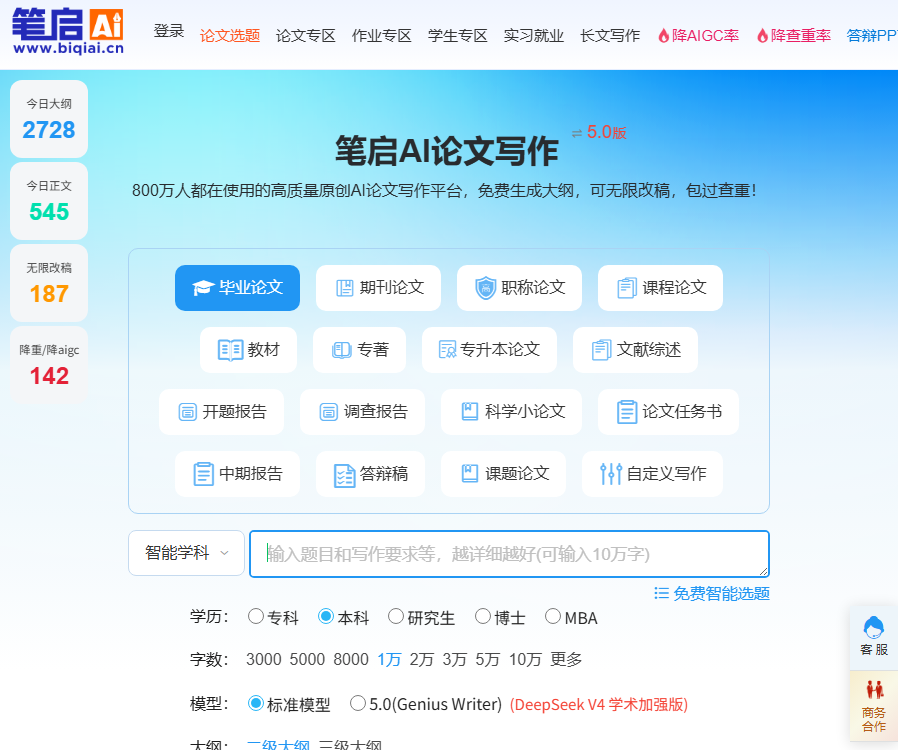
Penqi AI Paper Writing Platform
Penqi AI is capable of generating various types of papers, including graduation theses, course papers, assignment papers, journal articles, papers required for professional qualifications, papers for advancing from one academic level to another, literature reviews, and project proposal documents. It meets the needs of different academic scenarios and users.
Tags:AI writing toolsWhat is a paper on Penqi AI?
Penqi AI Papers is an online academic assistance platform designed for writing papers, textbooks, and monographs.
It can generate outlines and main text, and it also offers functions for feeding in materials, providing references, editing drafts, and supplying supplementary materials.
Core functions
| Functions | Main function | Key points of use |
|---|---|---|
| Free outline | Generate a secondary or tertiary chapter structure | First, verify the research questions and methods. |
| Custom outline | Add, delete, and modify chapters | The author controls the logic of the paper. |
| Data feeding | Upload documents to assist in generation | Materials that cannot be processed due to lack of authorization must not be uploaded. |
| Text generation | Create a preliminary draft of the essay based on the outline. | It cannot be submitted directly as a paper. |
| References | Match documents and insert annotations. | Verify the author, title, and source item by item. |
| Chart formula code | Add structured content to the paper | The data and calculations need to be reperformed independently. |
| Unlimited revisions | Repeatedly adjust chapters and wording. | Rewriting does not equate to academic quality assurance. |
Supported writing types
- Graduation thesis, course paper, thesis for upgrading from an associate to a bachelor’s degree.
- Journal articles, papers for professional titles, and research project papers.
- Textbooks, monographs, and literature reviews.
- Proposal, task assignment, and interim report.
- Investigation reports, scientific papers, and defense presentations.
- Custom academic materials such as application forms and project plans.
Different types of structures have varying citation standards and review requirements; it is not possible to simply replace the title and use the same template.
Outline and material feeding
Users can create second-level or third-level outlines, or they can enter the content manually and make adjustments to each chapter.
- Before generation, enter the level of education, field of study, desired word count, and language.
- You can paste text directly, or upload DOC, DOCX, PDF, TXT, and MD files.
- On the outline stage page, a maximum of 10 files can be uploaded; the restrictions in the additional submission area may vary.
- For each chapter, a summary, the sources used, and the requirements for writing can be filled in.
- After inserting figures, tables, code, or formulas, it is necessary to check the numbering and the references within the text.
The feeding function can only serve as a reference for the model; it does not prove that the model has understood all the documents accurately.
References and Citations
The official website claims that it can identify 40 references of genuine origin, giving priority to more recent research findings.
- Check the author, title, journal, year, volume and issue, page numbers, and identifier.
- Open the original text to verify that the cited content is consistent with the arguments in the paper.
- Distinguish between direct quotes, paraphrasing, and the author’s own analysis.
- Adhere to the required formats such as GB/T, APA, MLA, etc., as specified by the school or journal.
- One cannot cite entries that have not been read or for which the original text cannot be found.
“Authentic documents” do not guarantee that the citations are correct; the author remains responsible for any mismatches, misinterpretations, and formatting errors.
Multilingualism and disciplinary scope
The platform currently lists writing in Chinese, English, Japanese, Korean, Russian, and Thai.
- The disciplines include philosophy, economics, law, education, and history.
- It also covers fields such as science, engineering, agriculture, medicine, management, and the arts.
- Specialized terminology, statistical standards, and research ethics should be reviewed by experts in the respective field.
- Foreign language papers require final proofreading by a native speaker or a professional editor.
Guide to Using the Penqi AI Paper Writing Tool
- First, read the regulations set by the school, supervisor, or journal regarding AI-assisted writing.
- Identify the research questions, methods, scope of data, and the key arguments that can be verified.
- Select the type of writing, subject area, level of education, word count, language, and outline level.
- Upload the authorized reference materials, create an outline, and then revise each chapter one by one.
- Confirm the logic of the outline before generating the main text; do not accept all the content at once.
- Add one’s own data, experiments, interviews, arguments, and critical analyses section by section.
- Check each literature source, number, formula, chart, and factual statement individually.
- Disclose the use of AI in accordance with academic standards and make the necessary revisions as required by the supervisor.
Price and number of articles package
The following are the prices of the time-limited packages as displayed on the official website on August 30, 2026.
| Package | Special price | Original page price | Validity period |
|---|---|---|---|
| 1 article | 38 yuan | 119.8 yuan | The download is valid permanently. |
| Write 3 pieces arbitrarily. | 78 yuan | 199.9 yuan | Valid forever |
| Write 5 pieces arbitrarily. | 118 yuan | 389.9 yuan | Valid forever |
| Write 10 pieces arbitrarily. | 228 yuan | 599 yuan | Valid forever |
| Bulk purchasing | Contact Business | As required | Subject to the contract. |
The actual order amount may also be affected by the length of the text, the type of writing, editing services, plagiarism reduction, and other additional services.
Prices, discounts, and service commitments may change; the terms that apply are those stated on the order confirmation page, the payment page, and the current agreement.
How to check refunds and service guarantees
The official website currently states that if the specific plagiarism rate and AIGC rate do not meet the required standards, a free rewrite or refund can be requested.
- First, confirm whether it is necessary to purchase the specified one-click plagiarism reduction add-on service.
- Verify the applicable testing platform, version, thresholds, and report format.
- Save the order page, scope of services, payment records, and inspection reports.
- “The refund guarantee” is part of the technical service terms and does not guarantee that the academic review will be successful.
- The testing systems and rules of different schools may vary from those specified in the platform guidelines.
No such statement as “guaranteed passing” can replace the supervisor’s evaluation, original research, and the university’s academic standards.
Supporting materials
- Literature review: It outlines the research context and existing controversies; the original texts still need to be read.
- Proposal: Helps to develop a preliminary version of the problems, objectives, methods, and plan.
- Chinese-English abstract: After generating the bilingual abstract, it is necessary to verify the terminology and research findings.
- Thank-you template: Provides a structural reference; it should be expressed in genuine terms by the author.
- Defense script: Organizes the key points of the presentation; it does not replace a genuine understanding of the research.
- Task assignments and interim reports: must be in line with the actual progress of the research.
API and open-source status
- Platform: It has been confirmed that web versions and WeChat mini-programs will be available.
- API: As of the time of verification, no public developer API documentation was found.
- SDK: No verifiable official SDK has been found.
- Open source: No complete source code for the platform, no generation engine, and no model weights were found.
Using a public model name does not mean that the platform’s model or the paper generation system is open-source.
Academic integrity and privacy
- The official website makes it clear that the full text produced is merely a preliminary draft and cannot be used directly as a graduation thesis or a manuscript for submission.
- The scope of use of AI and the manner in which it is disclosed must comply with the regulations set by the school, supervisors, and journals.
- It is forbidden to fabricate data, experiments, interviews, citations, or author contributions.
- Before uploading unpublished research, personal information, or confidential materials, ensure that you have the necessary authorization.
- Even if the platform offers encryption and deletion features, sensitive materials should first be anonymized.
- Ultimately, the author must understand and be able to explain each conclusion in the paper.
Frequently Asked Questions
Can the Penqi AI paper be used for free?
An outline can be generated for free; however, the creation of the full text along with certain additional services requires payment per order.
What types of papers does it support?
It supports graduation, courses, journals, professional titles, upgrades from junior to senior levels, textbooks, monographs, reviews, and proposal drafts.
Can I upload my own reference materials?
Yes, it supports pasting text as well as uploading common document formats such as DOC, DOCX, PDF, TXT, and MD.
Must references be accurate?
The platform claims to provide access to genuine documents, but users still need to verify each one individually with regard to the original text, its source, and the citation details.
How much is the Penqi AI paper package?
The current pricing on this page is 38 yuan per article, 78 yuan for 3 articles, 118 yuan for 5 articles, and 228 yuan for 10 articles.
Can the generated paper be submitted directly?
No, the official website clearly states that it is only a preliminary draft for reference, and its use in degree theses or journal submissions is strictly prohibited.
Does Penqi AI provide APIs or open-source code for its papers?
As of the time of verification, no public APIs, official SDKs, complete source code, or open model weights were found.
Tools similar to the Penqi AI paper writing platform




 Guigong Network Security Registration No. 45132202000164