






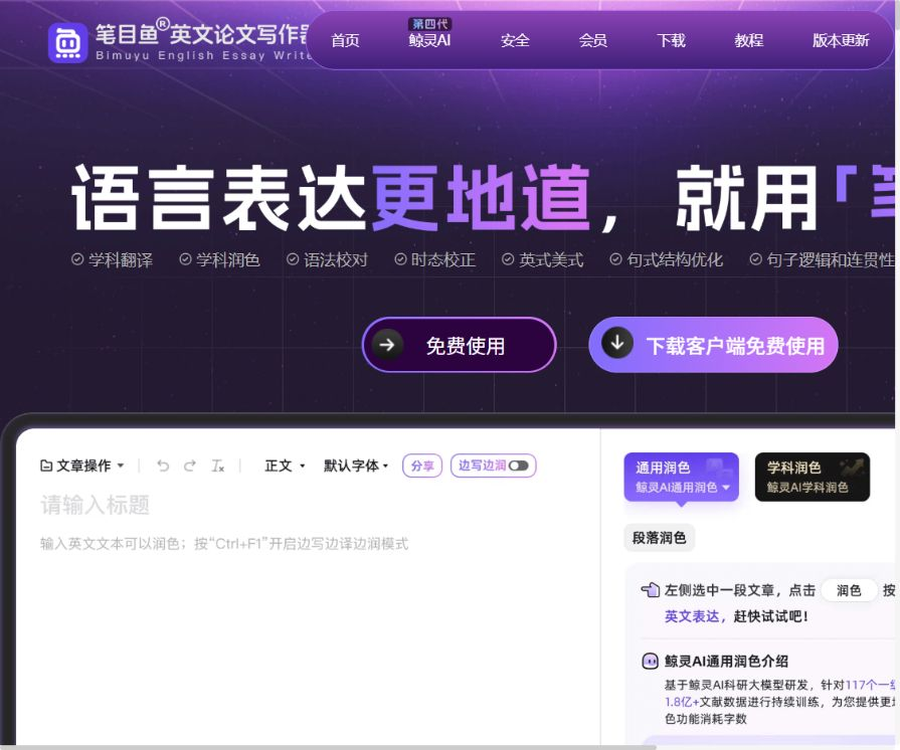
Penfish
A cloud-based tool for writing English papers that combines functions such as subject-specific translation, text polishing, rewriting, provision of high-scoring SCI sentences, and management of references and databases.
Tags:AI writing toolsWhat is a penfish?
Penmu Fish is an English paper writing and literature support platform developed by See Whale Technology (Nanjing) Co., Ltd.
It is based on the WhaleMind AI research model, and covers a range of processes from translation and text refinement to citation management, plagiarism checking, and journal formatting.
The main functions of the penfish
- Subject translation, full-text translation, and multi-engine switching.
- General polishing, subject-specific refinement, and grammar checking.
- A three-column workflow for writing, translating, and refining simultaneously.
- Search for sentences with high SCI scores and sentence patterns in papers.
- Recommendations for literature, reading of materials, and collection of personal corpora.
- Rewriting, abbreviating, expanding, and English AIGC reduction.
- Import of references, creation of citations, and generation of reference lists.
- Similarity detection, AIGC detection, and journal formatting.
- AI review, intelligent outline generation, summarization, and continuation writing capabilities.
Disciplinary translation
The platform offers both a general translation engine and Jingling AI for subject-specific translations, capable of handling paragraphs or entire texts.
The official website states that the corpus includes over 180 million documents, 117 primary disciplines, and more than 280,000 specialized terms.
- The general-purpose engines include Tencent, Youdao, Google, and DeepL.
- The discipline engine emphasizes specialized terminology and paper writing.
- It supports selecting a segment for translation and replacing the original text.
- A full translation ensures that the translated text corresponds to the original paragraph.
- The revised paragraph can be translated separately.
The volume of data keeps changing, and although a range of terms is available, misinterpretations can still occur in each specific area.
Polishing of English papers
General polishing
The general polishing function works only on English paragraphs; it allows for adjustments to grammar, tense, British vs. American usage, sentence structure, and coherence.
The official tutorial recommends selecting around 30 to 230 English words at a time to achieve more stable processing results.
Subject polishing
The subject-specific editing service supports both paragraphs and the entire text; the original Chinese manuscript is first translated before being converted into academic English.
The refined version can be replaced, copied, saved, translated, or further processed; the final version still requires confirmation by the author.
How to count the number of characters
The word count for polishing is calculated based on the number of English words; for the first processing, the same number of words as those in the selected text is deducted.
When continuing to generate, the character count is not deducted again; the entire text is processed anew, with deductions applied only to newly added or modified paragraphs.
Writing while translating and writing while refining
The user enters text in Chinese or English on the left, views the translation in the middle, and then refines it on the right.
This layout is suitable for refining the text section by section, but it is not recommended to submit the entire paper at once after making all changes.
- First, clearly state the research question, methods, and actual results.
- Enter the text in segments and check the translation terms.
- Choose English expressions that match the style of the journal.
- Use the polishing feature to adjust sentence structure and coherence.
- Keep the original draft along with records of each significant modification.
- Finally, the author unified the terminology and tense throughout the text.
High-SCI-score sentences and modular sentence patterns
The official website states that the platform offers over 3 billion high-scoring SCI example sentences, covering fields such as science and engineering, medicine, and humanities and social sciences.
Users can filter by paper type, chapter, database, impact factor, year, and other criteria.
- Smart search allows you to enter sentences in both Chinese and English.
- Precise search is more suitable for English keywords.
- The modular sentence structure covers abstract, background, methods, results, and discussion.
- Personal corpora can store common expressions and example sentences from their sources.
- Little Green Whale users can synchronize their collected English language materials.
Example sentences are used for learning how to express ideas; they should not be copied in their entirety, nor should they replace one’s own judgment regarding the context and copyright of the original text.
Recommendations and reading of literature
The Penfish tool can recommend relevant literature based on a topic or the key points of a paragraph, and it also provides facilities for reading materials and collecting textual data.
Data support the import of PDFs, images, text, and links; it is also possible to synchronize documents from Xiao Lü Jing.
- Determine whether the recommended literature is truly relevant based on the research question.
- Open the original paper to check the title, authors, and year.
- Distinguish between summary viewpoints, research findings, and the author’s hypotheses.
- Check whether the literature has been withdrawn, corrected, or falls outside the scope of the research.
- One cannot rely on summaries generated by AI as a substitute for systematic searching.
Reference management
The platform allows the import of bibliographies, as well as the insertion of citations and reference lists within articles.
- It supports EndNote, BibTeX, RIS, and PubMed formats.
- Literature catalogs can be imported from the minke whale.
- Records can also be uploaded locally or entered manually.
- The catalog includes fields such as author, year, title, journal, and DOI.
- The citation style for common journals can be switched.
- After the connection is canceled, it will be converted to plain text and the article will be saved separately.
Any automated cataloging may contain missing fields or identification errors; it is necessary to verify each item against the original text of the paper before submission.
Rewriting, reducing redundancy, and minimizing AIGC influence
The rewriting tool supports synonym substitution, sentence structure adjustment, abbreviation and expansion, and it also allows users to view the details of the changes made.
English language models based on AIGC are used to adjust the characteristics of the generated text, but the detection results cannot indicate who created the content.
- After rewriting, check whether the meaning of the research has changed.
- Professional terms and statistical findings must not be replaced arbitrarily.
- Reducing similarity does not mean that there is no plagiarism.
- Reducing AI features does not equate to compliance with school or journal rules.
- All borrowed content still needs to be cited properly.
Plagiarism check and AIGC detection
According to the official tutorial, Similarity Check is based on iThenticate technology and is used to generate reports on the similarity of papers.
The detection supports Word and PDF documents; each file must not exceed 50MB, and annotations must be removed along with any encryption.
- The list of references should be placed at the end of the text and properly cited.
- The manuscript for testing should be consistent with the future version to be submitted.
- Different versions and exclusion rules can affect similarity.
- The report is usually returned within 30 minutes; in case of any issues, you can contact customer service.
- The report records can be retained, or the user can download them and then delete them.
Similarity and the proportion of AIGC are merely technical indicators; they cannot be equated directly with academic misconduct or the quality of a paper.
Journal format formatting
The platform offers thousands of journal templates in accordance with the submission guidelines, which can be used to adjust the format and layout of articles.
Even after automatic formatting, it is still necessary to check the journal’s latest guidelines, chart dimensions, supplementary materials, and the requirements of the submission system.
- Verify that the template corresponds to the correct journal and article type.
- Check the heading hierarchy, abstract, and keyword format.
- Check the chart caption, units, and resolution.
- Check the reference style against the in-text citations.
- Download the latest author guidelines once more before submitting.
AI review, summary, and outline
AI review can summarize manuscripts, identify potential issues, and assist in understanding review comments as well as in drafting response letters.
Smart outlines, literature reviews, and continuation writing help to organize topics, compare studies, and identify gaps.
- AI-based evaluation cannot replace genuine peer review.
- The review must specify the search databases, search queries, and selection criteria.
- Research gaps need to be supported by evidence from primary literature.
- When responding to reviewers, one should not make promises regarding experiments that have not yet been completed.
- New arguments and evidence must be traceable and the author must be responsible for them.
Guide to using the penfish
- Register by scanning the WeChat code and filling in the required information.
- Choose the web version or install a client suitable for your system.
- Create a new article, or import drafts in DOCX and TXT format.
- Create data folders based on the research topics.
- Import literature, bibliographies, and authorized local materials.
- Complete the actual research first, and then proceed with the translation.
- Refine each section using subject-specific techniques and verify the terminology.
- Use example sentences and modular sentence patterns to check expression habits.
- Insert citations and verify the metadata for each reference.
- Adjust the format according to the template of the target journal.
- Run a plagiarism check or AIGC detection and interpret the report.
- Save a version; the author and collaborators carry out the final review.
File and capacity limits
- Currently, the article upload feature supports docx and txt formats.
- For regular users, the maximum length for a single article is 120,000 characters.
- Reading materials can be imported in PDF, image, TXT, and link formats.
- The hierarchy of the data folders should not exceed three levels.
- Files for plagiarism checking can be in DOC, DOCX, or PDF format, with a maximum size of 50MB.
- The article can be exported as Word or TXT.
Free version and membership prices
The official website offers regular accounts and a free trial; the paid options include membership plans, word count packages, character count packages, and testing services.
As of August 30, 2026, the public member page did not provide any figures for anonymous subscription plans that could be verified reliably.
- After logging in, go to the member page to view your current plan and its validity period.
- Character packs and byte packs may correspond to different functional requirements.
- Plagiarism checking and AIGC detection may be charged separately.
- Event, promotional, and channel prices may change.
- The amount shown on the order confirmation page shall prevail prior to payment.
Since it is not possible at the moment to verify the total cost of all packages, no price comparison table that could lead to misunderstandings will be included in the text.
Data after the membership expires
Once the membership expires, the account will be downgraded to a regular account, but the existing data will not be deleted immediately.
The 10GB exclusive cloud storage space for members will be taken away, with the account retaining a permanent capacity of 500MB.
- The data that exceeds the normal capacity can still be viewed and deleted.
- Uploading new data is not possible once the capacity is exceeded.
- Important papers and reports should be backed up before the membership expires.
- The membership validity period and payment history can be viewed in the personal center.
Refund rules
According to the official tutorial, no refunds will be issued if a feature does not meet expectations or lacks features that users were hoping for.
If a service failure or data loss occurs due to the platform’s negligence, a refund request can be submitted.
- After the refund, the account will be downgraded to a regular account.
- The amount is calculated based on the duration for which the platform is unable to provide services.
- The complimentary credit is not included in the refund.
- The refund will not exceed the actual amount paid.
- Before making a purchase, it is advisable to fully experience the functions of a regular account.
Privacy and manuscript security
Manuscripts, unpublished data, review comments, and information on collaborators can all be highly sensitive.
The official website provides information on ISO 27001 and ISO 27701 certifications, but users still need to ensure proper management of their own data.
- Delete the ID number, contact information, and unrelated metadata before uploading.
- For unpublished research, it is necessary to adhere to the cloud service rules set by the institution and the funding providers.
- Manuscripts subject to confidentiality agreements must first obtain authorization.
- Regularly export local backups and maintain version records.
- Manuscripts and test reports that are no longer needed should be deleted promptly.
Which users are it suitable for
- Researchers in need of academic translation between Chinese and English.
- Students, teachers, and research teams preparing SCI papers.
- Authors who need to organize their corpus and references.
- Users who need English polishing and journal formatting checks.
- For authors who wish to better understand the review comments.
- Users who use the Little Green Whale to read literature.
API and open-source status
As of the time of verification, the official website did not provide developer API documentation available to the public.
No official open-source repository for the complete Penyu product was found either, so it cannot be classified as an open-source tool.
Usage restrictions and precautions
- AI translation and editing may alter the scientific meaning.
- Literature recommendations and automatic bibliographies must be checked against the original texts.
- AIGC detection cannot prove the actual identity of the author.
- A low similarity score does not mean that there is no academic misconduct.
- Journal templates may be outdated compared to the latest submission guidelines.
- Anonymous pages do not disclose the complete package prices that can be verified.
- After the membership expires, the storage capacity of the cloud storage will drop from 10GB to 500MB.
- The platform is not open-source, nor does it provide public developer APIs.
Frequently Asked Questions
What is the main use of the penfish?
It is used for translating and polishing English papers, searching for linguistic data, reading literature, managing citations, checking for plagiarism, and formatting journals.
Can the Penfish be used for free?
The official website offers regular accounts and free features; membership, character packages, and certain testing services require payment.
How much is the membership for Penmu Fish?
The public page does not display the current amount that can be verified accurately; the price should be taken as shown on the order confirmation page after logging in.
Which file formats are supported by the Penfish?
The article can be in docx or txt format; the reading materials can be in PDF, image, txt formats or as links, and plagiarism checking is also supported for doc and PDF files.
Are the reference sources recommended for the Penfish reliable?
It cannot be assumed to be reliable; it is necessary to consult the original paper in order to verify the author, title, year, DOI, and to ensure that the arguments presented are consistent.
Will the data be deleted once the membership expires?
It will not be deleted immediately; however, the storage space on the cloud drive will be reduced from 10GB to 500MB. The excess amount can be viewed and deleted, but no further uploads are possible.
Does Penmu Fish provide APIs or open-source code?
As of the time of verification, no public developer API was found, nor was there any official open-source code repository for the complete product.
Tools similar to those of the penfish




 Guigong Network Security Registration No. 45132202000164