






Cowriter
Cowriter – makes AI-assisted writing more efficient and simpler.
Tags:AI writing toolsCurrent status of Cowriter
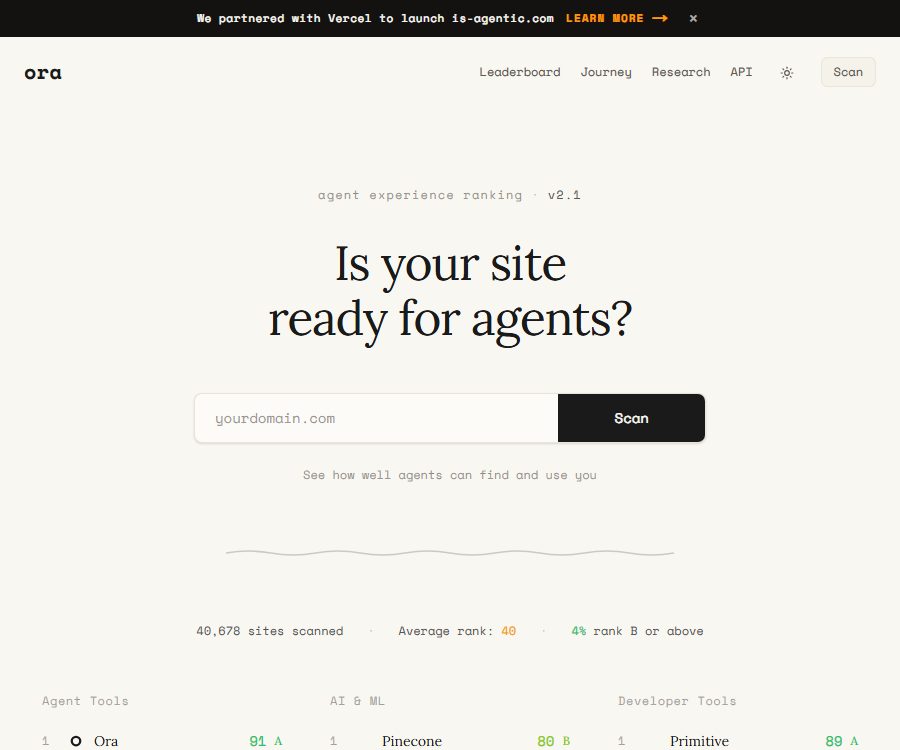
Cowriter was originally an AI writing tool, but its original website now redirects to Ora, and its domain name has been changed to that of a platform for testing the readiness of AI agents.
The current page lacks a Cowriter editor, a login interface, writing functions, as well as any information regarding subscription or migration; therefore, it can no longer be recommended as an active online writing tool.
It is necessary to distinguish between the name and the product’s identity.
- Cowriter: The writing product to which this record originally corresponded is no longer accessible on the original site.
- Ora: An independent product currently in use for domain registration, designed to determine whether a website is easy for AI agents to discover, understand, access, and use.
- CoWriter AI: There are currently other academic writing products that use similar names but different domain names; therefore, it cannot be considered a version derived from the original Cowriter.
- In the absence of any instructions regarding account migration or brand inheritance, the service terms, prices, or features of the new Ora should not be applied to the old Cowriter.
Can the original Cowriter still be used?
At the moment, it is not possible to create documents, generate text, or restore old accounts using the original entry point; there are also no downloadable pages, mobile applications, or browser extensions that can be used for this purpose. Old users who need access to historical content should first check locally saved files, email records, and notifications from their original account.
Do not enter the old Cowriter password on the Ora page after the redirection, as the purpose of the products and the account system on the new site have not been confirmed to be identical to those of the original service.
What is Ora at the moment?
Ora is operated by Era Labs and serves as a platform for assessing an agent’s experience and readiness when working on a website. It is intended for developers, product teams, and website operators, and it is not a general-purpose writing editor.
Website scanning and scoring
- After the domain name is entered, Ora checks various elements such as documents, structured information, public APIs, proxy protocols, the registry, as well as authentication and payment mechanisms.
- The results are presented on a scale of 0 to 100, along with letter grades and a checklist of hierarchical criteria; the main dimensions include discovery, accessibility, availability, and payment.
- The items that failed will indicate the directions for correction; developers can modify the site and then scan it again to observe any changes in the scores and inspection items.
Real agent journey
- Deep Journey enables real AI agents to access websites for specific tasks, and it records the pages viewed, tool calls, successful steps, as well as any obstacles encountered.
- Public tasks can be executed using predefined intents, while custom tasks require a partner’s key.
- Proxy tracing is useful for identifying issues with forms, logins, documents, or API integrations, but a single execution cannot represent all models and user environments.
Rankings and product discovery
- The public ranking shows the readiness level of the agents for the products that have been scanned, by industry, which makes it easy to compare the scores and identify the weaknesses of similar websites.
- The product discovery interface can return products with a high level of readiness as determined by the task, and the catalog also includes MCPs, APIs, skills, and payable invocation capabilities.
- The ranking reflects Ora’s methods and the current scan results; it does not equate to product quality, safety, market share, or commercial recommendations.
API, MCP, and CLI
- The REST API allows for scanning domain names, retrieving cache scores, checking directories, and discovering products; public reading interfaces require no registration or API keys.
- The MCP server provides 13 tools and skill resources that enable coding agents supporting MCP to scan websites, identify failed items, and re-verify them.
- The command-line tool can perform audits locally or as part of continuous integration, and it supports structured results as well as a minimum score threshold.
Current input and output of Ora
| Functions | Enter | Output | Primary uses |
|---|---|---|---|
| Site scanning | Domain name, MCP address, or MCP App address | Scores, grades, and results of stratification tests | A problem was detected with the proxy connection. |
| Select to check | Address and inspection item number | Result of passing or failing each item | Re-test after repair |
| Product discovery | Task description or industry category | Products sorted by readiness level | Agent selection tool |
| Agency trip | Target domain name and predefined intent | Step-by-step trajectory, bottlenecks, and results | End-to-end experience testing |
| Feedback | Agent verification and user experience | Product feedback and error checking | Improve public evaluation data |
Use the current Ora process.
- It is confirmed that the goal is to assess the availability of AI agents on the website, rather than looking for Cowriter’s writing editor.
- Enter the public domain name for scanning; first, read the overall score, grade, and the various inspection items at each level.
- Check the documentation related to failed items, machine-readable files, APIs, MCP, authentication, and the handover processes between humans and machines.
- Use the REST API, MCP, or CLI to integrate scanning into the development workflow and run specified checks on critical fixes.
- When end-to-end verification is required, run the predefined proxy journey to determine at which step the proxy fails or requires manual intervention.
- Re-scan to record any changes, and supplement the Ora score using real users, various proxies, and security tests.
Current access and billing
The prices, free usage limits, subscription options, and refund policies of the old Cowriter are no longer known. For Ora’s public reading and basic scanning functions, no account or key is required, but there are restrictions on the speed and daily quota.
| Package or version | Price | Billing cycle | Core benefits or quota | Suitable for users |
|---|---|---|---|---|
| Old Cowriter | No longer available for purchase | None | The original entry point for writing is unavailable; the current privileges have not yet been made public. | Used solely to understand the product status. |
| Ora is now publicly accessible. | 0 dollars | None | The read interface is accessible; each IP address is allowed to perform up to 10 scans per minute, with 30 scans over a 24-hour period and 6 forced scans. | Individual developers and basic auditing |
| Ora scan key | Contact the team | Customization | Manual distribution; it is possible to bypass the public rate limits applicable to scanning sequences. | Continuous integration and frequent scanning |
| Custom proxy journey | Contact the team | Customization | Partners can submit custom tasks using their own keys; tasks based on predefined intents can be executed without any keys. | Product and enterprise experience testing |
Caching results does not consume the scanning quota; once this limit is reached, it is necessary to retry after waiting for the specified time. There are no fixed public prices for commercial services, custom analyses, and partnership keys – it is necessary to contact the team to get accurate information.
APIs, open source, and licenses
- Currently, Ora offers public REST APIs, OpenAPI specifications, MCP servers, and command-line tools, which are suitable for programmed scanning and continuous integration.
- The code repository for the Ora command-line tool is licensed under the MIT license, and the current version of the released package is 0.5.2.
- AgentReady is an open standard that is separate from the scoring implementation, and it is also licensed under the MIT license.
- The fact that CLI and the standard open-source components are available does not mean that the Ora scanning platform, scoring data, proxy journeys, or hosting services as a whole are open source.
- These APIs, SDKs, and licenses belong to the current Ora and are not related to the now-discontinued Cowriter writing product.
Privacy and data considerations
- Ora scans the content of public websites, documents, metadata, and API documentation; by default, the results of these scans are displayed on the public rating page, ranking lists, as well as the REST API and MCP data sections.
- In-depth analysis may involve sending the content of public domain names to model service providers such as Anthropic, OpenAI, and Google for proxy simulation.
- The website utilizes product analysis, session replay, form management, and services for identifying visitors from the United States; the data collected is used for its own sales and marketing purposes, and is not sold to advertisers or data brokers.
- Users can request corrections or deletions of domain name scanning results, export machine-readable data, and ask for a manual review of automated scoring.
- The services are primarily hosted in the United States, and data may be processed across borders; the privacy policy states that measures such as encryption, access control, rate limiting, and proxy authentication are employed.
- Do not scan unauthorized internal networks, testing environments, or addresses that contain sensitive parameters; public ratings should not be regarded as conclusions of a security audit.
Usage restrictions
- Currently, Ora is unable to restore Cowriter documents, writing accounts, or old subscriptions; it also does not provide the capabilities for creating and editing documents using Cowriter.
- Scanning is only performed on surfaces that are publicly accessible; it is not possible to verify the design of internal access controls, the quality of business data, or all security measures.
- The scores and methods are updated, so the same location may yield different results at different times.
- The API is subject to rate limits; obtaining permission is required in order to fetch scan results in bulk or to bypass the regular interfaces.
Frequently Asked Questions
Can Cowriter still be used for online writing?
It cannot be used from the original entry point. Both the original site and the registered domain names are now on Ora’s proxy readiness platform; the Cowriter editor is no longer displayed there.
Has Cowriter been renamed to Ora?
At present, it can only be confirmed that the domain name and entry point have changed; there is no clear information regarding a brand transfer or account inheritance, so it should not be assumed that it is simply the same product under a new name.
Can Ora generate articles now?
Its main purpose is not to generate articles, but rather to scan, evaluate, and test whether a website can be detected and utilized by AI agents.
What to do with old Cowriter accounts and documents?
There is no verifiable recovery option available at the moment. Users should check the locally exported data, their registered email address, and past notifications, and avoid submitting old passwords to new websites that have different purposes.
Is there a fee for the basic scan with Ora?
Public reading and basic scanning do not require an account or key, but there are quotas set per minute as well as on a rolling 24-hour basis; for high-frequency access and commercial services, it is necessary to contact the team.
Is Ora an open-source product?
The hosting platform is not fully open source. The command-line tools and the AgentReady standard are licensed under the MIT license, but this does not apply to all services, data, and scoring mechanisms.
Tools similar to Cowriter




 Guigong Network Security Registration No. 45132202000164