






ChatRank
ChatRank makes AI-driven writing more efficient and simpler.
Tags:AI writing toolsWhat is ChatRank?
ChatRank is an AI-powered platform for optimizing search visibility and generative engines, developed by ChatRank, Inc.; it was founded by Jon Mest and Joe Delgado.
It is aimed at brands and agents; it continuously monitors how these companies appear in the responses provided by ChatGPT, Google AI Overviews, Perplexity, Claude, etc., and transforms any identified gaps into content, technical improvements, and tasks to be carried out outside the website.
The differences between GEO and traditional SEO
| Dimension | Traditional SEO | ChatRank focuses on GEO. |
|---|---|---|
| Target interface | Search results page and organic ranking | AI-generated answers, recommendations, and citations |
| Objects of monitoring | Keywords, pages, clicks, and external links | Topics, prompts, brand mentions, models, and competitors |
| Main actions | Page optimization, technical fixes, and link building | Complete the answer with content, authoritative information, external signals, and structured machine-readable content. |
| Measurements of results | Ranking, display, clicks, and conversions | AI visibility, recommended locations, changes in mentions, and traffic driven by AI recommendations |
These two types of tasks are not substitutes for one another; AI-generated responses are still influenced by the quality of the webpage, the authority of the brand, and available public information. The results provided by ChatRank should be evaluated in conjunction with the search console, analysis tools, and actual business conversions.
Main functions
Themes, prompts, and AI model monitoring
- The team first identifies the topics and questions that users might ask, after which the platform regularly checks whether the brand is mentioned or recommended in the AI responses.
- The tracking panel is used to compare the performance of different times, prompts, and models, in order to identify topics that see an increase or decrease in their rankings or that are absent for extended periods.
- AI Topic Creator and search volume estimation can help determine the scope of monitoring, but these estimates are not equivalent to the actual number of queries for an AI product.
- Plus covers ChatGPT and Google, while Pro and Power extend to Perplexity and other models; the official website also mentions Claude.
Competitor and brand intelligence
- Pro and Power allow one to place their own brand alongside those of competitors within the same category in order to see which ones are recommended more often.
- Brand intelligence can be used to identify any misunderstandings that AI has regarding a company’s positioning, capabilities, and reputation, thereby helping to determine what additional public evidence is needed.
- The comparison results are suitable for creating a list of opportunities, but they cannot prove the actual market share, sales volume, or customer satisfaction of competing products.
- Model responses vary depending on time, location, account, context, and randomness; for accurate judgments, a stable set of questions should be used along with historical snapshots.
Weekly Inbox and content recommendations
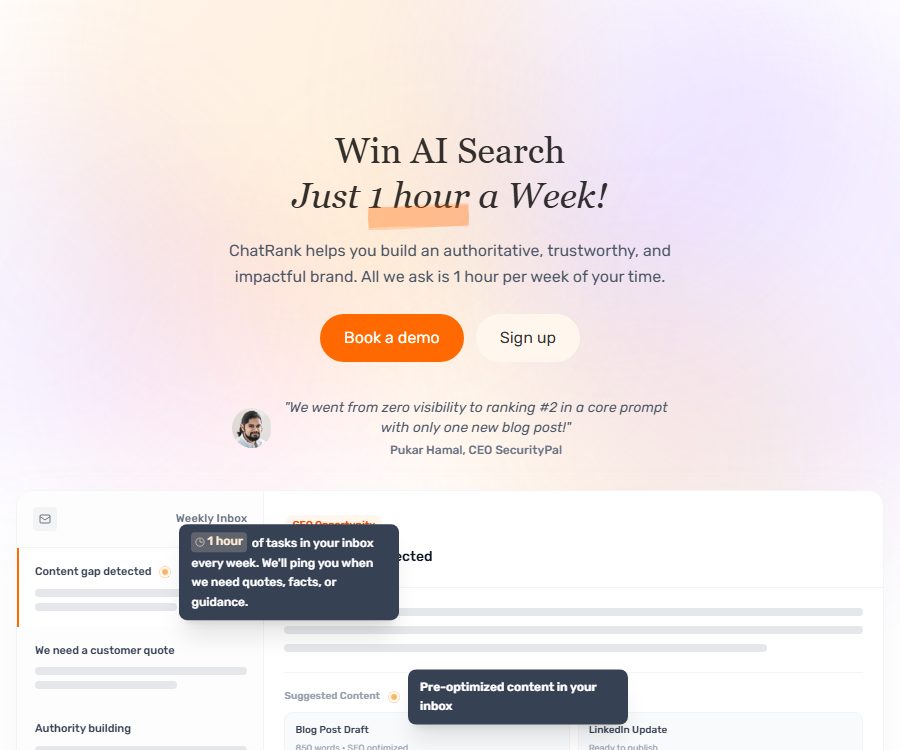
- Weekly Inbox aggregates information on gaps, opportunities for establishing authority, and mentions of competitors on a weekly basis, breaking down the work into tasks that can be completed within about an hour each.
- The platform may ask the team for customer reviews, operational data, experience, and facts, and then incorporate this unique information into the draft content.
- Suggested formats include blog posts, frequently asked questions, social updates, and other external content; the weekly limits for the paid tiers are 5, 15, and 30 items respectively.
- Automatically generated drafts must undergo reviews in terms of branding, facts, legality, and copyright; it is not allowed to publish large quantities of low-quality content merely to ensure mentions.
Content editing and brand consistency
- The content editor supports AI-driven conversations, rewriting, paraphrasing, and document collaboration, and it can convert the findings from monitoring into editable text.
- Brand tone and style guides are used to standardize terminology, target audience, expression methods, and prohibited practices, and they are suitable for use by multi-person teams in their collaborative work.
- The version history makes it easy to track the modifications made, and allows the team to retain records of fact verification and approvals by responsible persons before publishing.
- AI detection is a supplementary signal; it cannot reliably determine who created the text, nor should it be used as the sole basis for punishing the author.
Technical Audit and LLMs.txt
- Website audits are used to identify technical issues that affect the reading and understanding capabilities of AI search engines, and they can be used in conjunction with existing SEO audits.
- The platform lists those generated and hosted in LLMs.txt, allowing for the organization of website entries and key contents that machines are intended to understand.
- LLMs.txt is a supplementary file designed to assist with AI scraping; it is not equivalent to the standards used by search engines, nor can it guarantee that any model will be able to read it, reference it, or see its rankings improved.
- After it is generated, it is still necessary to check whether the page is accessible, whether the content is accurate, and whether the robots file, structured data, and sitemap are consistent.
AI-driven traffic and Google Analytics
- After connecting to Google Analytics, it is possible to view page visits, interactions, and conversions from AI channels such as ChatGPT.
- The platform combines visibility monitoring with actual traffic to help determine whether a particular mention generates potential customers.
- Some AI products may not transmit complete referral information, and analysis tools might classify such visits as direct traffic; as a result, the data does not reflect the full extent of the impact of AI.
- When establishing a connection, only the necessary read-only analysis permissions should be granted, and the authorization for the Google account should be revoked when ChatRank is disabled.
Input and output
| Process | Enter | Output | Typical uses |
|---|---|---|---|
| Visibility monitoring | Brands, websites, themes, and prompts | Cross-model referencing and variation | Establish an AI search baseline |
| Competitor analysis | Competing brands and common set of issues | Compare performance with content gaps | Determine the topics to be optimized first. |
| Content planning | Gaps, expert facts, and brand tone | Blogs, FAQs, and social tips | Weekly content production |
| Traffic analysis | Google Analytics authorization | AI-driven referral and conversion metrics | Assess business value |
| Technical optimization | Website and scraping configuration | Audit Issues and LLMs.txt | Improve machine readability |
Usage tutorial
- Select key brands and websites, and identify the actual questions that customers ask an AI before making a purchase, as well as the competing brands that need to be compared.
- In ChatRank, establish topics and prompts; first run baseline monitoring to record different models, dates, and response environments.
- Connect to Google Analytics, check the scope of authorization and historical data, and then correlate the changes brought about by AI with metrics related to visits, leads, and sales.
- Check the Inbox once a week to add facts, examples, and customer reviews that are only known to the company, and remove any information that cannot be verified or should not be made public.
- Complete the content in the editor, and after it has been approved through the brand tone check, legal review, and manual fact verification processes, it can be published.
- Fix the website audit issues and check LLMs.txt; do not use file configurations as a substitute for high-quality web pages, structured data, and proper site maintenance.
- Re-test using a fixed set of questions, and compare brands, competitors, and business outcomes, in order to avoid adjusting the entire strategy just because of a change in one response.
Price packages
ChatRank does not currently offer any publicly available permanent free plan or self-service free trial; it provides 30 minutes of free time for discussing requirements. Payments are made on a monthly basis, while the annual plan comes with a discount equivalent to two months’ worth of service, but the full annual cost must be paid in advance.
| Package or version | Price | Billing cycle | Core benefits or quota | Suitable for users |
|---|---|---|---|---|
| Plus | 499 dollars | Monthly payment | 20 topics, weekly updates, ChatGPT and Google, up to 5 suggestions per week, unlimited users | Preliminary operation of a single brand under GEO |
| Plus | 4990 US dollars | Annual payment, with one upfront payment | Similar to the Plus monthly plan, the cost comes out to 416 US dollars per month. | A growing brand that has been in use for a long time |
| Pro | 999 dollars | Monthly payment | 100 topics, weekly updates, more AI models, competitors, plugins; up to 15 suggestions per week | Multi-topic brands and agents |
| Pro | 9,990 US dollars | Annual payment, with one upfront payment | Similar to the Pro monthly plan, the cost is 833 US dollars per month when converted to pages. | Ongoing competitor and content projects |
| Power | 1999 US dollars | Monthly payment | 200 topics, daily updates, competitors, plugins, APIs; up to 30 suggestions per week | High-frequency monitoring and enterprise integration |
| Power | 19,990 US dollars | Annual payment, with one upfront payment | Similar to Power Monthly, the cost is 1,666 US dollars per month. | Large brands and large-scale agents |
- All three tiers list an unlimited number of users, while the theme quota is calculated based on the brand.
- Plus only monitors ChatGPT and Google; if you need to work with more models such as Perplexity and Claude, you should choose Pro or Power and check the list of available models in real time before making a purchase.
- The Power card lists the APIs, and the package comparison section indicates those options specific to enterprises; access qualifications, speeds, and costs must be confirmed in writing by the sales team.
- Shopify and WordPress plugins are listed under the Pro and Power plans, but the installation methods, distribution channels, and additional restrictions are not specified in the public store information.
Cancellation, refunds, and price changes
- The price page states that cancellation is possible at any time, and this is usually used to stop the renewal for the next period; the fees already paid for the current period or year will not be refunded based on the remaining time.
- The terms of service stipulate that all sales are final transactions, with no partial or full refunds provided, even if the service is not used, abandoned, suspended, terminated, or transferred.
- The price can be changed at any time, and the adjustment will take effect during the next renewal.
- The annual fee is charged in a single payment; before making a purchase, it is necessary to confirm the number of brands, themes, model coverage, plugins, APIs, and the scope of services.
- The current terms were last updated before the current products and packages, and they contain outdated phrasings that do not fully correspond to those of the AI search platform; companies should request the latest versions regarding orders, data processing, and service commitments.
Platforms, plugins, and APIs
| Channels | Current status | Explanation |
|---|---|---|
| Web platform | Already provided | The main entry point for monitoring, analysis, content, and collaboration |
| Google Analytics | Already supported | Link AI-driven referrals to visits and conversions |
| Shopify and WordPress plugins | The Pro and Power columns represent benefits. | No details from public app stores could be verified. |
| API | Power or enterprise scope | Unpublished endpoints, authentication, rates, and development documentation |
| Slack | Supports service communication | The package includes a dedicated Slack support channel, which is not equivalent to public data integration. |
| Native mobile and desktop applications | Not confirmed yet | No official app store or download/installation page was found. |
Privacy and data security
ChatRank collects information such as names, addresses, email addresses, transaction details, usage data, device information, browser details, IP addresses, and clickstream data, and it makes use of cookies or services like ChatRank, Stripe, Google, Facebook, TinyMCE, and Zapier.
The services and the central database are hosted in the United States; data from users outside the country is transmitted to the U.S. for processing. The current privacy policy requires users to be of legal age in their respective regions, with an age minimum of 18 years.
- Customer data is encrypted both at rest and during transmission; computing resources are located in a virtual private cloud, and employee access is restricted based on their roles.
- Backups are retained for up to 45 days; the specific default retention period for account master data is not disclosed.
- Payments are processed by Stripe, and ChatRank means that only the last four digits of the bank card number are stored in the database.
- Google Analytics is used for providing site analysis and diagnostics, and ChatRank states that it complies with the limited usage requirements of the Google API.
- Users can update their accounts and request access to, correction of, or deletion of their personal data, but legal, contractual, dispute, and transaction records may remain retained.
- The privacy policy and the earlier terms of service contain different specifications regarding the minimum age; therefore, the newer and stricter rule of 18 years should be applied.
Content rights and commercial usage notes
- The user retains ownership of the data and content they submit, and guarantees that they possess the necessary rights without infringing upon the interests of others.
- The terms also grant ChatRank a global, irrevocable, perpetual, transferable, and royalty-free license to provide, improve, optimize, and promote the services.
- Brand cases, customer reviews, sales data, and unrevealed strategies are considered high-value content; before submitting them, it is necessary to ensure that the organization agrees to the applicable licensing terms and that the sensitive information has been removed.
- The rankings, suggestions, and drafts generated by AI are not guaranteed to be accurate, complete, or free from infringement; facts, citations, trademarks, and copyrights should be verified independently before they are published.
- Platform data cannot demonstrate the overall market performance of a particular AI model, nor can it guarantee that optimizations will result in more mentions, traffic, or revenue.
API, GitHub, and open-source status
- The Power package promotes API access, but no public developer documentation, SDKs, example projects, or interface licenses are available at present.
- To date, no GitHub repository for ChatRank’s official product nor an open-source license has been found; therefore, the web platform should be considered a closed-source hosting service.
- Just because a Shopify or WordPress plugin can be installed, it does not mean that the monitoring engine, content management system, or API are open source.
- The ChatRank service calls or monitors ChatGPT, Google, Perplexity, and Claude, but this does not imply any official partnership for ranking purposes with these model providers.
Suitable for users and typical use cases
- Consumer brands and e-commerce: Monitor the appearance of products in AI-driven shopping recommendations, and supplement with product details, reviews, and comparison information.
- Local services, medical and dental facilities: Monitor the performance of recommendations in relation to local issues, but shall not generate false qualifications or medical promises automatically.
- SaaS and application teams: Monitor questions with high intent, such as those related to \"tools suitable for a certain need\", and connect them with AI-driven recommendations for trials and registrations.
- Content and PR team: Transform brand facts, expert opinions, and customer cases into verifiable, authoritative content.
- Agent: Use Pro or Power to manage multi-brand themes, competitors, and weekly recommendations, and display historical changes to customers.
Advantages and limitations
| Aspect | Actual judgment |
|---|---|
| Overlay process | Monitoring, competitor analysis, content analysis, technical insights, and traffic analysis are all integrated within a single platform. |
| Execution method | Weekly Inbox transforms opportunities into small tasks, making it suitable for ongoing operations. |
| Model and frequency | The higher the level, the wider the coverage; Power offers daily updates. |
| Price | The minimum cost is $499 per month; there are no free options available, and it is suitable for teams with clear business objectives. |
| Result reliability | AI responses are inconsistent and based on sampling only; there is no guarantee of improved rankings or traffic. |
| Contract transparency | The current package is clear, but the terms of service are outdated; there is no refund option and the licensing scope is broad. |
Summary
ChatRank is suitable for teams that already consider AI-based search as a means of attracting customers and are willing to provide brand-related information on a regular basis as well as to carry out content updates on a weekly basis; it is not intended for individual users who only want to conduct a single ranking query.
Before making a purchase, it is necessary to establish a baseline using a set of fixed issues, and pay close attention to the list of models, the definition of topics, the delivery of plugins and APIs, the non-refundable annual subscription model, as well as the licensing terms for user-generated content.
Tools similar to ChatRank




 Guigong Network Security Registration No. 45132202000164