






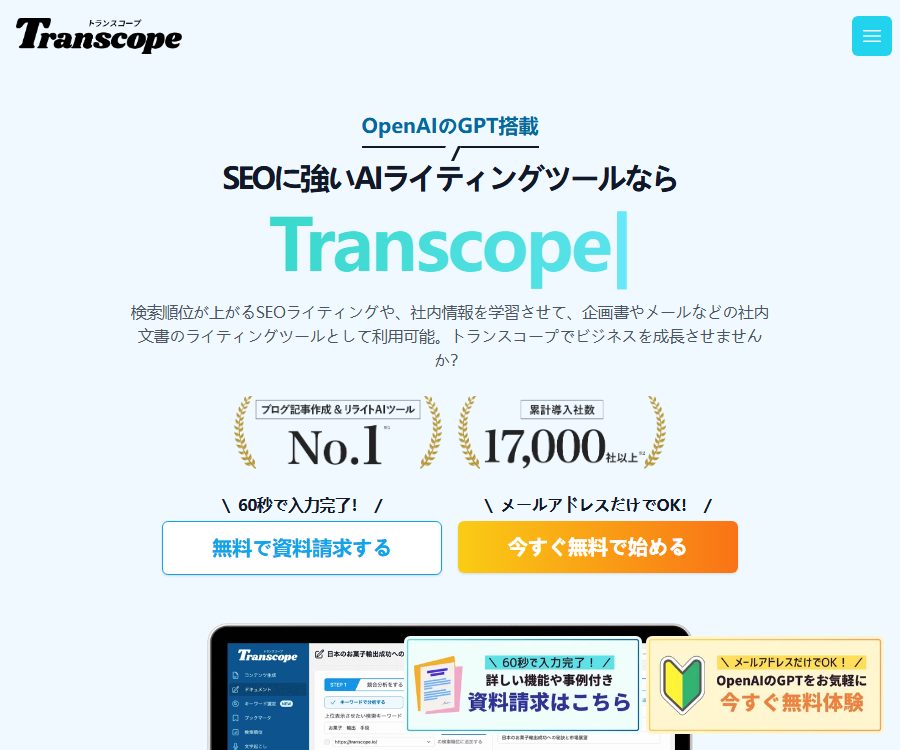
Transcope, an SEO writing tool from OpenAI equipped with GPT.
Transcope, an SEO writing tool from OpenAI equipped with GPT, makes AI-driven writing tasks more efficient and simpler.
Tags:AI writing toolsWhat is Transcope?
Transcope is an AI-powered writing and SEO content tool developed by the Japanese company Sharemol Co., Ltd.; it is designed to support content marketing in Japanese, search optimization, and the creation of corporate documents. This tool integrates functions such as analysis of competitor pages, keyword research, tracking of search rankings, and text generation using OpenAI models within a single workflow.
It can generate articles based on target keywords, and it can also create internal documents such as business plans and emails after learning about a company’s information. This product is more suitable for teams that need to produce large volumes of Japanese content in a consistent manner, rather than being a simple general-purpose chatbot.
A one-sentence summary
Transcope is an AI-based writing and SEO platform designed for the Japanese market; it can generate, rewrite, and review articles based on data related to competitors and keywords, and it also supports the analysis of corporate information as well as multi-modal input.
Core functions
SEO writing driven by competitor analysis
After the user enters the target keyword, the platform can analyze the competitive pages in the search results and use this information to plan the structure of the article and draft its content. This approach combines search intent, common topics, and content creation, thereby reducing the time needed to manually review multiple pages.
- Organize competitive content and suggested topics based on the target keywords.
- Generate titles, outlines, and text suitable for search content.
- It supports SEO rewriting based on existing articles.
- The manual editing step is retained to facilitate adjustments to the brand’s tone and the facts presented.
Keyword selection and ranking tracking
The platform offers keyword suggestions and insights into website search rankings, helping teams move from selecting topics to monitoring their performance after publication. Different packages allow for a varying number of keywords to be tracked; the free version is suitable for testing, while the enterprise version is designed for managing larger sets of keywords.
Article review and rewriting
Once generation is complete, users can carry out various checks on the article and use the rewriting function to improve its expression or structure. The results of these checks serve only as a helper for editing; the accuracy of facts, citations, professional judgments, and the overall quality of the final version must still be ensured by humans.
Learning about company information
Users can have the system learn about the company’s information, so as to generate articles, emails, or project content that are more in line with the business context. All public packages include a certain amount of data for learning purposes; larger volumes of data can be purchased separately for expansion.
- Company information can be supplemented using files such as CSV.
- Suitable for product descriptions, service materials, and common expressions.
- It can generate marketing content as well as some internal business documents.
- When dealing with customer data and confidential information, an internal compliance assessment must be carried out first.
Multimodal input
In addition to text, the platform can also process web content, images, audio, and other types of input in order to extract information or generate documents. Both the free version and the paid plans offer a limited amount of text-to-speech transcription; more usage time can be purchased on a monthly basis.
Timed generation and batch creation of content
The platform offers document generation capabilities suitable for ongoing content management, which helps to reduce the need to repeat certain tasks. While batch creation allows for quicker production, it does not mean that the content can be published right away; the team still needs to establish processes for review, removal of duplicates, and updates.
Comparison of main packages
The information on the packages below was verified on August 24, 2026; all amounts shown are in yen, including taxes. Subscriptions are billed on a monthly basis and are automatically renewed, while the actual features, tax treatments, and any promotional offers are subject to those specified on the purchase page.
| Package | Price | Monthly generation quota | Ranking tracking | Suitable for users |
|---|---|---|---|---|
| Free | 0 yen | A total of 4,000 characters | Up to 3 keywords | Personal experience and functional testing |
| Basic | 11,000 yen per month | 50,000 characters | Up to 10 keywords | Small websites and lightweight content teams |
| Pro | 38,500 yen per month | 250,000 characters | Up to 100 keywords | Maintain the operation of multiple sections or client projects. |
| Enterprise | 66,000 yen per month | 600,000 characters | Up to 1,000 keywords | Large content teams and organizations |
| Customize | Contact sales | Configure as required | Configure according to the contract | Enterprises that require a higher credit limit, additional interfaces, or specialized optimization. |
Main benefits for each tier
The Free version has certain limitations: analysis of competitors and selection of keywords are each allowed 3 times, 10,000 characters of corporate information can be processed, and voice transcription is available for 5 minutes. It is suitable for checking the quality of Japanese-generated text, but not as a solution for large-scale, ongoing production.
Basic, Pro, and Enterprise versions give access to the main functions; there are no limits on the number of documents, competitive analysis reports, or keyword selections. For the Basic version, it is recommended to use internal links 3 times per month, while for Pro and Enterprise versions, no such limit applies to the use of internal links.
| Equity | Free | Basic | Pro | Enterprise |
|---|---|---|---|---|
| Competitor analysis | 3 times | No limit on the number of public displays | No limit on the number of public displays | No limit on the number of public displays |
| Keyword selection | 3 times | No limit on the number of public displays | No limit on the number of public displays | No limit on the number of public displays |
| Number of documents | Partial restrictions | No restrictions | No restrictions | No restrictions |
| Learning about company information | 10,000 characters | 10,000 characters | 10,000 characters | 10,000 characters |
| Suggestions for internal links | Restricted | 3 times a month | No limit on the number of public displays | No limit on the number of public displays |
| Speech transcription | 5 minutes | 5 minutes | 5 minutes | 5 minutes |
Price for additional credit limit
When there is a shortage of characters generated, data for company profiles, or speaking time, corresponding add-ons can be purchased. The ways in which these additional quotas are activated vary; it is necessary to determine the payment cycle before making a purchase.
| Additional items | Applicable packages | Price | Rules |
|---|---|---|---|
| Increase by 20,000 to generate characters. | Basic | 4,400 yen | Tax is included; any unused credit at the end of the current settlement period becomes invalid. |
| Increase by 20,000 to generate characters. | Pro | 3,080 yen | Tax is included; any unused credit at the end of the current settlement period becomes invalid. |
| Increase by 20,000 to generate characters. | Enterprise | 2,200 yen | Tax is included; any unused credit at the end of the current settlement period becomes invalid. |
| Increase the amount of information learned about companies. | Paid users | 11,000 yen per month | Charged monthly per 1 million characters |
| Add voice transcription | Paid users | 3,300 yen | An additional 10 hours will be added; the specific period is subject to the settlement page. |
Usage tutorial
- First, register for a free account and use a real Japanese topic to test the quality and the editing process.
- Enter the target keywords, and specify the country, language, audience, and search intent.
- Run competitor analysis to identify truly relevant topics and remove suggestions that are not related to the business.
- Generate a title and an outline, first by adding the brand’s perspective, product information, and the questions that need to be answered.
- Let the system generate the text in segments, to avoid having overly long content generated at once, which could lead to a loose structure.
- Each fact, figure, proper name, and product attribute is verified individually before undergoing SEO rewriting.
- After publishing, register the target keywords, continuously monitor the rankings, and update the article based on actual performance.
Which users are it suitable for
- Content teams that manage websites, blogs, or corporate media for the Japanese market.
- Editors, agencies, and freelancers who need to create Japanese SEO articles.
- Marketers who need to conduct keyword research, competitor analysis, and ranking tracking simultaneously.
- Companies that wish to generate emails, business plans, and operational descriptions based on their company information.
- Site operators who need to rewrite existing articles in bulk and establish a process for ongoing updates.
Product advantages
- It integrates competitor analysis, keyword selection, article generation, and ranking tracking into one product.
- Designed for the Japanese market and Japanese writing scenarios, to reduce the need to switch between different language tools.
- The free version allows you to test the interface, features, and output quality before making a purchase.
- The characters generated by the public packages, as well as the quota for tracking keywords, are clear, which facilitates budget estimation.
- It supports the learning of corporate materials, covering external marketing as well as certain internal document scenarios.
- Custom enterprise solutions offer higher limits, additional interfaces, and optimization of existing articles.
Restrictions and Precautions
- It is primarily aimed at Japanese speakers; a Chinese interface and Chinese content are not part of its core focus.
- Articles generated may contain factual errors, repeated expressions, or unnatural phrasing; editorial review cannot be omitted.
- The free version allows for a total of only 4,000 characters, which makes it difficult to fully assess the effectiveness in large-scale production.
- The price difference between the Basic plan and the more premium plans is significant; it is advisable to calculate the actual monthly character requirement before making a choice.
- The additional characters generated become invalid at the end of the billing cycle, so they are not suitable for being accumulated in large quantities in advance.
- Improvements in search rankings are based on examples and estimates; the platform does not guarantee the same results for every keyword.
- When dealing with high-risk topics such as medicine, finance, and law, it should be reviewed by professionals.
Subscription, cancellation, and refunds
The minimum contract period for the public paid plans is one month, with automatic renewal on a monthly basis starting from the date of application. A charge is made at the time of the first application, and subsequent charges are incurred every month; the price listed for these public plans is based on a prepaid system.
Users can request to terminate the contract during its validity period; by giving notice before the next settlement date, no further bills will be issued. Payments that have already been made cannot be refunded on a daily basis, and no partial refund is provided for early termination; therefore, it is necessary to confirm one’s intentions before the renewal date.
Privacy and content security
When using corporate data for learning, multi-modal input, or speech transcription, the system needs to process the content submitted by the user. Before uploading customer lists, unreleased product plans, contracts, or personal information, it is necessary to verify the organization’s authorization, the level of confidentiality required, and the rules regarding data processing.
The team should also distinguish between materials that can be used for model processing and those that can only be stored within internal systems, and establish procedures for deletion, access control, and handover upon employee departure. Before releasing content generated by AI, it is necessary to check personal information, copyright issues, trademarks, and the scope of use of third-party materials.
Interfaces, models, and open-source status
Transcope uses the GPT series of models developed by OpenAI; it was officially announced that GPT-4.1 would be adopted, but the underlying models may change as the services are upgraded. Users purchase application services, and therefore cannot expect to have direct control over the version of the models or the way in which they are trained.
The public page lists the available interfaces under the Customize option; no public development documentation or self-service key console available for all users is present. Companies that need system integration should contact sales to discuss certification requirements, call limits, data storage options, and service guarantees.
Transcope itself is a commercial, closed-source service; there is no official project in which the vendor has made the complete source code of the product available. Repositories with the same name on code hosting platforms or third-party automation scripts cannot be considered official open-source versions.
Basic information
| Project | Content |
|---|---|
| Product name | Transcope |
| Operating company | Sharemol Co., Ltd. |
| Tool type | AI writing, SEO content, and enterprise document tools |
| Primary language | Japanese |
| Model | OpenAI GPT series |
| Price pattern | Free version, monthly subscription, and enterprise customization |
| Whether an interface is provided | Custom solutions are available; no public self-service interface has been seen. |
| Is it open source? | No |
Recommendation score
Its rating is 4.3 points, and it is suitable for teams that need Japanese SEO services, keyword management, and the creation of corporate content. If short texts only need to be generated occasionally, free general-purpose writing tools might be a cheaper option; however, for a comprehensive approach to search optimization in Japan, Transcope is more appropriate.
Frequently Asked Questions
Can Transcope be used for free?
Yes, the free version does not require a monthly fee; it allows for the creation of up to 4,000 characters, as well as limited access to functions such as competitor analysis, keyword selection, and rank tracking. The free features are intended for testing purposes only, and they do not mean that 4,000 characters can be generated on a monthly basis.
How to choose between Basic, Pro, and Enterprise?
The choice is primarily based on the number of keywords, which is tracked by the characters generated and the rankings obtained on a monthly basis. Small websites can start with the Basic version, while content agencies and teams working on multiple projects usually need the Pro or Enterprise version.
Can a paid plan be canceled at any time?
It is possible to terminate the contract during its valid period; by giving notice before the next settlement date, further charges can be stopped. Payments that have already been made are not refunded on a daily basis, and no partial refunds are provided.
Can it ensure that the article appears among the top results in searches?
No, the platform offers competitive analysis, keyword suggestions, and writing assistance, but rankings are still influenced by the quality of the website, the level of competition, the credibility of the content, and external factors.
Are development interfaces provided?
Interface capabilities are listed in the Customize options; there are no self-service development documents available for the standard packages. Companies need to contact sales to determine the technical scope and costs involved.
Is Transcope open source?
It is not open-source; it is a commercial software service provided by Sharemol. Third-party repositories and scripts do not represent the official source code of the product.
Summary
The distinctive feature of Transcope is not merely using large language models to write articles; rather, it integrates SEO research for the Japanese market, content creation, rewriting, and ranking monitoring into a cohesive workflow. When selecting a package, it is necessary to take into account the number of characters per month, the keywords to be monitored, as well as any additional quotas, while also preserving the process of manual verification and editing.
Tools similar to Transcope, SEO writing tools equipped with GPT from OpenAI




 Guigong Network Security Registration No. 45132202000164