






On Target AI
On Target AI: an intelligent tool focused on AI-driven writing.
Tags:AI writing toolsTool Introduction
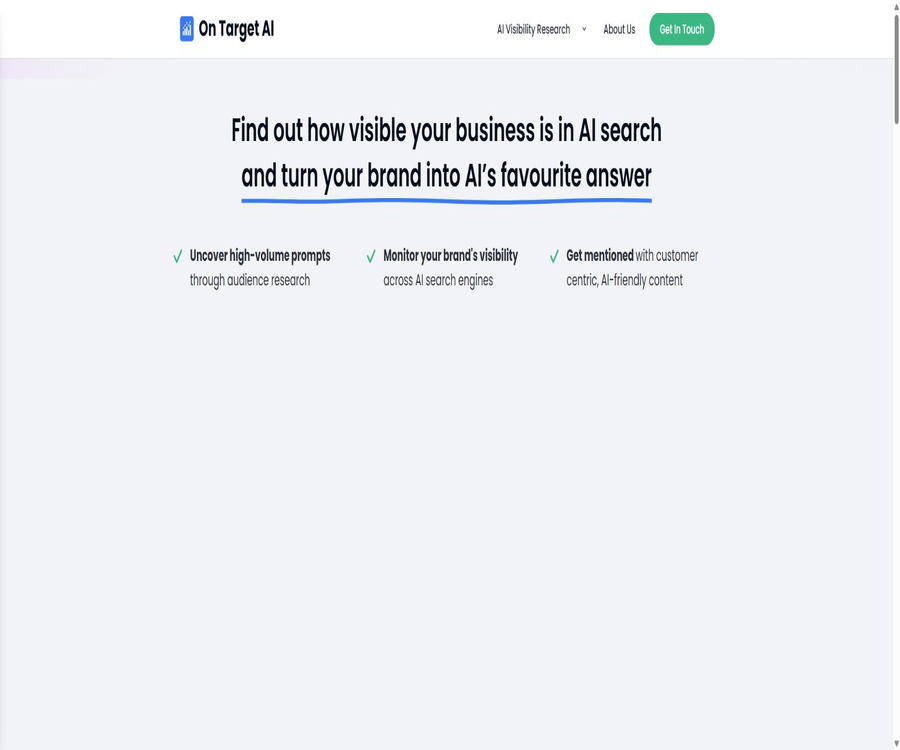
On Target AI is an AI-driven search optimization and visibility analysis platform developed by the British company On Target AI Ltd. It helps brands understand what questions their actual audience will ask through AI, monitors their own presence as well as that of their competitors in the AI-generated responses, and uses this information to create content that is more likely to be cited.
Main functions
Audience research and prompt intelligence
The platform can combine a company’s own customer data with public discussions in order to identify the language used by its audience and generate keywords that should be monitored. The inputs available include tables, documents, audio files, as well as insights from comment platforms, forums, marketplaces, and social media channels.
- Build a set of prompts based on customers’ questions, needs, and purchase intentions.
- It provides topic-related suggestion for prompts, rather than relying solely on traditional keywords.
- Different packages include 2, 5, or 10 audience insight reports per month.
- Authorization and personal information cleanup must be completed before importing comments, interviews, and survey materials.
AI Visibility and Citation Monitoring
The system runs the predefined prompts on a daily basis to analyze the visibility of brands and competitors in AI-generated responses, as well as their domain rankings and citation links. The monitoring targets specified in the current self-service package are ChatGPT, Gemini, and Google AI Overview.
- Check whether the brand is mentioned and its relative performance compared to competitors.
- Identify which domain names and pages are frequently used as sources for AI responses.
- Analyze extended queries as well as search questions derived from the same topic.
- Reports and exported results provide clues for determining content priorities and for external dissemination.
Content strategy and generation
Users can utilize insights into their audience, the brand’s tone, and business data to identify gaps in content and create drafts that address customers’ needs. Whether the published content appears among AI-generated answers depends on factors such as data capture, indexing, the credibility of the sources, and changes in the models; the platform cannot guarantee that such content will be cited or ranked highly.
- Look for topic ideas in low-visibility prompts and references from competitors.
- Generate or rewrite customer-oriented content in line with the brand’s tone.
- Combine monitoring, strategy, and execution within the same workflow.
- Before publication, it is still necessary to verify the facts, originality, compliance with professional standards, and the purpose of the search.
Usage tutorial
- Create an account or schedule a demonstration, and add the brands, domain names, and key competitors that need to be monitored.
- Upload authorized customer feedback, survey, or interview data, and add information on the industry and target market.
- Review the audience prompts generated by the system, and remove any irrelevant, repetitive, or inappropriate questions.
- Enable daily monitoring to compare mentions, competitors, domain rankings, and referencing pages across different AI platforms.
- A content plan is developed based on unresolved issues and highly impactful citations; after a draft is created, it is edited and published by professionals.
- Observe trends over multiple cycles, while using website analysis tools to verify actual visits and conversions.
Which users are it suitable for
- Marketing teams that wish to understand a brand’s visibility in generative AI search.
- It is necessary to compare the SEO, GEO, and content managers in terms of the sources they mention and cite from their competitors.
- Brands that possess comments, interviews, and customer survey data and wish to turn them into content strategies.
- Agents and consultants who provide AI search optimization services to multiple clients.
- Teams that only need traditional web ranking, backlinks, or ad management still require other platforms as well.
Prices and packages
| Package | Public monthly price of the page | Number of prompts and answers | Insight Report | Seats |
|---|---|---|---|---|
| Starter | 75 dollars per month | 50 prompt phrases per day, with 4,500 answers analyzed each month | 2 copies per month | 2 |
| Growth | 190 dollars per month | 150 prompts per day, with 13,500 answers analyzed each month | 5 copies per month | 5 |
| Advanced | $ | 300 prompts per day, with 27,000 answers analyzed each month | 10 copies per month | 10 |
| Enterprise | Contact the team | According to the enterprise’s needs | In accordance with the plan’s provisions | In accordance with the plan’s provisions |
All three self-service packages include daily updates, ChatGPT, Gemini, Google AI Overview, competitor tracking, citation analysis, report export, as well as email and chat support. The pricing page offers the option to pay monthly or annually; however, the static information available does not show the total cost for annual payment or any discounts. It is necessary to confirm the actual payment period and applicable taxes at the time of settlement.
The terms permit the platform to offer a free trial period, after which charges may be applied automatically; subscriptions are renewed on a monthly basis, and cancellation usually takes effect in the following month. The terms also state that no refund will be given in case of cancellation, so users should cancel before the end of the trial period and keep a record of the confirmation.
Product advantages
- Use the language of actual customers in prompt research to reduce the biases that arise from the marketing team’s assumptions alone.
- At the same time, observe the brand, competitors, domain ranking, and answer citations to help explain the visibility gaps.
- The results of the prompts are updated on a daily basis, and the scale of analysis for each package is made public.
- It connects audience insights, monitoring, and content delivery, making it suitable for continuous optimization.
- The self-service tiers, ranging from two to ten seats, allow teams of various sizes to make a suitable choice.
Usage restrictions and precautions
- AI responses vary depending on region, account, time, model version, and personalization; the monitoring results do not represent a complete reflection of all user experiences.
- An increase in visibility does not necessarily mean an increase in website traffic, sales, or conversions.
- The self-service package lists only three types of AI search environments; it is necessary to check separately whether other platforms support them.
- The analysis volume of the answers reflects the scale of operations, and it does not represent the number of searches conducted by individual users or the actual market demand.
- The generated content must be reviewed manually to avoid factual errors, repetitive content, and unnatural brand expressions.
Data and content rights
The privacy policy states that the AI functions involve sending the content provided by users to services offered by OpenAI, Anthropic, and Google; it is stated that these service providers will not use such content to train general-purpose models through the existing API protocols. Companies still need to check whether the uploaded content contains customer personal information, confidential data, or restricted data.
The terms of service grant the platform broad, long-term, and sublicensable rights to use the customer’s content, including for purposes such as improving AI models; this provision should be understood in conjunction with the restrictions outlined in the privacy policy, as well as considering the specific functions and agreements involved. Before uploading core research, recordings, or unpublished strategies, it is advisable to consult the platform regarding the intended use of such content, the duration of its retention, and the procedures for deletion or withdrawal.
Platforms, APIs, and open-source status
On Target AI currently offers web applications and online reports; while its terms of service suggest that online or mobile services may be available, the company has not yet confirmed the existence of downloadable native desktop or mobile clients. The public interfaces and materials are primarily in English, and the official languages for other interfaces have not been disclosed yet.
The authorities have not yet made public the public developer API, the official SDK, the pricing or rate limits for calls, nor have they disclosed the open-source license for the product itself. The use of third-party model APIs on the self-service platform does not mean that users can directly access On Target AI’s interfaces, nor does it imply that the product is open source.
Frequently Asked Questions
Is On Target AI a traditional SEO tool?
It primarily monitors a brand’s performance in terms of generative AI-generated answers and citations, rather than focusing on providing rankings on traditional search result pages. A comprehensive search strategy still requires traditional keywords, technical SEO practices, indexing, and website analysis tools.
Are there any free packages?
The official price page does not list any permanently free tiers; the terms only state that a free trial may be available. Whether a trial is offered, its duration, and the date on which automatic charges will occur are specified on the registration and billing pages.
Can the platform ensure that a brand is recommended by AI?
No. It can provide monitoring and content suggestions, but the final answers are generated by external AI systems; the citations and recommendations keep changing.
Tools similar to On Target AI




 Guigong Network Security Registration No. 45132202000164