






Neuraltext
Neuraltext, an intelligent tool focused on AI-driven writing.
Tags:AI writing toolsWhat is NeuralText?
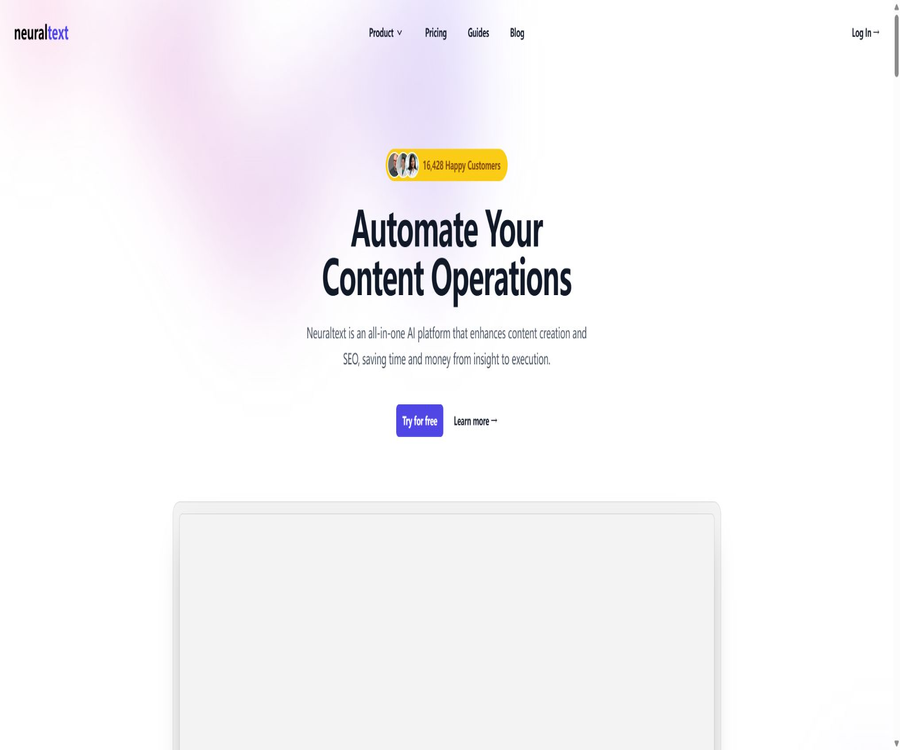
NeuralText is an online SEO content platform operated by the Italian company Atmos Media sas; it brings together keyword discovery, clustering, search result analysis, content optimization, and AI-driven writing in one single workspace. It assists editors, SEO consultants, and content teams throughout the process, from topic research to article creation and performance monitoring.
The value of a product lies not only in generating text, but also in creating content summaries based on real-time search results, while during the editing process assessing aspects such as topic coverage, length, and readability. Search results and content scores serve only as guidelines for making decisions; they do not guarantee that certain keywords will appear in the rankings.
Main functions
Keyword discovery
- After entering a seed word and selecting the target country or language, the system generates extended long-tail queries and displays information such as search intent, trends over the past 12 months, SERP characteristics, average monthly search volume, difficulty level, and click cost.
- The results can be filtered and exported based on search volume, difficulty, or word length, and can also be fed into content summaries or clustering tools in bulk.
- Search volume, difficulty level, and click-through cost are estimated figures; they are suitable for comparing the priority of different opportunities, but should not be used as accurate indications of traffic or advertising costs.
Keyword clustering
- Users upload or select a set of keywords; the platform then uses semantic similarity and common ranking URLs to group together those queries that can be covered by the same page.
- Each cluster is centered around the main keyword with a high search volume, and related variations are retained to help determine how many pages need to be created and what the main topic of each page should be.
- Processing each keyword consumes one cluster quota; if the quota available in the package is insufficient, additional quota can be purchased within the account.
- The results of clustering still require manual inspection to determine the search intent; brand names, location terms, or time-sensitive queries may seem similar but are not suitable for being combined into a single piece of content.
SERP Analysis and Content Briefing
- When creating a SERP document, it is possible to enter up to three keywords at a time, and you can specify the language, location, and search engine; the system typically generates the analysis within 30 to 45 seconds.
- The platform retrieves the first 20 natural search results, analyzes the competing pages in terms of word count, title structure, common questions, main topics, and subtopics, and establishes a baseline for content scoring.
- The editor uses colors to indicate whether a theme is not covered, is appropriately covered, or is overused, making it easier to adjust the structure and keyword density while writing.
- Users can directly edit the automated outline, adding information about the target audience, the perspective of the article, and the writing requirements, before submitting the content brief to internal or external authors.
AI writing and editing
- A blank document can be used to continue typing with the Tab key, and selected text can be expanded, abbreviated, rewritten, summarized, simplified, or have its grammar corrected.
- There are over 40 AI prompt templates covering AIDA copy, product descriptions, and various marketing materials; it is possible to select 1 to 10 results at a time and save or copy them.
- The AI generation quota is deducted based on the number of characters generated; a blank document does not consume any quota for SERP analysis.
- Automatically generated content may contain factual errors, repetitions, outdated information, or unnatural phrasing; it is necessary to verify the data, examples, brand tone, and copyright risks before publishing it.
Monitoring with Google Search Console
- The account can be authorized to use a Google account, and Search Console site resources can be linked to the project; the package determines the number of sites that can be connected.
- The Performance panel provides an overview of the number of views, clicks, click-through rate, queries, as well as changes in page rankings; it allows users to filter out opportunities for improvement for items ranked 3 to 20, as well as potential topics for those ranked 21 to 100.
- The existing queries can be clustered again to determine whether the original page should be expanded or new content created.
- This integration pulls data from Search Console; it does not mean that NeuralText can control how search engines crawl, index content, or determine rankings.
Prices and packages
| Package or version | Price | Billing cycle | Core benefits or quota | Suitable for users |
|---|---|---|---|---|
| Starter | 19 dollars | Monthly | 100,000 AI words, 5 content briefs, 2,000 keyword suggestions, 5,000 clustered terms, 1 website resource, 1 seat | Individual writers and small websites |
| Basic | 49 dollars | Monthly | 100,000 AI words, 40 content briefs, 20,000 keyword suggestions, 10,000 clustering terms, 1 site resource, 1 seat | SEO specialists responsible for the ongoing management of content |
| Pro | 119 dollars | Monthly | 300,000 AI-generated words, 100 content summaries, 50,000 keyword suggestions, 30,000 clustering terms, 5 website resources, 3 seats | Agents and multi-person content teams |
| 5-day trial | The page indicates that it is free. | 5 days | The functions and specific trial quotas are as indicated on the account settlement interface. | Users who verify the workflow before purchasing |
The various quotas are reset every 30 days with the start of a new billing cycle; the content summaries, keyword suggestions, clustered terms, and the amount of text processed by AI are all measured separately. The current public price list shows only the monthly payment option; there is no information available regarding the annual payment amount or corporate customization levels.
The product page states that a 5-day free trial is available and can be canceled at any time, but the terms also mention the possibility of a \"paid trial\". Before starting the trial, it is necessary to check the payment page to see if any payment method is required, when charges will be deducted, and what the actual balance in the account is.
Registration and complete workflow
- Register an account and choose between a trial period or a subscription; on the billing page, check the renewal date, the package details, and the option to cancel.
- Create a project and specify the target website, country, and language; if it is necessary to monitor existing content, then authorize the corresponding Search Console account.
- A keyword report is generated from the seed words, with candidate keywords filtered based on search intent, trends, search volume, and difficulty.
- The candidate terms are fed into clustering tools, and after manually examining each intent group, the structure of the sections and the list of articles are determined.
- Create SERP documents for key topics by entering up to three keywords and selecting the location, language, and search engine.
- Review the first 20 results, as well as the title and topic models, adjust the outline, target audience, and unique perspective, and then write in the intelligent editor.
- Optimize based on content score and thematic guidelines, but avoid using excessive words merely to make it appear positive; publish after reviewing facts, grammar, citations, and branding.
- Use Search Console to monitor changes in impressions, clicks, and rankings, and then decide whether to update old articles, create new pages, or re-cluster content.
Input, output, and platform
| Stage | Main inputs | Main output | Precautions |
|---|---|---|---|
| Keyword research | Root words, countries, languages | Keywords, intent, trends, search volume, difficulty, and click cost | The figures are estimated values. |
| Keyword clustering | Keyword list or CSV | Theme groups organized according to common search intentions | The quota is reduced based on the number of keywords entered. |
| SERP analysis | Up to 3 keywords, location, language, search engine | Scores for competition pages, titles, themes, questions, and content | Each analysis consumes 1 briefing quota. |
| AI writing | Tips, selected text, briefings, and outlines | Continuation, rewriting, summarization, and marketing copy | The quota is deducted based on the number of characters generated. |
| Effect monitoring | Sites authorized by Search Console | Queries, pages, displays, clicks, click-through rate, and ranking trends | The number of connections is limited by the package. |
| Platform | Modern web browsers | Online projects, documents, reports, and exported data | The official native mobile app has not been confirmed. |
Suitable for users and scenarios
- Independent websites, SaaS, and e-commerce teams create a blog topic database and convert keyword sets into a content calendar.
- SEO consultants quickly create data-driven content summaries, eliminating the need to examine competition results page by page.
- The editorial team carries out competitor research, topic coverage checks, and AI-assisted rewriting in the same document.
- Agents use multiple projects and Search Console sites to track opportunities for customer content, but the number of seats and sites must be matched accordingly.
Advantages and capabilities boundaries
Advantages
- Keyword discovery, clustering, SERP summaries, writing, and performance monitoring are interconnected, which reduces the need to transfer data between various SEO tools.
- It allows for the combined analysis of up to three queries, and supports settings for location and language, making it suitable for analyzing content in local markets or across multiple markets.
- The three-tier package specifies the main quotas, allowing teams to estimate their needs based on the number of briefings, the size of the clusters, and the number of sites.
Boundary
- The search results keep changing; the pages that appear as competitors for the same keyword can vary depending on the location, device, and time.
- The theme relevance score reflects the degree of similarity to existing competitive content; it does not take into account originality, real-world experience, external links, technical SEO aspects, or brand authority.
- AI authors are not databases of facts; medical, legal, financial, and other high-risk content requires review by qualified professionals.
- Some documents still label the one-click AI article generator as a feature to be released soon; this description should not be taken as indicating that the function is already available to all accounts.
- There are no public SLAs, public APIs, or official guidelines for automatic deployment to content management systems; therefore, the process for batch deployment must be arranged separately.
Refunds, copyrights, and commercial use
- Subscriptions are automatically renewed on a periodic basis; cancellation usually takes effect at the end of the current payment cycle, with access remaining valid for the remaining time.
- The subscription fee is generally non-refundable, and any trial fee that has been charged will also not be refunded; the platform may consider issuing a refund only in cases where it can be proven that the service cannot be provided.
- Cancellation will remove the discounts, coupons, and promotions from the account, and their restoration is not guaranteed upon re-subscription.
- The terms confirm that the customer has the right to submit data and to receive derived data based on that data, but they do not guarantee that the AI-generated text will not infringe upon the rights of third parties.
- Before making a commercial release, it is necessary to verify the facts, trademarks, names of persons, citations, and similar expressions, as well as to ensure that one has the permission to use the customer information provided.
Privacy and data security
- The service handles account and usage-related data, while the website also records network addresses, browsers, visit times, pages visited, and click information through logs and cookies.
- The terms consider unpublicized customer data to be confidential information, while allowing the platform’s analysis services to use such data, as well as performance and derived information, for purposes of improvement, development, diagnosis, and error correction.
- External disclosures should be in a summarized or anonymized form; however, the official policies do not explicitly guarantee that all such hints and generated content will not be used for model training.
- Connecting to Search Console grants the platform access to data regarding the site’s performance; sites that do not require this access should have such authorization revoked promptly.
- The GDPR guidelines specify that Atmos Media sas is the data controller; data related to website visitors is typically stored for no more than 12 months, and it may be transferred to the United States in accordance with the relevant compliance regulations.
- After termination, customer data is available for electronic retrieval for 30 days; thereafter the platform may delete it, though it is not obligated to do so immediately. Therefore, it is important to export important documents and keyword data before leaving.
Some of the content on the privacy page relates to website visitors and advertising cookies; however, the information provided regarding in-app documents, AI suppliers, sub-processors, encryption, and incident response is not detailed enough. Before submitting unreleased products, customer lists, or confidentiality strategies, the team should consult the operation team to confirm the data processing agreements and policies regarding the use of models.
APIs, open source, and application status
To date, there is no confirmed NeuralText API available for the public, nor any SDKs, official GitHub repository, or open-source license. The web-based service constitutes proprietary software; the existence of public documentation does not mean that the platform itself is open source.
There are also no apps available on the App Store, Google Play, or Chrome Web Store that were released by the same company as this SEO product. Extensions and projects with the same name or similar names may belong to other developers, and cannot be considered versions of NeuralText for download.
Summary
NeuralText is suitable for individuals and small teams who wish to integrate SEO research, content summaries, writing tasks, and analyses from Search Console into a cohesive workflow. Starter is appropriate for handling a small amount of content; Basic enhances the capabilities related to generating summaries and conducting research; Pro adds features such as increased AI-generated text volume, more site options, and additional collaboration slots.
Before making a choice, it is important to check the trial fees, the monthly quota, as well as the arrangements for data processing and export. When using it, scores should be regarded as a tool to assist in research; manual verification of facts, judgment of originality, and confirmation of actual outcomes should still be carried out.
Tools similar to Neuraltext




 Guigong Network Security Registration No. 45132202000164