






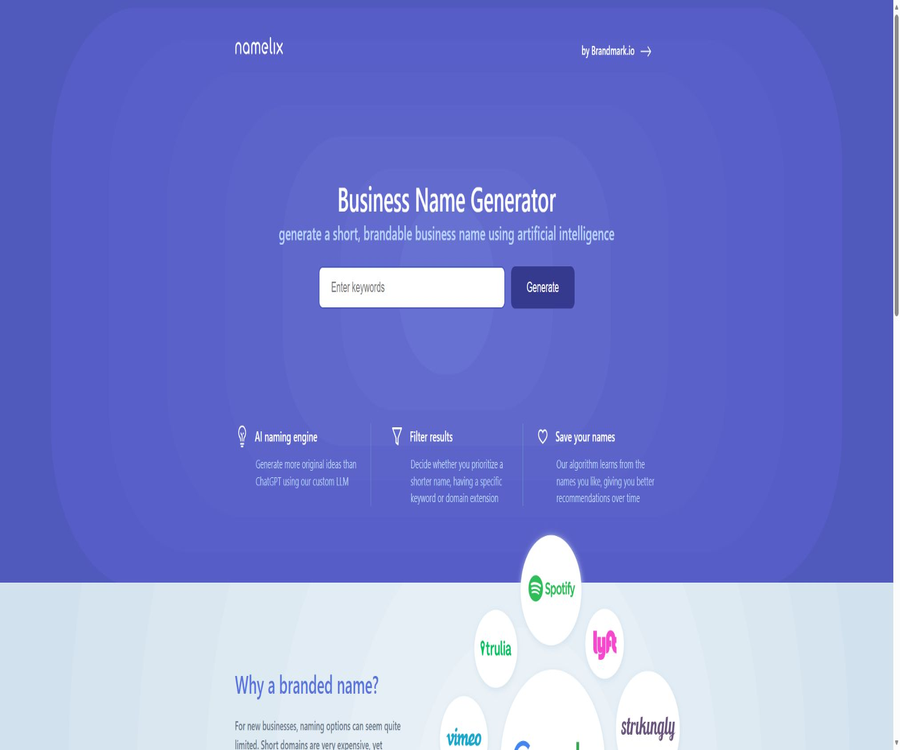
Namelix
Namelix, an intelligent tool focused on AI-driven writing.
Tags:AI writing toolsWhat is Namelix?
Namelix is an AI tool developed by Brandmark for creating company names, product names, and brand names; it addresses the issue of a lack of naming options in the early stages of starting a business. It utilizes its own LLM to generate short names, combinations, alternative spellings, phrases, or actual words based on keywords and descriptions of the business.
The database classifies Namelix as an AI writing tool, but its true purpose is to serve as a tool for creating brand names and conducting initial checks on domain names. Names can be generated directly on the website, without the need to register first or purchase a subscription.
Main functions
- Keyword-based naming: Enter the industry, product, target audience, value proposition, or emotional keywords, and the system will generate candidate brand names based on these elements.
- Business description: It is possible to add a sentence describing the product or company, which helps the model understand the relationships between keywords and reduces the likelihood of inaccurate results.
- Name style: You can choose automatic, branded names, associative names, phrases, compound words, alternative spellings, non-English words, or real words.
- Randomness control: Low results in outputs that are closer to the input words; Medium strikes a balance between relevance and creativity; High generates more varied ideas.
- Length and exclusion words: It is possible to set a maximum number of characters, and to use a blacklist to exclude words, prefixes, or suffixes that are not desired.
- Domain suffix filtering: It allows you to check common generic suffixes as well as suffixes specific to various countries or regions, so that the candidate results are prioritized based on the desired domain name.
- Saving and preference learning: After saving favorite names, the algorithm adjusts subsequent recommendations based on these preferences, which is suitable for multiple rounds of refinement.
- Domain availability: The candidate cards can show the status of a domain and enable a more comprehensive search for domains, but the indication of availability does not mean that registration has been completed.
- Preliminary trademark screening in the United States: Some of the results provide a quick assessment by the USPTO for federally registered trademarks, indicating potential conflicts as well as the applicable goods and services.
- AI name feedback: It is possible to view the automatic analysis of the meaning and suitability of a name, but the interface clearly indicates that the feedback may not be accurate.
- Logo preview: The candidate names are presented along with the corresponding logo concepts; the actual editing, downloading, and management of brand assets are carried out through Brandmark’s dedicated software.
Input and output
| Settings | You can enter or select content. | Main impacts | Usage suggestions |
|---|---|---|---|
| Brand keywords | Industry, product, value, and emotion-related words | The theme that determines the candidate names | Use 3 to 6 specific words, avoiding general industry terms only. |
| Business description | A description of the product or service | Add target customers and uses | Specify who it is intended to help and what problem it solves. |
| Name style | Branding, associations, phrases, compound words, etc. | Change the way words are formed | Generate in batches to avoid mixing too many directions at once |
| Randomness | Low, Medium, High | Control correlation and degree of divergence | Start with Medium, then test at both ends. |
| Length and blacklist | Maximum number of characters, excluded words, and suffixes | Reduce overly long or inappropriate names | Add competitor names, negative terms, and hard-to-read words. |
| Domain suffix | Generic and regional suffixes | Filter by domain preference | Do not rely on just a single suffix. |
Complete usage tutorial
- Clarify the brand positioning by identifying the target customers, core products, differentiating factors, brand personality, and words that should not be used.
- Enter 3 to 6 keywords to generate results; select a name style and a randomness level for Medium to start the first round.
- As an additional business description, specify the maximum length, excluded words, and domain suffixes that are to be checked.
- Save 5 to 10 potential names, so that the system can continue to suggest similar options based on those you have saved.
- Check the domain status, AI feedback, and the preliminary assessment by the U.S. Federal Trade Commission; however, treat these results merely as a quick way to identify potential issues.
- Check for identical names of trademarks, company names, social media accounts, and app stores in the target country or region, and examine their pronunciation and any negative connotations in different languages.
- Conduct real-user tests on the candidate names to evaluate memorability, spelling difficulty, clarity when spoken over the phone, and distinctiveness in searches.
- Identify the name first, then register the domain name, apply for a trademark, and purchase the logo files, in order to avoid encountering rights conflicts after having developed the entire visual identity.
Suitable for users and scenarios
- Entrepreneur: Develop the initial list of name options for a new company, product, feature, or sub-brand.
- Independent developers: Look for short names suitable for applications, websites, open-source projects, or SaaS services, and simultaneously check the domain names as well.
- Brand and marketing teams: They develop ideas based on the distinct characteristics of each brand, after which these ideas are screened using strategic approaches and legal procedures.
- E-commerce sellers: Create memorable names for stores, product lines, and campaigns, but must also check the platform’s and trademark-related rules.
- Students and creative projects: Find inspiration for courses, clubs, podcasts, and fictional brands without the need to purchase logo packages.
Advantages and capabilities boundaries
Actual advantages
- Name generation requires no account or subscription, making it ideal for quickly testing multiple sets of keywords.
- The name style, randomness level, length, blacklist, and domain suffixes together constitute a fairly comprehensive filtering process.
- Saving preferences helps the results converge gradually from a large number of possibilities, rather than starting over completely in each round.
- Domain names, AI feedback, and the preliminary screening for U.S. federal trademarks are included in the candidate details, thereby reducing the number of times that the tool needs to be switched.
Capacity boundaries
- The generated results may be similar to those of existing companies, products, social media accounts, or other users; no guarantee of uniqueness is provided.
- Domain availability is provided as an immediate query result, and it may become unavailable due to caching, domain squatting, premium-priced domains, or changes in the registrar’s status.
- The functions of the USPTO apply only to trademarks that are registered under the federal system in the United States; it does not cover trademarks at the state level, those governed by common law, those from other countries, or any similar trademarks.
- AI feedback may misjudge meaning, pronunciation, cultural associations, and industry relevance; it cannot replace testing by native speakers or legal advice.
- Options for non-English names do not guarantee accuracy in terms of grammar, semantics, and cultural context; they must be verified separately before entering new markets.
- The public page does not provide any commitments regarding the number of candidates, the speed of generation, the availability of the service, or the duration for which names will be retained.
Prices and Logo packages
Namelex’s name generation, filtering, and bookmarking functions are available for free at the moment; there is no subscription or payment required for name generation. Domain registration, trademark applications, and Logo files are not included in this free naming service.
| Package or version | Price | Billing cycle | Core benefits or quota | Suitable for users |
|---|---|---|---|---|
| Namelix naming | 0 dollars | Free to use | Name generation, filtering, saving, domain status, and preliminary feedback | Naming research and candidate collection |
| Brandmark Basic | 35 dollars | One-time use | PNG and vector format logo files | Those who only need basic marker files |
| Brandmark Designer | 95 dollars | One-time use | Source files, unlimited revisions, brand guidelines, one-page websites, business cards, social media and presentation design | Teams that need a complete set of foundational brand assets |
| Brandmark Enterprise | 195 dollars | One-time use | All content from Designer, along with downloads of up to 10 original custom concepts and fonts. | Companies that wish to join the manual design approach |
Brandmark is labeled as a one-time purchase with no monthly fee, and it allows for modifications after purchase; the Logo package is a related product, not a subscription for name generation via Namelix. The price of a domain depends on the suffix, the registrar, whether it is a premium domain, and the renewal terms.
Refunds and purchasing notes
- Namelix’s free naming service does not involve any refunds.
- The public pricing page of Brandmark does not clearly indicate the uniform deadline and conditions for refunds; it is necessary to check the details regarding refunds, taxes, and delivery scope on the settlement page before making a payment.
- Although Basic includes vector files, the price page does not list all formats individually; it is Designer that explicitly includes the source files for logos.
- The maximum number of manual tasks that can be handled by Enterprise is 10; the specific number of communication rounds, delivery time, and scope of customization must be determined before making the purchase.
Copyright, Trademarks, and Commercial Use
- Names generated by AI are merely suggestions; they do not mean that the platform carries out trademark checks, company registrations, or domain name reservations on behalf of the user.
- Before adopting a name, it is necessary to examine the textual trademark, the graphical trademark, homophones, similar spellings, the categories of goods and services, as well as the target market.
- The price page for Brandmark states that the paid logo package includes full copyright rights and can be used in both commercial and personal projects; however, this does not mean that third-party trademarks will not raise any objections.
- The specific license documents for icons, fonts, and custom concepts should be saved together with the downloaded assets; if necessary, consult support to confirm the conditions for transfer and delivery to the customer.
- Do not use candidate names that may mislead consumers, impersonate existing brands, or make use of celebrities’ names and protected trademarks.
Platform, API, and open-source status
- Namelix is currently a web-based tool that can be used in desktop and mobile browsers; there is no confirmation yet regarding official native iOS or Android apps or browser extensions for it.
- The AI NameLix page with a similar name in the app store cannot be confirmed as having been released by Namelix or Brandmark; it should not be considered an official client.
- No official Namelix API, SDK, authentication documentation, or pricing information for developers was found.
- The publicly available pynamelix Python package and various copycat projects are all third-party implementations; they do not represent official support, and their maintainers have stated that it is difficult to incorporate new features into them.
- No source code repository for the Namelix product nor any open-source license was found; therefore, third-party MIT projects cannot be considered part of Namelix’s open-source nature.
Privacy and data security
- Namelix uses the entered keywords, business descriptions, filtering settings, favorites, and feedback on items not liked to generate results and learn about users’ preferences.
- No current privacy policy, data retention period, deletion procedure, or option to withdraw from model training is available on the Namelix page.
- Brandmark’s general privacy policy mentions browsers, language, referral pages, time of access, IP addresses, account information, cookies, and remarketing purposes, but it does not provide detailed explanations regarding Namelix name data.
- In the absence of clear rules regarding reservations, do not enter unpublicized merger and acquisition plans, customer names, patent information, or other trade secrets.
- Saving lists and preferences may rely on the browser’s local storage or cookies; before clearing the browser data, it is necessary to manually back up the final selections.
Summary
Namelix is suitable for turning a brand name idea from a blank page into a set of comparable candidates; it is particularly useful for achieving rapid progress by taking into account style, randomness, domain names, and preliminary checks related to U.S. federal trademarks. It does not offer any guarantee of exclusivity for the name nor any legal protection; before adopting a name officially, it is still necessary to conduct checks regarding trademarks in various regions, domain names, company registration, as well as language and cultural aspects, along with user testing. The logo package should also be evaluated as an item to be purchased separately.
Tools similar to Namelix




 Guigong Network Security Registration No. 45132202000164