






Koah
Koah, an intelligent tool focused on AI-driven writing.
Tags:AI writing toolsA one-sentence summary
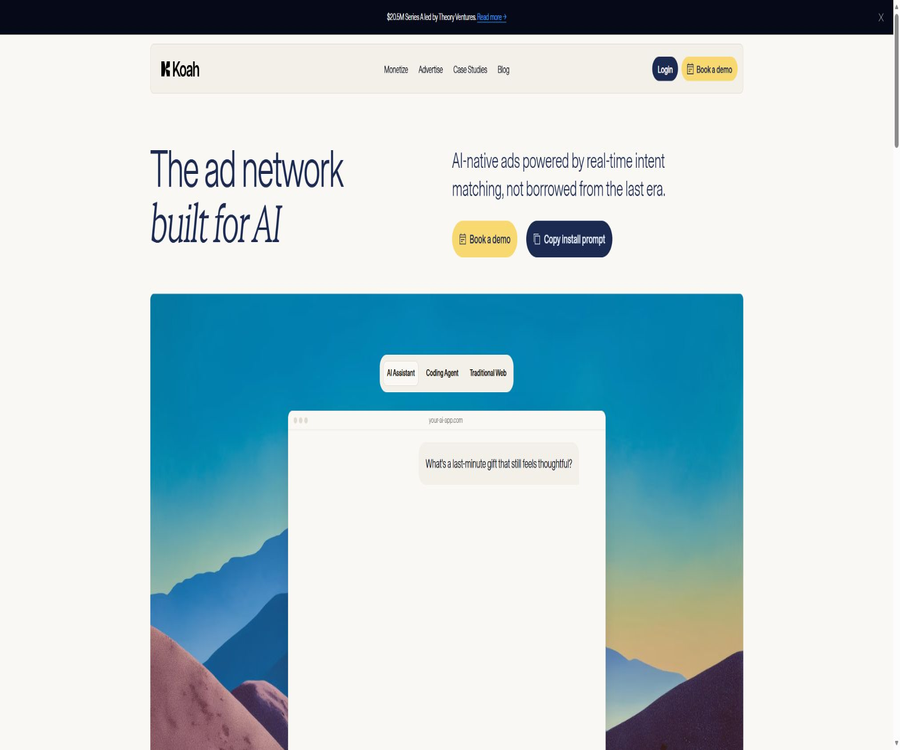
Koah is a native advertising network designed for AI chat and agent-based products; it allows the selection of ad content and presentation formats based on the intent of the current conversation, helping publishers generate revenue while also enabling brands to display ads when users ask relevant questions.
What is COPD?
Koah is operated by Koah Labs Inc., and it serves AI application publishers, new AI interfaces for traditional platforms, advertisers, as well as channel partners. Unlike traditional banner ads, the advertisements are embedded within the conversation flow in the form of clearly marked native cards, interactive questions, or product catalogs.
The platform includes a publisher SDK, functions for advertising request handling and rendering, context matching, advertiser campaigns, conversion tracking, revenue and placement reports, as well as tools for privacy and content management. Integration partners must still comply with local advertising, privacy, consumer protection regulations, and the rules of app stores.
The publisher side and the advertiser side
| Participants | What can be done with Koah? | The results obtained | It is necessary to take on the responsibility. |
|---|---|---|---|
| AI application publishers | Add advertising spaces to the chat, Agent, or content interface | Display, click, and revenue data | Experience, Privacy, Disclosure, and Store Declarations |
| Traditional platforms | Replace the existing ads on new AI chat or non-chat pages. | Contextual native ads | Compatible with existing ad stacks and user consent |
| Advertisers | Submit the brand, objectives, theme, and materials. | Gain exposure and conversions through relevant AI conversations | The content is accurate, and the budget as well as the landing page comply with relevant regulations. |
| Channel partners | Aggregate inventory from multiple publishers | Expanding ad supply and revenue | Traffic quality, billing, and customer support |
AI-native context matching
When requesting ads, the publisher provides the ad slots along with the necessary context; Koah analyzes the user’s intentions in real time, matches them to the brand’s objectives, and selects the appropriate ad format. The system handles the acquisition, rendering, and display of ads automatically, so developers do not need to assemble each ad creative themselves.
- Users pose questions or carry out tasks within AI products.
- The application passes the approved dialogue or page context to Koah.
- The platform analyzes topics, intents, devices, and available ad slots.
- The advertising market selects candidates that comply with the brand and content policies.
- The system generates or selects a native format suitable for the current scenario.
- The SDK renders advertisements and displays clear sponsorship identifiers.
- Exposure, clicks, interactions, and conversions are included in the reports.
- Publishers earn revenue, while advertisers assess the effectiveness of their ads.
The quality of context matching depends on the incoming text and the available ads. Publishers should not submit personal information, confidential conversations, or protected data that is not necessary for selecting ads.
Ad format
Koah selects the format automatically based on the size of the advertising space and the platform; developers cannot fix the format for each display. The more flexible the available space is, the greater the number of formats that can be chosen, but it is also necessary to ensure that the ads do not make the page too tall or interfere with the conversation.
| Format | Display method | Suitable for the target | Platform precautions |
|---|---|---|---|
| Action Card | Short text accompanied by clear action buttons | Direct navigation and retrieval on click | Suitable for compact advertising spaces |
| Image Card | Copy paired with a product banner image | Brand and product display | It is necessary to handle image loading and scaling. |
| Poll | Votable interactive questions | Engagement, preferences, and brand enhancement | It is necessary to explain the purpose of the interactive data. |
| Expandable | Initially compact; long content expands upon clicking. | Narration and in-depth introduction | Check the version for Web, iOS, and Android support. |
| Catalog | Scroll horizontally through multiple products or offers | Multiple product browsing | Current priority is given to supporting the JavaScript Web SDK. |
Earlier advertiser FAQs described various plain-text formats, while the current development documentation shows more diverse formats such as images, votes, expandable sections, and directories. It is necessary to check the update logs of the target SDK to determine whether a specific version is available.
Theme and interface adaptation
The SDK allows for adjustments to the accent colors, fonts, rounded corners, and interface elements, thereby making the ads more in line with the visual style of the product. The integration of ads should not undermine their recognizability; sponsorship or ad labels must remain clear, well-placed, and visible on different devices.
- Set an accent color that matches the product.
- Choose a font and font-size scheme that is compatible with the interface.
- Adjust the card’s rounded corners and appearance style.
- Limit the maximum width or height of the ad space.
- Reserve layouts for loading, empty, and error states.
- Keep the clear advertising or sponsorship labels.
- Test accessibility, dark mode, and devices with small screens.
The terms of service require publishers to retain the tags and disclosure text provided by Koah, and must not delete, obscure, reduce in size, or place them in incorrect locations. Even if the visual element of the advertisement matches the content of the chat, it must not give users the impression that it is a neutral recommendation from AI.
Publisher SDK
| Platform | Access method | The SDK is responsible for it. | Suitable for projects |
|---|---|---|---|
| JavaScript | Scripts and unified ad requests | Acquisition, rendering, tracking, and themes | Web chat and content products |
| React | Components, Hooks, and JSX | Component-based ad presentation | React Web applications |
| React Native | Expo or native project components | Move native views and events | Cross-platform mobile apps |
| Flutter | Dart component package | Flutter interfaces and tracking | Flutter apps |
| iOS | Swift Package or XCFramework | Native ad views and privacy list | Swift and iOS apps |
| Android | Kotlin and Jetpack Compose components | Native ad views and events | Android apps |
All SDKs follow a similar process: installing the library, initializing it using a Publisher ID, rendering the first ad, and then configuring the theme and ad context. The actual package version, minimum system requirements, and available formats can be found on the reference pages and update logs for each respective platform.
Connection steps
- Apply for a publisher account and complete the platform’s verification process.
- Obtain the Publisher ID from the console.
- Choose JavaScript, React, React Native, Flutter, iOS, or Android SDK.
- Install and initialize the SDK in the testing environment.
- Create ad slots that will not interfere with core tasks.
- Only the context required to complete the matching is passed in.
- Configure the theme, size, and clear disclosure labels.
- Test ads, empty content, network failures, and error conditions.
- Complete the approval process for data management and submission to the app store.
- After going live, monitor revenue, fill rate, clicks, retention, and complaints.
Koah also provides skills for installing coding agents; developers can use compatible coding tools to read instructions and select the appropriate SDKs. Even after automatic integration, engineers are still required to review the code, keys, data fields, and platform policies.
APIs and reports
In addition to the client SDK, Koah also provides REST APIs for managing publishers and retrieving reports. Advertisers can use conversion pixels to record events such as purchases and registrations, and they can assess the effectiveness of their campaigns based on impressions, clicks, and conversions.
| Data or interface | Uses | Key checks |
|---|---|---|
| Publisher management | Managing publisher accounts and configurations | Permissions, key rotation, and multi-application isolation |
| Reporting | Obtain reports on views, clicks, revenue, etc. | Time zone, attribution window, and latency |
| Impression | Track the effective display of advertisements | Visibility definition and recurring events |
| Click | Log user clicks | Invalid clicks and bot filtering |
| Conversion | Measure outcomes such as purchases and registrations | Agreement, attribution, and repeated conversion |
| Polls and interactions | Measuring engagement in ads | Do not infer sensitive personal attributes. |
| Ad Report | Reasons for receiving user reports | Review, removal from service, and feedback loop |
The backend reports should be verified against the analysis results and settlement statements. Advertising revenue, clicks, and conversions can be affected by factors such as invalid traffic filtering, attribution windows, refunds, region, device type, and the availability of ads.
Advertiser placement process
Advertisers first submit their brand, objectives, theme, and existing materials; based on this information, Koah generates and optimizes ads suitable for AI-driven scenarios. The system identifies relevant intents during real-time conversations, and advertisers can manage their campaigns using metrics such as Campaigns, Ad Groups, creatives, spending, impressions, clicks, and conversions.
- Explain the brand, products, and advertising objectives.
- Select the topics you wish to see and the scenarios that are prohibited.
- Provide landing pages, brand guidelines, and compliance materials.
- Determine the budget and the billing method, whether it is CPM or CPC.
- Review the copy and format generated by the platform.
- Set the region, device, and theme settings.
- Configure conversion events and attribution rules.
- Start with a small budget to test a real conversation environment.
- Optimized based on clicks, conversions, brand security, and Pulse insights.
Positioning and Pulse Insights
Advertisers can target their campaigns based on location, device, and search topics. Koah emphasizes real-time, first-party intent – that is, the questions users pose within AI products at the moment – rather than relying solely on traditional demographic data or historical browsing patterns.
Each campaign generates a Pulse report, which allows one to see the questions asked by users before they click, the context in which the ads appear, and which expressions are most suitable to meet those needs. The reports should be used in an aggregated and anonymized manner; it is not permissible to use them to identify or track individual people.
Pricing, Revenue, and Settlement
The price information was verified on August 23, 2026; the actual amounts, taxes, exchange rates, and discounts may vary, and the final figures will be those displayed on the settlement page.
Koah does not disclose any fixed percentage of revenue shared with publishers, minimum payment amounts, settlement periods, or guaranteed earnings. Publishers’ income varies depending on the volume of requests, region, device type, content category, availability of ads, format, as well as performance in terms of views and clicks.
| Object or pattern | Price method | Public status | Confirmation is needed. |
|---|---|---|---|
| Publisher integration | Apply or schedule a demonstration | Platform fees or royalties are not disclosed. | Revenue share, payment cycle, and minimum amount |
| Awareness ads | CPM is charged per thousand impressions. | There is no publicly available fixed CPM. | Budget, region, inventory, and invalid traffic |
| Other advertising objectives | Fixed CPC, charged per click | There is no publicly fixed CPC. | Click to define the rules for limits and refunds. |
| Channel collaboration | Customized business contracts | Not disclosed | Responsibilities for division, inventory, support, and settlement |
| SDK and API | Provided along with the partnership. | No public subscription price available. | Call restrictions, support, and SLA |
The revenue, eCPM, CTR, and percentage increases shown on the official website are part of the platform’s demonstration or marketing statistics, and should not be regarded as guarantees of earnings for individual publishers. Before integrating with the platform, it is necessary to make conservative estimates based on one’s own traffic volume, user location, and ad acceptance rate.
Privacy design
Koah makes use of context-based matching and anonymized audience data, and it states that specific data related to publishers and advertisers is not shared among the parties involved. Personal information is anonymized and the content is reviewed before any advertising requests are processed, while reports are provided in an aggregated and anonymized format.
| Data | Primary uses | Is it used for cross-application tracking? | Publisher responsibilities |
|---|---|---|---|
| Dialogue or page context | Show relevant ads | No | Only transmit the necessary text and disclose it to the user. |
| Device and application information | Format compatibility, diagnosis, and invalid traffic filtering | No | Declare it in the privacy statement. |
| IP and approximate location | Geographic matching, reporting, and anti-fraud | No | Indicates rough position handling. |
| Installation-level random ID | Stable sessions and attribution | No | Submit by device ID category |
| Exposure, clicks, and votes | Measurement, settlement, and quality | No | Disclosure of ad interaction data collected |
| Age, gender, income range | Optional target audience targeting | No | It is only transmitted when it is legal, necessary, and with consent. |
The mobile SDK does not read the Apple IDFA or Android Advertising ID, nor does it create profiles across different applications or websites. It still sends to Koah advertising context, device information, an approximate location inferred from the IP address, a random client ID, and interaction events; therefore, it cannot be said to collect no data at all.
Filing with the mobile app store
The Koah documentation provides mappings for the Apple App Privacy and Google Play Data Safety fields. Developers must include, in addition to the data provided by the Koah SDK, the data collected by their own application as well as other SDKs; they cannot simply copy a statement and ignore the rest of the application’s data.
- In Apple, device IDs, product interactions, approximate location, and diagnostic data are reported.
- Declare the user’s content additionally when the user’s chat text is transmitted.
- When using age, gender, or income range, fill in the corresponding optional fields.
- Declare device identity, interactions, location, and diagnostics in Google Play.
- It has been confirmed that Koah does not utilize Advertising ID permissions.
- Check the Flutter project to see if it is necessary to manually add items to the privacy list.
- Re-evaluate the IDFA and ATT requirements when using the optional AdMob adapter.
- Recheck the data list after each SDK upgrade.
The core SDK of Koah does not require the Apple ATT prompt, but other advertising or analytics SDKs used in an application may need it. Publishers should make decisions based on the actual behavior of all components, rather than relying solely on the instructions provided by Koah.
GDPR, U.S. state laws, and child protection
In the European Economic Area and the UK, the application operator is the controller of user data and must establish an appropriate legal basis before initializing Koah; this usually involves using a consent management platform to control data loading. Under state laws in the United States, notifications must be provided, as well as the option to refuse sales or sharing of data.
| Rule-based scenarios | Requirements for Koah documents | Product implementation |
|---|---|---|
| GDPR and UK privacy | Obtain a valid basis before initialization. | Place the SDK loading in the approved state after giving consent. |
| CCPA and similar state laws | Provide notifications and respect any refusal to choose. | Connects the privacy center with the SDK switch |
| Children's apps | Not applicable to applications and sections designed for children. | It is not allowed to embed in products intended primarily for children. |
| Audience of mixed ages | Use neutral age filtering. | The ad is not initialized when the conditions are not met. |
| Under 13 years of age | The mobile SDK ignores the relevant age settings. | One cannot rely on technical limitations as a substitute for compliant design. |
| Delete request | Supports requests to delete. | Establish user identity and event localization processes |
Brand safety and content policies
Koah carries out content review for each display in accordance with the brand guidelines, and filters out robotic and fraudulent traffic. Ads must have clear labels, and they cannot contain misleading, offensive, or inappropriate content.
- Set allowed and prohibited topics.
- Verify that the generated copy matches the brand facts.
- Block restricted goods and illegal landing pages.
- Avoid disguising advertisements as AI-neutral suggestions.
- Provides a mechanism for users to report issues and to close them.
- Monitor abnormal clicks and automated traffic.
- Increase manual review for high-risk industries.
- Save the creative versions and deployment records.
Generative advertising can change dynamically depending on the context, so advertisers cannot rely on a single static version of the ad. The contract and the control panel should clearly specify the allowed boundaries for creative content, sensitive topics, procedures for dealing with incorrect statements, and processes for shutting down campaigns urgently.
GitHub and the open-source status
Koah has an official GitHub organization that contains publicly available versions of the Swift Package Manager advertising SDK wrappers, AdMob integration projects, the Skills product, as well as a branch for privacy-related research. The Swift-related repositories are licensed under Apache-2.0, while the Skills and OpenClio repositories are licensed under the MIT license.
| Public projects | Uses | License | Correct understanding |
|---|---|---|---|
| Swift Koah Ads package | Distribute iOS advertising components via Swift Package Manager | Apache-2.0 | It belongs to the client connection package. |
| Swift AdMob adaptation package | Connect Koah to Google Mobile Ads | Apache-2.0 | Using it will change the privacy declaration. |
| Koah Skills | Provide public skills for Koah products. | MIT | Develop supplementary content |
| OpenClio branch | Research on Insights into the Use of AI for Privacy Protection | MIT | It is not the core source code of the advertising platform. |
| Advertising market and backend | Matching, bidding, and services for advertisers and publishers | Not disclosed | The core business platform cannot be marked as open source. |
Making the SDKs and adapters available publicly helps in monitoring client behavior, but it does not include the advertising market, matching algorithms, as well as the backend and settlement systems. The open-source status of the product should be indicated as follows: the core platform remains closed source, while some of the components are available in open source form.
Which users are it suitable for
- Publishers that offer consumer-grade AI chat products.
- Teams that develop coding agents, efficiency tools, or search assistants.
- Platforms that add AI dialogue interfaces to traditional products.
- AI startups that hope to supplement their subscription revenue with advertising.
- Brand advertisers seeking to reach AI users with high intent.
- An advertising network that aggregates the inventory of various AI applications, along with channel partners.
- Teams are needed to develop advertising SDKs for web and mobile platforms.
Product advantages
- Specifically designed for AI dialogue and agent interfaces.
- Match ads using the current context, rather than relying solely on historical profiles.
- It supports a variety of native and interactive ad formats.
- Covers Web, React, cross-platform mobile, and native SDKs.
- Automatically handles ad acquisition, rendering, tracking, and targeting.
- A complete market is formed between publishers and advertisers.
- The guidelines for public data collection and store reporting are quite specific.
- The core mobile SDK does not read the IDFA or Android Advertising ID.
- Some of the official Swift integration packages and skills are made available to the public.
Main limitations
- The publisher’s share, the minimum payment amount, and the payment cycle are not disclosed.
- There are no publicly fixed unit prices for advertisers’ CPC and CPM.
- In areas where revenue depends heavily on traffic, devices, topics, and advertising demand.
- Ads may influence users’ assessment of the neutrality of AI responses.
- The conversation context will still be sent for ad matching.
- Certain formats are available only in specific SDKs or versions.
- Applications primarily aimed at children are not suitable for connection.
- Publishers still need to handle consent, state laws, and store registrations on their own.
- Using the AdMob adapter introduces additional tracking and permission considerations.
- The core advertising market and settlement platform are not open source.
Access Assessment Checklist
- Verify that the advertisement is in line with the product’s positioning and users’ expectations.
- Estimate whether advertising revenue can cover the costs associated with providing the experience and ensuring compliance.
- Select pages with low interference and advertising spaces to conduct tests with low traffic volume.
- Check the formats and data fields supported by each SDK version.
- Remove personal information and corporate secrets from the context.
- Configure consent management, state law exit, and child filtering.
- Complete the privacy declarations for the Apple and Google stores.
- Verify that the ad label is clearly visible on all devices.
- Test without padding, errors, offline conditions, and slow network connections.
- Compare revenue, clicks, retention, complaints, and task completion rates.
- Confirm the split, payment, invalid traffic, and termination terms.
- Establish processes for advertiser blocking, emergency suspension of campaigns, and data deletion.
Frequently Asked Questions
Who is COPD meant for?
On one end, it serves publishers who wish to generate advertising revenue from AI-based products; on the other end, it serves advertisers who want to display their brand’s ads in AI-driven conversations with high intent, and it also supports channel partners.
Which development platforms does Koah support?
It offers integration methods for JavaScript, React, React Native, Flutter, iOS, and Android, as well as publisher and reporting APIs.
What are the different ad formats?
The current document lists formats such as Action Card, Image Card, Poll, Expandable, and Catalog. The actual range of available formats depends on the size of the advertising space, the platform, and the version of the SDK.
How much can publishers earn?
There are no fixed guarantees. Revenue is influenced by the volume of requests, the users’ location, the device used, the topic in question, advertising demands, the format, as well as performance in terms of views and clicks; details regarding earnings and payment are determined after an application is submitted.
How do advertisers calculate fees?
For the Awareness goal, CPM is used, while for other goals a fixed CPC is applied. Koah does not disclose a unified price; the actual price depends on the campaign and available inventory.
Does Koah read the IDFA?
The core mobile SDK does not read the IDFA or Android Advertising ID, nor does it perform tracking across different apps or websites. The optional AdMob adapter introduces Google Mobile Ads, which requires a reevaluation of the relevant permissions.
Is an Apple ATT popup required?
When only the Koah core SDK is used, there is no need to display an ATT popup specifically for Koah. If there are other tracking SDKs in the application, a decision should be made based on the overall data behavior.
Can it be used in children’s applications?
It is not suitable. Koah makes it clear that its third-party advertising services are not designed for apps aimed at children, the Apple Kids category, or Google Family Plan.
Is Koah open source?
The core advertising market, matching, and settlement platforms are not open-source projects. Some Swift integration packages, adapters, and Skills are available on the official GitHub repository, licensed under the Apache-2.0 or MIT licenses.
Summary
Koah offers AI applications a complete set of tools for generating revenue, including context-based ad matching, native ad formats, cross-platform SDKs, as well as reporting functions and options for advertisers to place ads. It is suitable for publishers who wish to earn additional income beyond subscriptions and who are committed to maintaining transparency and quality in the advertising experience.
Before connecting, it is essential to verify the commercial revenue sharing, actual earnings, handling of conversation context, user consent, store registration requirements, and restrictions related to children. The official documentation provides detailed information on the mobile data fields, but the fixed prices, payment rules, and the source code of the core platform remain undisclosed.
Tools similar to Koah




 Guigong Network Security Registration No. 45132202000164