






Hello History
Hello History: an intelligent tool focused on AI-driven writing.
Tags:AI writing toolsA one-sentence summary
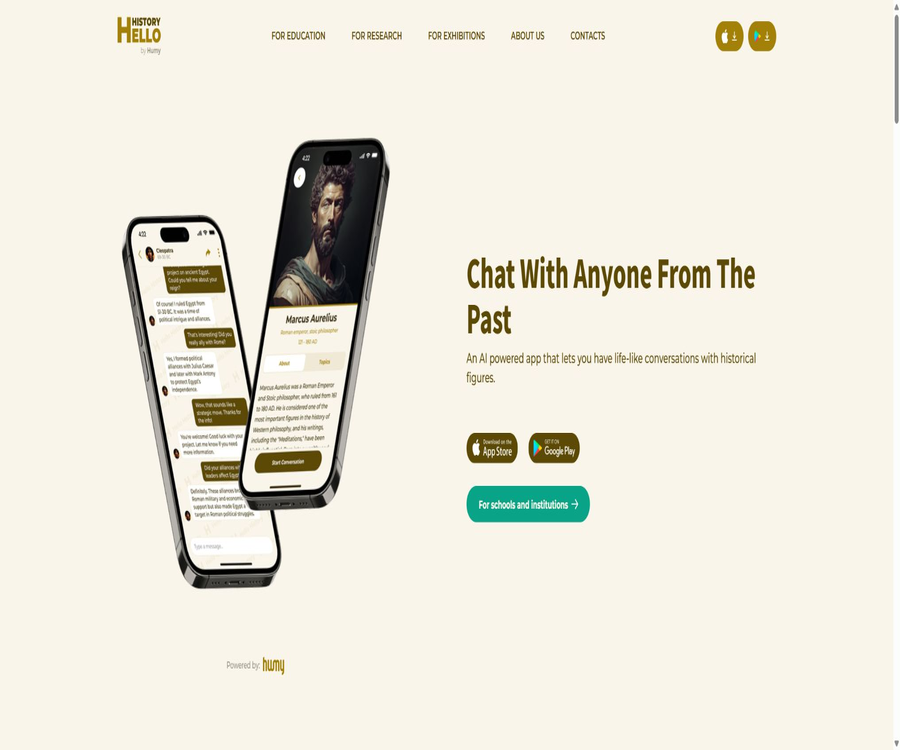
Hello History is an AI-powered application for interacting with historical figures; it allows users to converse with simulated historical personalities via text or voice, and to explore history, philosophy, science, and culture through first-person questions, debates, and role-playing.
Tool Introduction
Hello History was developed by the Swedish company FACING IT International AB, with the educational aspects of the service being managed by the Humy team. Individual users primarily use it through iOS and Android apps, while schools and teachers rely on web tools that are gradually provided by the Humy platform.
Large language models are used to generate responses in real time based on information about individuals and the questions posed by users; these are not recordings of actual historical figures, their memories, or statements that have been verified sentence by sentence by humans. Such tools can help stimulate interest and prompt research questions, but they cannot replace textbooks, original documents, or reliable academic materials.
Current product status
| Project | Current situation | Explanation |
|---|---|---|
| iOS apps | It can still be downloaded; version 3.5.1 | Updated in October 2025; compatible with iPhone and iPad |
| Android apps | It can still be downloaded. | The store indicates an update in August 2024 and over 100,000 downloads. |
| Personal website | The mobile app is still displayed. | 20 and 30 free messages are written on the page at the same time, with inconsistent wording. |
| Educational Web Version | Provided by the Humy platform. | For teachers, schools, universities, and museums |
| Number of characters | The old individual page listed over 400 items, while Humy’s current education database is larger. | Different products and packages cannot be combined into a single set of benefits. |
| Model | The official website states that it uses advanced AI models with reasoning capabilities. | The store’s description still mentions GPT-4; the specific model number has not been disclosed yet. |
Main functions
One-on-one chats with historical figures
After selecting a character from the list, users can ask questions, discuss, or debate; the answers are generated dynamically based on the current conversation. Different phrasings may lead to different answers, which means it functions more like a character-based AI simulation rather than a fixed historical encyclopedia.
Figures and themes across various fields
The characters and themes cover areas such as art, music, literature, philosophy, science, technology, justice, and military strategy. The official website listed over 400 characters; the educational platform offers an even greater number of historical and fictional characters, though the available count depends on the products and packages chosen.
Planning theme
The application offers organized topic entries to help users initiate conversations based on a person’s life experiences, the historical context, or a specific field of study. By providing these themed topics, the barrier to asking questions is reduced; however, this does not mean that all the information presented has been academically verified.
Voice character experience
Version 3.0 introduces voice dialogues for iconic characters, attempting to read the AI-generated content in a style that matches that of the characters. The so-called authentic or characteristic voices are synthetic simulations and should not be construed as original recordings left by the actual characters.
Session saving
Mobile apps allow chat history to be retained across different sessions, making it easier to continue following the same person. The privacy policy regarding chat history is somewhat outdated; users should not enter sensitive personal information in these chats.
Character search and continuous updates
The application offers a function for searching for characters, and it allows users to request the addition of new ones. The store’s update records show that new characters have been continuously added and the user experience has been improved, but the dates of recent updates vary across different platforms.
Educational role-playing
Teachers can have students simulate interviews, debates, or historical scenarios in order to discuss events from various perspectives. The educational web version also allows AI characters to be integrated with course materials, assignments, and classroom activities.
Teacher-generated content
The Humy education platform provides lesson plans, classroom activities, quizzes, and homework assignments, as well as support for automatic grading. It is part of a more comprehensive set of tools for teachers; not all of these functions are available through the individual Hello History mobile subscription.
No need to share student accounts
Teachers can share educational AI chat sessions through classroom links; students do not need to use their real names, email addresses, or personal accounts. Administrators can also control access to the assistant, as well as view usage statistics and chat records, with specific permissions determined by the school’s settings.
Which users are it suitable for
- History enthusiasts: Learn about the lives of individuals, their views, and the historical context through dialogue.
- High school and university students: Practice interview questions, compare different perspectives, and identify potential areas for further research.
- History and Sociology Teachers: Design role-playing, discussion, debate, and reflection activities.
- Parents: Use interactive methods to help children develop an interest in history.
- Language learners: Practice reading, asking questions, and expressing themselves through character dialogues.
- Museums and educational institutions: Evaluating customized characters, courses, and interactive exhibition experiences.
Typical teaching scenario
- Interview with a person: Students prepare questions and interview a politician, scientist, or artist.
- Debate of opinions: Have two historical perspectives discuss the same event, and then verify the historical facts.
- Comparative analysis of eras: Comparing the views of people from different periods regarding rights, technology, or social systems.
- Critical analysis of historical sources: Identify sections in AI-generated responses that lack evidence, are anachronistic, or use modern terminology.
- Preparation for writing: First, create a list of questions through discussions, and then use reliable sources to complete the paper.
- Language practice: Practice asking questions and repeating phrases in the target language around familiar historical topics.
Tutorial for individual users
- Install Hello History from the official app store, and verify that the developer name matches the current privacy label.
- To create an account or start using the service, first check the remaining free messages and the subscription price in your area.
- Choose a familiar person and start the conversation with questions that include the time, place, and scope of the events.
- Characters are required to distinguish between known facts, assumptions, and personal opinions, and not to raise only general questions.
- Record the key statements as items to be verified, and check each one using textbooks, archives, or reliable research.
- Before purchasing a subscription, check the auto-renewal settings, message limits, and ways to cancel it.
Classroom usage procedure
- The teacher first sets learning objectives and selects characters that are appropriate for the scope of the course and the age of the students.
- Provide background materials and a list of facts, emphasizing that AI may generate fabricated content and should not be regarded as historical evidence.
- Create or select AI characters using Humy, and share them through class links rather than personal accounts.
- Have students save the questions, answers, points of doubt, and materials used for verification.
- Organize groups to compare different responses, identifying biases, missing perspectives, and anachronisms.
- The evaluation is based on the students’ verification process and the quality of their arguments, rather than on the length of the AI-generated responses.
How to design better historical questions
- Include specific years, locations, events, and relationships between characters to reduce the room for arbitrary interpretation by the model.
- Ask the person about the information they might have had at that time; there is no need for them to comment on events that occurred after their death.
- It is required to indicate the basis for one’s views and the uncertainties involved, followed by independent verification.
- Separate factual issues from issues related to positions and roles, and avoid treating simulated opinions as historical facts.
- Use multiple characters to discuss the same event, in order to observe differences in power, social class, region, and era.
- Prevent controversial figures from becoming unregulated spokespersons for hate, violence, or discrimination.
Price and subscription
The Hello History mobile app can be downloaded for free; it offers a limited number of sample messages, and subscription is required to unlock more messages about historical figures. One section on the official website states that 20 messages are available for free, while another mentions 30; the actual number of free messages is determined by what is shown for a new account.
| Plan | Reference price | Billing cycle | Core benefits or quota | Suitable for users |
|---|---|---|---|---|
| Free trial on mobile | Free | One-time usage limit | The official website shows 20 or 30 items, but the actual number depends on the account. | First-time users |
| Monthly access | 6.99 dollars | Automatic monthly renewal | HH Unlimited and more messages | Individuals who use it on a continuous basis over a short period of time |
| Yearly access | 39.99 dollars | Automatic renewal every year | HH Unlimited and more messages | Long-term learners |
| Old weekly or monthly in-app purchases | 1.99 to 4.99 dollars, and so on | Weekly or monthly payment | The store still displays various historical or regional items. | Select only when the benefits are clearly specified on the settlement page. |
| Education Web Free | $ | Free plan | Basic features such as single-user access and 10 messages per month | Teachers trying out Humy |
| Education Web Plus | 129 dollars | Per user per year | More characters, teaching tools, and annual message quota | Independent teachers and learners |
| Schools, universities, and museums | Contact sales | Institutional contracts | Multiple teachers, administrators, as well as course and data protocols | Educational institutions |
Message limit
The mobile store states that subscribed users can send up to 10,000 messages per month; however, this limit, as well as the rules regarding reasonable use and the capabilities of the system, may be adjusted. The educational web version has its own limits on messages or generation capacity, and these cannot be replaced by the limits set for mobile subscriptions.
Automatic renewal and refunds
- Mobile subscriptions are automatically renewed on a weekly, monthly, or annual basis; it is necessary to check the current billing details in the store before making a purchase.
- Automatic renewal must be turned off at least 24 hours before the end of the current period.
- The account may be charged for renewal within 24 hours before the end of the period.
- Unused subscription periods are generally not refundable; exceptions are determined by the app store’s policies.
- After purchasing a subscription, any unused free trial period may expire immediately.
- The currencies, taxes, price ranges, and available options vary depending on the country and store.
Platform and version
| Platform | Current status | Requirements or instructions |
|---|---|---|
| iPhone | Support | iOS 15.1 or later is required. |
| iPad | Support | iPadOS 15.1 or later is required. |
| Mac with Apple chip | The iPad version is available for use. | Requires macOS 12.0 and an Apple M1 or newer chip |
| Apple Vision | The store is listed as compatible. | The current store compatibility information shall prevail. |
| Android phones and tablets | Support | Google Play apps can still be installed. |
| Chromebook | Supports Android apps | Install via Google Play |
| Education Web | Provided by Humy | Targeted at teachers, students, and institutions; it is not equivalent to a personal mobile version. |
Model and response accuracy
The mobile app still relies on GPT-4 as its core technology, while the official website refers more generally to the use of advanced AI models with reasoning capabilities. Since these models may be updated in the background, it is not possible to ensure that the same specific version will always be used across all platforms and in every interaction.
Both the official app instructions and the terms of service advise users not to rely entirely on the content generated by the system. The models may fabricate quotes, mix up dates, replace historical contexts with modern values, or have characters express information about future events that they could not possibly know.
| Risk | Common manifestations | Verification method |
|---|---|---|
| Anachronism | A person talks about events or concepts that occurred after their death. | Check the dates of birth and death of the individuals as well as the timeline of events. |
| Fictional quotes | Generate seemingly reasonable but non-existent quotes. | Search for reliable versions and the original text. |
| Simplified stance | Reduce complex characters to a single perspective. | A considerable number of works and studies from various periods |
| Mixed facts | Combine multiple characters, locations, or events. | Check the name, date, and relationship item by item. |
| Modern expression | Using language or moral frameworks that are not in line with the times. | Distinguish between instructional paraphrasing and historical context |
| Voice deception | Synthetic voices make the content appear more realistic. | View the voice as an AI performance rather than a historical recording. |
Privacy and data processing
The consumer privacy policy states that the application collects account email addresses, passwords, and device information, and it makes use of services such as Firebase, RevenueCat, and OpenAI. The policy also specifies that the service provider does not store conversations on its own servers; however, the AI service providers may process these conversations in order to offer or improve their services. This statement should be understood with caution, taking into account the policies of the respective service providers.
| Data category | Public explanation | Risk control |
|---|---|---|
| Account information | It may collect email addresses, names, passwords, and device information. | Use a separate password and enable account protection for the store. |
| Dialogue content | Send it to the AI service provider for processing. | Do not enter real information regarding students, health, finances, or identity. |
| Payment | Handled through RevenueCat and app stores | Buy only from the official store and verify renewals. |
| Use advertising data | It may be used for analysis, measuring ad effectiveness, and cross-app tracking. | Limit tracking and advertising identification in device settings |
| Location and diagnosis | The store’s privacy label lists approximate location and performance data. | Check system permissions and disable unnecessary access. |
| International transmission | The data may be processed in Sweden, the United States, or other locations. | Institutional users confirm the region and sub-processors through DPA. |
| Retention period | Retained for services, disputes, audits, and legal requirements | Apply for access, export, or deletion before cancellation. |
Student data needs to be distinguished from the personal version.
The Humy education page states clearly that student messages will not be used for training models or in advertising, and it offers data processing agreements. This commitment applies to educational uses only; it cannot be assumed automatically that all conversations in personal mobile applications are covered by the same protective terms.
Schools can use class links that do not require real student names, email addresses, or accounts; administrators can then monitor usage and chat records. Teachers should still adhere to the school’s policies, obtain the necessary approvals, and inform students in advance about who can view those records.
Product advantages
- Turning characters, eras, and disciplinary knowledge into interactive dialogues stimulates questions more easily than passive reading.
- It covers historical figures from various fields, making it suitable for interdisciplinary classrooms and individual exploration.
- Text and synthesized speech offer different immersive experiences.
- Questions and answers change according to the user’s interests, making it suitable for open discussions.
- The Humy educational version provides classroom links, teacher tools, assignments, and institution management.
- Official guidance emphasizing the need to verify facts helps integrate AI literacy into teaching.
Usage restrictions and precautions
- The responses provided by historical figures are AI-generated simulations, not actual testimony, real interviews, or authoritative historical sources.
- Characters may invent facts, quotes, and causal relationships; important information must be verified independently.
- Synthesized speech may enhance the illusion of authenticity, and it is particularly important to explain this to minors.
- The number of free messages available on a personal website varies between 20 and 30.
- The App Store offers various weekly and monthly in-app purchases; the benefits and prices must be confirmed prior to settlement.
- iOS and Android have different update schedules, so their features may not be identical.
- The accounts, prices, quotas, and privacy policies for the mobile personal version and the Humy Education web version differ from one another.
- The guidelines in the consumer privacy policy regarding how AI service providers handle sessions may change depending on the rules set by those providers.
- The information in the main app stores is displayed in English; the performance and layout in other languages require actual testing.
- When dealing with topics related to trauma, war, hatred, or controversial figures, age-appropriate adjustments and teacher guidance are necessary.
API, GitHub, and open-source status
No public APIs, SDKs, plugins, or official developer documentation for Hello History have been found. The features related to customized school characters and classrooms are part of Humy’s commercial platform services, and they do not represent open programming interfaces.
Hello History is not an open-source product; there is no official code repository available for self-hosted mobile applications, character prompts, or models. Third-party projects with similar names that offer historical chat functions cannot be considered official versions of it.
Basic information
| Project | Content |
|---|---|
| Tool name | Hello History |
| Development company | FACING IT International AB |
| Education brands | Humy |
| Tool type | AI chat with historical figures and educational role-playing |
| Core interaction | Text-to-speech dialogue synthesis |
| Price pattern | Free trial, mobile subscription, and educational web packages |
| Supported platforms | iOS, iPadOS, Android, Chromebook, and Humy Web |
| Age grouping | App Store 9+,Google Play 10+ |
| Whether API is provided | No findings were detected. |
| Is it open source? | No |
Frequently Asked Questions
Is Hello History free?
It is possible to download it for free and receive a limited number of free messages, but the official website mentions both 20 and 30 as the possible numbers. Once the free usage limit is reached, it is usually necessary to purchase an auto-renewing subscription.
Are the answers from Hello History reliable?
It cannot be assumed to be reliable by default. The authorities explicitly warn that AI-generated content may contain errors; learners should verify dates, quotes, relationships between individuals, and the historical context.
Can one hear the voices of historical figures?
The mobile version now offers a synthesized voice experience with character-specific styles. Both the voices and dialogues are generated by AI; they are not actual recordings of the characters themselves.
Can schools use it?
Yes, the capabilities related to education on the Web are mainly provided by Humy; these include classroom links, teaching tools, administrative controls, and institutional plans. Schools should handle student data through education contracts and DPA agreements.
How many messages are included in the subscription?
The mobile store states that after subscribing, up to 10,000 messages can be sent per month; however, this figure may change depending on reasonable usage and product limitations. The Humy educational version uses a different set of annual or monthly quotas.
Does Hello History offer an open source version or APIs?
No official open-source code or public API has been found. It is a commercial application operated by FACING IT and Humy.
Summary
Hello History transforms traditional history learning into an interactive exploration through conversations featuring historical figures; text, audio, and characters from various fields help stimulate questions. The mobile version is suitable for casual learning, while schools benefit more from Humy’s classroom and management features.
Its educational value depends on whether fact-checking is incorporated into the process, rather than on treating the AI as an authority figure. Before making a purchase, it is also necessary to distinguish between individual plans and educational packages, and to check the prices in different regions, as well as the options related to automatic renewal, message limits, and privacy policies.
Tools similar to Hello History




 Guigong Network Security Registration No. 45132202000164