






Eilla
Eilla, an intelligent tool focused on AI-driven writing.
Tags:AI writing toolsA one-sentence summary
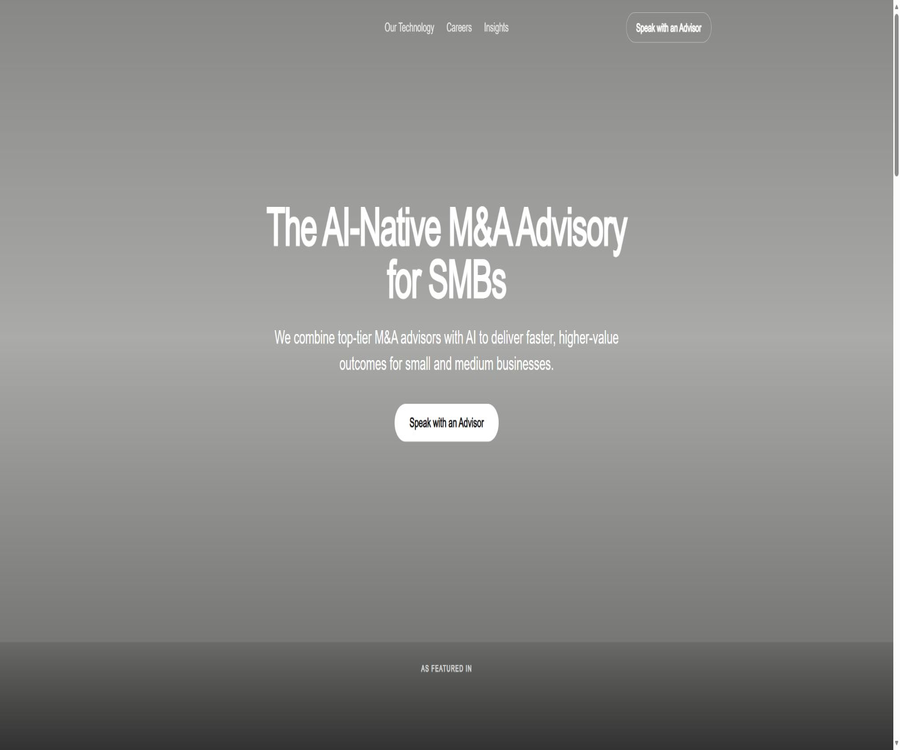
Eilla is an AI-driven M&A advisory service aimed at suppliers in small and medium-sized enterprises; it leverages the expertise of experienced M&A advisors together with AI systems to identify potential buyers, prepare transaction documents, develop financial models, engage with those buyers, and manage due diligence processes.
Tool Introduction
Eilla is operated by the British company Eilla AI Ltd. Its official website presents it as an AI-driven M&A advisory service, rather than a chat tool that ordinary users can subscribe to on their own. Companies need to first communicate with the advisors before they can access the customer platform and the related transaction services, through separate agreements.
The core idea is to use AI to handle repetitive tasks such as company research, document organization, drafting of models, and answering questions related to due diligence, while experienced consultants are responsible for making decisions regarding transactions, identifying opportunities, managing relationships, conducting negotiations, and carrying out final reviews. The information on the website does not constitute investment, legal, tax, or any other type of professional advice.
Current product positioning
| Clients/Service recipients | Main requirements | Eilla’s role | Delivery method |
|---|---|---|---|
| Founders of small and medium-sized enterprises | Sell the entire asset or the control rights. | Seller M&A advisor | Consultant-led transaction projects |
| Shareholders of growing companies | Seeking strategic or financial buyers | Establish a buyer competition process | Buyer screening, contact management, and quote management |
| Management team | Prepare materials and due diligence data | AI organization plus consultant review | Customer platform and project collaboration |
| Investment firms and banks | Research, valuation, peer and buyer analysis | AI Analyst platform | Demonstrations and customization for enterprise use |
The official website still features a page for the AI Platform aimed at VC professionals, PE investors, and M&A specialists, but the main focus of sales on this site is currently advisory services for small and medium-sized enterprises as sellers. The contracts, data, permissions, and pricing related to these two types of customers should not be mixed together.
Main functions and services
Large-scale buyer screening
Eilla’s technical page states that it selects potential buyers from over 8 million companies, ranking them based on acquisition history, industry synergy, payment capacity, and other factors. The size of the database is an indicator of the platform’s reach; it does not mean that every project will come into contact with all of those companies.
Proprietary and licensed data
Buyer research takes into account structured data from public web pages, authorized data sources, as well as the acquisition preferences shared directly by buyers. The official website lists data sources such as Capital IQ, LinkedIn, and Crunchbase, but access to the original data fields is subject to authorization and contractual restrictions.
Reasons for buyer matching
Potential buyers are not listed merely based on their industry; information such as the rationale for acquisition, potential synergies, past transactions, and financial capabilities is also provided as criteria for evaluation. Based on this information, consultants determine the order in which to approach them and the reasons for personalized communication with each of them.
Decision-maker identification and outreach
The platform is used to locate the relevant decision-makers and to generate contact information suitable for that buyer. Before sending the message, it is necessary for the consultant to confirm the confidentiality level, the disclosure of the company’s identity, the content of the message, and the permissions for communication.
Transaction data collection
Companies can submit materials such as spreadsheets, presentations, text files, and contracts. AI extracts transaction-related data such as revenue, gross profit, market conditions, customers, and competitive advantages from these files, and identifies any missing or contradictory information.
| Data type | Possible content to be extracted | Primary uses | Key points of manual inspection |
|---|---|---|---|
| Financial tables | Revenue, costs, gross margin, EBITDA, and forecasts | Valuation and financial models | Caliber, one-time adjustment, and audit consistency |
| Board materials | Strategy, market, products, and key risks | Shareholder stories and management preparations | Time range and undisclosed information |
| Orders and customer data | Order book, customer concentration, and retention | Commercial due diligence and revenue quality | Personal information, contractual restrictions, and customer anonymization |
| contract | Terms regarding deadline, renewal, termination, and change of control rights | Legal due diligence and risk checklist | It requires review by a professional lawyer. |
| Technical and intellectual property information | Architecture, licensing, patents, and dependencies | Technical due diligence | Trade secrets and third-party licenses |
| Personnel information | Organizations, positions, and key employees | Human resources due diligence | Minimize personal data and restrict access. |
Trade marketing materials
The advisory team uses AI to transform the company’s information into various marketing materials such as Teasers, CIM documents, and presentations for management. The AI handles the drafting and structuring of these materials, while the consultants are responsible for developing the narrative surrounding the equity structure, providing the necessary evidence, determining the order in which information should be presented, and ensuring the overall quality of the materials.
Financial model
Eilla states that AI can be used to create financial models, which are then refined by experienced consultants. These models must be consistent with historical accounts, the assumptions underlying predictions, and accounting standards; the automatically generated results cannot be regarded as audit or valuation conclusions.
Organization of virtual data rooms
The system analyzes the files in the data room, categorizing them according to workflows such as company laws, finance and taxation, business clients, technical intellectual property, human resources management, and important contracts. It can display the degree of completion, missing materials, and the current review status.
Buyer Q&A
AI can use complete transaction data to identify relevant facts and draft responses to the buyer’s questions, while also detecting areas where information is insufficient and requires further input from the company. All external responses must still be reviewed by the transaction team and relevant expert advisors.
Due diligence progress management
The platform is used to track the progress of workflows, identify pending documents and questions, and prevent issues from getting scattered across emails. The percentage progress shown only reflects the status of materials and tasks; it does not indicate that legal, financial, or business risks have been eliminated.
Professional AI Analysts
The AI Platform page lists several specialized roles, including Sophia for corporate research, Lucas for valuation and comparable companies analysis, Mark for market research, and Hunter for buyer identification. These roles represent task-specific analytical capabilities; they are not independent consultants with legal qualifications.
| AI characters | Main tasks | Typical output | Manual review is required. |
|---|---|---|---|
| Sophia | Company and competitor research | Company overview, competitive landscape, and SWOT | Company identity, business scope, and factual basis |
| Lucas | Valuation and comparable companies | Public private comparables, valuation drivers, and football field | Comparability, transaction terms, and valuation assumptions |
| Mark | Market research | Market size, growth, drivers, and challenges | Data year, definition, and duplicate calculation |
| Hunter | Strategic and financial buyer searches | List of potential buyers and reasons for the match | Conflicts of interest, engagement strategies, and the true intentions of buyers |
How consultants and AI divide the tasks
| Work stages | AI is primarily responsible for | Consultants are primarily responsible for | The corporate management needs to take responsibility. |
|---|---|---|---|
| Data preparation | Extract fields, identify missing and conflicting items. | Determine importance and disclosure strategy | Provide accurate and complete information. |
| Company positioning | Organize products, markets, and metrics | Shape the equity narrative and transaction logic | Confirm statements and risks |
| Buyer research | Filtering, scoring, and generating matching criteria | Determine the scope and priorities of buyers. | Disclosure of conflicts and prohibited contact lists |
| Trading materials | Generate a draft, structure, and data citations | Review, revision, and control of disclosures | Verify all business facts |
| Buyer contacts | Assisting decision-makers and providing personalized reasons | Managing relationships, pace, and confidentiality | Approve the scope of identity disclosure and communication. |
| Quotations and negotiations | Organize comparison information and feedback | Evaluating terms, strategies, and competitive dynamics | Make shareholder decisions |
| Due diligence | Categorize documents, track gaps, and draft FAQs | Coordinate the professional team and review the responses. | Provide additional information in a timely manner and assume the responsibility for making statements. |
Complete M&A process
- The founder or shareholders have initial discussions with Eilla consultants to outline the industry, scale, ownership structure, and objectives for the sale.
- The two parties determine whether a transaction involving the seller’s control rights is appropriate, and sign documents regarding services, confidentiality, and data processing.
- Companies submit financial, customer, contract, product, and organizational information to a controlled environment.
- AI extracts transaction data and creates a list of missing items, which are then filled in by management and consultants.
- The consultant defines the positioning and equity narrative, and uses AI to accelerate the development of the teaser, CIM, and preliminary financial models.
- The system filters potential buyers, while consultants assess conflicts of interest, reasons for collaboration, and the order in which to approach them.
- Contact the buyer at the appropriate stage of confidentiality, and manage NDAs, meetings, feedback, and preliminary quotes.
- Consulting firms organize competitive processes to compare prices, structures, terms, and the certainty of transactions.
- Once the due diligence process begins, the platform organizes the data, identifies any missing documents, and prepares answers to the buyer’s questions.
- Management, lawyers, and tax and financial advisors carry out the review, negotiations, signing, and settlement processes.
How to get started
Application and initial consultation
- Before contacting a consultant, organize information on the company’s main business activities, shareholder structure, revenue levels, and the reasons for selling the company.
- Prepare a basic financial summary for the past three years, but do not upload sensitive documents via the regular contact form.
- Specify whether you wish to sell the entire asset, the control rights, or some other structure, and indicate the desired timeline.
- Ask Eilla whether she deals with that industry, region, scale, and type of transaction.
- Confirm the level of confidentiality for the initial discussion; sign an NDA if necessary.
- Have the consultant explain the basis for the success fee, the timing at which it is incurred, the minimum fee, and the fees applicable after termination.
- Compare at least two different consulting options before deciding whether to enter into a formal engagement.
Prepare the data room
- First, create a list of files and assign responsible persons; do not upload all the materials without any classification.
- Standardize the financial criteria, customer names, contract numbers, and time periods.
- Mark personal information, trade secrets, and materials with legal privileges according to their sensitivity level.
- Use anonymous identifiers for customer data, and establish controlled decryption pathways when needed.
- Confirm the final version, owner, date, and usage restrictions of each file.
- After uploading, verify the fields extracted by AI, especially the amounts, currency, period, and negative values.
- Assign responsible persons and deadlines for missing or conflicting items.
- Before the buyer gains access, lawyers, financial experts, and transaction supervisors carry out a verification of permissions.
Review the list of potential buyers
- Group potential buyers by strategy, finance, region, and collaboration type.
- Verify the actual business activities, acquisition history, and financial capacity of each company.
- Identify competitors, customers, suppliers, and other entities that may pose business risks.
- Establish a list of entities to which contact is absolutely prohibited and that require special approval.
- It is required to explain the matching logic and evidence for each high-priority buyer.
- Distinguish between confirmed acquisition preferences and model predictions.
- Prepare anonymous teasers, materials following the NDA agreement, and content for management meetings for different stages.
- The order of engagement, disclosure of identities, and the persons responsible for communication are approved jointly by the shareholders and advisors.
Which companies are suitable?
- Small and medium-sized enterprises owned by their founders, which are ready to sell all or part of their control rights.
- Growing companies that are looking to connect with strategic buyers from different industries or regions.
- Companies that do not have large trading teams in-house but require a systematic seller process.
- Companies that possess a large amount of financial, customer, and contract-related information and need to accelerate their preparation and due diligence processes.
- Shareholders who prefer to pay a success fee rather than an upfront monthly consulting fee.
- VCs, PE firms, banks, and M&A teams can consult the AI Analyst platform separately.
Typical use cases
- Identify potential acquirers for corporate sales outside of traditional networks.
- Quickly extract transaction data from financial, product, and market materials.
- Prepare anonymous teasers, CIMs, and management presentations for founders.
- Conduct analysis of comparable companies and similar transactions, and examine the factors that influence the valuation.
- Manage buyer interactions, NDAs, meetings, quotes, and the feedback process.
- Automatically categorize files in the data room and identify any due diligence materials that are still missing.
- Draft responses to the buyer’s questions based on the context of the transaction, and have them reviewed by experts.
- Conduct company, market, and buyer research for funds, banks, or M&A teams.
Service advantages
- AI and experienced consultants divide the tasks: AI handles automated, repetitive research while human consultants make the trading decisions.
- Buyers filter based on comprehensive public data, authorized data, and preference information shared directly by buyers.
- It not only generates a list but also provides reasons for the matching and synergy with potential buyers.
- Data extraction, materials, models, and due diligence all utilize the same transaction context.
- It is able to identify data gaps and avoid drawing conclusions based solely on incomplete information.
- The platform provides centralized management of the data room workflow and buyer inquiries.
- The success fee model is adopted publicly to reduce cash expenditures prior to the commencement of a transaction.
- Targeted at small and medium-sized enterprise sellers, it fills the scale range where large investment banks typically provide insufficient services.
Usage restrictions and transaction risks
- Eilla is a consulting service rather than self-service software; new clients must go through a screening process and sign a contract.
- The official website does not disclose the success rate, minimum fee, renewal fee, exclusivity period, or termination fee.
- Buyers identified by AI may lack genuine interest, budget, or internal approval.
- The size of the database, the number of contacts, and speed do not guarantee that a quote will be obtained or that a transaction will be completed.
- It automatically identifies possible misinterpretations regarding currencies, time periods, contract terms, and financial adjustments.
- The CIM, models, and Q&A generated by AI must be verified by management and professional consultants.
- A success fee may motivate consultants to secure a deal, while shareholders need to make their own judgment regarding price and terms.
- Cross-border transactions also involve antitrust rules, foreign investment scrutiny, tax regulations, labor laws, and data regulations.
- Revealing customer, pricing, and technical information to competitors can lead to irreversible business risks.
- Buyer due diligence, financing, regulatory approval, or key customer consent can all lead to a delay or failure of the transaction.
Pricing model
As of August 22, 2026, Eilla’s official website states that no upfront fees are required; a fee is charged only once the transaction is successfully completed. The specific percentage, calculation basis, minimum amount, and payment timing are not disclosed, and these details must be determined through a separate agreement established upon signing the transaction.
| Cost items | Public status | When it occurs | It should be confirmed before purchasing. |
|---|---|---|---|
| Upfront consulting fee | The official website states that no fees are charged. | Project initiation and preparation phase | Do all items and additional services apply? |
| Monthly Retainer | The official website states that there is none. | During transaction execution | Are third-party costs charged separately? |
| Success fee | Charged, but the rate is not disclosed. | When the transaction is successfully completed | Percentages, tiers, base amounts, minimum fees, and taxes |
| Third-party professional fees | Prices not listed on the official website | Tasks related to law, taxation, auditing, and data | Who hires, approves, and pays for it |
| Trading platform fees | Not made publicly available separately | During the use of the customer platform | Is it included in the success fee? |
Key points of the success fee contract
- The definition of success is signing, delivery, receipt of payment, or some other event.
- The fee is calculated based on either the enterprise value, the equity value, the cash consideration, or the total consideration.
- How are deferred payments, earn-outs, rolling equity, and seller loans calculated?
- Whether to set a minimum success fee, tiered rates, or a maximum amount.
- Is it still necessary to pay the final payment after the commission agreement is terminated, in case a deal is reached with a buyer who has already been contacted?
- Whether it is an exclusive assignment, and how to handle buyers brought in by the shareholders themselves.
- Are third-party costs such as legal fees, taxes, data room fees, and travel expenses require prior approval?
- How should the two parties handle the data, communication with the buyer, and access rights when the transaction is not completed?
Comparison between AI platforms and consulting services
| Comparison items | AI Platform | AI-native M&A consultants |
|---|---|---|
| Primary users | VC, PE, banking, and M&A specialist teams | Founders and shareholders of a company that is ready to be sold |
| Core competencies | Research, peer companies, valuation, market, and buyer analysis | Complete seller process and transaction execution |
| Human participation | Led by the client’s professional team | Led by Eilla’s senior consultant. |
| Method of acquisition | Schedule a demo and enterprise configuration | Discuss with the consultant and sign the engagement agreement |
| Price | Not disclosed | A success fee is charged; the specific percentage is not disclosed. |
| Responsibility boundaries | Analyzing collaboration tools | Seller’s advisory services governed by a separate agreement |
Privacy, confidentiality, and security
The public privacy policy, as updated in July 2026, applies only to marketing websites and consultation forms; it does not cover the customer platform accessible after logging in. The customer platform and M&A advisory services are governed by separate terms and privacy notices, which must be obtained and reviewed prior to signing a contract.
- A standard contact form may collect name, email, phone number, company, and a message.
- Do not place files from the data room in the website’s free-text fields before a confidentiality agreement has been established.
- The policies of marketing websites explicitly require that sensitive data of special categories not be submitted.
- Website consultation information may be sent to HubSpot, while analysis services include Cloudflare, PostHog, and Google.
- Some service providers may process data outside the UK, using appropriate transmission safeguards.
- The official policy states that personal data is not sold, and analyzed data is retained for a maximum of two months.
- The customer platform must separately confirm the mechanisms for encryption, access logging, backup, retention, and deletion.
- Transaction data should be accessed under the principle of least privilege, based on role, workflow, buyer, and disclosure stage.
- Before uploading customer, employee, and contract data, it is necessary to verify the legal basis and ensure proper data masking.
- After the transaction is completed or terminated, access and download audit records should be retrieved, and the specified deletions should be carried out.
Website data rights
Under the UK data protection regulations, website visitors can request access to their data, as well as its correction, deletion, restriction, or opposition to its processing; they also have the right to port their data. The data rights related to the customer platform and the obligations regarding data retention are detailed in a separate privacy notice.
Boundaries between regulation and professional responsibility
The terms on the official website state that Eilla’s services are limited to acting as a consultant for sellers in transactions involving the sale of control rights, and it is indicated that it is not subject to regulation by the UK Financial Conduct Authority outside of this scope. Eilla does not provide regulated investment advice.
- The content on this website is intended for general informational purposes only and does not constitute investment, legal, tax, or financial advice.
- Using a website does not automatically establish relationships of consultation, trust, or clientship.
- The official scope of services is determined solely by the customer agreement, power of attorney, and attachments.
- The seller shall engage appropriate legal, tax, financial, and regulatory advisors separately.
- The shareholders retain the final decision on whether to sell, which offer to accept, and under what conditions.
- For cross-border or regulated industry transactions, an assessment of the regulatory pathway should be completed before engaging with the buyer.
Supported platforms
| Platform or method | Support status | Explanation |
|---|---|---|
| Marketing website | Support | Learn about the services and technologies, and request advisory consultation. |
| Customers log in to the platform | Support | Subject to separate agreements and privacy notices. |
| Enterprise document upload | Support | The technology page shows tables, demonstrations, CSV, and document processing. |
| Trading Data Room | Support | File classification, completion status, and Q&A management |
| Consulting services | Support | The seller’s process is led by experienced M&A consultants. |
| Self-service personal subscription | Not provided | The current main site does not offer any public instant subscription options. |
| Native mobile apps | No findings were detected. | No official iOS or Android apps have been identified. |
| Public API | No findings were detected. | There is no public developer interface. |
APIs, SDKs, and open-source status
No API, official SDK, or repository containing the source code of Eilla’s products was found to be available to the public. The direct data integration features shown on the official website are part of the capabilities of the enterprise platform, and they do not constitute open developer interfaces.
| Project | Current conclusion | Explanation |
|---|---|---|
| Public API | No findings were detected. | There are no documents available regarding public keys, interfaces, or rate limits. |
| Official SDK | No findings were detected. | There is no public language SDK. |
| Official GitHub | No product warehouse was found. | The personal GitHub accounts of co-founders do not represent the open-source nature of the company’s products. |
| Data integration | Corporate capabilities | Connection authorization and access to internal data must be confirmed through a contract. |
| Is the product open source? | No | Platforms and proprietary data fall under commercial services. |
Checklist before selecting a consultant
- Verify whether Eilla handles the current industry, country, revenue level, and transaction structure.
- It is requested to list the senior consultants involved in the project, their responsibilities, and the amount of time they can dedicate.
- Understand buyer database channels, licensing restrictions, and how to handle potential conflicts of interest.
- Complete drafts of the success fee, minimum fee, final payment terms, exclusivity clauses, and termination provisions.
- Determine who will bear the costs related to law, taxation, auditing, and data for the third method.
- Review the customer platform terms, privacy notice, data processing agreement, and security materials.
- Establish mechanisms to prevent contact with competitors, customers, and sensitive buyers.
- It specifies the responsibilities for reviewing and approving teasers, CIMs, models, and Q&A sessions.
- The project dashboard is required to display information on contacts with buyers, NDAs, meetings, feedback, and bottlenecks.
- Compare team, buyer coverage, processes, costs, and exit mechanisms with other consulting solutions.
Basic information
| field | Content |
|---|---|
| Tool name | Eilla |
| Common names | Eilla AI |
| Operating company | Eilla AI Ltd |
| Company registration address | England and Wales |
| Tool type | AI-based M&A advisors and trading platforms for sellers |
| Primary users | Founders and shareholders of small and medium-sized enterprises preparing to sell their businesses |
| Core competencies | Buyer screening, materials, models, contact, and due diligence |
| Price pattern | No upfront fee; a fee is charged upon completion of the transaction. |
| Public rates | Not disclosed |
| Usage method | Book a consultant and use the customer platform after signing the contract |
| Public API | No findings were detected. |
| Official SDK | No findings were detected. |
| Is it open source? | No |
| Regulatory boundaries | No regulated investment advice is provided. |
Recommendation score
It receives a rating of 4.2 out of 5 points. Eilla integrates buyer screening, data extraction, transaction documents, modeling, and due diligence within the same transaction framework, and has senior consultants oversee the process; it is suitable for small and medium-sized enterprise sellers that do not have a large in-house transaction team.
The main shortcomings are that the percentage charged for success, the details related to platform security, and the customer contracts are not made public; moreover, the figures regarding speed, the number of buyers, and the increase in value listed on the official website cannot be considered as guarantees of results. Companies should evaluate this service alongside other consulting options, and the engagement should be reviewed by independent lawyers and tax advisors.
Frequently Asked Questions
What is Eilla?
Eilla is an AI-driven M&A advisory firm aimed at founders and shareholders of small and medium-sized enterprises that wish to sell their businesses. It combines experienced advisors with AI tools for buyer screening, document preparation, modeling, and due diligence.
Is Eilla a self-service AI software?
The current main platform is not a self-service tool designed for individual immediate registration. Companies need to first consult with a consultant and sign a separate agreement before they can use the customer platform and the consultant’s services.
How does Eilla find buyers?
The platform filters from large corporate databases using criteria such as acquisition history, synergy potential, financial strength, and buyer preferences. Consultants then review the list, the reasons for each selection, any conflicts, and the order in which contacts should be made.
Does Eilla charge a upfront fee?
The official website states that no upfront fees or monthly retainers are charged; a fee is only imposed after a transaction is completed. The specific rates and applicable conditions are outlined in the commission agreement.
What is the success fee?
There is no publicly specified fixed percentage. Companies need to determine the calculation basis, tiered rates, minimum amounts, deferred consideration, rolling equity, final periods, and taxes.
Can the company definitely be sold using Eilla?
It cannot be guaranteed. The buyer’s interest, valuation, due diligence, financing, regulatory approval, and negotiations between the two parties can all lead to the failure or delay of the transaction.
Can AI automatically generate CIM and financial models?
AI is used to extract information and create a preliminary draft, while experienced consultants work on refining the objectives and assumptions. Management, accountants, and lawyers are still required to verify all financial and legal aspects.
Can Eilla handle due diligence?
The platform can categorize files in a data room, track missing items, and draft buyer questions and answers. It cannot replace the professional review of legal, financial, tax, business, and technical experts.
Is the company’s data secure?
The official website claims to adhere to enterprise-level security standards, but the published privacy policy applies only to the marketing website. Customers should request the platform-specific privacy notice, security guidelines, data processing agreements, and deletion procedures before signing a contract.
Can financial documents be uploaded through the contact form?
It is not recommended. Public policies require that sensitive information not be submitted via free-text forms; confidential documents should be transmitted through approved customer platforms after a confidentiality agreement has been signed.
Is Eilla regulated by the UK’s financial regulations authority?
The terms on the official website state that its services are limited to acting as a consultant for sellers in transactions involving the sale of control rights; it does not operate outside this scope and does not provide regulated investment advice. Specific transactions still need to have their regulatory requirements verified by independent professional consultants.
Does Eilla provide an API?
No public APIs or SDKs were found. The capabilities related to enterprise data integration and customer platforms need to be confirmed through demonstrations and contracts.
Is Eilla open source?
It is not open source; no official source code repository or open-source license for the product has been found, and the proprietary platform and data are provided as commercial services.
Which companies are suitable for consulting?
It is primarily suitable for small and medium-sized enterprises as well as growing companies that are considering selling all of their assets or their control rights. The scale of the transaction, the industry, the country, and whether a specific structure is acceptable need to be confirmed during the initial discussions.
Summary
The value of Eilla lies not only in generating M&A research, but also in enabling AI to assist with the data and materials related to the seller’s side of the process, as well as with the identification of buyers and the conduct of due diligence; it is then up to experienced consultants to make decisions and carry out the transactions. It functions more like a technology-driven M&A advisory service, rather than merely a simple AI tool for investment purposes.
When considering a commission-based arrangement, it is essential to carefully examine the actual project team, the buyer’s strategy, the contract regarding success fees, data confidentiality measures, and the responsibilities related to manual review. Any indicators related to speed, valuation, or the range of buyers can only serve as a way to understand the services offered; they cannot replace independent judgment nor constitute a guarantee of the outcome of the transaction.
Tools similar to Eilla




 Guigong Network Security Registration No. 45132202000164