






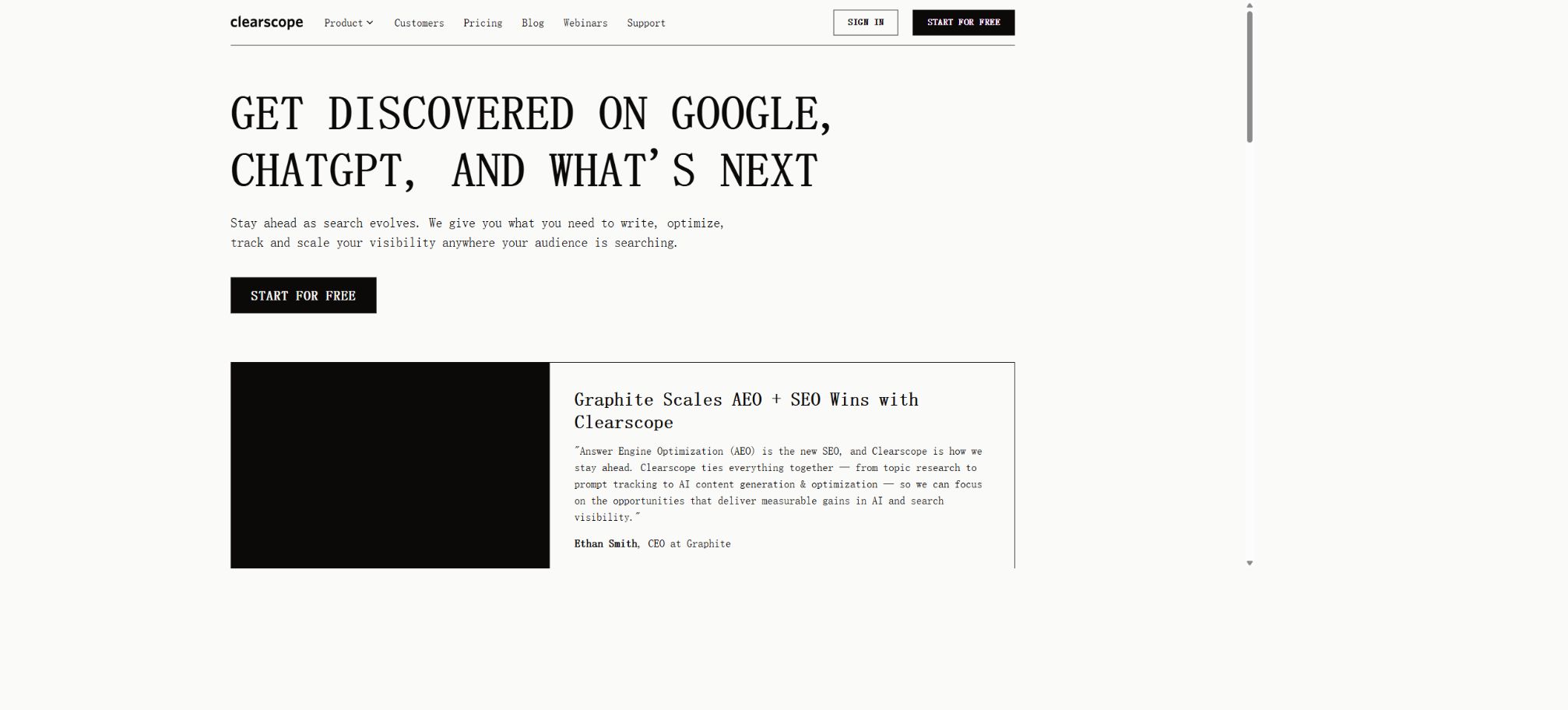
Clearscope
A tool that uses thematic data and ratings to help teams optimize search results.
Tags:AI writing toolsWhat is Clearscope?
Clearscope is a platform for content teams, SEO specialists, and editors aimed at improving search visibility. By analyzing in real time the Google results for specific queries, competing pages, search intentions, and language patterns, it provides suggestions for writing and optimizing new articles; it also continuously monitors the performance of already published content in both traditional search results and AI-generated answers.
The current product has expanded its capabilities beyond simply evaluating individual SEO content; it now covers Drafts, Topic Explorations, Content Inventory, suggestions for internal links, brand visibility, as well as tracking prompts from ChatGPT and Gemini. It addresses all aspects related to topic selection, writing, post-publication maintenance, and AI-driven search monitoring.
Topic Explorations: Thematic Research
Topic Exploration helps teams understand related queries, user intentions, and content opportunities within a given topic, thereby enabling them to decide which pages to create and how to organize the topic clusters. The Essentials version includes 20 such analyses per month, while the Business version provides 50.
Thematic data serves as a reference for formulating strategies; the choice of topic should not be determined solely based on search volume. The team must also take into account business value, the stage of conversion, existing authoritative sources, and the risk of content duplication.
Content analysis of drafts
When creating a draft, the user enters the desired search query, selects the language, region, and optional local location. Clearscope simulates the corresponding search environment, analyzes the 30 top-ranking pages on Google’s desktop and mobile versions, and generates writing suggestions within one to two minutes.
Each draft consumes part of the monthly quota. Both the Essentials and Business plans include 20 drafts per month; once this limit is reached, additional drafts can be obtained automatically as part of an upgraded plan.
Search intent grouping
The platform organizes the ranking pages according to the main search intentions, thereby helping authors determine whether users are looking for tutorials, definitions, comparisons, purchase information, or content in a specific format. Search intentions are more important than simply inserting keywords mechanically; when the type of content is incorrect, it is difficult to meet the user’s queries even if the relevant keywords are used.
Recommended topics and terms
Clearscope recommends relevant words based on the frequency of use, coverage, and importance of the topics on competitive pages, and organizes them according to their semantic relationships. Authors can see which topics have not yet been used and add the necessary information without compromising readability.
Recommendation words are not a list of keywords that must appear one by one. Repeating words in an attempt to achieve high scores can lead to awkward phrasing and homogenized content;
Questions should be answered first, along with the addition of first-hand experience.
Content Grade and readability
During the writing process, the editor displays in real time the Content Grade, word count, and reading difficulty, which helps the team compare the current draft with the SERP benchmarks. This scoring system facilitates the establishment of uniform editing standards and the identification of any obvious omissions.
A high score does not guarantee a certain ranking, nor can it indicate the accuracy of the information, its originality, the author’s expertise, the credibility of the links, or the effectiveness of the conversion. The final decision regarding publication still rests with human editors.
Audience Questions and Competitor Outline
Draft aggregates the actual questions found in sections such as “People Also Ask” and displays the title structures of the top 30 competing pages. Based on this information, the author can create FAQs, organize chapters, and structure the content in a way that ensures no aspects of interest to users are overlooked.
Competitor outlines can only be used as research material and should not be copied directly. A better approach is to identify common needs and then add unique data, examples, tools, or expert opinions.
Hint for citing sources
The platform displays authoritative external resources that are frequently cited in the rankings, thereby assisting authors in finding data and background information. Before making a citation, it is necessary to consult the original source to verify the publication date, the methodology used for the statistics, and the licensing terms; it is not acceptable to rely solely on second-hand accounts.
Content Inventory – content repository
Content Inventory aggregates all published pages in a single dashboard. Once connected to Google Search Console, it allows users to view click counts, impressions, average ranking, target queries, content ratings, and an estimated SEO value; it also enables organizing different topics or business areas using custom views.
The system scans and evaluates the content on a monthly basis, and sends weekly alerts to inform users of any changes. It is useful for identifying situations such as a decline in traffic, outdated content, misaligned target queries, and pages that need re-optimization.
Competitive page monitoring
For each target query, Content Inventory displays the top 30 competing pages along with their word count and content score, helping the team determine whether there have been any changes in the search environment. Any changes in the competition should be assessed in conjunction with one’s own ranking and conversion rates; it is not advisable to rewrite content merely because the competitors have made updates.
Suggestions for internal links
The Internal Linking view analyzes the main queries of the imported pages and identifies suitable locations on other pages where links can be created, offering suggestions for target pages and anchor text. Proper internal linking helps search engines and AI systems understand the structure of a site, as well as improving user navigation.
Before automating the suggestion process, it is necessary to check the context, the naturalness of the anchor text, existing links, and the status of the target page, in order to avoid repetition, errors, or excessive optimization.
AI search suggestion tracking
All plans include Tracked Prompts, which allow for monitoring the responses to specific questions in ChatGPT and Gemini, as well as tracking when a particular brand is mentioned or cited and how those mentions change over time. Essentials and Business currently include 50 and 300 prompts respectively.
AI responses are random and can be influenced by factors such as region, model version, and time. The monitoring results are useful for identifying trends, but they cannot be considered equivalent to the fixed rankings that all users actually see.
Brand visibility and AI citations
Clearscope combines prompt tracking with Content Inventory to show which monitored pages are cited by AI responses, along with the corresponding prompts, platforms, and preview of those responses. Teams can thus identify the content that has been referenced by AI as well as the topics occupied by competing brands.
Being cited does not necessarily lead to clicks or revenue. It is also necessary to take into account the quality of the brand mentions, the source page, website traffic, and downstream conversions.
Query Fan-out
The platform pays attention to the additional Web queries that AI systems initiate in order to generate answers; this allows teams to understand the various search intentions behind a natural language question, and to supplement the content accordingly.
The fan-out data represents the samples observed by the platform; the internal search mechanisms of specific AI systems may vary, and therefore it should not be considered as a public algorithm formula.
Integration with Google Docs
Clearscope offers a Google Docs plugin that allows authors to view draft suggestions, scores, and recommendations within the familiar collaborative document environment, without the need to switch platforms constantly. Before sharing the document with external authors, it is necessary to ensure that they are given only the permissions required for accessing that document.
WordPress plugins
A WordPress plugin can connect Draft to a CMS, displaying Clearscope suggestions while editing articles. It is still necessary to check the title, meta description, image alt text, links, and block formatting before publishing, in order to prevent the plugin from overwriting the edits made.
Collaboration, Sharing, and Exporting
All plans include unlimited users and projects, as well as the ability to share links and export content; they are suitable for use in collaboration among internal editors, freelance writers, and agencies. Clearcope emphasizes the portability of content, and it does not make exporting a feature that is available only as part of a premium paid subscription.
Language and local search
Currently, the Draft version supports English, German, French, Spanish, and Italian; it is also possible to specify a city, state, or region for local targeting. Chinese is not included in the list of supported languages, so teams working with Chinese content should first test the SERP results, word segmentation, and the quality of recommendations.
Price and version comparison
| Package or version | Prices, quotas, and core benefits |
|---|---|
| Essentials price | Essentials costs $129 per month and includes 50 Tracked Prompts, 50 Content Inventory pages, 20 Topic Explorations sessions per month, as well as 20 Drafts; it also allows an unlimited number of users and projects. This plan is suitable for individuals working in SEO, teams focused on creating high-quality content, or companies that manage a small number of key pages. Additional Inventory pages are charged at $25 per set per month, while additional Drafts cost $50 each; the actual pricing for these additional services will be indicated on the account billing page. |
| Business price | The Business plan costs $399 per month and includes 300 Tracked Prompts, 300 Inventory pages, 50 Topic Explorations per month, as well as 20 Drafts; it also comes with a dedicated account manager. The prices for additional usage under the Business plan are lower: the cost for additional Inventory items is currently $15 per month, while the cost for additional Drafts is $20 per month. The specific quantities included and the rules regarding automatic renewals can be found on the Billing page. |
Essentials price
Essentials costs $129 per month and includes 50 Tracked Prompts, 50 Content Inventory pages, 20 Topic Explorations per month, as well as 20 drafts; it also offers unlimited access to users and projects.
This plan is suitable for individual SEO practitioners, teams that create high-quality content, or companies that manage a small number of key pages. Additional Inventory pages are currently charged at $25 per set per month, while additional Draft pages cost $50 each; the actual pricing will be as indicated on the account settlement page.
Business price
The Business plan costs $399 per month and includes 300 Tracked Prompts, 300 Inventory pages, 50 Topic Explorations per month, as well as 20 Drafts; it also provides access to a dedicated account manager.
The additional usage costs for Business plans are lower: the cost for the Inventory add-on is currently $15 per month, while the cost for the Draft add-on is $20 per month. The exact quantities and the rules regarding automatic reordering can be found on the Billing page.
Enterprise plan
Enterprise offers customized pricing that includes Business capabilities, as well as custom credits, contracts, a whitelist for crawlers, and SAML SSO. It is suitable for organizations with large volumes of content assets and complex requirements in terms of procurement and security.
14-day free trial
The official website offers a 14-day free trial period. There is no minimum contract requirement for the monthly plan, and it can be canceled or modified at any time;
Credit cards can be used to pay for subscriptions, and annual customized plans can have invoices issued under specific conditions or can be paid through corporate payment methods.
Credits and automatic additions
Clearscope calculates the usage for the Topic Explorations, Drafts, Inventory pages, and Tracked Prompts separately. For some monthly plans, additional items are automatically added to the subscription once the allocated quota is exceeded; therefore, administrators should check the usage and any additional costs in Billing and credits.
The old example guides may show historical prices such as $189; the current pricing is $129 and $399 as listed on the latest pricing page.
Cancellation, upgrading, and downgrading
Monthly plans can be canceled without any penalty, and users can upgrade or downgrade them as needed. Terms related to suspension, data retention, and annual contracts depend on the specifics of each account; before cancellation, it is necessary to export any drafts and reports that need to be retained.
GitHub and the open-source status
Clearscope’s core SERP analysis tools, content scoring functions, inventory management features, AI tracking capabilities, and hosting platform are not open-source products. The clearscope-ai GitHub repository that appears in real-time searches has not been recognized by the official website or official documentation as being the source code repository of Clearscope; its contents resemble those of third-party SEO tools, and therefore cannot be considered an official open-source source.
Therefore, the catalog should classify Clearscope as a closed-source SaaS solution. No official repository offering a fully privatizable version of the product has been identified to date.
Clearscope Usage Guide
Complete a basic task.
- Identify the audience, purpose, tone, length, and the facts that must be included;
- Enter the topic and the verified reference materials in Clearscope;
- An outline is created using Topic Explorations for thematic analysis, and a preliminary draft is prepared through an analysis of the content in Drafts;
- Replace generic content with your own data, examples, and terminology;
- Verify facts, citations, keywords, repetitions, and brand tone;
- It is published only after manual editing, plagiarism checking, and approval have been completed.
Create reusable professional workflows
- Create a brand term list, prohibited expressions, and approved sample texts;
- Organize the topic research in Topic Explorations, the analysis of draft content, and search intent into a fixed workflow;
- Designate responsible persons for research, the first draft, editing, and fact-checking respectively;
- Randomly check whether the model fabricates numbers, sources, or examples;
- Compare readability, conversion rates, search performance, and rework time;
- The templates and rules are continuously updated based on actual outcomes;
Which users is it suitable for?
- A editing and marketing team that can establish SEO content standards is needed;
- Agencies that create content for multiple clients;
- Websites that need to monitor the performance of a large number of published pages;
- Companies that wish to track the visibility of the ChatGPT and Gemini brands;
- Authors who collaborate in Google Docs or WordPress;
- SEO specialists who need internal links, content updates, and suggestions for topic planning.
Product advantages
- Real-time analysis of the SERP and search intentions in the target area;
- The scoring and recommendation interfaces are relatively simple, making them easy for authors to use;
- After content is created and published, a closed loop is formed within Inventory;
- Traditional SEO, AI citations, and prompt tracking are all available on the same platform;
- All packages offer unlimited users and projects;
- It supports Google Docs, WordPress, and GSC workflows.
Restrictions and Precautions
- The starting price is high – Essentials comes with only 50 Inventory pages and 20 monthly drafts.
- Overpayment may also automatically result in additional fees.
- Chinese is not on the list of officially supported languages, so the Chinese version of the site should be tested first;
- ContentGrade, AI citations, and SEO value are all tool-based metrics that do not guarantee rankings or revenue.
- The content still requires original experience, reliable evidence, technical SEO, and manual quality control.
Frequently Asked Questions
How much is Clearscope?
Essentials costs $129 per month, Business costs $399 per month, while Enterprise offers a customized pricing; the official website provides a 14-day free trial.
Does Clearscope support Chinese?
The currently supported languages are English, German, French, Spanish, and Italian; Chinese is not listed explicitly, so it is recommended to try it out first for verification.
Is it possible to monitor ChatGPT’s rankings?
It is possible to track prompts, brand mentions, and page references in ChatGPT and Gemini, but this constitutes sample-based visibility monitoring rather than a fixed ranking.
What is the difference between Clearscope and Surfer SEO?
Both offer content scoring; Clearscope emphasizes simplicity and collaboration, as well as no limits on the number of users, along with Content Inventory and AI visibility. When making a choice, it is necessary to consider factors such as the number of pages, the amount of draft space available, the language, and the needs of the team.
Is Clearscope open source?
It is not open source. To date, no GitHub repository containing the complete source code of the platform as released by the official team has been found.
Tools similar to Clearscope




 Guigong Network Security Registration No. 45132202000164