






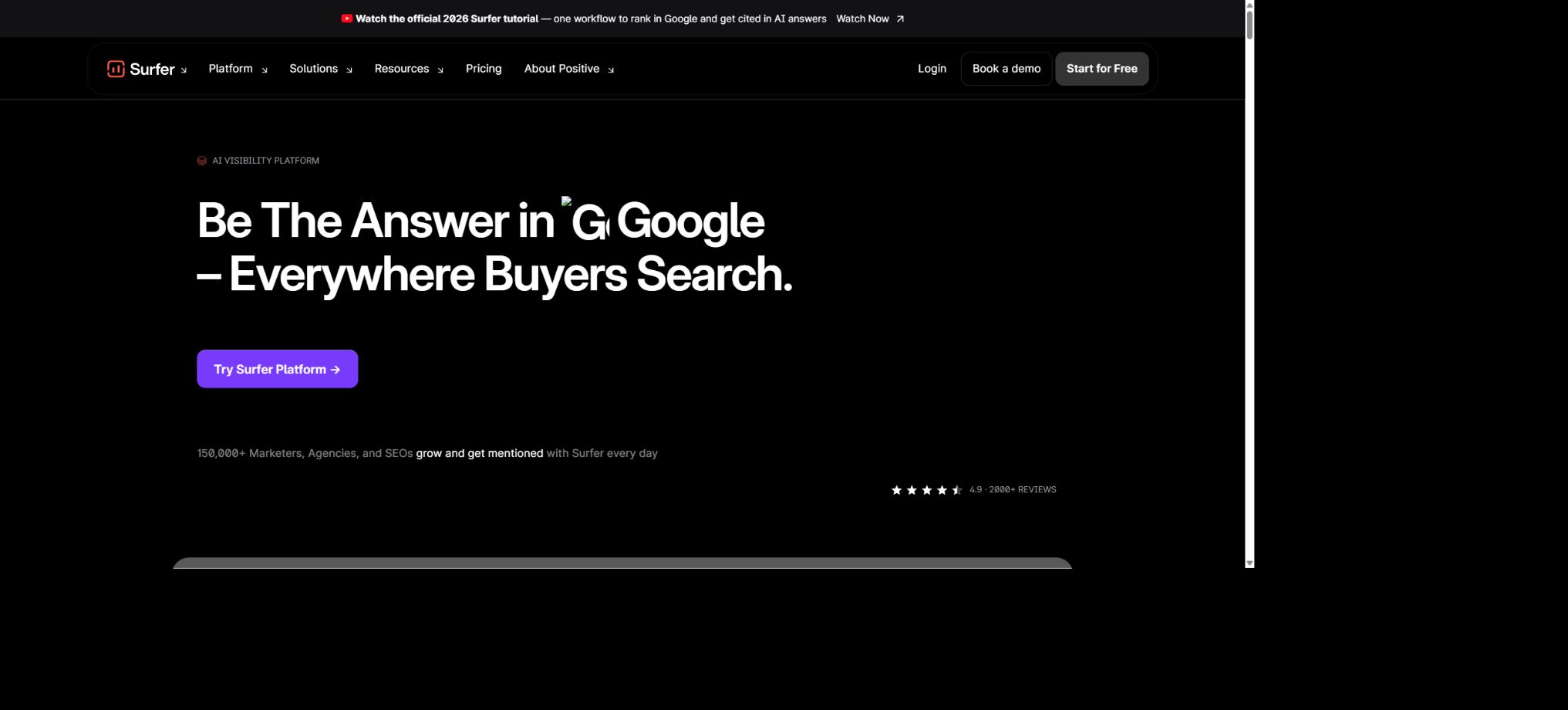
Surfer SEO
An SEO platform that uses data analysis and AI to optimize search content.
Tags:AI writing toolsWhat is Surfer SEO?
Surfer SEO is a platform for content research, writing, optimization, and monitoring, designed to improve both traditional search rankings and visibility in AI-driven searches. It analyzes the current SERPs in target regions, competing pages, as well as hundreds of web and AI-related indicators, and provides suggestions regarding the topic, structure, length, internal links, and coverage of content for articles.
Currently, Surfer integrates Google SEO with various answer-based platforms such as ChatGPT, Perplexity, Google AI Mode, AI Overview, and Gemini into a single workflow, enabling continuous monitoring throughout the process – from selecting content topics, creating content, and conducting audits to tracking mentions of AI brands.
Content Editor – Content editing tool
The Content Editor generates real-time guidelines based on the Focus Keyword, region, device, and competing pages. While writing, the author can see the Content Score, the recommended word count, the status of the title, paragraphs, images, and related entities.
The suggestions provided by the editor are based on competitive data, not Google’s public ranking formulas. Authors should prioritize meeting search intent and ensuring the quality of the information presented, and should not repeat words mechanically just to achieve a perfect score.
Content Score: Rating of the content
The Content Score takes into account theme coverage, structure, and content relevance, and uses a value ranging from 0 to 100 to help compare the current article with selected competitive pages. It is useful for identifying obvious shortcomings and tracking progress in optimization efforts.
High scores do not guarantee a good ranking, nor do they reflect the author’s experience, the authority of the links, page speed, brand reputation, or conversion rates. Once reasonable goals have been achieved, attention should be shifted to enhancing the quality of the information and improving the user experience.
Surfy AI writing assistant
Surfy is an AI assistant built into the Content Editor; it can answer questions, generate paragraphs, adjust the tone, add content to a topic, and help revise existing text. It uses the current article along with optimization guidelines as context, thereby reducing the need to switch between different tools.
The generated text must be checked for accuracy of facts, copyright issues, citations, and the appropriate tone with regard to brands. Content related to medicine, law, finance, etc., requires professional review.
Surfer AI article generation
Surfer AI can generate complete articles based on keywords, templates, Brand Voice, and custom knowledge, while also incorporating the SEO guidelines provided by Content Editor. It is suitable for accelerating the creation of drafts and enabling large-scale content production.
The new package no longer offers AI-generated articles for sale as separate credits; AI-generated content and manually written content are both included within the quota allocated for creating or optimizing documents. To generate an article, human editing, evidence, and original creativity are still required.
Auto Optimize – one-click optimization
Auto Optimize adds missing entities and relevant expressions to the existing content, thereby improving topic coverage with just one click. It can be used for new drafts, as well as to quickly update existing pages after importing them from Content Audit.
Automatic insertion can affect tone, logic, and accuracy. Keep a version before execution, and review the differences section by section after completion.
Coverage Booster
Coverage Booster addresses the issue of factual coverage and opportunities for AI citation by adding missing information to pages, so that articles not only contain relevant keywords but can also answer the questions posed by both models and users.
The facts that are automatically added may not have a reliable source; generalizations should be replaced with primary sources, data, and expert opinions.
Internal link insertion
One-click Internal Linking takes into account the websites that are already linked, as well as the relevant pages and anchor texts suggested by Google Search Console, and inserts those links into the articles. It helps to reduce the number of isolated pages and strengthen thematic clusters.
Plans Pro and higher focus on providing the ability to create one-click internal links. After inserting such links, it is necessary to check the target page, the anchor text, any duplicate links, and the status of the redirection.
Outline and custom templates
The Content Editor can generate an outline, and it allows control over the structure and tone using Brand Knowledge, Custom Voice, and Templates. Pro includes 10 custom templates, while Peace of Mind offers more template options within the bounds of fair use.
The AI outline should be adjusted in line with search intentions and the audience’s journey; not all articles should have the same beginning, ending, and FAQ section.
AI Detector and Humanizer
Surfer offers AI-based content detection and Humanizer tools for analyzing text patterns and making the expressions more natural. Plans starting with Discovery include these capabilities.
AI detectors can make mistakes, and therefore cannot be used as the sole evidence for academic discipline actions, employee penalties, or copyright decisions. Humanizer also does not guarantee that it is possible to bypass these detectors or improve the quality of the information provided.
Plagiarism Checker
The Standard and higher plan versions include a Plagiarism Checker that helps identify sections similar to existing public content. It is useful for editorial review and the verification of externally submitted manuscripts.
Similarity is not a legal conclusion; common definitions, product names, and references may appear repeatedly. Once such issues are detected, the original text should be checked.
Keyword Research
The keyword research tool generates relevant queries and clusters based on topics, regions, and SERP data, to assist in planning pillar pages and supporting content. It is currently available primarily under the Standard and higher-tier plans.
Search volume and clustering are only useful as references for selecting topics; it is also necessary to evaluate intent, business value, conversion rates, and the website’s existing authority.
Topical Map thematic map
Once connected to Google Search Console, Topical Map identifies the topic clusters that are already covered by a website as well as those that are missing; it shows which competitors cover these topics and offers ideas for new content. The system updates its data approximately every 14 days.
Plans Pro and above include a Topical Map. When there is insufficient data for small websites or new sites, it may be necessary to conduct keyword research and prepare basic content first.
When multiple URLs are ranked in the same cluster, a potential erosion warning is also issued.
Content Audit – Content review
Content Audit combines GSC’s rankings, clicks, impressions, and CTR with SERP and Content Score to identify the pages that are most likely to need updating. The data is retrieved on a daily basis and presented based on the entire 30-day period.
The recommended pages can be imported directly into the Content Editor, after which Auto Optimize and internal linking can be used to make updates. Only those pages that have been indexed and are receiving traffic typically undergo auditing, and this process applies mainly to the pages that appear in the top search results.
Rank Drop Detection
Surfer monitors page rankings and traffic changes, and provides weekly reports or alerts when there is a decline in rankings. This allows teams to promptly detect changes in SERP rankings, outdated content, and updates made by competitors.
Fluctuations in rankings can be caused by seasonality, algorithms, the regions being tracked, and technical issues; it is not necessary to rewrite an article every time there is a drop in rankings.
Content Cannibalization
Plans Pro and above include a Cannibalization Report, which helps identify situations where multiple URLs are competing for similar queries or topics. Teams can then decide to merge them, redirect traffic, differentiate them, or adjust the internal links accordingly.
The sharing of keywords between two pages does not necessarily constitute encroachment; what matters is whether there is a conflict between the search intent and the actual performance.
SERP Analyzer
The Advanced SERP Analyzer offers a more in-depth analysis of competitive pages and various search factors; it is currently included in the Peace of Mind and Enterprise versions. It is suitable for professional SEO specialists who want to compare page characteristics beyond just the content itself.
Correlation does not equate to causation; elements common to competing pages cannot be used as criteria for search engines to determine rules.
AI Tracker
AI Tracker monitors a brand’s Visibility Score, Share of Voice, Mention Gap, and Brand Sentiment in the responses provided by ChatGPT, Perplexity, Google AI Mode, AI Overview, and Gemini, and compares it with competing brands.
AI responses vary depending on the prompt, region, account, and time. The monitoring results reflect trends based on samples, and it does not mean that all users will see the same responses.
AI Prompts refresh quota
Standard allows tracking of 25 AI Prompts, with updates on a weekly basis; Pro supports 50 prompts and updates them daily; Peace of Mind handles 100 prompts, also with daily updates. Discovery does not include any functionality for tracking AI Prompts.
The suggestions should cover brand, product category, comparison, and purchasing-related questions. Monitoring only brand terms will lead to an overestimation of the actual visibility.
Brand Knowledge and Brand Workspace
Brand Knowledge assists with writing and optimization to ensure that the product facts and tone are accurate. Discovery and Standard each manage 1 Brand Workspace, while Pro allows for 5 such workspaces; Peace of Mind offers an unlimited number of workspaces under its fair use policy.
Brand information needs to be updated regularly, as AI will repeatedly insert new content in place of any incorrect or outdated information.
Team collaboration
Discovery, Standard, Pro, and Peace of Mind include 1, 3, 5, and 10 Team Seats respectively, and higher versions offer additional features such as version history, Activity Log, real-time collaboration, comments, folders, and external collaboration links.
Before sharing externally, check whether the document contains unreleased products, customer data, or internal strategies.
Integration of WordPress with Google Docs
Systems at the Standard level and above can make use of integrations such as WordPress, Google Docs, Contentful, and Zapier to incorporate optimization processes into existing CMS platforms and collaboration tools. The specific methods for writing, exporting, and syncing data depend on the permissions granted to the connector.
Before publishing, check the HTML, images, metadata, and links once again to prevent the edited changes from being overwritten simultaneously.
Price and version comparison
| Package or version | Prices, quotas, and core benefits |
|---|---|
| Discovery price | When billed annually, Discovery costs $49 per month; the annual plan includes 120 sessions for creating or optimizing documents, 10 sessions for page tracking, 1 Brand Workspace, and 1 user seat. It offers basic functions such as Surfy, Humanizer, and Content Score. It is suitable for optimizing a small amount of content, but it does not include AI-powered search suggestions, full team collaboration features, or advanced content planning tools. The annual fee must be paid in one lump sum at the start of the year. |
| Standard price | When billed on an annual basis, Standard costs $99 per month. It includes 360 documents for the whole year, 25 AI prompts that are updated weekly, 50 page trackers, 1 Brand Workspace, and 3 user seats. In addition, it offers features such as integration capabilities, Brand Knowledge, one-click content optimization, plagiarism detection, and monitoring of ranking drops. It is suitable for teams that want to manage their visibility on both Google and AI search engines at the same time. |
| Pro price | When billed on an annual basis, Pro costs $182 per month; it includes 360 documents for the whole year, 50 AI prompts that are updated daily, 200 page trackers, 5 Brand Workspaces, and 5 Seats. Pro offers additional features such as one-click internal linking, Topical Map and Coverage Gap analysis, the ability to customize tone and templates, as well as a Cannibalization Report – making it the ideal solution for most teams that need to manage ongoing content. |
| Peace of Mind price | When paid on an annual basis, Peace of Mind costs 299 dollars per month. Under the fair use policy, it offers unlimited capabilities for creating or optimizing documents, 100 prompts that can be refreshed daily, 500 page tracking sessions, unlimited Brand Workspaces, and 10 user seats. It also includes Advanced SERP Analysis, API Access, personalized onboarding, and a dedicated Success Manager – making it suitable for agencies and large-scale content teams. |
| Enterprise price | Enterprise starts at $999 per month and offers customized packages that include SSO, enterprise security, consulting services, legal Onboarding, custom quotas, team training, white labeling, and priority support. The actual contract shall specify the number of seats, documents, prompts, APIs, data retention policies, as well as the boundaries regarding service usage. |
Discovery price
When paid on an annual basis, Discovery costs $49 per month; the annual plan includes 120 sessions for creating or optimizing documents, 10 sessions for page tracking, 1 Brand Workspace, and 1 user seat. It also offers basic features such as Surfy, Humanizer, and Content Score.
It is suitable for optimizing small amounts of content; it does not include AI-driven search suggestion tracking, full team collaboration, or advanced content planning. For an annual subscription, the fee must be paid in one lump sum for the entire year.
Standard price
When billed on an annual basis, Standard costs $99 per month; it includes 360 documents for the whole year, 25 AI prompts that are updated weekly, 50 page trackers, 1 Brand Workspace, and 3 user seats. In addition, it offers integration capabilities, Brand Knowledge services, one-click content optimization, plagiarism detection, and functionality for detecting drops in rankings.
It is suitable for teams that are just starting to manage visibility on both Google and AI search results.
Pro price
The Pro plan, when paid on an annual basis, costs 182 dollars per month; it includes 360 documents for the whole year, 50 AI prompts that are updated daily, 200 page trackers, 5 Brand Workspaces, and 5 Seats.
Pro offers one-click internal linking, Topical Map and Coverage Gap functions, the ability to customize tone and templates, as well as a Cannibalization Report; it is the preferred solution for most teams that are responsible for maintaining content on a continuous basis.
Peace of Mind price
When paid on an annual basis, Peace of Mind costs $299 per month; under the fair use policy, it offers unlimited access to Create or Optimize Documents, 100 prompts that can be refreshed daily, 500 page tracking sessions, unlimited Brand Workspaces, and 10 Seats.
It also includes Advanced SERP Analysis, API Access, personalized Onboarding, and a Dedicated Success Manager – making it suitable for agencies and large-scale content teams.
Enterprise price
Enterprise starts at $999 per month and offers customized packages that include SSO, enterprise security, consulting services, legal Onboarding, custom quotas, team training, white labeling, and priority support.
The actual contract should specify Seats, documents, Prompts, APIs, data retention, services, and fair use boundaries.
AI Search Analytics can be purchased separately.
Users who only need AI search monitoring can purchase AI Search Analytics. The current annual plan, which includes 100 Prompts, costs $158 per month; it offers daily updates, 5 Brand Workspaces, as well as features such as Mention Gap, Sentiment, Visibility Score, Share of Voice, and CSV export.
This product is not equivalent to the full Content Editor package; it is necessary to determine whether writing and SEO workflows are required before making a purchase.
Credit reset and payment
The annual plan requires payment of the full yearly fee in one go, with a discount of up to 17%. The quota specified in this document is reset on an annual basis, and changes in tier level also result in adjustments to this quota.
Unlimited features are subject to the Fair Usage Policy.
The platform accepts credit cards and debit cards; annual payments can also be made by bank transfer. PayPal is not supported at the moment. Subscriptions are renewed automatically, but renewal can be disabled in the Billing section.
Language support
Content Editor, Keyword Research, Sites, Topical Map, and Auto Optimize can be used for different languages and regions; the guidelines are based on the competitive pages in the target region. AI Outline supports all language orientations.
Surfer AI’s full article generation feature currently supports English, German, Dutch, Polish, French, Spanish, Danish, Swedish, Portuguese, Brazilian Portuguese, Italian, and other languages; the ability to generate articles in Chinese is subject to the availability of the account.
GitHub and the open-source status
The core platform of Surfer SEO, its scoring algorithm, AI-based writing tools, the Audit function, and AI Tracker are not open-source products. The official GitHub repository does provide technical resources such as a word-splitting Polyfill, Elixir examples, and the Readability branch, but it does not contain the complete source code for the Surfer application and its models.
The catalog should be labeled as closed-source SaaS. Public auxiliary libraries do not demonstrate that SEO algorithms or hosting platforms can be deployed privately.
Surfer SEO Usage Guide
Complete a basic task.
- Identify the audience, purpose, tone, length, and the facts that must be included;
- Enter the topic and the verified reference materials in Surfer SEO;
- Use the Content Editor to create an outline, and then employ Content Score to draft the segmentation.
- Replace generic content with your own data, examples, and terminology;
- Verify facts, citations, keywords, repetitions, and brand tone;
- It is published only after manual editing, plagiarism checking, and approval have been completed.
Create reusable professional workflows
- Create a brand term list, prohibited expressions, and approved sample texts;
- Organize the Content Editor, Content Score, and Surfy AI writing assistant into a fixed workflow;
- Designate responsible persons for research, the first draft, editing, and fact-checking respectively;
- Randomly check whether the model fabricates numbers, sources, or examples;
- Compare readability, conversion rates, search performance, and rework time;
- The templates and rules are continuously updated based on actual outcomes;
Which users is it suitable for?
- Content team responsible for writing and updating SEO articles;
- Agencies that manage multiple client sites;
- Authors who need a Content Score and real-time guidelines;
- SEO specialists who look for opportunities for old content through GSC;
- Companies that monitor the visibility of the ChatGPT and Perplexity brands;
- An editorial team that generates and reviews AI-generated articles on a large scale.
Product advantages
- Research, writing, optimization, auditing, and monitoring form a complete closed loop;
- The real-time guide is based on the competitive pages of the target region;
- It covers both Google rankings and the visibility of AI-generated answers;
- Auto Optimize, Coverage Booster, and internal linking reduce manual work;
- The GSC connection enables the identification of genuine traffic opportunities;
- It offers team collaboration, integration, and advanced APIs.
Restrictions and Precautions
- The current plan is primarily available for annual payment, and its price is significantly higher than that of the previous version. The amount of documents allowed per year as well as the frequency of updates for AIPrompt need to be calculated separately.
- The “unlimited” option offered by PeaceofMind is subject to the fair use policy.
- ContentScore, AI-based detection, and brand sentiment are all estimates provided by tools, and they should not be regarded as guarantees of ranking, academic evidence, or definitive conclusions regarding a brand.
- AI-generated text and automatic optimizations must be reviewed manually;
Frequently Asked Questions
Is Surfer SEO free?
The core platform does not offer a permanently free, complete package; the official website provides an option for a trial version. Some individual tools such as AI Detector may be available for free testing, while the lowest cost for Discovery on a monthly subscription basis is 49 dollars per month.
How much does Surfer SEO cost?
The annual fees are 49 dollars per month for Discovery, 99 dollars per month for Standard, 182 dollars per month for Pro, 299 dollars per month for Peace of Mind, and 999 dollars per month for Enterprise.
Do I need to purchase separate credits for Surfer AI articles?
The new package is now based on a Documents quota; both AI-generated content and content edited manually fall under the category of Create or Optimize Documents, with the old system of separate AI article credits no longer in use.
Does Surfer support Chinese?
Core optimization allows for the analysis of competitive pages based on Chinese keywords and regions; however, the list of languages supported by the full Surfer AI article generator does not include Chinese, so it is necessary to try it out first for verification.
Is it possible to monitor the ranking of the ChatGPT brand?
Yes, AI Tracker supports platforms such as ChatGPT, Perplexity, Google AI Mode, AI Overview, and Gemini; it allows you to set the number of prompts and the refresh frequency according to the chosen package.
Is Surfer SEO open source?
It is not open source. There are repositorys containing supplementary technologies on the official GitHub, but the source code for the core SEO platform, the scoring algorithms, and the AI services is not made available publicly.
Tools similar to Surfer SEO




 Guigong Network Security Registration No. 45132202000164