






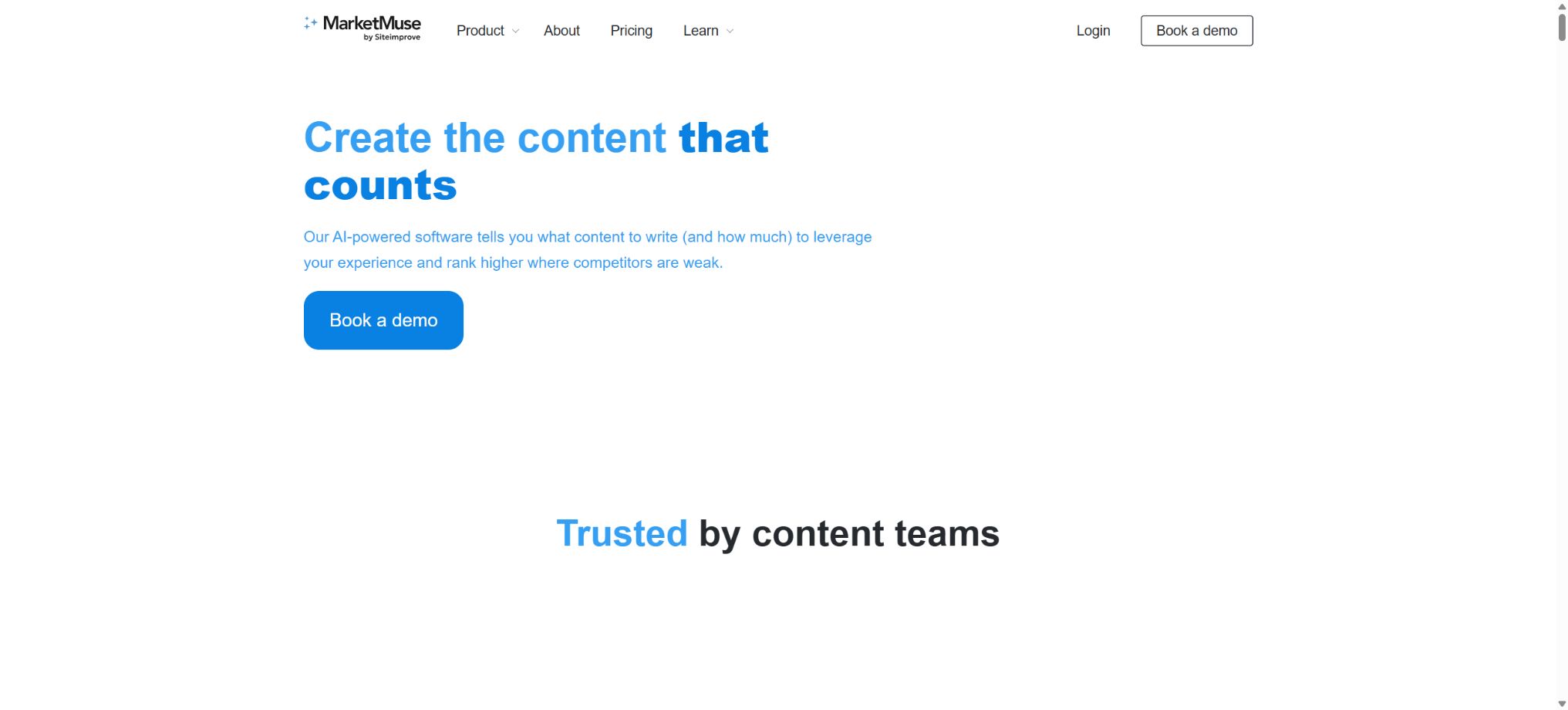
MarketMuse
An AI platform that provides content strategies, topic research, and article optimization.
Tags:AI writing toolsWhat is MarketMuse?
MarketMuse is an AI-powered platform for content research and planning, designed for SEO tasks, content strategy development, and editorial teams. It analyzes existing website pages, topic coverage, and search competition to help teams determine which content deserves to be created, expanded, or updated; it also provides writers with structured content briefs and real-time optimization suggestions.
Its core purpose is not to enable the bulk creation of articles with just one click, but rather to use theme models, content libraries, and personalized metrics to help determine \"what should be written, to what extent it needs to be covered, and in which topics there is a greater chance of success.\" MarketMuse was acquired by Siteimprove in 2024, but the product is still offered under the MarketMuse brand.
Website content Inventory
The paid plan allows for the creation of a Site Inventory, which automatically records the pages that have been published on a website, the relevant topics, as well as the combinations of pages and topics; these records are updated on a regular basis. This way, the team can keep an eye on their content assets, identify any coverage gaps, and review past performance, without having to maintain separate tables over time.
Inventory is not a CMS; it does not replace content management systems such as WordPress or HubSpot. It is used for analysis and planning, while actual page modifications still need to be carried out in an editor or CMS.
Topic Authority – Theme Authority
Topic Authority evaluates a website’s coverage of a specific topic, the completeness of its content, its performance, potential traffic, and the level of competition involved, thereby helping to determine whether the existing authority is sufficient to support the creation of new pages or updates.
This indicator serves as a decision-making signal; it is not one of the ranking factors made public by search engines. The actual ranking is also influenced by links, brand reputation, technical SEO aspects, content quality, and changes in search demand.
Personalized Difficulty
Personalized Difficulty estimates the difficulty for a website to achieve a certain ranking for a specific topic, based on the content available on that site, its historical performance, and the authority of its topics; this value ranges from 1 to 100. It differs from the generic keyword metrics, which assign the same difficulty level to all websites.
The team can combine the general Difficulty level with the Personalized Difficulty level in order to find relatively easy opportunities. A low difficulty level does not guarantee a higher ranking; it is also necessary to assess the commercial value and the suitability of the content.
Competitive Advantage
Competitive Advantage reflects the gap between the general difficulty of a task and the difficulty associated with personalizing a website; it helps identify topics in which one has an advantage over ordinary competitors. It is useful for prioritizing those areas where quick results can be achieved and where existing authority can be built upon.
Advantageous metrics should be assessed in conjunction with conversion goals, the target audience, and the product; it is not sufficient to focus solely on traffic that facilitates ranking but carries no business value.
Topic Navigator
Topic Navigator is composed of Topic Model, Keywords, Questions, and Reflect. The Topic Model identifies around 50 semantically related concepts based on hundreds of related pages, and provides information on the scope of mentions, search volume, CPC, and trends.
Keywords can include up to around 1000 relevant terms; Questions display the most frequently asked questions by users; Reflect maps the thematic universe to the website’s Inventory, identifying existing pages, gaps, and pages that need updating.
Patent topic model
MarketMuse employs patented topic modeling techniques to analyze hundreds or thousands of pages, removing low-quality, outlier content and then calculating the correlations between various concepts. It focuses on organizing content around topics rather than relying solely on keyword density.
The recommended number of mentions serves as a guide to the depth of writing, not as a formula for ranking. Attempting to repeat words mechanically in order to reach that number will actually reduce readability and professionalism.
Research application
Research offers theme models, keywords, questions, SERP X-Ray, SERP Heatmap, and Site Heatmap to help understand search intent, competitive pages, and the thematic coverage of an entire website. The free version also provides access to some of these analytical tools, but with a limited number of queries per day.
The research findings should be combined with actual SERP results, the latest industry data, and the expertise of internal experts. The model is unable to automatically determine whether all information is accurate or outdated.
SERP X-Ray and Heatmap
SERP X-Ray allows you to view the Content Score, word count, and topic coverage of competing pages; SERP Heatmap presents this information in a matrix format, showing whether different pages cover important concepts, thereby helping to identify opportunities for differentiation that all competitors have overlooked.
Not everything mentioned on competing pages is worth copying. Editors should distinguish between essential background information, repetitive paragraphs, and content that truly adds value.
Optimize article optimization
Optimize allows you to paste existing articles or create new content; it displays the Content Score, Target Content Score, Word Count, and related topics based on the Focus Topic. The scores are updated in real time while writing, making it easy to identify any gaps in coverage.
The goal of optimization is not to include every possible recommendation in the article. It is necessary to select themes that suit the audience and the narrative, to remove irrelevant suggestions, and to maintain a natural tone and structure.
Content Score
The Content Score is calculated based on the extent to which a page covers the important sub-topics within the theme model; the scores of competing pages are used to determine the target score. It allows for an assessment of the completeness of a topic, but it does not directly measure originality, credibility, brand value, or conversion ability.
Reaching the target score is just one aspect of content evaluation; the author’s experience, evidence, examples, accuracy, and the value of the information provided are also important.
MarketMuse AI writing assistant
Optimize’s built-in generative AI can be used to improve the quality of selected text, expand on it, develop concepts further, shorten it, summarize it, and answer questions. The generated results are displayed first for the user’s review, who can decide whether to keep them or discard them.
The authorities emphasize that human oversight must be maintained in the editing process. AI cannot replace professional authors; facts, citations, experience, and the brand’s tone need to be supplemented and verified manually.
Question research
Questions returns user inquiries related to a specific topic, which can be used to create subheadings, FAQs, and separate pages. High-value questions can form their own sections with links to more in-depth pages.
Just because a topic has high search volume doesn’t mean it’s suitable for the current article. If it isn’t relevant to the narrative, separate content should be created rather than forcing in FAQs just to increase coverage.
Internal links in Connect
Connect recommends internal links, external non-competitive links, as well as web and competitive pages based on theme models and the website’s inventory, and it also provides suggestions for anchor text. It is suitable for creating theme clusters and fixing isolated pages.
Automatic suggestions require checking whether the page is truly relevant, whether the links are valid, and whether the anchor text appears natural. Internal links should not all use exact keyword matches.
Content cluster analysis
Cluster Analysis organizes related topics and pages into content clusters, determining how much content is needed, which new pages should be created, and which existing pages deserve to be updated. It helps teams shift from optimizing for individual keywords to covering entire topics.
Excessive segmentation leads to duplication and keyword overlap. Queries with similar intentions should be combined; separate URLs are only appropriate when the audience needs and page objectives differ significantly.
Content quality analysis
Content Quality Analysis is used to assess the credibility, accuracy, structure, and overall quality of content, as well as to identify pages of low quality or suspicious claims. This analysis complements topic coverage by considering more than just the frequency of words.
Automatic quality assessment can still lead to misunderstandings of professional opinions. Medical, legal, financial, and scientific content must be reviewed by qualified personnel.
Keyword and Intent Analysis
Keyword/Intent Analysis incorporates the audience and search intent into theme clustering, separating needs such as awareness, comparison, purchase, local research, and brand research. This approach helps to avoid having the same article address conflicting intents at the same time during planning.
Search intent changes over time, along with SERPs and market conditions. High-value pages should be analyzed regularly, as a single brief does not remain valid indefinitely.
Analysis, Plan, Brief workflow
The full process at MarketMuse starts with the creation of an Analysis Document to assist senior management in making decisions; thereafter, a Planning Document transforms the selected elements into specific Content Ideas. Finally, the appropriate ideas are turned into Content Briefs, which are then given to the writers to develop further in the Optimization stage.
Each step builds upon the data from the previous step, thereby reducing the need for repeated research. The team still needs to choose the final plan based on budget constraints, product release schedules, and editorial resources available.
Content Strategy Documents
Policy documents include types such as Cluster Analysis, Keyword/Intent Analysis, Content Quality Analysis, and Content Plan; they are used to transform a large number of pages and topics into actionable roadmaps. Different subscription plans offer varying numbers of these documents per month.
The document quota for each paid account is reset on a monthly basis, and the remaining quota can be viewed in the application sidebar.
Content Brief – Summary of the content
The Content Brief not only provides an outline of the title but also includes information such as the target audience, pain points, intentions, theme models, key questions, competitive gaps, internal links, target word count, and Content Score. It is usually generated by the authorities within a few minutes after submission.
Brief allows the inclusion of opinions, level of expertise, personal experience, tone, factual statements, target market information, and structural preferences, helping the writer to better understand why the content is being created and how to differentiate it from others.
Nine types of Briefs
The comprehensive Strategy package offers nine different types of briefs: Article, Comparison, FAQ Collection, Guide, How-to, Listicle, Local, News/Event, and Product Review. Optimize and Research mainly include Article Brief; the specific permissions depend on the current plan in use.
The content type influences the structure of the recommendations. Reviews and news require different types of evidence and have varying time sensitivities, so it is not possible to use a single article template for both.
Brief and content export
A Content Brief can be exported to Google Docs or Microsoft Word; the data related to writing and applications that has been saved can also be exported according to specific plans. Optimize also offers the option of Copy for Publishing, which allows clean HTML code to be copied into a CMS.
After exporting, check the title hierarchy, links, images, metadata, and styles to avoid copying hidden formats or outdated suggestions.
Content planning and task management
Teams can assign members, set statuses, define deadlines, and add notes to content, thereby keeping track of the progress from research to writing. Strategy is designed for agencies and large content teams, and it supports more users as well as a larger range of topics.
MarketMuse is not a complete project management or CMS tool; for complex approval processes, it may still be necessary to use existing collaboration tools.
Price and version comparison
| Package or version | Prices, quotas, and core benefits |
|---|---|
| Free free version | The Free version is intended for 1 user and allows 10 queries per month; it does not include access to features such as Site Inventory, Tracked Topics, Content Briefs, or policy documents. It provides access to limited tools like Topic Navigator, Keywords, SERP X-Ray, SERP Heatmap, Site Heatmap, and Connect, and only allows the export of previously saved drafts. Each time a Focus Topic is entered and processed using tools such as Research, Compete, or Optimize, one query is used – repeated processing of the same topic also counts as queries. |
| Current price information | As of this verification, the MarketMuse website only reveals the features and quotas available in their packages; it does not specify fixed monthly prices in dollars for the Optimize, Research, and Strategy services. For all subscription levels, users are directed to schedule a demonstration. The Standard, Premium options or fixed dollar prices mentioned in older articles cannot be considered as current quotes. When making a purchase, it is necessary to inquire about the contract duration, number of users, number of sites, Tracked Topics, brief descriptions, strategy documents, training offerings, and any rules regarding excess usage. |
Free free version
The Free version is available for 1 user, allowing 10 queries per month; it does not include access to Site Inventory, Tracked Topics, Content Briefs, or policy documents. It provides access to limited tools such as Topic Navigator, Keywords, SERP X-Ray, SERP Heatmap, Site Heatmap, and Connect, and it only allows the export of previously saved drafts.
Each time a Focus Topic is entered and the process is run in applications such as Research, Compete, or Optimize, one Query is consumed; running the same topic multiple times also counts as separate Queries.
Optimize solution
Optimize includes 1 site inventory, 1 user, 100 Tracked Topics, 5 Article Briefs per month, 1 Content Strategy Document, and 100 Queries, along with the option to export applications and documents.
It is suitable for individuals or small teams that need to publish content on a regular basis. The current official website does not display prices in dollars; it is necessary to schedule a demonstration or request a quote.
Research plan
Research includes 1 site called Inventory, 3 users, 1000 Tracked Topics, 10 Article Briefs per month, 3 Content Strategy Documents, and an unlimited number of Queries; it also provides a comprehensive research view along with the possibility to export data.
\"Unlimited queries\" are still subject to fair use and account terms; there are still monthly limits on the number of briefs and strategy documents that can be created.
Strategy plan
The Strategy includes 1 site Inventory, 5 users, 10,000 Tracked Topics, 20 Content Briefs per month, all 9 types of Briefs, 5 Content Strategy Documents, and an unlimited number of Queries.
It is intended for agencies, as well as medium and large enterprise content teams; adding sites or increasing capacity requires sales confirmation.
Current price information
As of this verification, the MarketMuse website only reveals the features and quotas of its packages; it does not specify fixed monthly prices in dollars for the Optimize, Research, and Strategy services. For all subscription levels, users are directed to schedule a demonstration. The Standard, Premium options or fixed dollar prices mentioned in older articles cannot be considered as current pricing.
When placing an order, it is necessary to inquire about the contract duration, users, locations, Tracked Topics, brief descriptions, strategy documents, training provisions, and rules regarding excess usage.
GitHub and the open-source status
The core platform of MarketMuse, its theme models, Inventory functionality, and optimization services are not open-source products. There are a few historical or forked repositories in the official GitHub organization; most of the currently available projects have been archived, and the complete source code for MarketMuse’s applications, models, or server-side components is not provided.
The catalog should be labeled as closed-source SaaS. Historical Word2Vec, SDK, or third-party library repositories do not demonstrate that the commercial platform is open source.
MarketMuse usage guide
Complete a basic task.
- Identify the audience, purpose, tone, length, and the facts that must be included;
- Enter the topic and the verified reference materials in MarketMuse;
- Use the website content Inventory to create an outline, and then employ Topic Authority to draft the sections initially;
- Replace generic content with your own data, examples, and terminology;
- Verify facts, citations, keywords, repetitions, and brand tone;
- It is published only after manual editing, plagiarism checking, and approval have been completed.
Create reusable professional workflows
- Create a brand term list, prohibited expressions, and approved sample texts;
- Establish a fixed process for organizing the website content, including Inventory, Topic Authority, and Personalized Difficulty.
- Designate responsible persons for research, the first draft, editing, and fact-checking respectively;
- Randomly check whether the model fabricates numbers, sources, or examples;
- Compare readability, conversion rates, search performance, and rework time;
- The templates and rules are continuously updated based on actual outcomes;
Which users is it suitable for?
- Personnel responsible for planning the content strategy for SEO topic clusters;
- Teams that need to assess a large number of old articles and determine the degree of decline in their quality;
- Editor who creates detailed briefs for writers;
- SEO specialists who identify competitive gaps and internal links;
- Agencies that manage multiple client content plans;
- Brands that place emphasis on thematic authority rather than simply keyword density.
Product advantages
- Calculate personalized difficulty based on the website’s own authority;
- Patent topic modeling analyzes hundreds to thousands of pages;
- Inventory provides centralized management of pages, themes, and opportunities.
- Analysis, Plan, Brief, and Optimize constitute a complete process;
- It covers competitive gaps, content quality, and internal links at the same time;
- The free version allows you to try out the research application.
Restrictions and Precautions
- The paid plans do not have fixed prices listed publicly; a quote from the sales team is required.
- Brief, strategy documents, and TrackedTopics come with designated usage quotas, and free queries are very limited;
- ContentScore and recommended topics are not part of Google’s ranking formula;
- AI-generated copy, facts, and quality assessments require expert review, and the ultimate outcome still depends on the value of the content, technical SEO, backlinks, and market competition.
Frequently Asked Questions
Is MarketMuse free?
There is a free version that allows 1 user to perform 10 queries per month; it provides access to limited research tools, but does not include features such as the Inventory website, Tracked Topics, Content Briefs, or strategy documents.
How much is MarketMuse?
The current official website does not disclose the prices in US dollars for Optimize, Research, and Strategy; a demonstration appointment is required to obtain a quote, and it is not appropriate to continue using the old package prices.
Can MarketMuse write articles directly?
Optimize features include built-in AI for rewriting and expanding text, but the focus of this product is on research, planning, and optimization; the developers do not consider it a service that can write texts entirely automatically for customers.
Does a higher Content Score mean a better ranking?
Not necessarily. Scores reflect the coverage of topics, while rankings are determined by intent, quality, authority, links, technical SEO factors, and the competitive landscape.
Is MarketMuse suitable for Chinese?
Before use, it is necessary to evaluate the semantic model, search volume, SERP results, and quality of questions related to the target Chinese topic; the public examples and documentation provided by the product are primarily aimed at the English-speaking market.
Is MarketMuse open source?
It is not open source. The official GitHub repository contains mainly archived or forked historical projects; the source code for the core platform, models, and server side is not made available publicly.
Tools similar to MarketMuse




 Guigong Network Security Registration No. 45132202000164